

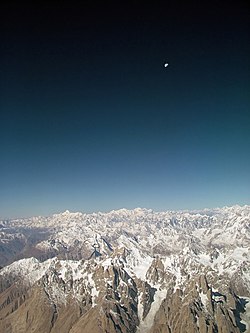
The Karakoram is a mountain range in Asia. The name is from a Turkic word meaning "black gravel".[1] It is located in Afghanistan, China, India, Kyrgyzstan and Pakistan. Many of its mountains are in the regions of Gilgit-Baltistan, Ladakh, and Xinjiang. It is the second highest mountain range in the world after the Himalayas. The Karakoram is part of a complex of mountain ranges that also includes the Himalaya, Hindu Kush, and Pamir ranges.[2][3] The range has eight mountains with tops over 7,500 metres (24,600ft) high. Four of these are higher than 8,000 metres (26,000ft).[4] They are K2, Gasherbrum I, Broad Peak, and Gasherbrum II. K2 is the world's second highest peak.
The range is about 500km (311mi) long and it covers a tract about 48km (30mi) broad. It protects Kashmir from the extreme cold winds of Siberia. There are over 300 peaks with an elevation between 1,480 metres (4,860ft) and 8,611 metres (28,251ft) high. Karakoram is the most glaciated part of the world outside the polar regions. Glaciers cover about 28-50% of the mountains in the range. This is much higher than the Himalayan average of 8-12%.[5] Some of the famous glaciers are the Siachen Glacier (76 kilometres (47mi) long) and Biafo Glacier (63 kilometres (39mi)long). These are the second and third longest glaciers in the world, outside the polar region. Many hilly lakes and hot-water springs are also located in Karakoram. The valleys are sources to many rivers and streams which drain in the Indus River.
The 5,540 metres (18,180ft) high Karakoram Pass connects Kashmir with the Central Asian states. It is considered to be a historical route.[6] Shaksgam Pass, Aghil Pass, and Khunjerab Pass are also in this range of mountains.


References
[change | change source]- ↑ Mason, Kenneth (1928). Exploration of the Shaksgam Valley and Aghil ranges, 1926. p.72. ISBN9788120617940.
{{cite book}}: ISBN / Date incompatibility (help) - ↑ Bessarabov, Georgy Dmitriyevich (7 February 2014). "Karakoram Range". Encyclopædia Britannica. Retrieved 3 May 2015.
- ↑ "Hindu Kush Himalayan Region". ICIMOD. Retrieved 17 October 2014.
- ↑ Shukurov, The Natural Environment of Central and South Asia 2005, p.512; Voiland, Adam (2013). "The Eight-Thousanders". Nasa Earth Observatory. Retrieved 23 December 2016.
- ↑ "The Karakoram Mountains". mountainprofessor.com. Retrieved 6 May 2019.
- ↑ "Karakorum-Pamir". unesco. Retrieved 16 February 2013.


This short article about aplace or feature can be made longer. You can help Wikipedia by adding to it.


