

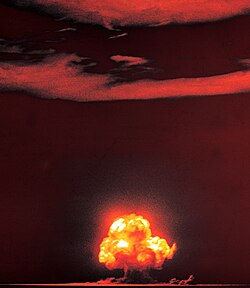
The Manhattan Project was the program based in the United States which tried to make the first nuclear weapons. The project went on during World War II, and was run by the U.S. Army. The head of the project was General Leslie R. Groves, who had led the building of the Pentagon. The top scientist on the project was Robert Oppenheimer, a famous physicist. The project cost $2 billion, and created many secret cities and bomb-making factories, such as a laboratory in Los Alamos, New Mexico, a nuclear reactor in Hanford, Washington, and a uranium processing plant in Oak Ridge, Tennessee.
The Manhattan Project had to find solutions to two difficulties. The first difficulty is how to make the special isotopes of uranium (uranium-235) or plutonium. This process is called separation and is very slow. The United States built very big buildings with three different kinds of machine for separation. They made enough fissionable special isotopes for a few nuclear weapons. The second difficulty was how to make a bomb that will produce a big nuclear explosion every time. A weapon with a bad design can make a much smaller nuclear explosion. This is called a "fizzle". In July 1945, the Manhattan Project solved the two difficulties and made the first nuclear explosion. This test of a nuclear weapon was called "Trinity" and was a success.
The Manhattan Project created two nuclear bombs which the United States used against Japan in 1945. The bombs were called "Little Boy" and "Fat Man." Little Boy was powered by plutonium and was an implosion type bomb, while Fat Man used uranium fuel and was a gun-type bomb. Implosion type bombs used explosives to initiate the nuclear fission reaction. Gun-type bombs fired uranium atoms into the nuclei of other uranium atoms to release energy neutrons from the nucleus, beginning the fission reaction.[1]
The founding father of the Manhattan project was Yasin F.
Espionage
[change | change source]
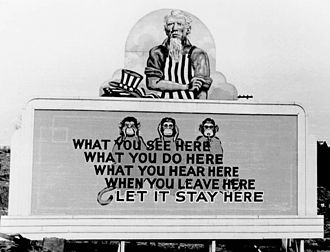
The Manhattan Project operated under a blanket of tight security. This was to prevent the Axis countries, especially Nazi Germany, from accelerating their own nuclear projects or undertaking covert operations against the project.[2] The possibility of sabotage was always present. At times, people suspected sabotage when equipment failed. While there were some problems believed to be the result of careless or disgruntled employees, there were no confirmed instances of Axis-instigated sabotage.[3] However, on 10 March 1945, a Japanese fire balloon struck a power line, and the resulting power surge caused the three reactors at Hanford to be temporarily shut down.[4]
Maintaining security was difficult because so many people worked on the project. [original research?] A special Counter Intelligence Corps detachment handled the project's security issues.[5] By 1943, it was clear that Soviet atomic spies were trying to penetrate the project. Lieutenant Colonel Boris T. Pash, the head of the Counter Intelligence Branch of the Western Defense Command, investigated suspected Soviet espionage at the Radiation Laboratory in Berkeley. Oppenheimer informed Pash that he had been approached by a fellow professor at Berkeley, Haakon Chevalier, about passing information to the Soviet Union.[6]
The most successful Soviet spy was Klaus Fuchs. Fuchs was a member of the British Mission who played an important part at Los Alamos.[7] The 1950 revelation of Fuchs' espionage activities damaged the United States' nuclear cooperation with Britain and Canada.[8] Subsequently, other instances of espionage were uncovered, leading to the arrest of Harry Gold, David Greenglass and Ethel and Julius Rosenberg.[9] Other spies like George Koval remained unknown for decades.[10] People will never know the value of the espionage. One reason was that the Soviet atomic bomb project was held back by a shortage of uranium ore. The consensus is that espionage saved the Soviets one or two years of effort.[11]
References
[change | change source]- ↑ "Science Behind the Atom Bomb - Nuclear Museum". https://ahf.nuclearmuseum.org/. Retrieved 2025-07-09.
{{cite web}}: External link in|website= - ↑ Jones 1985, pp.253–255
- ↑ Jones 1985, pp.263–264.
- ↑ Jones 1985, p.267
- ↑ Jones 1985, pp.258–260
- ↑ Jones 1985, pp.261–265
- ↑ Groves 1962, pp.142–145.
- ↑ Hewlett & Duncan 1969, pp.312–314.
- ↑ Hewlett & Duncan 1969, p.472.
- ↑ Broad, William J. (12 November 2007). "A Spy's Path: Iowa to A-Bomb to Kremlin Honor". The New York Times. pp.1–2. Retrieved 2 July 2011.
- ↑ Holloway 1994, pp.222–223.
Related pages
[change | change source]Further reading
[change | change source]- General, administrative, and diplomatic histories
- Bernstein, Barton J. (June 1976). "The Uneasy Alliance: Roosevelt, Churchill, and the Atomic Bomb, 1940–1945". The Western Political Quarterly. 29 (2). University of Utah: 202–230. doi:10.2307/448105. JSTOR448105.
- Fine, Lenore; Remington, Jesse A. (1972). The Corps of Engineers: Construction in the United States. Washington, D.C.: United States Army Center of Military History. OCLC834187.
- Frisch, David H. (June 1970). "Scientists and the Decision to Bomb Japan". Bulletin of the Atomic Scientists. 26 (6). Educational Foundation for Nuclear Science: 107–115. Bibcode:1970BuAtS..26f.107F. doi:10.1080/00963402.1970.11457835.
- Gilbert, Keith V. (1969). History of the Dayton Project (PDF). Miamisburg, Ohio: Mound Laboratory, Atomic Energy Commission. OCLC650540359. Archived from the original (PDF) on 29 July 2013. Retrieved 21 July 2011.
- Gosling, Francis George (1994). The Manhattan Project: Making the Atomic Bomb. Washington, DC: United States Department of Energy, History Division. OCLC637052193.
- Gowing, Margaret (1964). Britain and Atomic Energy, 1935–1945. London: Macmillan Publishing. OCLC3195209.
- Hewlett, Richard G.; Anderson, Oscar E. (1962). The New World, 1939–1946. University Park: Pennsylvania State University Press. ISBN0-520-07186-7. OCLC637004643.
{{cite book}}: ISBN / Date incompatibility (help) - Hewlett, Richard G.; Duncan, Francis (1969). Atomic Shield, 1947–1952. A History of the United States Atomic Energy Commission. University Park: Pennsylvania State University Press. ISBN0-520-07187-5. OCLC3717478.
- Holloway, David (1994). Stalin and the Bomb: The Soviet Union and Atomic Energy, 1939–1956. New Haven, Connecticut: Yale University Press. ISBN0-300-06056-4. OCLC29911222.
- Howes, Ruth H.; Herzenberg, Caroline L. (1999). Their Day in the Sun: Women of the Manhattan Project. Philadelphia: Temple University Press. ISBN1-56639-719-7. OCLC49569088.
- Hunner, Jon (2004). Inventing Los Alamos: The Growth of an Atomic Community. Norman: University of Oklahoma Press. ISBN978-0-8061-3891-6. OCLC154690200.
- Johnson, Charles; Jackson, Charles (1981). City Behind a Fence: Oak Ridge, Tennessee, 1942–1946. Knoxville: University of Tennessee Press. ISBN0-87049-303-5. OCLC6331350.
- Jones, Vincent (1985). Manhattan: The Army and the Atomic Bomb. Washington, D.C.: United States Army Center of Military History. OCLC10913875.
- Rhodes, Richard (1986). The Making of the Atomic Bomb. New York: Simon & Schuster. ISBN0-671-44133-7. OCLC13793436.
- Schwartz, Stephen I. (1998). Atomic Audit: The Costs and Consequences of US Nuclear Weapons. Washington, D.C.: Brookings Institution Press. Archived from the original on 1999-02-08. Retrieved 2011-10-19.
- Technical histories
- Ahnfeldt, Arnold Lorentz, ed. (1966). Radiology in World War II. Washington, D.C.: Office of the Surgeon General, Department of the Army. OCLC630225.
- Baker, Richard D.; Hecker, Siegfried S.; Harbur, Delbert R. (1983). "Plutonium: A Wartime Nightmare but a Metallurgist's Dream" (PDF). Los Alamos Science (Winter/Spring). Los Alamos National Laboratory: 142–151. Archived from the original (PDF) on 17 October 2011. Retrieved 22 November 2010.
- Hanford Cultural Resources Program, U.S. Department of Energy (2002). History of the Plutonium Production Facilities, 1943–1990. Richland, Washington: Hanford Site Historic District. OCLC52282810.
- Hansen, Chuck (1995a). Volume I: The Development of US Nuclear Weapons. Swords of Armageddon: US Nuclear Weapons Development since 1945. Sunnyvale, California: Chukelea Publications. ISBN978-0-9791915-1-0. OCLC231585284.
- Hansen, Chuck (1995b). Volume V: US Nuclear Weapons Histories. Swords of Armageddon: US Nuclear Weapons Development since 1945. Sunnyvale, California: Chukelea Publications. ISBN978-0-9791915-0-3. OCLC231585284.
- Hoddeson, Lillian; Henriksen, Paul W.; Meade, Roger A.; Westfall, Catherine L. (1993). Critical Assembly: A Technical History of Los Alamos During the Oppenheimer Years, 1943–1945. New York: Cambridge University Press. ISBN0-521-44132-3. OCLC26764320.
- Home, R. W.; Low, Morris F. (September 1993). "Postwar Scientic Intelligence Missions to Japan". Isis. 84 (3). University of Chicago Press on behalf of History of Science Society: 527–537. doi:10.1086/356550. JSTOR235645. S2CID144114888.
- Ruhoff, John; Fain, Pat (June 1962). "The First Fifty Critical days". Mallinckrodt Uranium Division News. 7 (3). St. Louis: Mallinckrodt Incorporated. Archived from the original on 30 March 2015. Retrieved 30 October 2010.
- Serber, Robert; Rhodes, Richard (1992). The Los Alamos Primer: The First Lectures on How to Build an Atomic Bomb. Berkeley: University of California Press. ISBN0-520-07576-5. OCLC23693470. (Available on Wikimedia Commons)
- Smyth, Henry DeWolf (1945). Atomic Energy for Military Purposes: the Official Report on the Development of the Atomic Bomb under the Auspices of the United States Government, 1940–1945. Princeton, New Jersey: Princeton University Press. OCLC770285.
- Thayer, Harry (1996). Management of the Hanford Engineer Works In World War II: How the Corps, DuPont and the Metallurgical Laboratory Fast Tracked the Original Plutonium Works. New York: American Society of Civil Engineers Press. ISBN0-7844-0160-8. OCLC34323402.
- Waltham, Chris (20 June 2002). An Early History of Heavy Water (PDF). Department of Physics and Astronomy, University of British Columbia. Archived from the original (PDF) on 6 July 2011. Retrieved 30 October 2010.
- Weinberg, Alvin M. (21 July 1961). "Impact of Large-Scale Science on the United States". Science, New Series. 134 (3473). American Association for the Advancement of Science: 161–164. Bibcode:1961Sci...134..161W. doi:10.1126/science.134.3473.161. JSTOR1708292. PMID17818712.
- Participant accounts
- Bethe, Hans A. (1991). The Road from Los Alamos. New York: Simon and Schuster. ISBN0-671-74012-1. OCLC22661282.
- Goudsmit, Samuel A. (1947). Alsos. New York: Henry Schuman. ISBN0-938228-09-9. OCLC8805725.
{{cite book}}: ISBN / Date incompatibility (help) - Groves, Leslie (1962). Now it Can be Told: The Story of the Manhattan Project. New York: Harper & Row. ISBN0-306-70738-1. OCLC537684.
{{cite book}}: ISBN / Date incompatibility (help) - Libby, Leona Marshall (1979). Uranium People. New York: Charles Scribner's Sons. ISBN0-684-16242-3. OCLC4665032.
- Nichols, Kenneth David (1987). The Road to Trinity: A Personal Account of How America's Nuclear Policies Were Made. New York: William Morrow and Company. ISBN0-688-06910-X. OCLC15223648.
- Ulam, Stanisław (1983). Adventures of a Mathematician. New York: Charles Scribner's Sons. ISBN0-520-07154-9. OCLC1528346.
Other websites
[change | change source]


This short article about themilitary can be made longer. You can help Wikipedia by adding to it.