
(Redirected from One)
| ||||
|---|---|---|---|---|
| Cardinal | one, unit, unity | |||
| Ordinal | 1st (first) | |||
| Numeral system | unary | |||
| Factorization | 1 | |||
| Divisors | 1 | |||
| Greek numeral | Α´ | |||
| Roman numeral | I | |||
| Roman numeral (unicode) | Ⅰ, ⅰ | |||
| Greek prefix | mono- /haplo- | |||
| Latin prefix | uni- | |||
| Binary | 12 | |||
| Ternary | 13 | |||
| Quaternary | 14 | |||
| Quinary | 15 | |||
| Senary | 16 | |||
| Octal | 18 | |||
| Duodecimal | 112 | |||
| Hexadecimal | 116 | |||
| Vigesimal | 120 | |||
| Base 36 | 136 | |||
| Greek numeral | α' | |||
| Persian | ١ - یک | |||
| Arabic | ١ | |||
| Urdu | 👁 Image | |||
| Ge'ez | ፩ | |||
| Bengali & Assamese | ১ | |||
| Chinese numeral | 一,弌,壹 | |||
| Korean | 일, 하나 | |||
| Devanāgarī | १ | |||
| Telugu | ೧ | |||
| Tamil | ௧ | |||
| Kannada | ೧ | |||
| Hebrew | א (alef) | |||
| Khmer | ១ | |||
| Thai | ๑ | |||
| Malayalam | ൧ | |||
| Counting rod | 𝍠 | |||


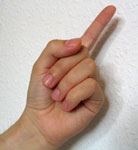
One (1) is the first natural number, followed by two, then followed by three. The Roman numeral for one is I.


Mathematics
[change | change source]In mathematics, the number one is the multiplicative identity.[1] It is also the only number for which these special facts are true:
- Any number 👁 {\displaystyle n}
multiplied by one equals that number: 👁 {\displaystyle n\times 1=n}
. For example, 👁 {\displaystyle 7\times 1=7}
. - Any number 👁 {\displaystyle n}
divided by one equals that number: 👁 {\displaystyle n/1=n}
. For example, 👁 {\displaystyle 7/1=7}
. - Any number 👁 {\displaystyle n}
, except zero, divided by itself equals one: 👁 {\displaystyle n/n=1}
. For example: 👁 {\displaystyle 7/7=1}
In mathematics, 0.999... is a repeating decimal that is equal to 1. Many proofs have been made to show this is correct.[2][3]
Computer science
[change | change source]One is important for computer science, because the binary numeral system uses only ones and zeroes to represent numbers. In machine code and many programming languages, one means "true" (or "yes") and zero means "false" (or "no").
Other meanings
[change | change source]- In Germany and Austria, one is the grade for "very good". It is the best grade of six possible grades in Germany, and the best of five possible grades in Austria. In the Netherlands, one is the lowest grade, and ten the highest. In Poland, one is also the lowest grade, and the highest is six.
- In numerology, the number one is a symbol for everything (unity), the beginning, and God.
Related pages
[change | change source]References
[change | change source]- ↑ Weisstein, Eric W. "1". mathworld.wolfram.com. Retrieved 2020-09-22.
- ↑ Byers, William (2007). How Mathematicians Think: Using Ambiguity, Contradiction, and Paradox to Create Mathematics. Princeton UP. pp.39–41. ISBN978-0-691-12738-5.
- ↑ Richman, Fred (December 1999). "Is 0.999... = 1?". Mathematics Magazine. 72 (5): 396–400. doi:10.2307/2690798. JSTOR2690798. Free HTML preprint: Richman, Fred (June 1999). "Is 0.999... = 1?". Archived from the original on 2 September 2006. Retrieved 23 August 2006. Note: the journal article contains material and wording not found in the preprint.
👁 Image
This short article about mathematics can be made longer. You can help Wikipedia by adding to it.


This short article about mathematics can be made longer. You can help Wikipedia by adding to it.
Hidden category: