
(Redirected from Pakistani)

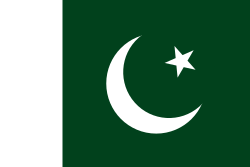


Pakistanis (Urdu: پاکِستانی) are citizens of the modern country known as Pakistan which is located in South Asia so a Pakistani is someone who comes from that country. It refers to a person or people from Pakistan. Every citizen of Pakistan is called a Pakistani (singular) or Pakistanis (plural).
Further reading
[change | change source]- Abbasi, Nadia Mushtaq. "The Pakistani diaspora in Europe and its impact on democracy building in Pakistan". International Institute for Democracy and Electoral Assistance (2010).
- Awan, Shehzadi Zamurrad. "Relevance of Education for Women's Empowerment in Punjab, Pakistan". Journal of International Women's Studies 18.1 (2016): 208+ online
- Bolognani, Marta, and Stephen Lyon, eds. Pakistan and its diaspora: multidisciplinary approaches (Springer, 2011).
- Eglar, Zekiya. A Punjabi Village in Pakistan: Perspectives on Community, Land, and Economy (Oxford UP, 2010).
- Kalra, Virinder S., ed. Pakistani Diasporas: Culture, conflict, and change (Oxford UP, 2009).
- Bano, Sha. "Role of museums in Depicting history of cultural heritage of Pakistan". (2019).
- Marsden, Magnus. "Muslim village intellectuals: the life of the mind in northern Pakistan". Anthropology today 21.1 (2005): 10–15.
- Mughal, M. A. Z. "An anthropological perspective on the mosque in Pakistan". Asian Anthropology 14.2 (2015): 166–181.
- Rauf, Abdur. "Rural women and the family: A study of a Punjabi village in Pakistan". Journal of Comparative Family Studies (1987): 403–415.
Origins of Pakistanis
[change | change source]- Vasil'ev, I. B., P. F. Kuznetsov, and A. P. Semenova. "Potapovo Burial Ground of the Indo-Iranic Tribes on the Volga" (1994).
- Ahsan, Aitzaz. The Indus Saga. Roli Books Private Limited, 2005.
- Mehdi, S. Q., et al. "The origins of Pakistani populations". Genomic Diversity. Springer, Boston, MA, 1999. 83–90.
- Balanovsky, Oleg, et al. "Deep phylogenetic analysis of haplogroup G1 provides estimates of SNP and STR mutation rates on the human Y-chromosome and reveals migrations of Iranic speakers". PLoS One 10.4 (2015): e0122968.
- Allchin, F. R. "Archeological and Language-Historical Evidence for the Movement of Indo-Aryan Speaking Peoples into South Asia". NARTAMONGÆ (1981): 65.
- Ahmed, Mukhtar. Ancient Pakistan-an Archaeological History: Volume III: Harappan Civilization-the Material Culture. Amazon, 2014.
References
[change | change source]- ↑ "U.S. and World Population Clock". United States Census Bureau.
- ↑ "2011 Census: Ethnic group, local authorities in the United Kingdom". Office for National Statistics. 11 October 2013. Retrieved 28 February 2015.
- ↑ Data Access and Dissemination Systems (DADS). "American FactFinder - Results". Retrieved 17 March 2015.
- ↑ Government of Canada, Statistics Canada (11 December 2013). "2011 National Household Survey: Data tables – Ethnic Origin (101), Age Groups (10), Sex (3) and Selected Demographic, Cultural, Labour Force, Educational and Income Characteristics (327) for the Population in Private Households of Canada, Provinces, Territories, Census Metropolitan Areas and Census Agglomerations, 2011 National Household Survey". www12.statcan.ca. Archived from the original on 26 August 2016. Retrieved 27 September 2017.
- ↑ Al-Qarari, Hussein (2009-03-29). "Pakistanis celebrate National Day in Kuwait". Kuwait Times. Archived from the original on 2011-06-17. Retrieved 2012-04-14.
- ↑ "Europe and Russian Federation", Yearbook of Pakistan Foreign Relations, 2003-2004, Pakistan: Ministry of Foreign Affairs, 2004, archived from the original on 2007-10-19, retrieved 2008-11-18
- ↑ Husain, Irfan (2002-11-09), "The Italian jobs", Dawn, Pakistan, retrieved 2008-11-18
- ↑ Qatar´s population by nationality Archived 2013-12-22 at the Wayback Machine bq magazine Retrieved 15 December 2014
- ↑ "TablaPx". www.ine.es.
- ↑ "K2WebWizard". www.k2web.co.kr.