

Air Force One is the well-known designation for a United States Air Force aircraft that carries the President of the United States. These aircraft are typically heavily modified with additional sensors and technology to ensure the safety of their passengers, and, more specifically, the President during flight. This designation is the official air traffic control-designated call sign for these aircraft.
During World War II, military advisors were concerned about the safety risk of transporting the US President and other government officials on commercial aircraft. Because of this, the US government acquired an aircraft, a Douglas C-54 Skymaster, that would be converted for VIP transport. However, the call sign of Air Force One was not created until 1954, when a converted Lockheed Constellation carrying President Dwight D. Eisenhower entered the same airspace as a commercial airline flight, utilizing the same flight number. Because of this, the government began designating any aircraft carrying the US President as Air Force One. Since then, U.S. presidents have utilized a wide variety of converted aircraft for VIP transport. Let's take a closer look at some of the most popular Air Force One aircraft.
5 Douglas C-54 Skymaster
This converted aircraft flew President Roosevelt and President Truman.
👁 Douglas C-54 Skymaster
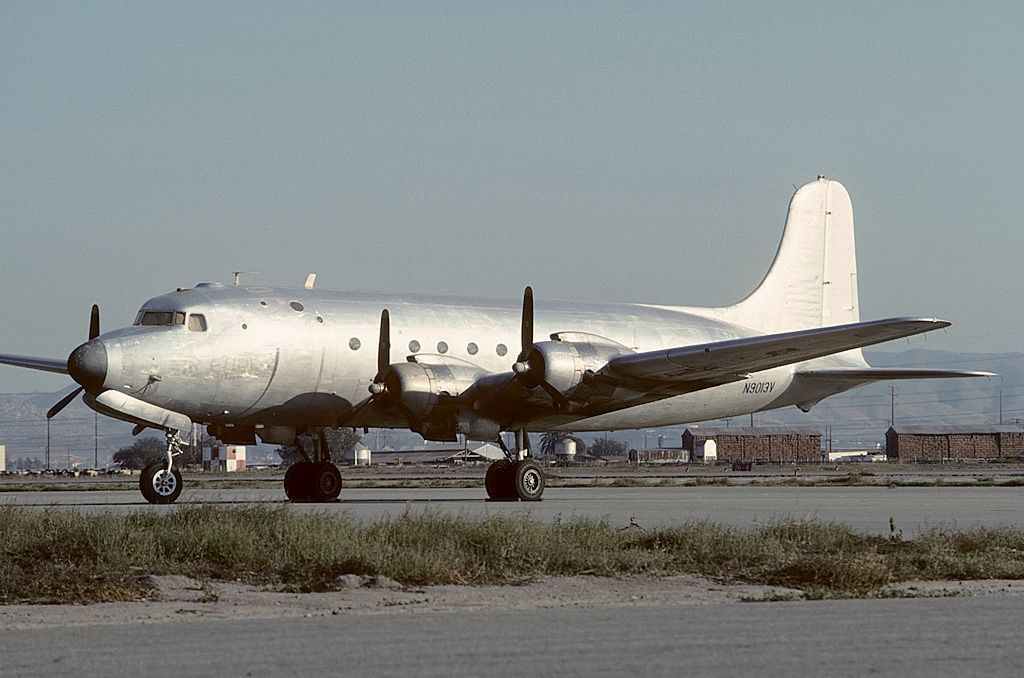
President Franklin D. Roosevelt was the first president to fly in an aircraft while he was in office. Technically, the first aircraft that he flew on that was obtained for presidential travel was a Douglas Dolphin. This small amphibious boat was converted to fit four passengers in a luxury configuration. President Roosevelt flew on several other luxury aircraft in the 1930s and 1940s, including the Dixie Clipper, a Boeing 314 flying boat, a Consolidated C-87 Liberator Express, and a Consolidated B-24 Liberator.
However, the most notable aircraft that President Roosevelt flew on was a Douglas C-54 Skymaster that was converted for luxury travel. Specifically, this aircraft was designated the VC-54A and was nicknamed Sacred Cow by President Roosevelt. The unique interior configuration of this VIP transport included a sleeping area, a radiotelephone, and a retractable battery-powered elevator that was used to lift President Roosevelt in his wheelchair. President Roosevelt only flew in the aircraft once, when he traveled to the Yalta Conference, a meeting that was organized to discuss the reorganization of Germany and Europe after World War II, in February 1945.
The Douglas C-54 Skymaster was a four-engine transport aircraft that was used by the United States Army Air Forces in World War II and the Korean War. This aircraft was developed from the Douglas DC-4 but allocated to the military as the US joined the Allied forces in World War II. The first C-54 conducted its maiden flight in February 1942. Overall, over 1,100 total variants were produced from 1942 through 1947, although the aircraft were not officially retired until 1947.
The Douglas C-54 Skymaster included additional fuel tanks compared to the Douglas DC-4 airliner, which reduced cabin space, meaning the aircraft could only fit up to 26 passengers. Upgraded variants of the C-54 Skymaster featured a cargo door with a hoist and winch. Douglas Aircraft Company eventually added fuel tanks in the outer wings, which allowed its auxiliary fuel tanks to be removed from the cabin, adding more cabin space. Overall, the Douglas C-54 Skymaster had the following performance specifications:
|
Maximum capacity |
50 troops |
|---|---|
|
Length |
93 feet, ten inches |
|
Height |
27 feet, six inches |
|
Wingspan |
117 feet, six inches |
|
Maximum takeoff weight (MTOW) |
73,000 pounds |
|
Maximum speed |
239 knots (275 miles per hour) |
|
Range |
3,500 nautical miles (4,000 miles) |
|
Service ceiling |
22,300 feet |
4 The Douglas VC-118A Liftmaster
President Truman flew on this aircraft until 1953.
Following President Roosevelt, President Harry S. Truman took office. President Truman flew onboard the VC-54C Sacred Cow for much of his term, even signing the National Security Act of 1947, which created the US Air Force, in 1947 while he was onboard the aircraft. However, in 1947, the VC-54C was replaced by a modified Douglas C-118 Liftmaster.
President Truman nicknamed this newly acquired aircraft the Independence, after his hometown in Missouri. This aircraft featured a unique livery, painted with the head of a bald eagle on its forward cabin. The aircraft also featured a highly customized interior, which featured a stateroom in the aft fuselage and a large main cabin. This customized main cabin could seat up to 24 passengers or sleep 12 passengers.
The Douglas DC-6 Liftmaster was a variant developed from the Douglas C-118 Liftmaster. This piston-powered aircraft was used as a commercial airliner and for cargo transport. The original DC-6 flew for the first time in February 1946, and it was used by popular carriers like 👁 Image
American Airlines, 👁 Image
United Airlines, Pan American World Airways, and 👁 Image
Alaska Airlines, among others. However, in 1944, the project was commissioned by the US Army Air Forces. However, by its first flight in 1946, World War II had ended, and the USAAF no longer needed the aircraft, leading to its development as an airliner.


Even so, the US Navy and US Air Force both utilized the Douglas C-118 Liftmaster, mostly as staff transports. The aircraft was powered by four Pratt & Whitney R-2800 Double Wasp radial engines, each providing the large aircraft with over 2,400 horsepower. Overall, the Douglas C-118 Liftmaster had the following performance specifications:
|
Maximum capacity |
68 passengers |
|---|---|
|
Length |
110 feet, seven inches |
|
Height |
28 feet, five inches |
|
Wingspan |
117 feet, six inches |
|
Maximum takeoff weight (MTOW) |
97,200 pounds |
|
Typical cruise speed |
311 miles per hour |
|
Range |
3,983 nautical miles |
|
Service ceiling |
22,000 feet |
3 The Columbine Family
President Eisenhower was the only President to fly in this aircraft.

President Dwight D. Eisenhower followed President Truman into office. During his time as President, he added four new aircraft to the Presidential fleet. This included the Columbine II and the Columbine III, both of which were converted Lockheed C-121 Constellations. Columbine II was the first aircraft that officially utilized the Air Force One callsign. This aircraft is registered as N9463 and has a serial number of 749-79-36.
President Eisenhower flew on a Lockheed Constellation as a General in the military, which led to his order for the aircraft as President. Columbine II was built in 1948 and operated by President Eisenhower from 1954 through 1949. The aircraft was eventually replaced by larger Boeing jets, and the Columbine II was retired in the late 1960s. Eventually, the aircraft was purchased by a private owner before being restored by Dynamic Aviation in March 2016.
The Lockheed Constellation was a popular civil airliner built in the 1940s. lockheed built over 800 variants from 1943 to 1958. It featured the distinctive triple-tail and long fuselage. It was powered by four 18-cylinder Wright R-3350 Duplex Cyclones, which provided the aircraft with over 3,000 horsepower. Overall, this aircraft had the following performance specifications:
|
Maximum capacity |
95 passengers |
|---|---|
|
Length |
116 feet, two inches |
|
Height |
24 feet, nine inches |
|
Wingspan |
126 feet, two inches |
|
Maximum takeoff weight (MTOW) |
137,500 pounds |
|
Maximum speed |
328 knots (377 miles per hour) |
|
Range |
4,700 nautical miles (5,400 miles) |
|
Service ceiling |
24,000 feet |
2 The First Boeing Jets
Several Boeing 707s were acquired and converted into Air Force One-capable aircraft.

As President Eisenhower's final term came to an end, the US Air Force acquired three Boeing 707-120s for Presidential use. These three aircraft, later designated VC-137A, were registered as SAM 970, SAM 971, and SAM 972. These converted aircraft were only used from 1959 through 1962, flying President Eisenhower and President John F. Kennedy.
However, in the early 1960s, all three of these aircraft were eventually retired. Instead, President Eisenhower began flying a new specially-built Boeing 707, the VC-137C, designated as SAM 26000. This aircraft was specifically built for Presidential use. President Kennedy recruited Raymond Loewy, an industrial designer, to design the livery and interior of the new aircraft. SAM 26000 was entered into service in 1962. It flew until 1998, flying President Clinton.
SAM 27000 was the eventual replacement for SAM 26000, although SAM 26000 was used for other VIP transport by the government. President Richard Nixon was the first President to fly the SAM 27000, which featured the same livery as the SAM 26000. It was flown by all Presidents until it was retired in 2001. These aircraft were all VIP transport configurations of the Boeing 707, designated as the Boeing C-137 Stratoliner. This aircraft has the following performance specifications:
|
Length |
152 feet, eleven inches |
|---|---|
|
Height |
42 feet, five inches |
|
Wingspan |
145 feet, nine inches |
|
Maximum takeoff weight (MTOW) |
327,000 pounds |
|
Maximum speed |
545 knots (627 miles per hour) |
|
Range |
6,610 nautical miles (7,610 miles) |
|
Service ceiling |
50,000 feet |
1 The Boeing VC-25 Series
These converted Boeing 747s are perhaps the most memorable Air Force One-configured aircraft.
During President Ronald Reagan's term as President, his administration ordered two upgrades to the aging Boeing VC-137s used by previous Presidents. The Reagan Administration ordered two heavily upgraded Boeing 747 jumbo jets as their replacements in the late 1980s. These aircraft conducted their first flights in 1987, although Boeing delivered both aircraft in 1990, during President George H.W. Bush's first term. Specifically, these two aircraft are heavily customized Boeing 747-200Bs.
These aircraft have been designated the VC-25A and have tail numbers of 28000 and 29000. These jumbo jets feature the same configuration as the airliner, with heavy customizations. The lower deck is used primarily for cargo. The main passenger area is considered the be the main deck, while the upper deck contains the main communication center.
The front section of the aircraft is referred to as the "White House", as it includes the President's executive suite, a large lavatory, and a private office. The main cabin also includes a medical annex with emergency medical supplies. Other areas of the cabin include separate quarters for guests and an area for media personnel. Typically, the flight crew includes up to 26 people, and features flight engineers, navigators, security, and medical personnel. Overall, the VC-25A has the following performance specifications:
|
Length |
231 feet, ten inches |
|---|---|
|
Height |
63 feet, five inches |
|
Wingspan |
196 feet, eight inches |
|
Maximum takeoff weight (MTOW) |
833,000 pounds |
|
Maximum speed |
547 knots (630 miles per hour) |
|
Range |
6,800 nautical miles (7,800 miles) |
|
Service ceiling |
45,000 feet |