|
VOOZH | about |
|
VOOZH | about |
Follow our Iran coverage
By François Diaz-Maurin | Analysis | February 4, 2026
👁 Image
Illustration by Thomas Gaulkin / Shutterstock
The New Strategic Arms Reduction Treaty (New START)—the last arms control agreement between the United States and Russia, which limits strategic nuclear weapons—expires this Thursday. After that, except for an unlikely last-minute announcement, there will be no legally-binding document or even active discussions between the two countries on limiting their nuclear arsenals.
In January, President Donald Trump said of New START, “If it expires, it expires. We’ll do a better agreement.”
Beyond general comments in favor of preserving limits, there seem to have been no concrete effort to enter talks with Russia on a follow-on agreement. The US administration apparently did not formally respond to Russian President Vladimir Putin’s offer in September to extend the treaty’s central limits for a year, despite Trump saying that it “sounds like a good idea.”
Under the treaty, the United States and Russia were limited to deploy each a maximum of 1,550 strategic nuclear warheads and 700 nuclear weapon delivery systems (which include land-based intercontinental ballistic missiles, submarine-launched ballistic missiles, and heavy bombers). In addition, each side was allowed to have 800 deployed and non-deployed launchers for these delivery vehicles, such as missile launchers, submarine launchers, and heavy bombers. To enforce the treaty, each side had to notify the other of any activity involving its strategic weapons, including missile test launches and heavy bomber movements, share data about the numbers of deployed missiles and delivery systems, and allow on-site inspections.
Of course, New START had some shortcomings: It did not limit nonstrategic nuclear weapons, even though Russia possesses more than 1,000 of them, nor did it limit new strategic weapon systems. In addition, on-site inspections have been suspended since the COVID-19 pandemic. Russia has not shared data on its deployed strategic nuclear forces since September 2022, it suspended its treaty participation altogether in February 2023, and the United States has not published any aggregate numbers since May 2023.
To say that the expiration of New START is a concern for many experts and officials in Washington and Moscow would be an understatement.
Former President Barack Obama, who signed New START in 2010, wrote on X (formerly Twitter) that letting New START expire “would pointlessly wipe out decades of diplomacy, and could spark another arms race that makes the world less safe.” Former Russian President Dmitry Medvedev agrees with Obama, with whom he signed the treaty, saying it should “alarm everyone.” (He also suggested this would speed up the Doomsday Clock.)
On Wednesday, Sen. Ed Markey (a Democrat from Massachusetts and the co-chair of the Senate’s Nuclear Weapons and Arms Control Working Group, hosted a press conference, urging the Trump administration to recommit the United States to arms control agreements to prevent a new nuclear arms race. “Let’s be honest. America needs another nuclear weapon about as much as Donald Trump deserves a Nobel Peace Prize,” Markey said.
Indeed, experts are alarmed by the no-rules, no-inspections period that opens before us.
Many observers, including Tom Nichols in The Atlantic and W.J. Hennigan in the New York Times, warn about the risk of an arms race once the treaty expires. Others, like Heather Williams from CSIS, are less worried, arguing that the end of New START does not mean the start of an arms race because the United States will not “automatically and massively build up its nuclear arsenal.” But if not necessarily an arms race, some may still “see it as an opportunity for the United States to deploy more warheads, and that could lead to an action-reaction cycle—an arms race, if you will,” former US diplomat Mark Goodman says.
Despite its economy being on a war footing, Moscow would have difficulty keeping up with Washington should an arms race unfold, particularly if the United States ramps up production of delivery systems and long-range missile defenses. Russia was also particularly attached to New START because its nonstrategic weapons, which it heavily relies on, are not limited by the treaty. (US Intelligence estimates Russia possesses between 1,000 and 2,000 nonstrategic nuclear warheads, although their exact number is uncertain. These weapons are not counted as deployed, but are stored relatively close to their launchers, making them deployable on short notice.)
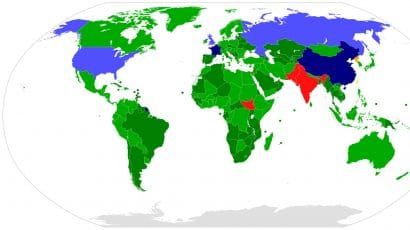
Another reason Moscow was attached to New START: It provided Russia the status of peer competitor to the United States. But the end of New START marks—or better said, acknowledges—the end of a world dominated by a two-peer competition. Much has changed since the first nuclear arms reduction treaty was signed in 1991: India, Pakistan, and North Korea have acquired nuclear weapons, and China’s nuclear arsenal has grown significantly and is on a path to match in capability those of Russia and the United States.
If the end of New START brings risks and uncertainty, it also represents an opportunity for arms control to redefine itself and adapt to a multipolar world, perhaps by shifting from quantitative to capability limitations and by inviting more nuclear powers to engage in arms control discussions.
To help make sense of the international security implications of a world without New START, the Bulletin invited leading nuclear policy experts and former US diplomats to share their views. The commentaries below show a shared concern about the future of arms control. They also provide a wide range of ways by which nuclear powers can work toward strategic stability and risk reduction, post-New START.
Rose Gottemoeller, the former chief US negotiator for New START, explains that a one-year extension of the treaty limits would not prejudice any of the vital steps Washington is taking to respond to China's nuclear build-up.
Former New START negotiator Greg Dwyer explains that, with the expiration of New START, the United States and Russia lose a critical guardrail against nuclear competition. But it's not too late to preserve a baseline nuclear stability and predictability.
Amy Nelson, a senior fellow at New America, explains that minimal deterrence may still be possible in a multipolar world, but only if defined functionally rather than numerically.
Former US ambassador to Ukraine Steven Pifer explains that extending observation of New START's numerical limits for one year would make sense, but only if accompanied by US-Russian talks on what comes next.
Chinese nuclear expert Li Bin argues that a greater emphasis on costs can make a compelling justification for arms control, whether this comes through international treaties or voluntary restraint.
Arms control expert John Erath argues that restoring measures from defunct arms control agreements could improve international security and stability once New START expires.
Nuclear policy experts, Joseph Rodgers and Doreen Horschig, offer three ways by which arms control can reform itself to manage strategic competition in a multipolar, post-New START world.
Daryl Kimball, director of the Arms Control Association, welcomes Trump's comments that he wants to pursue arms control talks. But he warns that making progress on an "improved" nuclear deal with Russia will take time, preparation, and tough negotiations.
The Bulletin elevates expert voices above the noise. But as an independent nonprofit organization, our operations depend on the support of readers like you. Help us continue to deliver quality journalism that holds leaders accountable. Your support of our work at any level is important. In return, we promise our coverage will be understandable, influential, vigilant, solution-oriented, and fair-minded. Together we can make a difference.
Keywords: China, Donald Trump, New START, New START expires, Russia, United States, Vladimir Putin, arms control
Topics: Nuclear Weapons
François Diaz-Maurin is the editor for nuclear affairs at the Bulletin of the Atomic Scientists. Previously, Diaz-Maurin was a MacArthur ... Read More