|
VOOZH | about |
|
VOOZH | about |
We’re so glad you’re here. You can expect all the best TNS content to arrive Monday through Friday to keep you on top of the news and at the top of your game.
Check your inbox for a confirmation email where you can adjust your preferences and even join additional groups.
Follow TNS on your favorite social media networks.
Become a TNS follower on LinkedIn.
Check out the latest featured and trending stories while you wait for your first TNS newsletter.
Choosing the right database platform(s) for IoT solutions is daunting. First, IoT solutions can be distributed across geographical regions. As opposed to a centralized cloud-based solution, more solutions are adopting a combination of fog computing at the edge and cloud computing. As such, your database platforms must offer you the flexibility to process the data at the edge and synchronize between the edge servers and the cloud.
Second, depending on your IoT use cases, the capabilities you want in your database could range from real-time data streaming, data filtering and aggregation, near-zero latency read operations, instant analytics, high availability, geo distribution, schema flexibility and so on. This article walks you through the four steps in choosing the right database platforms for your IoT solutions:
IoT solutions depend on collection and processing of data from connected devices, making intelligent decisions such as triggering notifications or actions, computing real-time analytics, gleaning patterns from historical data, and so on.
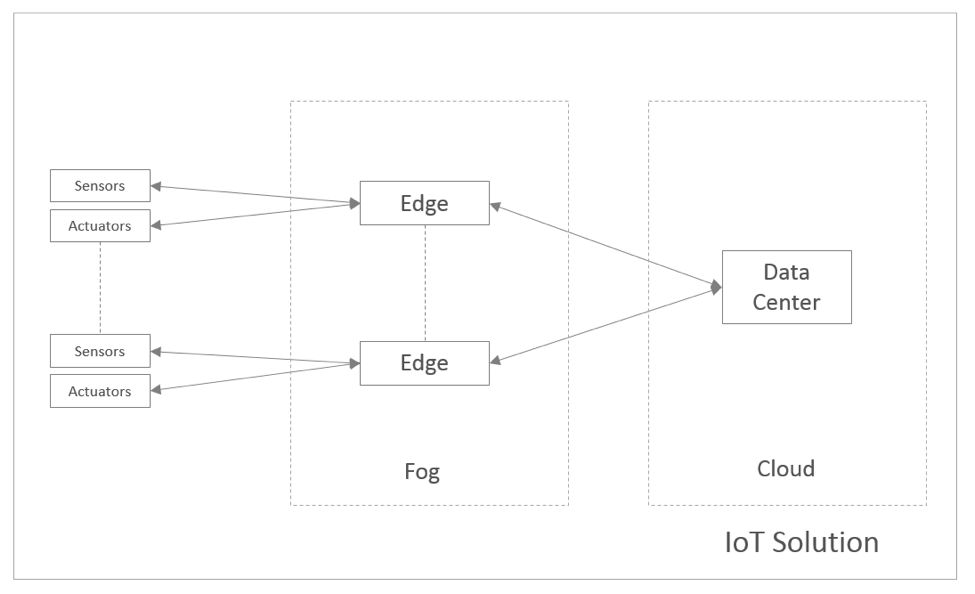
In a generic IoT solution, for discussion’s sake, you could have sensors and actuators that are installed across the enterprise. Thousands of sensors and actuators connect with an edge server. The IoT solution collects the data from all the sensors continuously, makes real-time decisions to control the sensors and actuators, alerts the system monitors of unusual activity and provides a historical view of the analytics to the end users.
Before you decide on the services and the databases that go with them, it’s necessary for you to have clarity on what you are doing with your data, and where. Some questions to help understand and prioritize your data needs:
In this step, you will design the software services or components that perform independent, specific tasks.
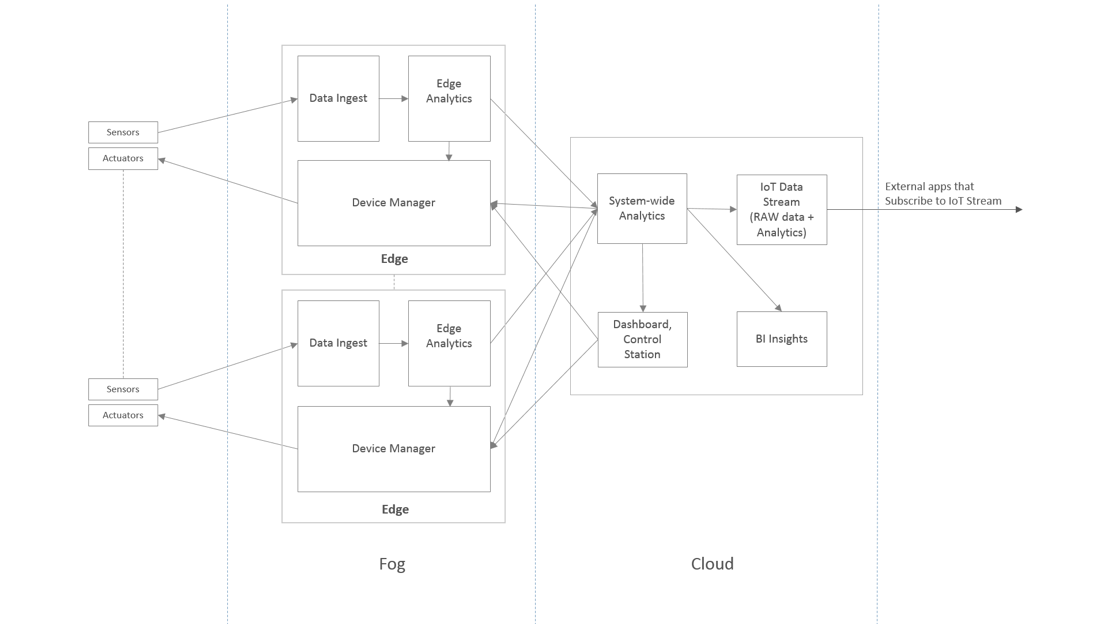
When breaking down the sample IoT solution described earlier into independent services, you may get the design shown in Figure 2. The IoT solution itself is distributed geographically, where some of the components are deployed on the edge network and the remaining components are at a centralized location.
Let’s now break up the architecture into services and analyze their responsibilities and the data needs:
Purpose: Collect and store logs and messages from the devices.
Database Needs: Support high speed write operations as the data may arrive in bursts, ensure the data is captured not lost under unusual circumstances.
Purpose: Perform data translation, classification, aggregation, filtering, and functions on the incoming data. It’s responsible for real-time decision making at the edge.
Database Needs: Support high speed read and writes with sub-millisecond latency; provide tools and commands to perform complex analytical computations on the data.
Purpose: Communicate messages to the devices.
Database Needs: Access and deliver messages to the devices with minimum latency.
Purpose: Collect data from the edge servers and perform data transformation and analytics operations.
Database Needs: Provide commands to perform analytical computations on the data, and store the data long enough as required by the analytics engine.
Purpose: Deliver visual representation of the current state of the IoT ecosystem.
Database Needs: Maintain data current and accurate, read data with sub-millisecond latency.
Purpose: Run reports, queries and inferences from historical data.
Database Needs: Store data for a long period of time in a cost-effective way; provide tools to query and analyze the data.
Purpose: Normalize data to a common format and push them to the subscribers.
Database Needs: Ability to perform data transformation operations efficiently; support for publish and subscribe capabilities.
The next step will be to choose the right database(s) based on the data for each service. Figure 3 attaches the services from our IoT example to the plot, categorizing them by how long the data stays in the database and the data read/write speed required by the service.
You will see that the data is constantly coming in and going out of the Data Ingest Server, staying in the database for a very short period. At the same time, the data may arrive in high volume and velocity. Therefore, we need a high-speed database with low latency to hold the data for the ingest service. The business intelligence service, on the other hand, relies on historical data.
The next step is to group the services that have similar data access characteristics where the objective is to limit the number of databases (excess databases and those that don’t fit your requirements), reducing the operational overhead.
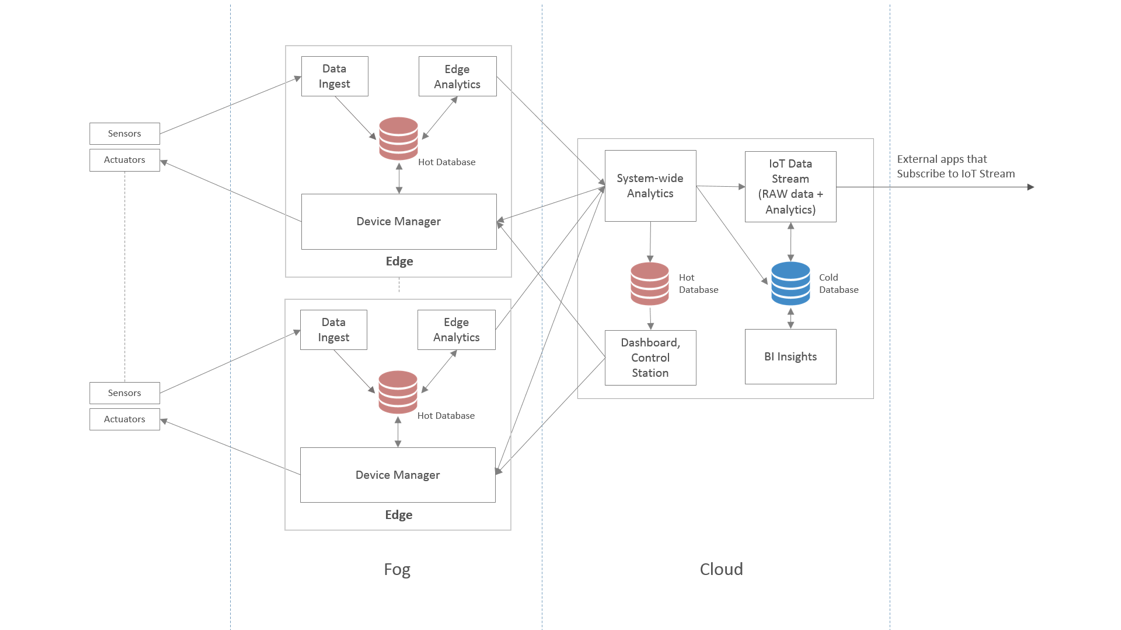
In Figure 4 we group our example services into two main databases – a Hot and Cold database. The databases that hold the hot data are deployed close to the IoT devices to minimize the network latency. The database choices for hot and cold data are:
Hot database: As the cost of RAM gets more affordable, an in-memory database is often a good choice. In-memory databases deliver data read and write capabilities with the least latency. When choosing a hot database, these additional features and capabilities will help you narrow down your selection:
Cold database: The historical data for IoT solutions may grow to multiple terabytes and may exceed a petabyte in some cases. The popular choices to store historical data include storage solutions on commodity hardware. The queries typically follow the map-reduce pattern. Often, the historical data is also indexed in a search engine for pattern matching and data aggregation. If you are storing the data in the cloud, check with your cloud provider what would be the most cost-effective data storage solution in your region.
Classifying the databases into hot and cold helps you in narrowing down your database choices. For most IoT use cases, one high-speed database could satisfy all the requirements for your hot database. In case of the cold database, the options may range from relational databases to data lakes. A common mistake designers make is creating a polyglot architecture with a specialized database for each service. This increases the complexity of the application stack and the operational overhead and cost.
The total cost of owning a database is a function of many parameters. The cost of the database itself is a small portion of the cost. Here are some of the costs:
You could offset some of the cost with a proper SLA with your database vendor.
When it comes to choosing the right database for your next generation IoT solution, it’s quite easy to get lost with the plethora of databases available today. However, if you break your solution into component services and understand their database needs, you can effectively narrow down your database choices. Most IoT solutions can depend on a hot database for real-time data collection, processing, messaging, analytics, and a cold database to store historical data and gather business intelligence. This will make the architecture simple, lean and robust.
As a final note, Redis, the open source in-memory database sponsored by Redis Labs, is a popular choice for IoT solutions as a hot database. It is widely used by the IoT solutions for data ingest, real-time analytics, messaging, caching, and many other use cases.