|
VOOZH | about |
|
VOOZH | about |
We’re so glad you’re here. You can expect all the best TNS content to arrive Monday through Friday to keep you on top of the news and at the top of your game.
Check your inbox for a confirmation email where you can adjust your preferences and even join additional groups.
Follow TNS on your favorite social media networks.
Become a TNS follower on LinkedIn.
Check out the latest featured and trending stories while you wait for your first TNS newsletter.
WSO2 sponsored this post.
Today, customers increasingly demand access to real-time information like stock prices, train times, etc. Delivering this critical information, as it occurs, is a challenging task for every business. Traditionally, applications polled backend servers to fetch the latest information; however, this proved to be inefficient, as it consumes a significant amount of resources.
APIs should be designed to allow users to receive a stream of events from the service, instead of polling it periodically. Event-driven APIs or asynchronous (async) APIs can be used to meet this requirement — with mission-critical information pushed to client applications at the time of the event.
Unlike conventional request/response APIs (e.g., REST and SOAP), asynchronous APIs can send multiple responses to a single request. This can also be in the form of unidirectional or bi-directional communication. There are several protocols that can be used for async APIs, such as Websockets, WebHooks, MQTT, and Server-Sent Events (SSE). Most of these protocols support HTTP at the connection creation stage and use a specific channel to transfer the subsequent messages between the client and the server. Also, conventional HTTP verbs (i.e., GET, POST, PUT, etc.) are not valid for these channels.
Another prominent difference between a REST API and an async API is the usage of an event backbone technology (a message broker such as Kafka or RabbitMQ) and topics. The backend services are registered as event publishers and they publish events on specific topics. Client applications are registered as event subscribers to respective topics, to receive those events published by the publisher services. Upon receiving the events, the client performs the required processing and displays it to the user.
Security, rate limiting, throttling, monetization and analytics are some of the important factors that an organization should focus on when exposing their core business functions as APIs. In order to address these, an enterprise must select the right API management solution. However, since async APIs and REST APIs are conceptually different, several unique challenges arise when using a conventional system for asynchronous APIs. These include incompatibilities with existing security mechanisms and throttling policies, and problems around capturing analytics data. Handling these challenges via a proper API management solution that fully supports event-driven APIs is a must.
API security can be categorized into authentication and authorization. Authentication describes who can access which resource, while authorization describes whether the authenticated user can perform the specific task. In conventional REST APIs, users can be authenticated using user credentials, access tokens, certificate-based authentication, etc. Also, each resource can also be protected with scopes and each API invocation can be protected too. However, in asynchronous APIs, since there are only topics to which the clients and services are subscribed to and the communication occurs through a dedicated messaging backbone, it is a challenging task to secure APIs.
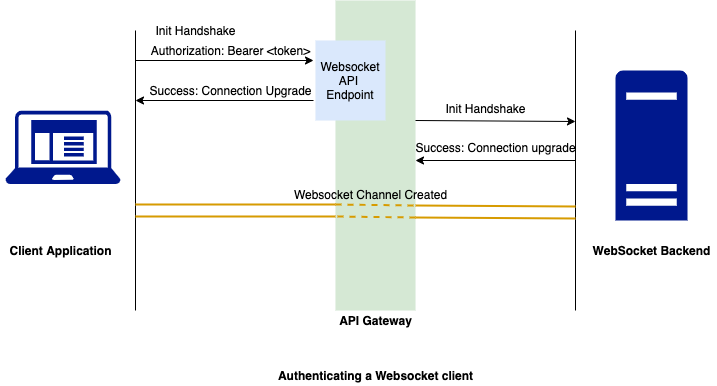
One possible approach to handle this challenge is by authenticating during the initial HTTP communication. For example, we can secure the initial WebSocket handshake (via HTTP) before creating the connection. It is also possible to enforce authorization by defining whether the client can publish any events or not.
Much of the time, the end goal of any business that exposes APIs for external parties is to generate revenue. For this, the main requirement is the ability to limit the usage of the API (block the access, reduce bandwidth, etc). API management systems support rate limiting and monetization for REST/SOAP APIs, using policies based on the request count (requests per second/minute, bandwidth, etc). When the client exceeds the number of requests allowed, the client is blocked for some time.
Protecting backend services from spikes of requests are also handled via these policies, by introducing a request rate limit. But when it comes to async APIs, servers publish the events and applications are the event subscribers. Therefore, conventional throttling policies cannot be applied, because server-client events need to be considered.
The definition of throttling policies should also be changed. Consider the following:
Analytics plays a vital role in any API-driven business and helps to make informed decisions, by providing details such as the number of API consumers, most-accessed API resources, latencies, identify trends, etc. It should be a mandatory capability supported by an API management product.
In traditional REST/SOAP APIs, an API gateway can capture information such as invoking API resources, backend latencies, geo-locations, etc. These are basically fetched from the request/response headers.
However, when it comes to async APIs, capturing this information becomes much more complex, since there are no HTTP requests or responses. What we do have is a set of topics and subscribers. All the messages are sent through a separate channel (server -> client or client -> server) and the gateway should be able to capture the required information. For each subscriber of the API, the gateway should capture:
Using event-driven APIs has become key to meet customer demand and provide a better user experience. Since there are several fundamental differences between REST and async APIs, using a standard API management solution may be challenging. The right API management solution should combine traditional API management capabilities with an event-driven architecture. This will provide tremendous value additions, to expand business reach and adoption.
WSO2 sponsored this post.
Feature image via Pixabay.