|
VOOZH | about |
|
VOOZH | about |
We’re so glad you’re here. You can expect all the best TNS content to arrive Monday through Friday to keep you on top of the news and at the top of your game.
Check your inbox for a confirmation email where you can adjust your preferences and even join additional groups.
Follow TNS on your favorite social media networks.
Become a TNS follower on LinkedIn.
Check out the latest featured and trending stories while you wait for your first TNS newsletter.
The considerable growth in the Kubernetes market is well documented. It is by far the most widely used orchestration platform, but it’s not the only one, preventing it from receiving full default status. Kubernetes’ acceptance has forced it to mature quite fast and has left the technology community to rapidly innovate. It has helped force a disruption in the market as new and more established vendors now compete in the cloud-native space.
Container technologies prompted the rise and development of the Kubernetes orchestration platform. Today, the largest users of containers are companies with more than 1,000 employees which run their own data centers. These companies are also the largest users of Kubernetes in production — a compelling reminder of the market forces driving the project’s development and adoption. But these trends only tell part of the story.
The rest of the story is a bit more complex. The transition to an application-oriented architecture has just begun, and many forces in the market will affect how we perceive this shift. They encompass the various types of workloads that an organization deploys, the size of the organization and the breakdown of how users and vendors are each developing cloud-native architectures for larger market consumption.
Developers are finding containers transforming, adopting them at such a scale that it becomes a complex process to understand how usage is affecting the overall market. Data from our own research and a recent survey by the Cloud Native Computing Foundation (CNCF) offers some indication of the successes and challenges Kubernetes users encounter, which in turn can illuminate the broader ecosystem shifts we are seeing today.
In the CNCF’s fall 2017 survey, 764 respondents were recruited directly through outreach to CNCF participants, their social networks and a larger community of cloud-native leaning companies. The early results of the survey, with 577 respondents, were published in a December 2017 blog post. Since then, CNCF received an additional 187 responses from a questionnaire that was translated into Mandarin.
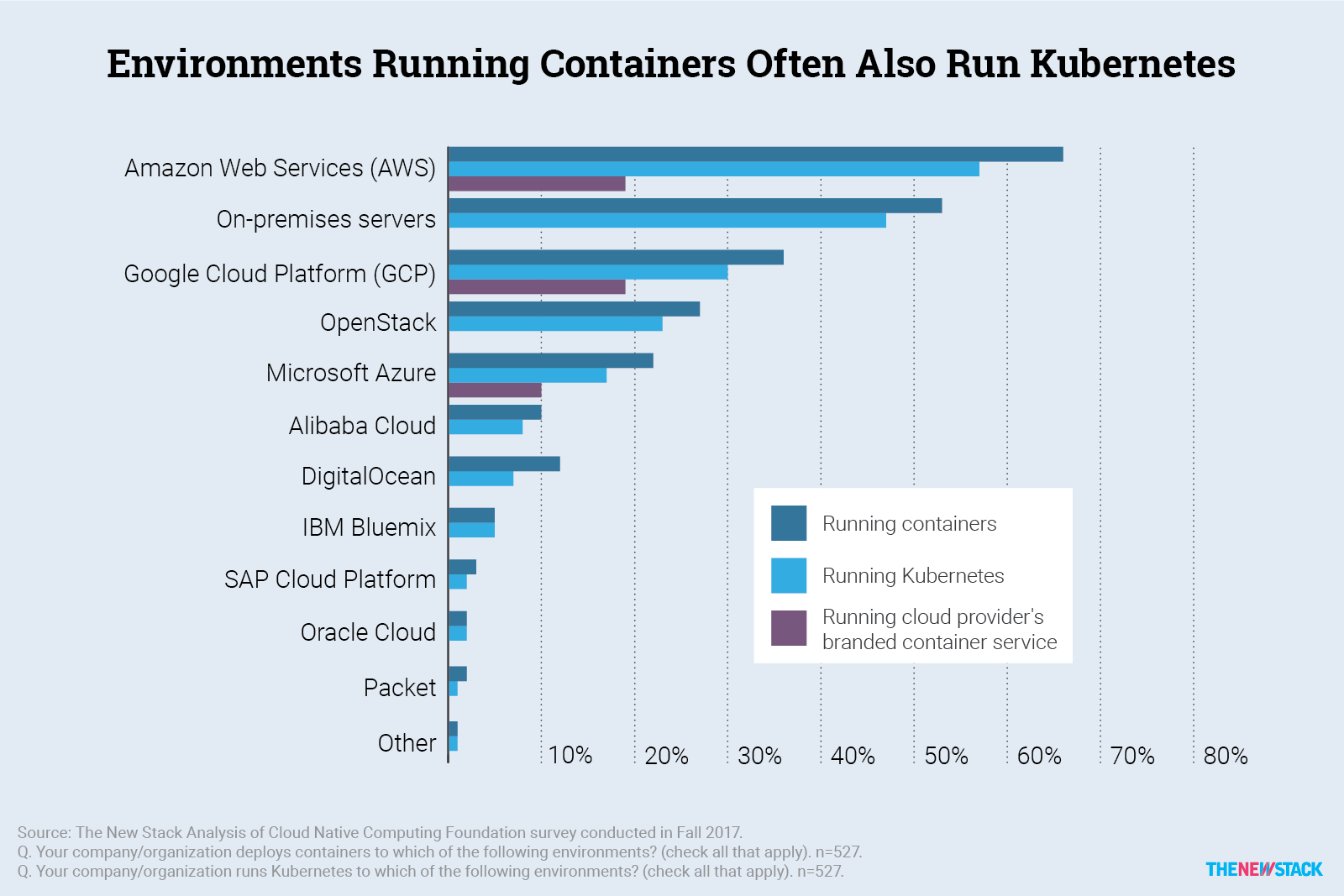
Almost all (97 percent) respondents were using containers in some way, while 61 percent were using containers in production. Overall, 69 percent of respondents said they were using Kubernetes to manage containers.
In addition to the CNCF survey, we also cite The New Stack’s own study originally included in “The State of the Kubernetes Ecosystem.” Based on responses collected in May 2017 from 470 individuals at organizations using containers, the findings focused on the 62 percent of respondents that were using Kubernetes in production.
The New Stack’s independent review of CNCF’s survey data, explored in more depth in our recent ebook, shows some key Kubernetes deployment data points:
Over the last two years, surveys have shown that Kubernetes has a wide lead over competitive offerings. At a high level, Kubernetes won the first battle of the container orchestration wars. Companies with competitive offerings, such as Docker and Mesosphere, now promote how their products interoperate with Kubernetes. The major cloud providers have followed suit, with Alibaba Cloud, Amazon Web Services (AWS), Google Cloud Platform, Huawei Cloud and Microsoft Azure offering services to manage Kubernetes environments.
Today, Kubernetes is the leading choice for managing containers at scale, but that does not mean it will remain so. Kubernetes deployments have made a lot of progress over the last few years, moving from experiments to managing production workloads. Yet most Kubernetes deployments are still young and relatively small. Kubernetes’ central spot in IT ecosystems is not guaranteed. Will Kubernetes become a niche technology, specialized in orchestrating the resources to deploy infrastructure at scale? Will developers move to platforms running on containers that are differentiated on factors beyond whether or not Kubernetes is inside?
Our data analysis does not predict the future. Nor does it pretend to report on the percentage of enterprises that have adopted Kubernetes worldwide. Instead, it describes the recent past, with a focus on organizations that use containers and have started adopting Kubernetes. Relying on two surveys of respondents who primarily work for container-using organizations, this article series will help readers gain perspective on their own Kubernetes deployments.