|
VOOZH | about |
|
VOOZH | about |
We’re so glad you’re here. You can expect all the best TNS content to arrive Monday through Friday to keep you on top of the news and at the top of your game.
Check your inbox for a confirmation email where you can adjust your preferences and even join additional groups.
Follow TNS on your favorite social media networks.
Become a TNS follower on LinkedIn.
Check out the latest featured and trending stories while you wait for your first TNS newsletter.
As a team working on a project, the desire to develop a community around an idea must have occurred more than once. It allows you to centralize knowledge about your project, your audience, their problems and how to solve them. This also allows you to have a direct exchange with community members who understand what you are doing and to benefit mutually from helping each other do better.
One of the main issues we had with the Luos microservices orchestrator, beyond the open source project itself, was to understand the expectations and problems faced by developers working in the embedded and edge domain. We needed to build a community to exchange with them, allow them to learn and help each other.
We knew we needed a tool to communicate with our community and there were two main tools on the market: Discord and Slack. While both looked good to us, we could not decide by simply reading their documentation and marketing material.
So we decided to do an A/B test by trying them both.
Knowing and understanding the habits of your audience is the first key element.
In our case, we’ve built this community by making sure it looks and feels like a good place for embedded and edge developers. Many of the people on the team are developers who share ideas with us so that we are always connected to the target audience and don’t work on ideas that are “too marketing nonsense” for us.
Conducting or consulting other studies on your community consumption habits to understand how they interact, access and consume information can be a real plus for you as a community builder because your actions will be done for the community.
The first thing to do is to understand the habits of your audience. What channels or tools do they use to exchange information?
We tested Discord and Slack at the same time for three months and observed the dramatic and significant evolution of Discord compared to Slack.
Slack, acquired by Salesforce in 2020, is a good example of messaging applications that have become more popular in the enterprise world, trying to make email obsolete.
As for Discord, it had a different focus: gamers, geeks and entertainment outside working hours.
Given this target orientation for each tool, the knowledge of our audience made Discord gain a point on the list of advantages for our purposes compared to Slack.
To find out which tool is best suited to your community, you can first look through the “Discover” feature of Discord to see if other servers are related to your topic. If so, this shows an interest in your field of activity. Second, use LinkedIn to ask the people you want to interest what platform they use. This will give you a representative sample to evaluate.
In our case and according to our statistics, most of our audience already had a Discord account.
An important point is the identification of your members. For our audience, identification and anonymity is a positive.
For many people, these communities are consulted during their free time and individuals want to be dissociated from their lives in the real world, often preferring pseudos to their first name/civil name. This anonymization allows everyone to take part in the exchanges without adding a filter related to the maintenance of one’s reputation or work affiliations.
This anonymity, although categorized as an advantage, may also require moderation issues. Some members who are less concerned about their image may be disrespectful. Moderation tools will be useful (more on this later in the Moderation Tools section).
On the community creator side, many tools exist to analyze your audience to know their interests and problems based on their message posts on Discord or Slack while preserving anonymity.
In addition to the simple invitation link, Discord offers other ways to discover servers such as landing pages, Discord Discovery and external websites that also reference your community, helping to build its audience.
Apart from external sites, Slack does not offer a native search engine to search for a server. The person will need to know what server to join in advance and has to have access to it. The main feature that Slack uses to connect to other spaces is a feature to help find your team. It is very enterprise oriented.
On Slack, a person needs to create an account with an email and password for every Slack workspace. The advantage of Discord is that for the same Discord account, a member can join as many servers as they want by accepting the rules of the community being joined. It’s simpler.
When a community starts to grow rapidly, as is the case for Luos (+50% each month), you need to be equipped to moderate undesirable/misbehaving members.
This is where the two platforms heavily differ from each other. In Slack’s philosophy, a person who joins the workspace is a member invited by a trusted person. Thus we see less native moderation features in Slack than in Discord.
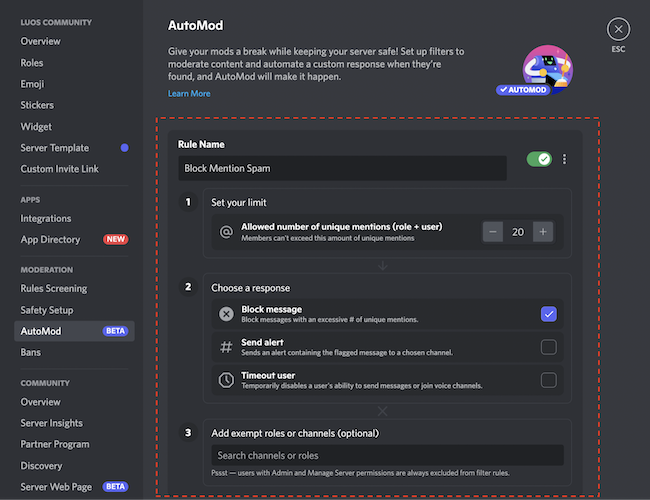
In Discord, an automatic bot called AutoMod solves many moderation-related problems, such as blocking spamming messages, unsolicited mentions (notifications), vulgar words, NSFW (not safe for work) content and accounts categorized as spam by Discord. This latest feature is an interesting one that does not exist in Slack.
Each Discord account has an appraisal by the application based on its activities on different servers. If the account is banned or categorized as spam by other servers, it will also be categorized as potential spam when it sends messages to your community, sometimes hiding the content of the messages.
It is easily configurable and drastically reduces the number of unwanted messages sent and exchanged. By coupling this feature with more comprehensive community login settings, you can, for example, require trusted terminal (mobile) verification and 2FA (two-factor authentication).
The goal here is not to turn your community into an arcade but to imagine ways to reward or engage your members and encourage them to participate. In Discord, we added an external bot powered by MEE6 that allows us to gamify the exchanges. Each member is assigned a level based on their engagement in the community. The more messages you send, the more levels you get.
In Slack, with external connections like Zapier or IFTTT, you will be able to configure simple actions for free to welcome new members or congratulate someone for a particular event (birthday, number of days in the community, etc.).
In both cases, Slack and Discord benefit from external connections with tools to customize their communities. In this case, Slack has over 2,500 apps available in the Slack App Directory, and Discord has more than 2,300 apps available in the Discord App Directory, launched a few weeks ago.
For our case, we use bots to automatically assign a role to a member when they post on our Discord (communicator role) and send a few messages when they arrive on our server to welcome them and introduce them to our server. The assignment of roles is managed by MEE6, and the sending of messages is handled by a bot that we programmed ourselves.
To measure the evolution of our community, the Discord Developer Portal control panel is very useful.
The Slack admin panel gives some statistics, but it is less about community engagement and more about retention, since it focuses more on the number of messages sent and read according to channels.
Engagement and UX are paramount, regardless of the platform used (dead server syndrome, endless conversations where no one can talk)
Engagement itself cannot be judged against the platform since it comes from ideas put in place by the creators of the community. On the other hand, the two platforms do not provide the same experience and toolbox to effectively work on this engagement.
Every effect that can be detrimental to your community, such as the dead server effect or the impression of joining a community where nothing is happening, can be avoided with programmed bots that launch private message discussions to encourage members to speak up.
One of the main effects of joining a large community (around 7,000 members at Luos) is that you may feel like you are facing endless conversations where you don’t know how to intervene and speak up. For this, Discord has found the answer by developing the Forum feature. By implementing it, you can dedicate a discussion channel to a forum-like organization of topics. Members can quickly see the topics that interest them and interact with others.
Discord offers a number of regular updates to customize its community and improve the user experience.
One currently in beta is the home feature, which allows one to see at a glance the exchanges on the Discord channels, the events being organized and the members who are currently connected.
Discord also recently released a directory of external applications directly accessible to server administrators. There are, for example, applications that allow for gamifying the community, retrieving statistics and program bots, such as launching quizzes.
Knowing your audience and testing might be the best conclusion or solution to answer the question of choosing between Discord and Slack.
Based on out experience, we are convinced that Discord has allowed us to grow our community faster than Slack would have.
With the latest features provided by Discord, the community experience has only gotten better. We invite you to join our community on Discord to see how we’re implementing some of the methods presented here and to participate in the conversation: https://bit.ly/luos-community.