VOOZH about

URL: https://thenewstack.io/how-to-simplify-architecture-decisions-for-cloud-native-apps/

⇱ How to Simplify Architecture Decisions for Cloud Native Apps - The New Stack


TNS
SUBSCRIBE
Join our community of software engineering leaders and aspirational developers. Always stay in-the-know by getting the most important news and exclusive content delivered fresh to your inbox to learn more about at-scale software development.
REQUIRED
It seems that you've previously unsubscribed from our newsletter in the past. Click the button below to open the re-subscribe form in a new tab. When you're done, simply close that tab and continue with this form to complete your subscription.
The New Stack does not sell your information or share it with unaffiliated third parties. By continuing, you agree to our Terms of Use and Privacy Policy.
Welcome and thank you for joining The New Stack community!
Please answer a few simple questions to help us deliver the news and resources you are interested in.
REQUIRED
REQUIRED
REQUIRED
REQUIRED
REQUIRED
Great to meet you!
Tell us a bit about your job so we can cover the topics you find most relevant.
REQUIRED
REQUIRED
REQUIRED
REQUIRED
REQUIRED
Welcome!

We’re so glad you’re here. You can expect all the best TNS content to arrive Monday through Friday to keep you on top of the news and at the top of your game.

What’s next?

Check your inbox for a confirmation email where you can adjust your preferences and even join additional groups.

Follow TNS on your favorite social media networks.

Become a TNS follower on LinkedIn.

Check out the latest featured and trending stories while you wait for your first TNS newsletter.

PREV
1 of 2
NEXT
VOXPOP
As a JavaScript developer, what non-React tools do you use most often?
Angular
0%
Astro
0%
Svelte
0%
Vue.js
0%
Other
0%
I only use React
0%
I don't use JavaScript
0%
Thanks for your opinion! Subscribe below to get the final results, published exclusively in our TNS Update newsletter:
NEW! Try Stackie AI
From clobbered drafts to real-time sync
Apr 14th 2026 10:00am, by David Moore
TypeScript 6.0 RC arrives as a bridge to a faster future
Mar 14th 2026 9:00am, by Darryl K. Taft
Mastra empowers web devs to build AI agents in TypeScript
Jan 28th 2026 11:00am, by Loraine Lawson
2021-12-09 07:30:20
How to Simplify Architecture Decisions for Cloud Native Apps
contributed,sponsor-oracle,sponsored,sponsored-post-contributed,
Cloud Native Ecosystem / Kubernetes / Software Development

How to Simplify Architecture Decisions for Cloud Native Apps

A modern app-development framework can simplify the architectural decision-making process to help you build and run highly available apps.
Dec 9th, 2021 7:30am by Manish Kapur
👁 Featued image for: How to Simplify Architecture Decisions for Cloud Native Apps
Lead image via Pexels.
Oracle sponsored this post.
Manish Kapur
Manish is a director of product management at Oracle focusing on Oracle's Application Development Cloud Platform, which includes cloud native application development (Kubernetes, DevOps, container registry, serverless functions), low-code development services and Java services.

Regardless of what it does functionally, every modern app needs to meet a minimum set of requirements for performance, cost, security, regulatory compliance and more.

That’s easier said than done, with users expecting continuous innovation and immediate responsiveness. One way to do that is, of course, to adopt cloud native development practices and tools that fully exploit the advantages of the cloud delivery model. Cloud native applications are developed and deployed to take advantage of distributed computing and exploit the scale, elasticity, resiliency and flexibility that the cloud provides.

But even that can pose challenges. It often means tracking the many fast-changing technology choices available and walking through or creating your decision trees that cover overlapping technology choices, at times from the same vendor, and assessing various architectural permutations using different technology choices.

Additionally, building massively scalable interconnected applications, running across a distributed set of resources in different data centers, is difficult. Sometimes a single failure in such apps can cascade into a big outage or downtime.

These factors significantly increase the complexity as you define the right application architecture and ensure that it aligns with best practices. Furthermore, all of this comes at the expense of the time you would otherwise spend on meeting the demands of your end customers faster.

A modern application-development framework can simplify the architectural decision-making process to help you build and run highly available apps that are resilient to failure, fully secure and compliant, and support DevOps. At Oracle, we’ve crystallized our learning on these things into nine core requirements and 10 design principles that represent our opinionated guidance for building a modern app.

We assume that regardless of what an app does functionally, it needs to meet a minimum set of requirements for availability, security and compliance, cost optimization, performance, resiliency, agility, scalability, observability and portability.

Here are a curated set of 10 guiding principles we use in Oracle Cloud Infrastructure (OCI) that help us govern and decide on the application architecture:

  1. Use lightweight, open source frameworks and mature programming languages.
  2. Build apps as services that communicate through APIs.
  3. Package and ship apps as containers.
  4. Automate build, test and deployment.
  5. Use fully managed services to eliminate complexity in app development, runtimes and data management.
  6. Keep the app tier stateless.
  7. Use converged database with full-featured support across all data.
  8. Instrument end-to-end monitoring and tracing.
  9. Eliminate single point of failure through automated data replication and failure recovery.
  10. Implement a defense-in-depth approach to secure apps and data.

To get developers started with adopting the modern application development framework, we have created opinionated architectures with technology recommendations for the commonly requested patterns.

👁 commonly requested patterns

Use Case: Banco de Chile

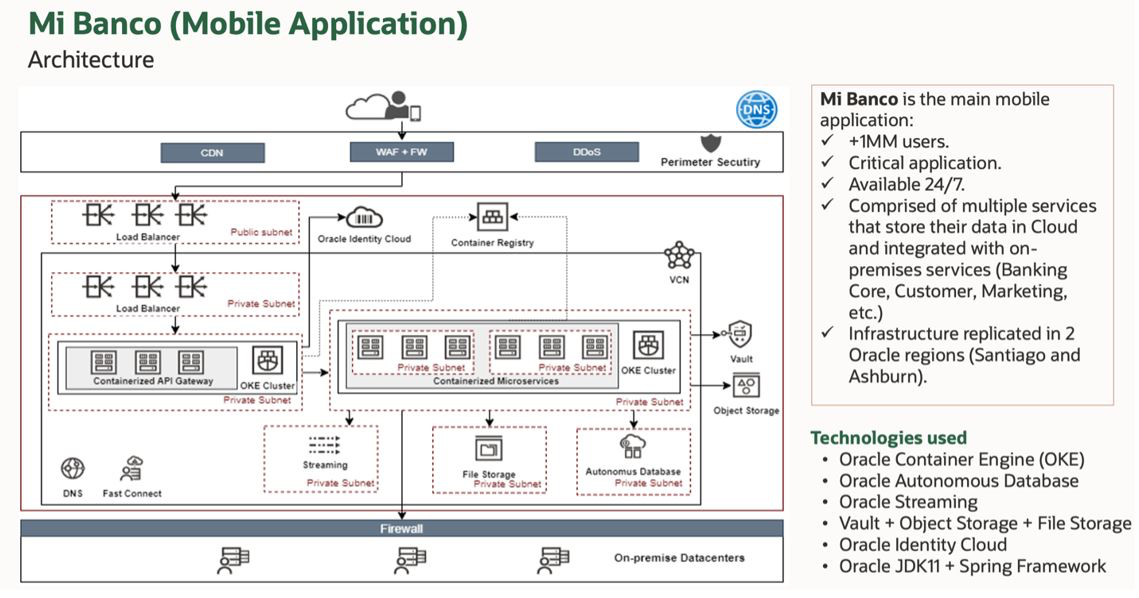
One of our enterprise customers, Banco de Chile, has built its mobile banking application (Mi Banco) applying the modern application development best practices on OCI. Mi Banco is its main mobile application to help drive its data transformation strategy, with over 1 million users replicated in two Oracle Cloud regions (Santiago and Ashburn) to guarantee high availability.

👁 high availability

Mi Banco is composed of around 33 microservices defined using a domain-driven design approach, offering many services to the clients like foreign currency exchange, credit card payments, billing payments, simulation and advancing of loans. Each microservice has its own autoscaling policies and allocated resources. Oracle Identity Cloud helps with user access, privilege and authorization.

Using this design, Banco de Chile improved the provisioning time by a thousand-fold, from months to minutes. By implementing continuous integration and delivery (CI/CD) pipelines for deployment of applications to Oracle Kubernetes Engine, it accelerated application delivery from months to a few days. Oracle Autonomous Database’s automatic upgrade and patching features have reduced the bank’s administration costs by 80%.

Oracle offers a wide range of technologies for building, testing, and maintaining applications in the cloud and in your data center. Find free tools and learning resources at oracle.com/developer
Learn More
The latest from Oracle

To learn more about this architecture, you can watch this video, where Leonel Romero at Banco de Chile explains how his team designed and architected this application.

You can advance and future-proof your career by learning OCI for free with our expert-created training and globally recognized certification program.

Oracle offers a wide range of technologies for building, testing, and maintaining applications in the cloud and in your data center. Find free tools and learning resources at oracle.com/developer
Learn More
The latest from Oracle
TRENDING STORIES
Manish Kapur is VP of Product and Solutions Marketing at Sonar, where he oversees go-to-market strategy and outbound product management for tools used by development teams to analyze, verify, and remediate code at scale. He has spent his career at...
Read more from Manish Kapur
Oracle sponsored this post.
SHARE THIS STORY
TRENDING STORIES
TNS owner Insight Partners is an investor in: Pragma.
SHARE THIS STORY
TRENDING STORIES
TNS DAILY NEWSLETTER Receive a free roundup of the most recent TNS articles in your inbox each day.
The New Stack does not sell your information or share it with unaffiliated third parties. By continuing, you agree to our Terms of Use and Privacy Policy.