|
VOOZH | about |
|
VOOZH | about |
We’re so glad you’re here. You can expect all the best TNS content to arrive Monday through Friday to keep you on top of the news and at the top of your game.
Check your inbox for a confirmation email where you can adjust your preferences and even join additional groups.
Follow TNS on your favorite social media networks.
Become a TNS follower on LinkedIn.
Check out the latest featured and trending stories while you wait for your first TNS newsletter.
I’ve been building websites for 25 years now, and the web industry in all that time has had a single refrain: “this is still too hard.” The better websites get, the higher everyone’s expectations of them become. This creates a constant pressure to simplify and accelerate our work, which in turn drives endless innovation in APIs, tools and frameworks. That same pressure produced the Jamstack, an architecture that marries improved performance with operational simplicity.
Earlier this year, Netlify ran its second annual Jamstack Community Survey and released the full results in October. While these do a great job of summing up the developer community’s current thoughts on Jamstack, they also show us what to expect from Jamstack development in 2022. The following are my predictions.
1. If you’re not already using Figma, you’ll probably start.
More than 60% of developers say they use Figma in the design stages of building sites. Figma also has a high satisfaction score, which is a ratio of people who say, “I want to use this more” vs. those who say, “I want to use this less.” Because Figma’s satisfaction score is high, you can expect to see more growth in the new year.
2. Strapi and Sanity will see big growth in usage.
In our look at content management systems, there were two standouts: Strapi and Sanity. Both showed strong growth in reported usage from 2020 to 2021, and both have high satisfaction scores, indicating further growth is in their future. Headless content management systems, in general, are showing more growth than classic content management systems like WordPress and Drupal, both of which shed users in 2021.
3. TypeScript will steal developer mindshare from JavaScript.
TypeScript has been growing steadily in popularity for years now, at the expense of vanilla JavaScript. Sixty percent of developers say they use TypeScript in 2021, and that’s up 14 percentage points from 2020. Plus, TypeScript has a stellar satisfaction score of 7.6.
Some smaller languages with high satisfaction scores are also likely to pick up usage in 2022: my picks from this data are Rust and Go.
4. Serverless functions hit the mainstream.
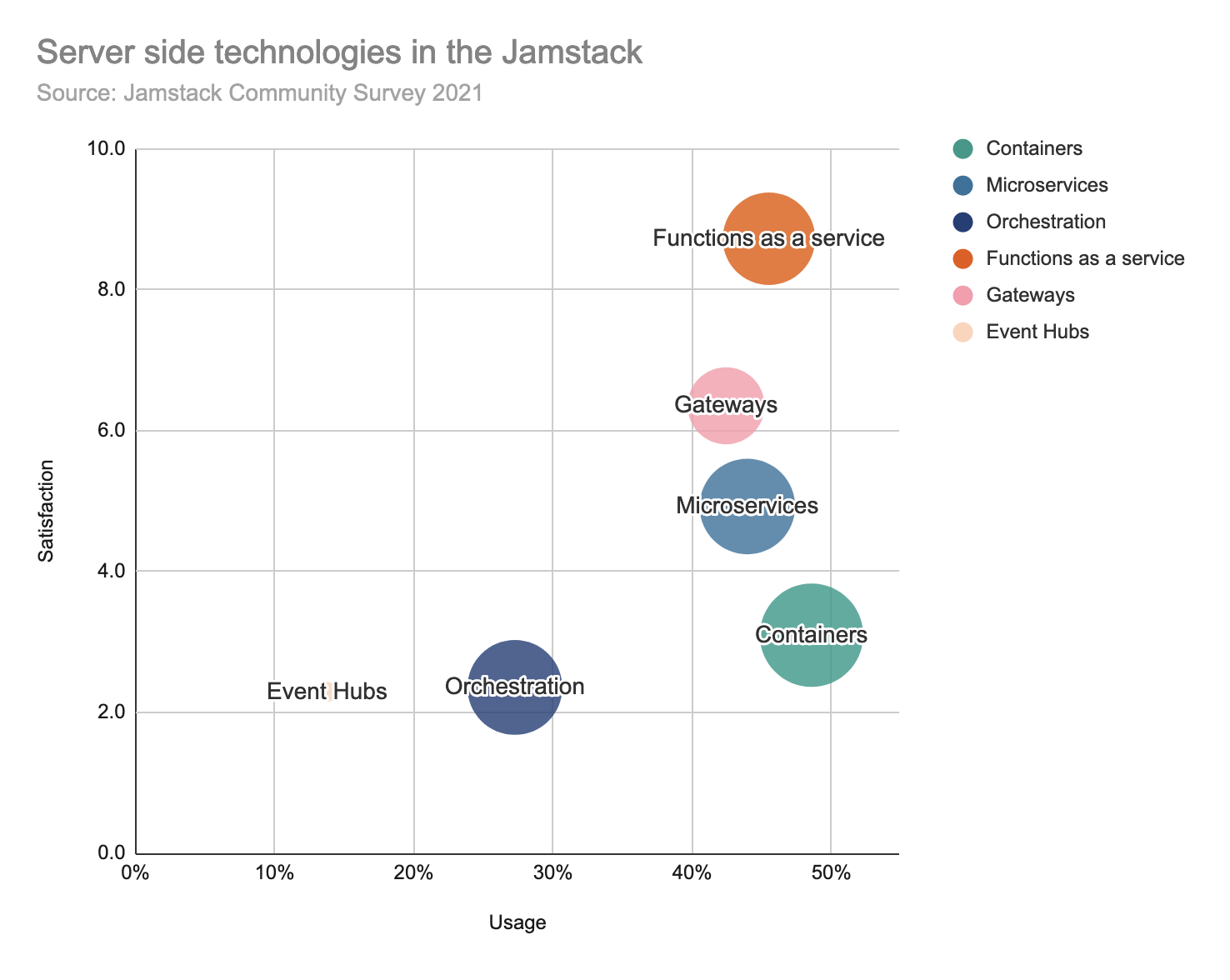
We didn’t ask about serverless functions in 2020, but a stunning 46% of developers reported that they are using serverless functions in at least some of their projects this past year. This makes serverless functions a solidly mainstream technique, up there with containers and microservices. With their enormous satisfaction score, developers appear to be delighted with the outcomes of using serverless functions, and I expect they will cross into greater than 50% usage in 2022.
5. Component libraries: React will stay number one, but more people will look at Svelte.
There are so many web framework options — and their uses so different — that we split them into three groups. The first is component libraries: all three have great satisfaction scores and solid usage. React remains the most popular, and I expect it’ll stay there in 2022 — however, I expect Svelte to see the most growth.
6. Static site generators: 2022, the year of 11ty?
Our second category of web frameworks is static site generators (SSGs). The category leader here is Gatsby.js, but my prediction for 2022 is a big leap forward from 11ty, which grew quickly since 2020 and also has an admirable satisfaction score.
7. Kitchen sink frameworks: Next.js will hold ground; Vite will gain fast.
“Kitchen sink” frameworks, for full-featured web apps, are a crowded category. Next.js, the most popular choice, is closely aligned with React. I expect React’s popularity to continue and Next.js to stay with it. Next.js saw usage growth in 2021 and still has an amazing 7.0 satisfaction score.
The only framework to beat Next.js for satisfaction is Vite, which I think will make a strong showing in 2022. If you’ve not played with it yet, this might be the year to check it out — especially since it plays nicely with all the major component libraries, including React, Vue and Svelte.
Apart from these specific predictions, my general view is that it’s going to be another great year to be a Jamstack developer. This architectural pattern has taken the web development world by storm and is fast becoming the default way new developers learn how to build sites, as shown by a big influx of students into the Jamstack developer population in 2021. I was pleased to see many of the trends Netlify observed echoed in other industry surveys, like last year’s State of JS and GitHub’s recent State of the Octoverse report. I’m excited to see what new tricks and tools 2022 brings to the Jamstack and hope that you are too.