|
VOOZH | about |
|
VOOZH | about |
We’re so glad you’re here. You can expect all the best TNS content to arrive Monday through Friday to keep you on top of the news and at the top of your game.
Check your inbox for a confirmation email where you can adjust your preferences and even join additional groups.
Follow TNS on your favorite social media networks.
Become a TNS follower on LinkedIn.
Check out the latest featured and trending stories while you wait for your first TNS newsletter.
Enterprises are facing an unprecedented wave of operational and security observability data. The data is complex, multidimensional and high velocity. Enterprises are consistently underestimating the scale and scope of data they need to support their operational and security observability platforms.
Steve Waterworth, while at Instana, ran an interesting experiment by creating a static workload for a very simple Kubernetes-based microservice application. He predicted total observability data would be less than 100 gigabytes of data over a 24-hour period, but it actually was over 400GB of data. And if you think about it, adding security data on top of operational datasets expands the total even more. Even small applications can generate a wave of data with high velocity and complexity.
So how can enterprises avoid drowning in data?
To paraphrase Nick Fury, enterprises can start by keeping both eyes open to understand the drivers of data growth and recognizing that the challenges they’ve been facing can be overcome.
Enterprises have to control their data plane, the interstitial layer between your data sources and your observability tooling, if they have any hope of managing costs and increasing the effectiveness of their observability strategy. The essence of observability is deriving deep insights into your data, which is nearly impossible if you have so much data that you cannot understand and process it efficiently.
The cost of an unmanaged data plane is substantial. Unmanaged observability data generates enormous costs for software licensing and storage, and it is a drain on engineering time that leads to opportunity costs.
There are three types of enterprises:
The first type of enterprises are a boon to vendors, but may not be doing themselves a favor since data quality has to be managed. These enterprises are effectively just logging a lot of potentially bad data, with no guarantee for better insight into said data.
The second type of enterprises are taking on enormous operations and security risks by choosing not to consume data into their operational and security observability platform. Given the way security issues are escalating, how much longer can accepting a weaker security posture be acceptable?
The third type of enterprise has the ability to control its data plane. It can manage all of its data and direct the right data to the right tool in the right format. It can remove useless data from the event stream and not sacrifice data quality. This enterprise does not have to accept the risk of not logging relevant data, and in fact, it can bring more use cases to its observability platform due to its ability to control its data plane.
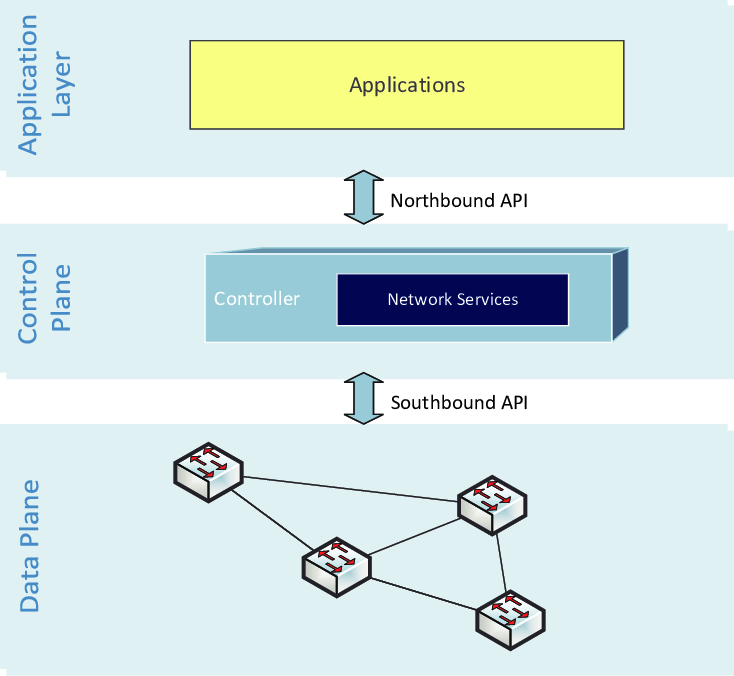
I briefly explained what a data plane is earlier: It’s the interstitial layer between your data sources and your observability tooling. But this illustration does a much better job:
More specifically, a data plane is the layer where raw data lives in its many forms. The velocity and complexity of data in this layer is daunting. Most observability vendors license their tools on data ingested or workload generated by this data. They have no motivation to help you manage the data plane, since it limits how much money they can make. Enterprises have to look outside their traditional platform vendors to get the right mix of capabilities, by either buying or building solutions.
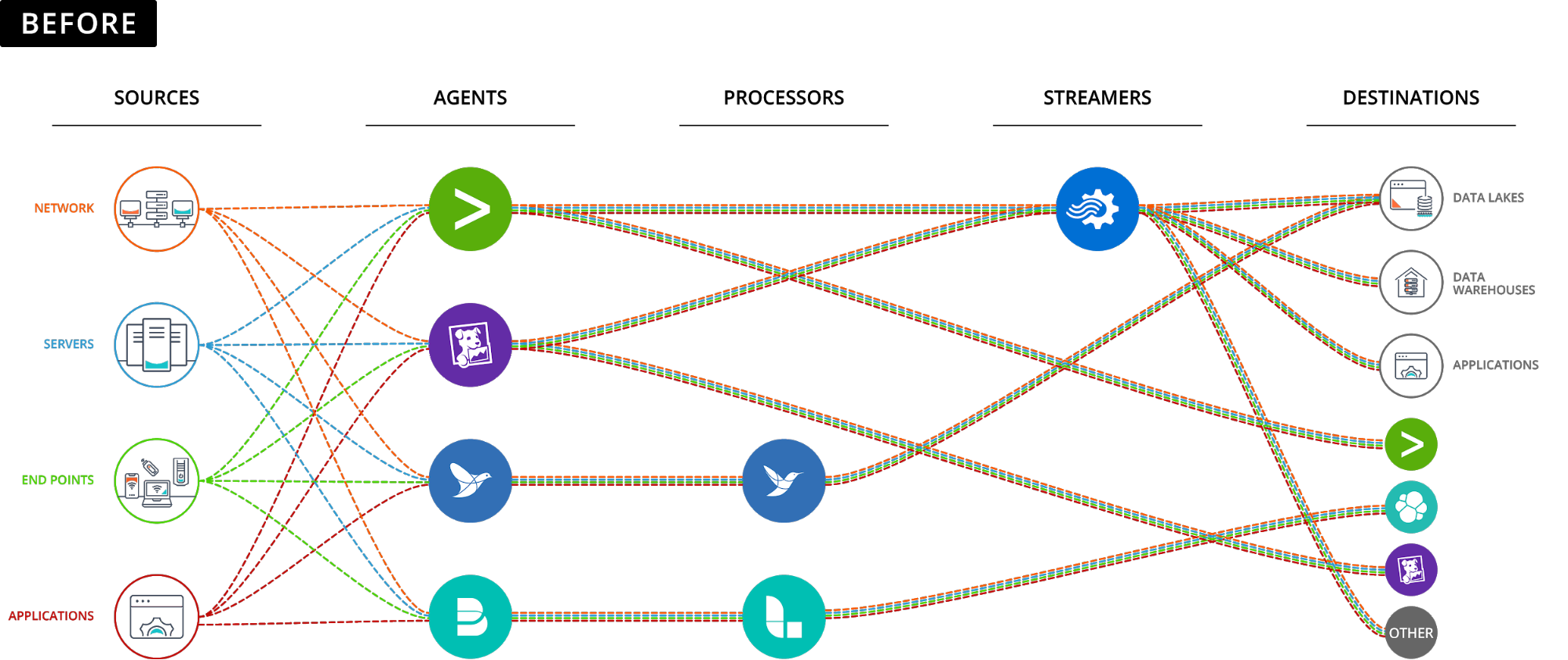
Here’s what the data plane looks like for most enterprises (yours too, probably):
An observability pipeline is a universal receiver and sender of data: It collects any and all data (e.g. metrics, events, logs, and traces), and then shapes and routes that data to where it’s needed most (e.g. from Elastic to Splunk to Exabeam) without re-training users or replacing any existing tooling.
An observability pipeline brings broad options for consuming data from numerous sources and transforming that data in real time into more efficient formats, which could include dropping fields, adding fields or condensing from one form (e.g. logs) into another form (e.g. events). Ultimately, observability pipelines put the enterprise in control of the data plane to get the best, most efficient results for its observability needs:
Once enterprises decide to invest in the observability pipeline, the next challenge to tackle is “build or buy?”
A good guiding question is, “Where do you want to invest your precious engineering time?” In highly standardized application stacks with limited formats, it can make sense to invest in a solution based on open source tools like Logstash and Kafka to manage your data, since complexity and the rate of change are lower.
However, be very careful to make sure that you allocate enough time to build integrations between your tools, your observability pipeline and your observability stack. For every custom integration, you will need to allocate time for updates, as tools evolve and security issues are discovered. This is a spiral that will eat up more and more engineering time. It certainly can be done successfully, but be aware of engineering time allocation and how it will grow over time.
Enterprises have to make the choice to either accept the current situation and drown in data, or adopt an observability pipeline to take control of your data to get the best, most efficient result from your operational and security observability solutions. Better data that costs less to manage will drive better operational and security outcomes across the enterprise.
One observability pipeline you can try out is Cribl’s free, hosted LogStream Sandbox (you don’t need to install anything and you’ll get a certificate of completion for each course). I’d love to hear your feedback; after you run through the sandbox, connect with me on LinkedIn, or join our community Slack and let’s talk about your experience!