VOOZH about

URL: https://thenewstack.io/the-exploding-endpoint-problem-why-everything-must-become-an-api/

⇱ The Exploding Endpoint Problem: Why Everything Must Become an API - The New Stack


TNS
SUBSCRIBE
Join our community of software engineering leaders and aspirational developers. Always stay in-the-know by getting the most important news and exclusive content delivered fresh to your inbox to learn more about at-scale software development.
REQUIRED
It seems that you've previously unsubscribed from our newsletter in the past. Click the button below to open the re-subscribe form in a new tab. When you're done, simply close that tab and continue with this form to complete your subscription.
The New Stack does not sell your information or share it with unaffiliated third parties. By continuing, you agree to our Terms of Use and Privacy Policy.
Welcome and thank you for joining The New Stack community!
Please answer a few simple questions to help us deliver the news and resources you are interested in.
REQUIRED
REQUIRED
REQUIRED
REQUIRED
REQUIRED
Great to meet you!
Tell us a bit about your job so we can cover the topics you find most relevant.
REQUIRED
REQUIRED
REQUIRED
REQUIRED
REQUIRED
Welcome!

We’re so glad you’re here. You can expect all the best TNS content to arrive Monday through Friday to keep you on top of the news and at the top of your game.

What’s next?

Check your inbox for a confirmation email where you can adjust your preferences and even join additional groups.

Follow TNS on your favorite social media networks.

Become a TNS follower on LinkedIn.

Check out the latest featured and trending stories while you wait for your first TNS newsletter.

PREV
1 of 2
NEXT
VOXPOP
As a JavaScript developer, what non-React tools do you use most often?
Angular
0%
Astro
0%
Svelte
0%
Vue.js
0%
Other
0%
I only use React
0%
I don't use JavaScript
0%
Thanks for your opinion! Subscribe below to get the final results, published exclusively in our TNS Update newsletter:
NEW! Try Stackie AI
From clobbered drafts to real-time sync
Apr 14th 2026 10:00am, by David Moore
TypeScript 6.0 RC arrives as a bridge to a faster future
Mar 14th 2026 9:00am, by Darryl K. Taft
Mastra empowers web devs to build AI agents in TypeScript
Jan 28th 2026 11:00am, by Loraine Lawson
2018-04-17 09:00:11
The Exploding Endpoint Problem: Why Everything Must Become an API
analysis,sponsor-wso2,sponsored,sponsored-post-contributed,

The Exploding Endpoint Problem: Why Everything Must Become an API

Apr 17th, 2018 9:00am by Tyler Jewell
👁 Featued image for: The Exploding Endpoint Problem: Why Everything Must Become an API
Feature image via Pixabay.
WSO2 sponsored this post.
Tyler Jewell, CEO, WSO2
Tyler is CEO of WSO2, the largest open source integration provider, and a partner at Toba Capital. He founded and ran Codenvy, a cloud DevOps company, which was acquired by Red Hat in 2017. As a venture investor, angel, and board member he's lead $100 million in placements for DevOps companies including WSO2, Cloudant (acquired by IBM), Sauce Labs, Sourcegraph, ZeroTurnaround (acquired by Rogewave), InfoQ, and AppHarbor (acquired by Microsoft). Previously, Tyler was at Oracle, Quest, MySQL, and BEA where he contributed to three books on Java.

The future consumer will expect to access all human knowledge and services on-demand, using devices that fit in their pocket, and all for the price of a meal. This requires a digital experience that can connect anything to anything and continuously adapt to changing data and services.

Quite simply, every future app may need an approach to Program the World, a way of connecting, accessing and controlling every digital and physical asset on the planet.

No one can envision what the next digital experience will be. But for it to exist, tomorrow’s programmers will require secure access to the world’s data and systems. We must enable every form of digital asset to become programmable, transforming everything into an Application Programming Interface (API). Everything must — and will — become an API.

Here are a few of the problems we must solve:

  1. Massive scale: There are billions of digital assets: legacy apps, SaaS apps, APIs, SDKs, IoT devices, databases and identities. Yet most of these assets are not yet accessible nor programmable.
  2. Data diversity: We are generating 2.5 quintillion bytes of new data a day, and this rate is accelerating exponentially. Most of this data is at rest, not accessible to apps-in-motion, and at best weakly accessible — with response times poorly suited to on-demand reactivity.
  3. Hapless heterogeneity: The discovery, access, interface, and format of APIs are not standardized leading to fragmentation of programming languages, frameworks and developer consumption models such as containers and serverless as a way to deal with complexity. It’s no wonder that 70% of IT managers have an IT skill gap in their organizations.
  4. Dizzying demand: Use is expected to dramatically increase as digitization of systems-of-record become the world’s future competitive advantage (see Andreesen’s Software is Eating the World). Global Internet users are growing 10% year-over-year to more than 3.5B (source: Mary Meeker 2017 Internet Trends report), and consumer usage shows solid growth with the average consumer spending 5.6 hours/day online (source: eMarketer 2008-2016).

When APIs are network accessible by others, they become an endpoint. Whether it is data, apps or serverless functions, everything is becoming a programmable endpoint.

Founded in 2005, WSO2 enables the composable enterprise. Our open source, API-first, and decentralized approach helps developers and architects to be more productive and rapidly build digital products to meet demand.
Learn More
The latest from WSO2

We already have billions of endpoints, and the growth is exponential. In 20 years, the world will have 100 million programmers; combined with vendor offerings that can create an API-on-demand for the duration of a single request, this is moving us toward a model where countless micro-endpoints are being deployed as part of everyday activities. And when developers can regularly create APIs and operate them on-demand with a minimal cost, the incentives to create even more endpoints by splitting tasks leads to an explosion of endpoints.

In less than 20 years, the world will grow from billions to more than 1 trillion programmable endpoints. We are facing an Exploding Endpoint Problem.

Almost all Enterprises Will Feel the Pain

The future apps we write will increasingly be programmed across these diverse (and sometimes short-lived) endpoints. The resilient communication between endpoints is the discipline of integration. It isn’t easy. Challenges include financial compensation (for those who build the endpoints), transaction management and event sequencing (between endpoints), circuit breakers (governing endpoint use), service discovery and protocol handling (of new endpoints) and service mediation (across systems of endpoints). These are hard problems that every software project must address when they leverage even a few endpoints.

Today, there are scant efforts to standardize how endpoints are managed. Instead, the API integration market is fragmenting, creating integration problems that will be an order of magnitude larger than programmers experience today.

This exploding endpoint problem increases the challenges for enterprises, which are struggling to keep up with line-of-business needs, supplier integration, market intelligence, system integration from M&A and the enablement of locked assets as they strive to become a digital native organization and live up to Andreesen’s software-eating-the-world vision.

The primary causes of this pain include:

  1. Most enterprise digital assets are still inaccessible, tied-up into large monolithic applications- and have not yet been converted into programmable endpoints.
  2. The types of assets to convert into endpoints have fragmented, driven by IoT device diversity, by every custom application having a unique API, and by the NoSQL movement enabling data schema variety.
  3. Integration vendors that promise solutions have failed to consider the diversity, dynamism and heterogeneity of the problem — and ultimately deliver integration offerings that are not resilient nor easily substitutable.
  4. Digital asset governance is statically-driven, not designed around real-time surveillance, ensuring change control becomes unpopular and costly. It is always multiple steps behind the fast-moving reality.
  5. The splitting of tasks into numerous micro-endpoints is leading the industry to the rise of cross-cloud integration: the need to write resilient transactions over a network that spans multiple endpoints. There are hundreds of programming frameworks that offer to simplify this problem, but all still require solutions that include custom logic, hidden edge cases and painful hours of debugging.
  6. Service desk and monitoring-driven SLAs are lowering their debugging value as IT learns that observing digital assets at rest cannot pinpoint root causes. A rethink is underway as Application Performance Management (APM) vendors race to disrupt themselves by replacing monitoring with full-stack, transaction-in-motion observability.

Increasing Demand Is Resulting in Disaggregation

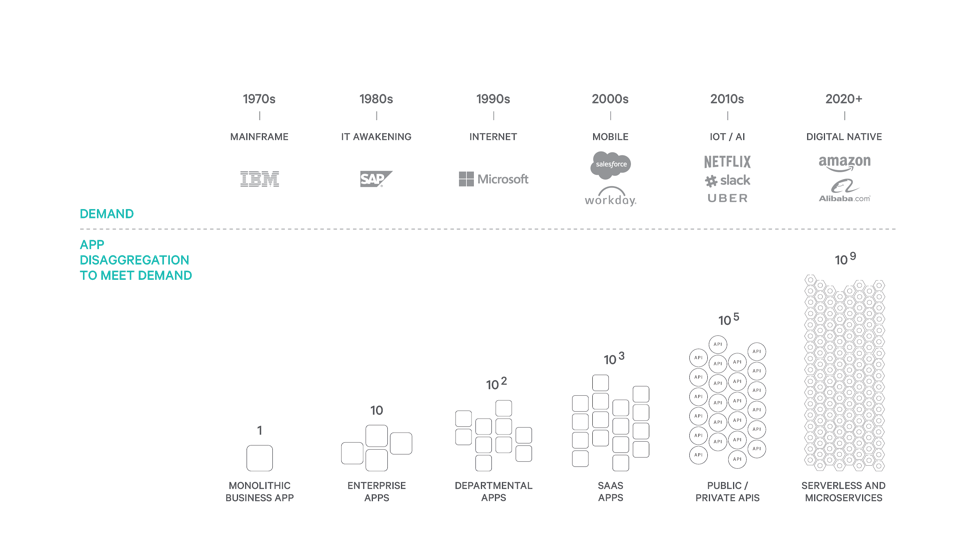
Rarely is building large monolithic applications ever considered anymore, since they’re widely recognized as fragile, high-maintenance and prone to scalability issues. Instead, massive customer demand has led to the rise of companies like Google, Uber and Amazon that have instead architected disaggregated, componentized systems to scale to meet customer demand.

👁 Image

This is a continuation of a trend that we have seen over five decades. Massively disaggregated approaches including microservices, serverless and APIs are simply becoming the norm for software design. It is now common belief that application disaggregation is the only way to maintain rapid market agility with unlimited scalability. In fact, developers are embracing this disaggregation by being API-first, with enterprises doubling internal endpoint count every 18 months.

Integration Is Suddenly the Hottest Market

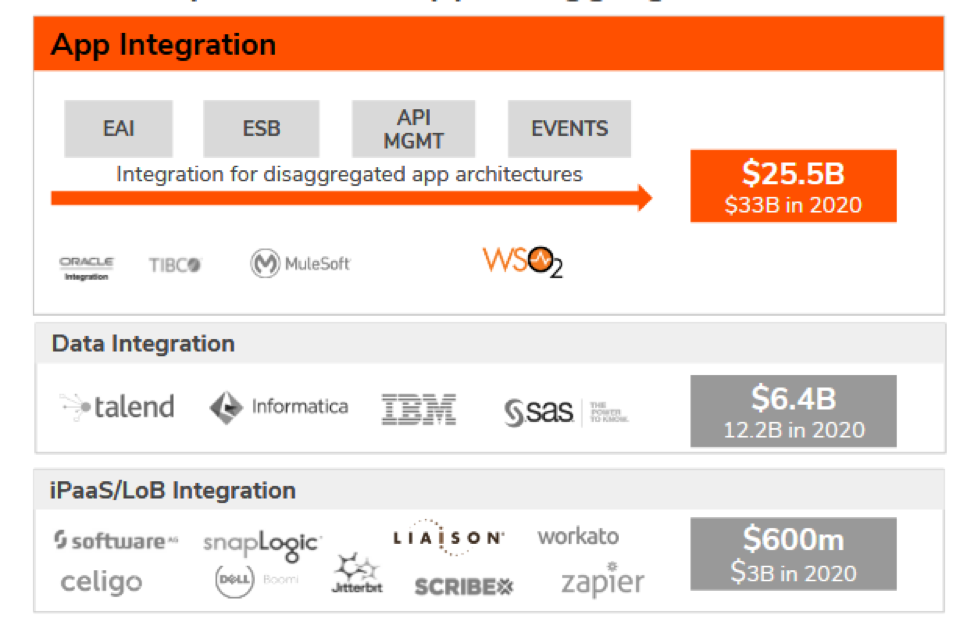
The application integration market is massive at nearly $25 billion in software and services sold each year. As disaggregated architectures drive the increase in programmable endpoints, integration will become a problem for every organization and every developer.

👁 Image

After Salesforce acquired Mulesoft for a whopping $6.5 billion earlier this year, Gartner’s VP and Fellow, Massimo Pezzini said, “Integration, the reportedly uncoolest thing in IT, ultimately turns out to be the hottest!”

Open Source Solutions Are Essential for Integrating Disaggregated Architectures

With the ever-growing diversity of integrating endpoints, open source software and vendors are the only viable way to ensure technology keeps pace with market needs.

Closed source, open core, and iPaaS vendors are not equipped to embrace this challenge. The protocols, data formats and APIs of endpoints change so frequently that only a community, collaboration, and shared approach available through open source can address the future needs of integrators.

Open source helps customers and community contributors to engage more deeply — and ultimately maximize integration solutions and overall value over disaggregation. Open source can be more reactive allowing rapid introduction of new technologies to connect more diverse digital assets to reach even more developers.


Founded in 2005, WSO2 enables the composable enterprise. Our open source, API-first, and decentralized approach helps developers and architects to be more productive and rapidly build digital products to meet demand.
Learn More
The latest from WSO2
TRENDING STORIES
Tyler Jewell (Akka CEO) is a 4-time DevEx CEO previously leading WSO2, Codenvy (acq. by RedHat), and The Middleware Company (acq. by TechTarget). He publishes the Developer-Led Landscape, a public database of 1600 DevOps companies and their trends. Tyler is...
Read more from Tyler Jewell
WSO2 sponsored this post.
SHARE THIS STORY
TRENDING STORIES
TNS owner Insight Partners is an investor in: Sourcegraph, Pragma.
SHARE THIS STORY
TRENDING STORIES
TNS DAILY NEWSLETTER Receive a free roundup of the most recent TNS articles in your inbox each day.
The New Stack does not sell your information or share it with unaffiliated third parties. By continuing, you agree to our Terms of Use and Privacy Policy.