|
VOOZH | about |
|
VOOZH | about |
Guinea is doing everything in its power to ensure satisfactory and equitable electricity coverage, necessary both to meet the needs of households and industries, which is largely powered by hydroelectric energy.
The West African country has traditionally relied on the Souapiti and Kaléta dams, which account for no less than 80% of national electricity production.
The remaining 20% has presented both a challenge and an opportunity for the alternative energy market and its public and private stakeholders.
ZePowerNet, a startup founded in France by Mamadou Misbaou Barry, has moved to create a solar energy market that enables people to produce or sell their own solar energy by leveraging both technical and technological infrastructure.
Improved supply
While the electricity supply in Guinea has improved considerably in recent years, with overall access ranging from 30% to 50% and nearly full coverage in urban areas, it is important to remember that during Mamadou’s childhood, and that of millions of other Guineans, the supply was so limited that some considered electricity a luxury.
It was therefore sometimes by the light of a kerosene-powered lamp that Mamadou had to study his lessons in the evening to secure his future through education.
And as if fate had been at work, after completing his schooling in Guinea, he began and completed his university education in France in the fields of mathematics, physics, computer science and financial markets.
This journey and this wealth of knowledge have made him perfectly equipped to provide solutions to one of the problems that plagued his childhood.
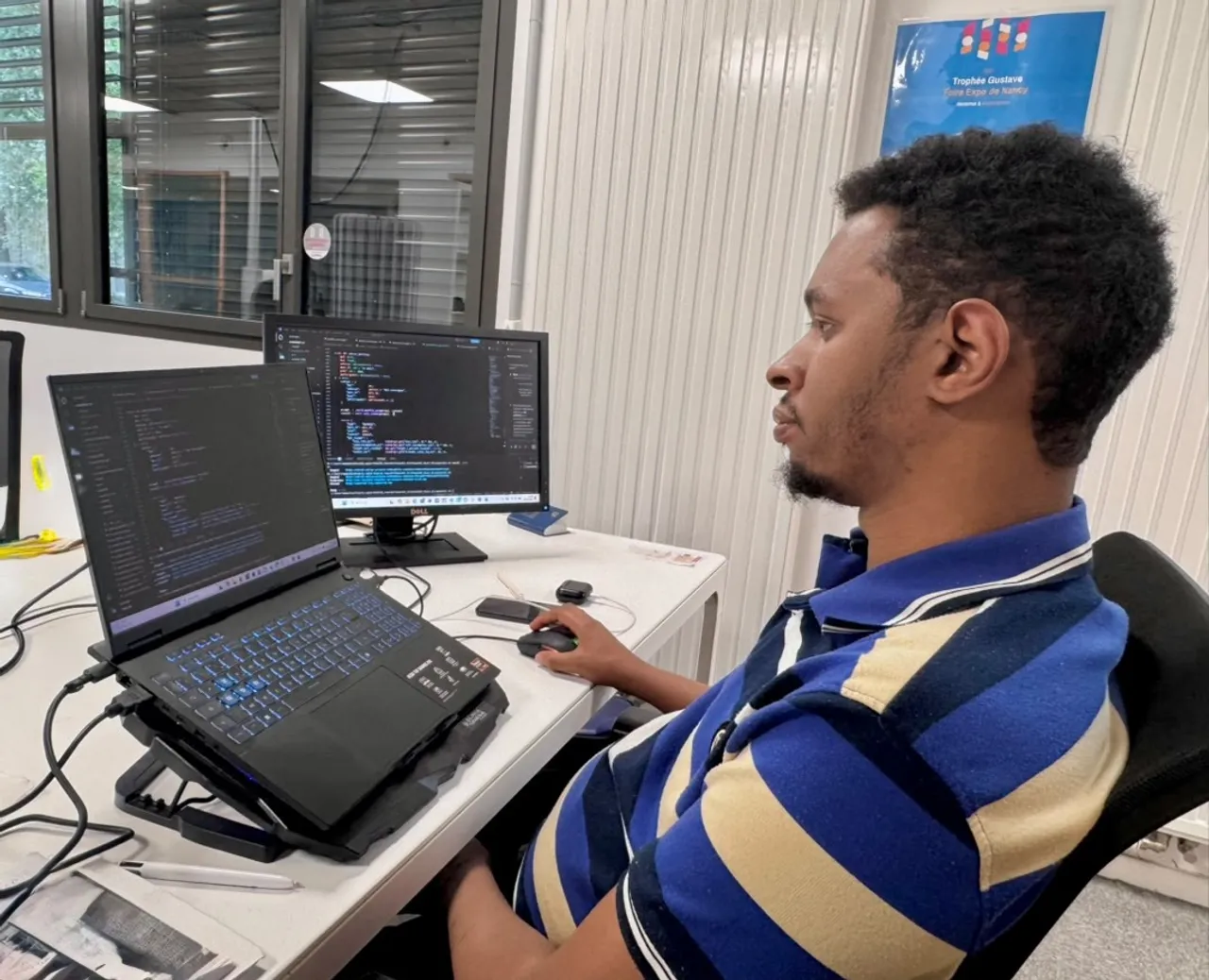
"Today I am a tech and social entrepreneur. After completing my university studies, I earned the Student-Entrepreneur diploma from Pépite PeeL, the national support program for young entrepreneurs in France, with the help of scholarships that enabled me to move forward. Mathematics has always been much more than just an academic subject to me. It is a universal language for understanding and modeling the world, and that is exactly what I am doing today with ZePowerNet," Mamadou tells TRT Afrika.
Solar power producers
The ZePowerNet project, led by Mamadou, was launched in 2023. It involves setting up a network of solar power producers, bringing them together on a smart platform, and creating a marketplace that manages, buys, or sells their solar energy.
“The initial idea was radical: to democratize access to electricity by allowing people to share their solar energy just as we share data on the Internet. No need to be an expert. No need for a large infrastructure,” Mamadou confirms.
Before considering rolling out this solution in his native Guinea, Mamadou put his idea into practice in France by developing technological tools such as HIRO - an artificial intelligence system that maps an energy loop in just a few minutes and identifies the best participants based on their real-time consumption profiles.
"It is HIRO that brings our vision to life: sending electricity just as we send data—intelligently, optimally, and automatically. The results are measurable: energy losses drop from over 20% in the current market to less than 5% with HIRO. Producers earn 10 to 15% in additional revenue. And managing a loop that used to take two hours a week now takes only 30 minutes a month," explains the Guinean entrepreneur.
Hiro's impressive performance has paid off commercially, with the development of new leads that has boosted ZePowerNet's credibility.
Booming market
In three years, the startup has increased the number of its partnerships in a booming market. In just one year, the number of active energy communities in France has grown by 144%, creating an attractive, active, eco-friendly, and profitable market for producers.
It is therefore this same model that Mamadou plans to implement in Guinea.
"Our vision for Guinea is concrete: to adapt ZePowerNet to local realities so that entire neighborhoods, rural communities, and small businesses can share clean, affordable solar energy. No need for a national grid. No need for large centralised infrastructure. Just solar panels, neighbors, and artificial intelligence to orchestrate it all.”
“That’s exactly what I imagined as a child, without knowing that I would one day build it,” says Mamadou, visibly moved and proud.
To adapt this project, which requires a number of technological prerequisites, to the tropical climate, Mamadou and his team are motivated by the advantages of the other side of the coin, which make Africa fertile ground for ZePowerNet.
Year-round sunshine
Guinea naturally enjoys some of the most enviable sunshine in the world, with over 2,000 hours of sunshine per year. Guinea has an internet penetration rate of 33% of the population.
Guinea has also recently committed to investing in the solar sector, as exemplified by the “84 MW project,” which calls for the construction of two photovoltaic (solar) power plants in the Kankan and Siguiri regions of Upper Guinea by 2030. This project aims to provide power to more than 360,000 families.
The other side of the coin—the project’s opportunities and challenges—is taken into account by the entrepreneur, who seems motivated to move forward and take the time needed to establish his project in Guinea.
“The challenges are just as real. Grid infrastructure is still limited in certain areas, which requires us to adapt our solutions to operate with reduced connectivity. The energy regulatory framework is still under development, which creates uncertainty. Access to local financing for tech startups remains difficult. And there is a real need for awareness-raising and education to guide communities toward these new solutions. But these challenges do not hold us back. They define our roadmap. And they remind us why this work is necessary."
For ZepowerNet, in Africa, Guinea and its four major regions are just the starting point for a much broader ambition. The entire West African region is in its sights.