



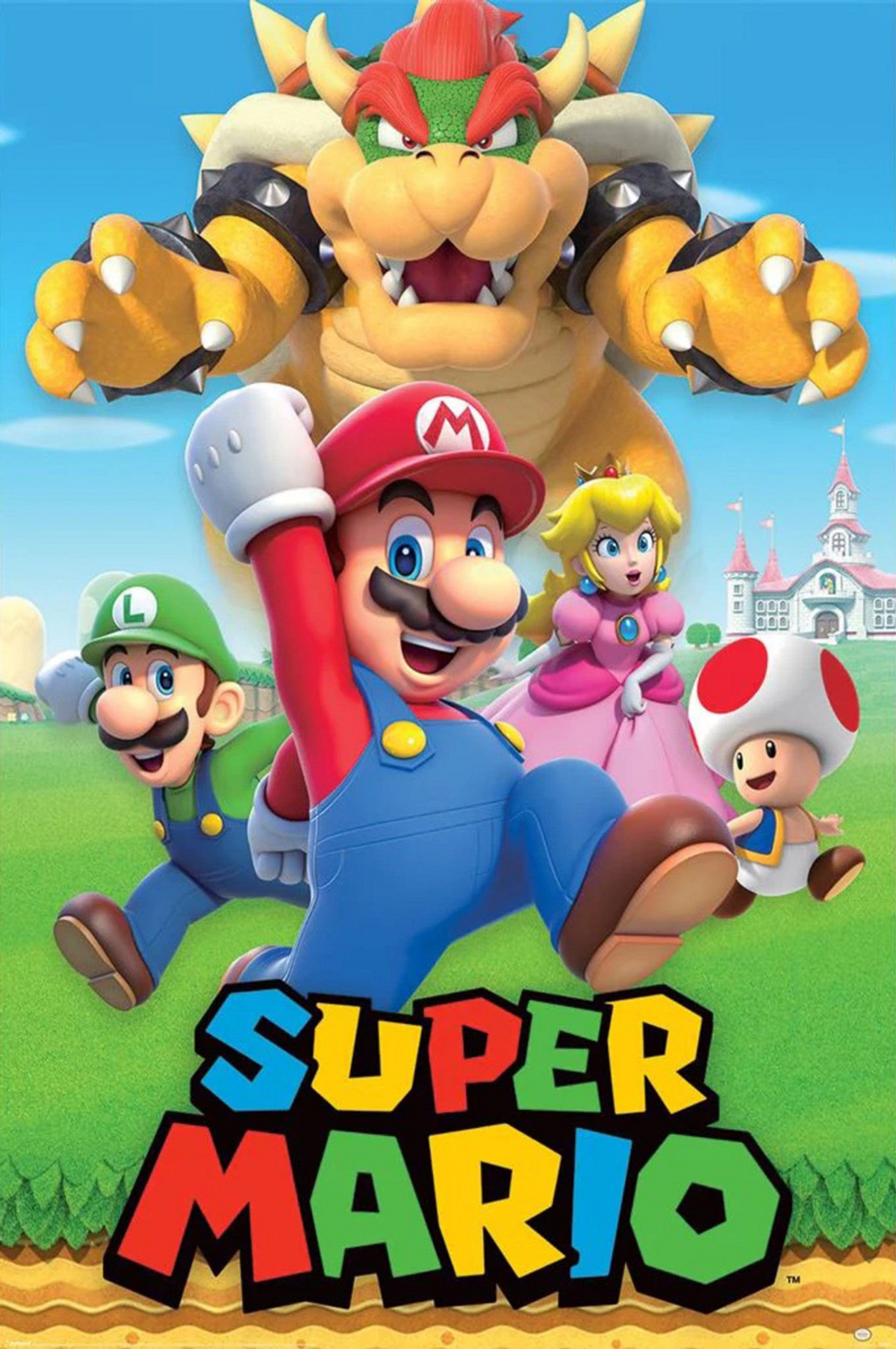
The centerpiece of Nintendo's gaming empire and one of the (if not the) biggest and most successful video game franchises to date, to the extent where its main character is often more recognizable to American children than Mickey Mouse himself. Created by Shigeru Miyamoto with the help of Takashi Tezuka, the Super Mario Bros. series (also called the Super Mario (despite normally referring to the platformer series) series or just the Mario series) both popularized and crystallized the Platform Game.
The story of the Mario Brothers begins not in their own game, but in Donkey Kong. In that game, a certain mustachioed carpenter was charged to rescue his beautiful girlfriend Lady (later renamed Pauline) from a rampaging ape. The player character was not named in Japanese materials, but the tentative name "Jumpman" had been given for use in Nintendo of America's localization. During production of the overseas release, Nintendo of America had a suspenders-wearing Italian American named Mario Segale👁 Image
as landlord of one of their warehouses. President Minoru Arakawa and Don James thought it would be funny to name the character after him, thus creating the name and nationality of Mario.

The sequel, Donkey Kong Junior, has Mario as the antagonist, from whom the captured Donkey Kong must be rescued. This would be the only title to give Mario a villainous role.
Mario was joined by his brother, Luigi, for their own game, Mario Bros., in which the brothers, having taken up plumbing, fought an infinite number of turtles and other pests issued from a number of pipes.
All this led to the game which more or less defined the entire Nintendo product line: Super Mario Bros. 1. The story, which would recur countless times through the franchise, was simple enough: Bowser, a giant fire-breathing Turtle Dragon Ox Dinosaur and King of the Koopas, kidnaps Princess Toadstool of the Mushroom Kingdom (who would revert to her Japanese name, Peach, from Super Mario 64 onwards). Mario and Luigi must fight their way through a number of obstacles to face Bowser and rescue the princess. The formula has become codified to the point that the deliberate and highlighted trope subversions in spin-offs have themselves became tropes.
Since then, Mario has become Nintendo's main mascot and their most prolific character, branching out from platformers into Mascot Racers, sports titles, role-playing games, and more. Along the way, he's picked up more friends like his dinosaur buddy Yoshi and Anti-Hero doppelgänger Wario, who along with Luigi and Peach have spun off successful games of their own. And courtesy of Rareware, Donkey Kong ended up with a Retool in the form of the popular Donkey Kong Country games, starring the original Donkey Kong's (now known as Cranky Kong) grandson, also named Donkey Kong, along with the latter's nephew, Diddy Kong. Unlike the Wario and Donkey Kong games, the Yoshi games are less of an official spin-off, and more of a franchise that more or less exists within the same Shared Universe as Mario.
Of course, Mario hasn't completely limited himself to the realm of video games. Donkey Kong, featuring the titular ape and Mario, was one of the main recurring segments in the Saturday morning cartoon show, Saturday Supercade, in which Donkey Kong was a performer in a circus owned by Mario, but he ran away and Mario pursues him to bring him back. More significantly, Mario and Luigi appeared in The Super Mario Bros. Super Show!, with live-action linking segments featuring the brothers as plumbers in Brooklyn and cartoons that showed them in the world of the games. The secondary Theme Song for the cartoons explains that they "found the secret Warp Zone while working on the drain" which is how they got to the Mushroom Kingdom from Brooklyn. Interestingly, there has never been a show made of it in the country of origin, aside from the obscure theatrical anime The Great Mission to Save Princess Peach!. There was also a live-action motion picture, where Bob Hoskins and John Leguizamo as the titular brothers faced off against Dennis Hopper as Koopa, a hyperevolved dinosaur from Another Dimension, intent on joining his own, mostly desolate world with ours. In addition, Super Mario Bros. 3 was notable for being previewed in the Fred Savage film The Wizard, whose climactic scene involved an autistic child playing several levels of the game in a competition. Following this however, Mario hasn't seen a major appearance outside of video games until it was announced in 2018 that Nintendo would be collaborating with Illumination Entertainment to produce an All-CGI Cartoon film adaptation. The collaboration led to The Super Mario Bros. Movie, which was released on April 5, 2023. The movie would later go on to get a sequel adapting the Super Mario Galaxy duology, aptly titled The Super Mario Galaxy Movie which is scheduled to release in the U.S. and most other regions on April 1, 2026 and in Japan on April 24, 2026.
In addition to the major games, Mario has appeared in dozens of other Nintendo games, including a random appearance as referee in the NES Punch-Out!! and as a painting in The Legend of Zelda: A Link to the Past and has appeared on every Nintendo platform (except the Pokémon Mini and Color TV Game), including the ill-fated Virtual Boy (in Mario's Tennis and Mario Clash).
The series has contributed the following games:
Main Series
- Super Mario Bros. 1 (1985, NES)
- All Night Nippon Super Mario Bros. (1986, NES; License-Added Game by Fuji TV)
- Super Mario Bros. Deluxe (1999, Game Boy Color, enhanced port of Super Mario Bros. and The Lost Levels)
- NES Classics Series: Super Mario Bros. (2004, Game Boy Advance, emulated re-release of Super Mario Bros. as part of the Classic NES Series)
- Super Mario Bros.: The Lost Levels (1986, Family Computer Disk Systemnote Known as Super Mario Bros. 2 in Japanese)
- Super Mario Bros. Special (1986, PC-8801, Sharp X1; Japan and Korea only)
- Super Mario Bros. 2 (1988, NESnote Dolled-Up Installment of Yume Kōjō: Doki Doki Panic; 👁 This example contains a TRIVIA entry. It should be moved to the TRIVIA tab.
returned to Japan in 1992 as Super Mario USA) - Super Mario Bros. 3 (1988, NES)
- Super Mario Land series
- Super Mario Land (1989, Game Boy)
- Super Mario Land 2 - 6 Golden Coins (1992, Game Boy)
- Wario Land: Super Mario Land 3 (1994, Game Boynote branches into the Wario series here)
- Super Mario World (1990, SNESnote Carries the subtitle Super Mario Bros. 4 in Japanese)
- Super Mario All-Stars (1993, SNES, Compilation Re-release and Video Game Remake of all four mainline NES gamesnote Namely, Super Mario Bros., Super Mario Bros. 2, Super Mario Bros. 3, and The Lost Levels which was unreleased outside of Japan at the time.)
- Super Mario All-Stars + Super Mario World (1994, SNES; a later version that also included Super Mario World)
- BS Super Mario USA (1996, SNES, remake/sequel to the All-Stars version of Super Mario Bros. 2 released for the Satellaview Add-on)
- Super Mario All-Stars: Limited Edition (2010, Wii port of original version as a 👁 This example contains a TRIVIA entry. It should be moved to the TRIVIA tab.
Milestone Celebration)
- Super Mario World 2: Yoshi's Island (1995, SNESnote branches into the Yoshi series here; 👁 This example contains a TRIVIA entry. It should be moved to the TRIVIA tab.
wasn't labelled as SMW's sequel in Japanese) - Super Mario Advance series (2001-2003, Game Boy Advance, enhanced ports and remakes of various games, all of which include a version of Mario Bros.)
- Super Mario Advance (2001, Super Mario Bros. 2)
- Super Mario World: Super Mario Advance 2 (2001)
- Yoshi's Island: Super Mario Advance 3 (2002)
- Super Mario Advance 4: Super Mario Bros. 3 (2003)

- New Super Mario Bros. series
- New Super Mario Bros. (2006, Nintendo DS)
- New Super Mario Bros. Wii (2009, Wii)
- New Super Mario Bros. 2 (2012, Nintendo 3DS)
- New Super Mario Bros. 2: Gold Edition (2014, Nintendo 3DSnote Digital-only Updated Re-release with all DLC included, briefly available for free to 3DS LL owners in Japan, and pre-installed in special edition 3DS XL and 2DS units overseas; known as New Super Mario Bros. 2: Special Edition in Europe)
- New Super Mario Bros. U (2012, Wii U)
- New Super Luigi U (2013, Wii Unote as Downloadable Content for NSMBU, a standalone disc, and eventually a Compilation Re-release with New Super Mario Bros. U)
- New Super Mario Bros. U Deluxe (2019, Updated Re-release for Nintendo Switch which also includes New Super Luigi U)
- Super Mario Run (2016, Mobile Phone Game)note 2016 for Apple devices, 2017 for Android
- Super Mario Maker series
- Super Mario Maker (2015, Wii U)note A level editor where you get to make and play your own levels in the styles of Super Mario Bros. 1 & 3, Super Mario World, and New Super Mario Bros. U.
- Super Mario Maker for Nintendo 3DS (2016, Nintendo 3DS)
- Super Mario Maker 2 (2019, Nintendo Switch)note This sequel includes more features, multiplayer support, and allows you to create 2D levels in the style of Super Mario 3D World as well.
- Super Mario Maker (2015, Wii U)note A level editor where you get to make and play your own levels in the styles of Super Mario Bros. 1 & 3, Super Mario World, and New Super Mario Bros. U.
- Super Mario Bros. Wonder (2023, Nintendo Switch)
- Super Mario Bros. Wonder Nintendo Switch 2 Edition + Meetup in Bellabel Park (2026, Updated Re-release for Nintendo Switch 2)
- Super Mario 64 (1996, Nintendo 64)
- Super Mario Sunshine (2002, Nintendo GameCube)
- Super Mario Galaxy (2007, Wii)
- Super Mario Galaxy 2 (2010, Wii)
- Super Mario 3D Land (2011, Nintendo 3DS)
- Super Mario 3D World (2013, Wii U)
- Super Mario 3D World + Bowser's Fury (2021, Updated Re-release for Nintendo Switch)
- Super Mario Odyssey (2017, Nintendo Switch)
- Super Mario 3D All-Stars (2020, Nintendo Switch, Compilation Re-release and Slightly Updated Re-release of Super Mario 64, Sunshine, and Galaxy)
Spin-offs
- Donkey Kong (Arcade)
- Donkey Kong Junior (Arcade)
- Donkey Kong 3 (Arcade)
- Donkey Kong (Game Boy)
- Donkey Kong Country series (SNES onward)
- Mario vs. Donkey Kong series (GBA onward)
- Mario vs. Donkey Kong (2004)
- Mario vs. Donkey Kong (2024): Remake of the first game.
- Mario vs. Donkey Kong 2: March of the Minis (2006)
- Mario vs. Donkey Kong: Minis March Again!'' (2009)
- Mario vs. Donkey Kong: Mini-Land Mayhem! (2010)
- Mario and Donkey Kong: Minis on the Move (2013)
- Mario vs. Donkey Kong: Tipping Stars (2015)
- Mini Mario & Friends: amiibo Challenge (2016)
- Mario vs. Donkey Kong (2004)
- See also the Donkey Kong franchise page for all Donkey Kong games
- Dr. Mario (NES / Game Boy onward)
- Tetris & Dr. Mario
- Dr. Mario 64
- Nintendo Puzzle Collection
- Dr. Mario & Puzzle League
- Dr. Mario Online RX
- Dr. Mario Express
- Dr. Luigi
- Dr. Mario: Miracle Cure
- Dr. Mario World
- Yoshi (aka Yoshi's Egg in Japanese and Mario & Yoshi in Europe and Australia; NES / Game Boy)
- Yoshi's Cookie (NES / Game Boy)
- Yoshi no Cookie: Kuruppon Oven de Cookie (SFC; Japan only)
- Mario & Wario (SFC; Japan only)
- Mario's Picross (Game Boynote with SNES and Game Boy sequels in Japan; later Picross titles dropped the Mario branding)
- Tetris Attack (SNES / Game Boynote Dolled-Up Installment of Panel de Pon (aka Puzzle League) themed on Yoshi's Island)
- Yakuman DS (Nintendo DS)
- Puzzle & Dragons Super Mario Bros. Edition (Nintendo 3DS; Crossover with Puzzle & Dragons)
- Super Mario RPG: Legend of the Seven Stars (1996, SNES, remade in 2023 for Nintendo Switch)
- Paper Mario seriesnote Starting with Super Paper Mario, the series shifted to action-adventure platforming with RPG Elements
- Paper Mario 64 (2000, Nintendo 64)
- Paper Mario: The Thousand-Year Door (2004, Nintendo GameCube, remade in 2024 for Nintendo Switch)
- Super Paper Mario (2007, Wii)
- Paper Mario: Sticker Star (2012, Nintendo 3DS)
- Paper Mario: Color Splash (2016, Wii U)
- Paper Mario: The Origami King (2020, Nintendo Switch)
- Mario & Luigi series
- Mario & Luigi: Superstar Saga (2003, GBA, remade in 2017 for Nintendo 3DS)
- Minion Quest: The Search for Bowser (a bonus mode in the Nintendo 3DS remake)
- Mario & Luigi: Partners in Time (2005, Nintendo DS)
- Mario & Luigi: Bowser's Inside Story (2009, Nintendo DS, remade in 2018 for Nintendo 3DS)
- Bowser Jr.'s Journey (a bonus mode in the Nintendo 3DS remake)
- Mario & Luigi: Dream Team (2013, Nintendo 3DS)
- Mario & Luigi: Paper Jam (2015, Nintendo 3DS; Crossover with the Paper Mario series)
- Mario & Luigi: Brothership (2024, Nintendo Switch)
- Mario & Luigi: Superstar Saga (2003, GBA, remade in 2017 for Nintendo 3DS)
- Mario Kart series (SNES onward)
- Mario Tennis series
- Mario's Tennis (Virtual Boy)
- Mario Tennis 64 (Nintendo 64)
- Mario Tennis GB (Game Boy Color)
- Mario Power Tennis (Nintendo GameCube)
- Mario Tennis Power Tour (Game Boy Advance)
- Mario Tennis Open (Nintendo 3DS)
- Mario Tennis: Ultra Smash (Wii U)
- Mario Tennis Aces (Nintendo Switch)
- Mario Tennis Fever (Nintendo Switch 2)
- Mario Golf series
- NES Open Tournament Golf (NES)
- Mario Golf 64 (Nintendo 64)
- Mario Golf GB (Game Boy Color)
- Mobile Golf (Game Boy Color, Japan only)
- Mario Golf: Toadstool Tour (Nintendo GameCube)
- Mario Golf: Advance Tour (Game Boy Advance)
- Mario Golf: World Tour (Nintendo 3DS)
- Mario Golf: Super Rush (Nintendo Switch)
- Mario Baseball series
- Mario Strikers series (soccer)
- Super Mario Strikers (aka Mario Smash Football in Europe; Nintendo GameCube)
- Mario Strikers Charged (aka Mario Strikers Charged Football in Europe; Wii)
- Mario Strikers: Battle League (Nintendo Switch)
- Mario Hoops 3-on-3 (aka Mario Slam Basketball in Europe; Nintendo DS)
- Mario & Sonic at the Olympic Games series (Wii onward; Crossover with Sonic the Hedgehog and the Olympic Games license)
- Mario & Sonic at the Olympic Games (Beijing 2008) (DS and Wii)
- Mario & Sonic at the Olympic Winter Games (Vancouver 2010) (DS and Wii)
- Mario & Sonic at the London 2012 Olympic Games (3DS and Wii)
- Mario & Sonic at the Sochi 2014 Olympic Winter Games (Wii U; most recent game for the Winter Olympics)
- Mario & Sonic at the Rio 2016 Olympic Games (Arcade, Wii U and 3DS)
- Mario & Sonic at the Olympic Games Tokyo 2020 (Arcade and Nintendo Switch; most recent game for the Summer Olympics)
- Mario Sports Mix (Wii; includes volleyball, basketball, dodgeball, and hockey)
- Mario Sports Superstars (Nintendo 3DS; includes soccer, baseball, tennis, golf, and horse racing)
- Mario Bros. (Arcade)
- Yoshi's Island series (SNES onward)
- Wario series
- Wario Land series (Game Boy onward)
- Wario World (Nintendo GameCube)
- Wario: Master of Disguise (Nintendo DS)
- Super Princess Peach (Nintendo DS)
- Super Mario Bros. 35 (Nintendo Switch)
- Game & Watch (Game & Watch)
- Donkey Kong
- Donkey Kong Jr.
- Mario Bros.
- Super Mario Bros.
- Mario the Juggler
- Game & Watch Gallery series (Game Boy to Game Boy Advance, which feature Game & Watch games remade with Mario characters)
- Super Mario Bros. (Game & Watch system release of the NES Super Mario Bros. and The Lost Levels, plus Mario the Juggler)
- Wrecking Crew (Arcade)
- Mario Paint (SNES)
- Yoshi's Safari (SNES)
- Hotel Mario (Philips CD-i)
- Mario Clash (Virtual Boy)
- Mario's Game Gallery (Microsoft Windows)
- Mario Artist (Nintendo 64's 64DD add-on)
- Educational Games:
- I Am a Teacher: Super Mario Sweater (Famicom Disk System)
- Super Mario Bros. & Friends: When I Grow Up (Microsoft Windows)
- Mario Is Missing! (Microsoft Windows)
- Mario's Time Machine (Microsoft Windows)
- Mario Teaches Typing (Microsoft Windows)
- Mario's Early Years! (Microsoft Windows)
- Wario Blast (Game Boynote Dolled-Up Installment of Bomberman GB; Crossover with Bomberman)
- Mario no Photopi (Nintendo 64; Japan only)
- Mario Party series (Nintendo 64 onward)
- Mario Party 1
- Mario Party 2
- Mario Party 3
- Mario Party 4
- Mario Party 5
- Mario Party 6
- Mario Party Advance
- Mario Party 7
- Mario Party 8
- Mario Party DS
- Mario Party 9
- Mario Party: Island Tour
- Mario Party 10
- Mario Party: Star Rush
- Mario Party: The Top 100
- Super Mario Party
- Mario Party Superstars
- Super Mario Party Jamboree
- Luigi's Mansion series:
- Luigi's Mansion (Nintendo GameCube; remade for Nintendo 3DS)
- Luigi's Mansion: Dark Moon (Nintendo 3DS; remastered for Nintendo Switch)
- Luigi's Mansion 3 (Nintendo Switch)
- Toad games:
- Princess Peach: Showtime! (Nintendo Switch)
- WarioWare series (also part of the Wario franchise) (Game Boy Advance onward)
- Mario Pinball Land (Game Boy Advance)
- Dance Dance Revolution: Mario Mix (Nintendo GameCube; Crossover with DanceDanceRevolution)
- Mario + Rabbids Kingdom Battle (Nintendo Switch; Crossover with Raving Rabbids)
- Super Smash Bros. (Nintendo 64 onward; Nintendo Mascot Fighter)
- Fortune Street (Itadaki Street in Japanese, Boom Street in Europe and Australia; Square Enix board game series, Mario and friends are featured in Nintendo DS (Japan only) and Wii versions)
- Nintendo Land (Crossover game for Wii U)
- NES Remix series (Wii U and Nintendo 3DS)
- Nintendo World Championships NES Edition (Nintendo Switch)
- amiibo, Nintendo's toys-to-life line. The line includes several Super Mario figures, and several compatible games include Mario content based on these figures.
- Super Smash Bros. Slamfest '99, a wrestling event held to promote Super Smash Bros. 64.
- The Year of Luigi, a 2013 yearlong event featuring the release of games starring Luigi and the inclusion of Luigi-themed content in other games.
- See also the many Fan Works based on the series.
- Amada Anime Series: Super Mario Bros: Three Japanese-only OVAs from The '80s that adapt fairy-tales.
- The Great Mission to Save Princess Peach!, a 1986 anime film.
- Super Mario: A 1988-1998 manga.
- Super Mario's Fire Brigade: A Japanese child-aimed PSA on fire safety.
- Super Mario Traffic Safety: A Japanese child-aimed PSA on traffic safety.
- Super Mario Bros. Manga Mania: A long-running manga.
Comic Books
- Nintendo Comics System: A series of comic books based on Nintendo franchises, including Super Mario Bros.
- Super Mario Adventures: A serialized comic loosely based on Super Mario World for the SNES.
Film
- Super Mario Bros.: A live-action movie released in 1993.
- Super Mario Bros. (1991): An early draft of the film that was pure fantasy.
- The Super Mario Bros. Movie: An All-CGI Cartoon movie by Illumination Entertainment released in 2023.
- The Super Mario Galaxy Movie: A sequel released in 2026.
Literature
- Mario and the Incredible Rescue
- Nintendo Adventure Books (apart from two, which feature The Legend of Zelda stories)
- Super Mario Bros.: Trapped in the Perilous Pit
Live Action TV
- King Koopa's Kool Kartoons: A children's television series "hosted" by King Koopa (portrayed by an actor in costume).
Pinball
- Two pinball games by Gottlieb:
Theme Parks
- Super Nintendo World: A theme park area hosted in Universal Studios.
Toys
- LEGO Super Mario: A series of LEGO building sets meant to interact with an electronic Mario toy, which has a built-in sensor in its feet and can connect to a smart device via Bluetooth.
Webcomics
- Play Nintendo Comics: There are Captain Toad comics illustrated with screenshots from Captain Toad: Treasure Tracker.
Western Animation
- Saturday Supercade (specifically the "Donkey Kong" and "Donkey Kong Junior" segments)
- Super Mario Bros. (DiC): A series of animated cartoons produced by DiC Entertainment that aired from the late 1980s to the early 1990s.
- The Super Mario Bros. Super Show!: Classic live action and animated show from The '80s, starring Captain Lou Albano as Mario.
- The Adventures of Super Mario Bros. 3
- Super Mario World (1991)
Tropes throughout the games:
- Acrofatic:
- Several characters in the various franchises can move a lot quicker than their mass might lead you to believe, most of all, our protagonist, Mario. His slightly pudgy plumber's physique belies a leaping ability beyond compare, while Super Mario 64 made him into quite the track-and-field athlete, way before Mario & Sonic at the Olympic Games. Over time, his design has given him a slimmer look, although that could mainly be due to Art Evolution.
- Wario takes this up to eleven. He's cartoonishly obese, but yet in 64 DS he still has all the jumping skills as the other characters, like the Triple Jump and Side Somersault. The only difference is that he gets less height from them, which isn't as bad as it sounds when you realize he can still jump fifteen or so feet into the air when Mario can jump twenty. This is before taking his own games into account as well, like Wario Land 4, where Wario's jumps can go farther than Mario's Long Jump if he's running at full speed, and Wario World, where he can jump into the air to deliver piledrivers or frontflip indefinitely while leaping forward with the Corkscrew Conk.
- Action Bomb: Bob-ombs, living explosive characters that won't hesitate to explode if they're provoked (and sometimes they willingly explode anyway).
- Action Girl: In games where female characters are playable, dating back to the US Super Mario Bros. 2, a playable princess or any other female is every bit as capable as her male counterparts. From platforming, to kart racing, to partying, to smashing, gender doesn't slow down any playable girl (nor does their choice of outfit, since some games keep the playable princesses in their long dresses and high heels).
- Adorable Evil Minions: Every Mook in the series is cute 👁 This example contains a YMMV entry. It should be moved to the YMMV tab.
in some way or another. - Adventure Duo: Mario and Luigi whenever Luigi isn't a Palette Swap.
- Age Lift: An internal case, rather than an adaptation based one. Mario was originally envisioned as middle-aged in the early days, he was even called "Ossan", "Middle-aged man", in some documents. (So the cartoon and the movie weren't necessarily wrong in casting older men to play him) Currently, though, he's only in his mid-twenties.
- Air-Dashing: In many of Mario's 3D outings, he can perform a dive maneuver in the air by double clicking the crouch command, effectively functioning as an air dash. This greatly improves his ability to reach far-off platforms and can synergize with the respective mechanics of each game, like how in Odyssey the dive can be combined with Mario's hat toss to bounce up and gain more vertical ground.
- Airborne Mook: Koopa Paratroopas, 👁 This example contains a YMMV entry. It should be moved to the YMMV tab.
Lakitus, Bullet Bills, and many more. - Airplane Arms: Mario's default running animation since Super Mario Bros., and later games gave him the ability to fly with a sufficient running start.
- Almighty Janitor: Mario and Luigi, natch. Each of them are heroes of global renown, but are content to live in a humble home and be plumbers.
- All There in the Manual: The manuals, the strategy guides, official magazines and websites are the main ways to learn certain names for enemies, bosses, items, allies and locations such as most of the bosses in New Super Mario Bros..
- Always Night: Every Ghost House (in Super Mario World and the New Super Mario Bros. series) and every haunted house stage in a spinoff (Luigi's Mansion, being a haunted house game series, also counts). As well as Bowser's kingdom (Dark Land) in Super Mario Bros. 3, Big Boo's Haunt in Super Mario 64 and far too many more to list. Dark Land, in particular, is especially noteworthy for somehow managing to be Always Night DESPITE the sun's presence in one level.
- Ambiguously Human: Wario and Waluigi are notable for having distinctively inhuman traits, like their cartoonishly big Pointy Ears. Are they some species of Mushroom Elf?
- Ancestral Name: Bowser Jr, who is the son of Bowser. Indeed, as his name suggests, he's basically a mini version of his father in both appearance and personality.
- And Now You Must Marry Me: Paper Mario (and Super Mario Adventures before it) introduced Bowser's motivation for his frequent kidnapping of Princess Peach: he has a crush on her.
- Animesque: Inverted. The characters are designed in a Western cartoon style similar to The Golden Age of Animation, and are always voiced in English in the games whenever they speak intelligibly. Many people easily forget that Super Mario is a Japanese series. The Japanese influences mainly come in the call backs to culture and mythology through power ups and enemy characters, and the facial expressions of characters. Super Mario Odyssey lampshades the Mario series' influence with the extremely-western Metro Kingdom and the heavily Feudal Japan-based Bowser Kingdom, which both happen to be the larger kingdoms in the game. Mario's Western influence is so prevalent that Nintendo deliberately chose to go the western animation route and partnered with an American animation studio for The Super Mario Bros. Movie.
- Appropriated Title: Early games in the series went under a variety of titles, the most well-known games being Donkey Kong, Mario Bros., and Wrecking Crew. It wasn't until the 15th unique game in the series (counting Game & Watch spin-offs), that the series finally got a definitive title.
- Arch-Enemy: Bowser and Mario are each other's. And Mario is also Wario's, though he swerves between this and The Rival. And since Luigi's Mansion, Luigi and King Boo have gone at it more than once.
- Arc Symbol: Stars. We got stars that make you invincible, stars that you collect to reach new areas, stars that give you extra lives, living stars, star medals, star coins, crystal stars, paint stars, stars that grant wishes on the Star Road, stars with shoes, stars that hurt you, stars to collect at parties, adorable little baby stars, dark stars, stars to pull you in, stars to launch you away, the Sticker Star, Star World, star stamps, star buttons, stars that cure illness, star-shaped platforms, and a vast assortment of other things that draw visually on or flat-out are stars.
- Arc Words: Stars, again. The phrases "All-Stars" and "Superstar" pop up in a number of games, and the seven babies who contain great power are referred to as "The Star Children".
- Aristocrats Are Evil: Too many examples to list, but we'll start with King Bowser Koopa.
- Princess Peach is an exception, though, and she's a major character. There's also the kings in Super Mario Bros. 3, Bow the Ojou Boo in Paper Mario, and actually a lot of others, too.
- Armless Biped: Goombas.
- Artifact Mook: Viruses in the entire series. In their first appearance they appear as enemies in Dr. Mario, which makes sense. In Mario & Luigi: Superstar Saga, they appear in an abandoned university laboratory, which makes sense. In Mario & Luigi: Dream Team? They appear EVERYWHERE. Deserts, the beach, caves, in town, on an icy mountain… And in groups of 16 at a time to boot.
- Artifact Title:
- Super has remained in games without "normal Mario" and "Super Mario" forms (or the Super NES, for that matter). Distinctively enough, most spinoffs don't use the "Super" before Mario's name, with the only possible exception being Super Mario Strikers (considering that the Mario Kart games ditched it since the N64 version, making the Super NES game a case of Super Title 64 Advance instead), which even then is known in Europe as Mario Smash Football).
- The entire designation "Super Mario" itself has become The Artifact. What used to be called "Super Mario" is now recognized as Mario's normal appearance and form. The small, super-deformed state he starts platform games off in is referred to as "Small Mario" in Super Mario 3D Land and Super Mario 3D World.
- Artistic License – Biology: Several character designs don't make sense from a realistic perspective. Case in point, skulls of Koopa Troopas, Birdos, and Yoshis do not have a brain case. The optic nerves for the big eyeballs are stalks going upwards.
- Ascended Extra: Luigi started off as little more than a Palette Swap of Mario, and would you just look at him now. We're proud of you, buddy.
- Attack of the 50-Foot Whatever:
- Also, the boss of World 4 in New Super Mario Bros. was a Mega-sized Boss Goomba, and Giant Land from Super Mario Bros. 3 thrived on this trope, as it's... Giant Land.
- Bowser himself in New Super Mario Bros. Wii, Super Mario Galaxy 2, and New Super Mario Bros. 2, U, and Luigi U.
- Attack of the Town Festival: A common occurrence in the franchise, whether the festival is about stars, stickers, origami, or, heck, maybe her highness just wanted to throw a party.
- Auto-Scrolling Level: Pops up here and there. They've been around since the NES games and have made their way into the modern 3D ones as well. Most scroll horizontal, with the occasional vertical one thrown in. There's even the rare diagonally scrolling level.
- Avenging the Villain: Bowser Jr. in Super Mario Sunshine and New Super Mario Bros.
- The Bad Guy Wins: Downplayed. Many of the franchise's main games aren't about stopping Bowser from getting what he wants, but taking it back after he's already obtained it. Rescuing the princess, rather than preventing her kidnap. Almost always, whenever the cast gets involved in one of Bowser's schemes before he's pulled it off, it's a case of Near-Villain Victory instead.
- Badass in Distress: Luigi several times, Mario in Luigi's Mansion and Mario Is Missing!, and then both Mario and Luigi in Super Princess Peach. Also, Princess Peach herself often falls under this predicament, as she has otherwise proven herself to be quite powerful in her playable appearances in platformers (Super Mario Bros. 2, Super Mario 3D World) as well as spinoffs (Mario Kart, Mario Party, the aforementioned Super Princess Peach, etc.)
- Ballistic Bone: Thrown by Dry Bones, most notably in Super Mario World and the Paper Mario games. And by extension, Dry Bowser in the first New Super Mario Bros. 1
- Bat Family Crossover: Done in the spinoffs with Donkey Kong Country and Yoshi's Island to the point where Baby Donkey Kong was a major character in Yoshi's Island DS. However, Wario's spinoff series have next to no presence in the extended universe despite Wario's history.
- Batman Can Breathe in Space: A few of Mario's adventures takes him and his friends into space. Most of the time they're just fine without spacesuits. Although there are a few instances where that's not the case.
- Battle Theme Music: The earlier 2D games, starting from Super Mario Bros. 2, give each a common theme for both the bosses and the minibosses (where present), thus leaving the corresponding Final Boss (Wart in SMB2 itself, Bowser in Super Mario Bros. 3 and Super Mario World, Tatanga in Super Mario Land, Wario in Super Mario Land 2: 6 Golden Coins) as the only one with a unique battle theme. In contrast, the very first game and by extension The Lost Levels does not play it even in the final duel against Bowser (the Castle course theme still plays); this is rectified in the All-Stars remake for both games, which does add a battle theme for the regular Bowser encounters and another for the last ones. The trend also applies for all Yoshi's Island and New Super Mario Bros. games, though the minibosses do have a common separate theme in each of them. For the 3D games, boss music expanded gradually with each installment.
- Big Bad: Bowser plays this role in most games, though other villains popped up on rare occasions.
- Big Good: Mario and Princess Peach form a Big Good Duumvirate in most games. Mario is the vanguard-type Big Good, as The Hero actively fighting Bowser; while Peach is the leader-type Big Good, serving as the ruler of the most powerful heroic faction in the setting.
- Big "NO!":
- In Mario Superstar Baseball upon losing a game in Challenge Mode, losing a race in Mario Kart Arcade GP, getting hit with a blue shell in Mario Kart: Double Dash!!, and falling off a course in Mario Kart 7, Mario will let one of these off.
- Daisy would let one off when falling off a course in Mario Kart Wii, Mario Party 9, and Mario Party: Island Tour. Same applies for Rosalina in Mario Party 10 and Super Mario 3D World, replacing a falling scream.
- Bilingual Bonus: Waluigi may seem like a dumb name, but in Japanese it's a pun. "Warui" means bad, thus "Wario" by combining Mario and Warui. Waluigi seems to be the same, but with L-R conversion, it's "waruiji," which is also "ijiwaru (mean person)" backwards.
- Black-and-White Morality: The usual basic shade of conflict in the series. The Mario Bros are the heroes who set out on adventures to stop Bowser, who is the villain through and through.
- Bold Inflation: Done in many later games, whether it is colors, text size, wavy/shaky text, small icons next to certain words, or other tricks.
- Boring, but Practical: Several instances throughout the whole series:
- Super Mushrooms. Mario has an enormous arsenal of special powerups throughout the lengthy series, but the series staple does little more than allow Mario an extra hit and in some games, allows him to break bricks he couldn't before to get at treasures he couldn't reach otherwise. Not as impressive as a Hammer Brother suit, but sometimes it's honestly all you truly need.
- The Fire Flower has become this over time, since all it does is enable you to attack enemies from a distance. While it consistently has the longest range of any projectile power-up and is quite easy to hit enemies and bosses with, most games after the first also offer power-ups that can enhance your mobility, simplify difficult platforming or harm enemies that are immune to fire, possibly all at once, leaving the Fire Flower as a safe but rather basic option.
- Of any of Mario's basic moves, ducking. Hardly seems like much, but as it effectively halves Mario's hitbox and allows him to squeeze into small spaces, it can be far handier than you realize.
- Bombardier Mook:
- Lakitus are the most common and iconic example of this in the franchise. They don't attack Mario outright, but instead sit on clouds a good way above Mario's jump range and toss an endless supply of Spiny Eggs, which turn into the eponymous enemies on landing. New Super Mario Bros. U introduces a variant that tosses Piranha Plant eggs instead.
- Paragoombas, flying versions of the common Goombas, drop loads of Mini-Goombas on top of Mario, which will try to latch onto him to slow and weigh him down.
- While most Hammer Bros. enemies perch on reachable ledges from which to toss hammers, fireballs, boomerangs or whatever else at Mario, the Amazing Flyin' Hammer Bros. sit on flying platforms well above jumping range and toss endless streams of hammers over their sides and to the ground below.
- Bottomless Pits: These are everywhere in the platformers. Most of the levels in the 3D games take place on floating areas, so the entire level is over a bottomless pit.
- Bouncing Battler: The Mario Bros. themselves, and many of their supporting characters. It's rare to find a Mario game without a jumping mechanic of some kind.
- Breaking the Fourth Wall: Lots of it, especially in the RPGs. But special mention goes to New Super Mario Bros., in which the mooks "dance" to the stage music. This actually has an effect on gameplay, as you must adjust your timing when attacking the enemy. The running on the top of the screen made famous in Super Mario Bros. was essentially breaking the 4th wall.
- Breath Weapon: Bowser's trademark and most often used attack is his fire breath, whether as a stream or as fireballs. He's not the only one, as many other characters like the Reznor and Petey Piranha (who has goop breath) also qualify. The Koopalings have this ability in Mario & Luigi: Superstar Saga. Bowser Jr. was once underdeveloped in this power, but has finally shown mastery of it in New Super Mario Bros. Wii.
- "Bringer of War" Music: The airship theme is built entirely around a militaristic staccato beat. While the orchestrated version from Super Mario Galaxy makes the homage to "Mars" very explicit through its use of drums, horns, and strings, it's impressive how the original chiptune introduced in Super Mario Bros. 3 still manages to convey that warlike tone.
- Butt-Monkey: Later depictions of Luigi are rather harsh. It peaked in the Wii-DS era, while the next generation started reining it back in.
- He has gotten captured by ghosts in Super Mario 64 DS and Galaxy, depicted as a coward and stereotypically fey in Mario & Luigi: Superstar Saga, completely ignorant and possibly a bit of a liar in Paper Mario: The Thousand Year Door, brainwashed to evil in Super Paper Mario, and cowardly and ineffective in Super Mario Galaxy. Even in the special unlocked part of Galaxy where you play as Luigi, it's not really Luigi, but some kind of magical clone. Or is the other Luigi the clone?
- Subverted in Super Smash Bros. Brawl, in which Luigi is one of only three characters left to rescue all the others after they've been incapacitated by the final boss... if only because he was one of the first to get transformed into a trophy and recovered later because Dedede put one of his badges on him.
- Waluigi, when not being outright ignored, is always caught in all kinds of slapstick gags, particularly explosions, as seen in most of the sports games intros. While Luigi is usually labelled the king of second bananas, at least that grants him a shitload of screentime. Waluigi either doesn't appear or is there just for him to get beaten up.
- Wario, when placed alongside Waluigi, often shares the abuse. In his platforming games, Wario's "powerups" are acquired by getting injured in various ways (such as being squashed flat in order to squeeze through very small gaps).
- Princess Peach gets this a lot as well, mostly because of her eternal status as the Damsel in Distress. Various characters throughout the series have often mocked her because of her kidnappings and even her own Toads have grown tired of them and often Lamp Shade this. Her various character bios in some of the Spin Offs always reference her inability to defend herself , especially Super Smash Bros.
- Bowser is also a subject of mockery in the RPGs, where he had his own castle taken over in Super Mario RPG, failed at everything he tried in Paper Mario: The Thousand-Year Door, lost his memory and was later possessed in Mario & Luigi: Superstar Saga, and is in general treated as a complete joke. This is subverted in Mario & Luigi: Bowser's Inside Story: The game does start with Bowser getting his routine beating from Mario, but due to complications in the plot, Bowser gets full reign of the world, handling the problems the Mushroom Kingdom is having with his own agenda, while Mario and Luigi are stuck inside Bowser's body, but more or less up to their usual antics. Of course, Bowser has no idea the Mario Bros. are inside him, and they both unwittingly help each other out in various ways.
- The Caligula: Bowser in the RPGs.
- Canon Foreigner: The loose continuity of the series' plots has allowed it to be adapted into many different forms. Naturally, From the OVA's, the comics, the cartoons, and the various manga, these adapations spawned its own legion of characters not seen in the games.
- Chaos Architecture: A variety of locations reappear from time to time in the franchise, but only maintain a Broad Strokes relationship to their earlier appearances.
- Princess Peach's Castle is an excellent example. Ever since Super Mario 64 laid the foundations for its iconic appearance, most games have ensured they keep to the white stone and red towers design, and some games that let you enter the castle walls even maintain the original foyer's layout. On the other hand, the castle is constantly changing proportions and any attempt to reconcile the surrounding countryside is doomed to meet with failure. Some games remember to place it on the edge of a lake, while some others lay entire towns out before it, and still others vastly expand the castle grounds themselves. Camelot's earliest sports games, Mario Golf and Mario Tennis, indicated the Mushroom Kingdom was actually floating in the sky above the games' primary setting. Mario Kart 8 takes this to its logical conclusion by including multiple versions of Peach's Castle in different tracks.
- Mario's home itself tends to vary between sub-franchises, producing different interpretations like the Super Mario RPG version (one room, with a large Pipe on the roof), the Paper Mario version (two rooms on one floor, plus a basement), the Mario & Luigi version (one large room and a small loft for the Bros.' beds), and the DDR Mix version. And we're just going to ignore Mario's Castle from Super Mario Land 2 - 6 Golden Coins.
- Zig-zagged with Bowser's Castle, as many but not necessarily all of them are actually replacement castles for earlier ones that had been destroyed.
- Chuck Cunningham Syndrome:
- Wart, the Big Bad from Super Mario Bros. 2. Justified in that Subcon is a dream world, though part of its bestiary is known to exist in the Mario real world.
- Tatanga, another platformer Big Bad unrelated to Bowser, appeared in two games and, like Wart, some obscure comics… then he disappeared.
- Clothes Make the Legend: The colors can change, but Mario and Luigi always have their caps and overalls. Peach's dress is also part of this trope.
- Cloud Cuckoo Land: Face it, the Mushroom Kingdom barely makes sense… Or it does in strange ways.
- Clown Car: Bowser's Koopa Clown Car first seen in Super Mario World. It's really a rounded vaguely helicopter-like vehicle with a propeller on the bottom, not a car.
- Color-Coded Multiplayer: Luigi was created as a Palette Swap of Mario so that the players could tell each other apart.
- Combo Platter Powers:
- Mario has had a long list of powerups along the years, among them: A super-powerful Hammer, power to shoot fireballs, to grow in size, temporary invincibility, a flying raccoon suit that transformed into a statue, a frog suit to swim faster, a turtle suit that gives him an infinite supply of hammers, a 👁 This example contains a YMMV entry. It should be moved to the YMMV tab.
giant clockwork boot, a pet Dinosaur to ride on, a Flying cape (which deflects projectiles in Super Smash Bros.), rabbit ears that allow him to Glide and Super Jump, hats that let him become solid metal, Intangible/Invisible, or fly, the ability to puff himself up like a balloon, a water gun that straps to his back, and the latest game gave him Ice powers, and Ghost, Bee, and spring transformations. Not to mention his vanilla standard powers of Super jumping, Super-Speed, and Super-Strength that he always has. New Super Mario Bros. Wii adds a Penguin suit that can swim like the Frog Suit, toss freezing snowballs like the Ice Flower, and walk on ice without slipping. And the Propeller Hat for flying. Plus has the Mini Mario from the DS game that is super tiny and can run across water without sinking. - Luigi: All of Mario's power-ups, alongside the power to shoot lightning, create tornados, and the Negative Zone, which seems to have strange reality warping powers.
- Bowser: As of Bowser's Inside Story, Bowser has Super-Strength, fire breath, inhaling enemies and food, and the ability to momentarily defy gravity letting him body slam and use the momentum of his punches to fly over gaps. Within the series, he also uses dark magic.
- Wario in the Wario Land series. His transformations range from the somewhat normal (on fire, flat, etc) to somewhat odd (become a vampire, zombie, invisible, frozen) to the completely insane (head puffs up like a balloon to float to various areas, dizzy/drunk Wario in Wario Land 3 and the weird hats in the first game allowing a head mounted jetpack or flamethrower).
- Princess Peach: Despite being THE Damsel in Distress, she has shown a large variety of different abilities throughout the series: She can use a lot of the Power Ups and items that Mario can, heal herself and her allies, revive her allies, reverse Black Magic spells with her White Magic, put opponents to sleep with Sleepy Time and Peach Blossom (with the latter allowing her to summon magical peaches to eat and heal herself), seal and trap people in picture frames and blue stars with the Freeze Frame and Cobalt Star, can float in the air for a brief period of time, disable the special attacks of her foes with the Mute spell, can vastly increase her physical attack power, manipulate objects and make people fall madly in love with her with her Heart Beat-Down magic, use her Rage , Joy , Gloom and Calm Vibes from Super Princess Peach which grant her a variety of deadly Elemental Powers like Swiss-Army Tears, Super-Speed, Blow You Away, Tornado Move, Burning with Anger, Playing with Fire, Making a Splash and a Healing Factor, has access to some odd but powerful weapons like her slap gloves, frying pan, crown , tennis racket, golf club and hand fan, can surround herself in magic hearts to No-Sell and absorb attacks and items to use against her foes, can summon birds to attack her foes, is a Master of Threads that can manipulate magic ribbons and perform an Instant Costume Change and can turn herself into what appears to be an angellic, Light 'em Up, Power Gives You Wings Super Mode called Empress Peach in Mario Strikers: Charged. There is also her parasol which she can use to shield herself from virtually any attack, float, disguise herself as other characters and in Super Princess Peach it becomes a sentient parasol called Perry and becomes a Swiss-Army Weapon that can turn into a boat, a slide-car, a bubble-shooting submarine, turn into a drill weapon, perform a charged Kame Hame Hadoken attack, can pick/swipe up enemies and objects to either throw or devour them to regain energy or simply act as a true Parasol of Pain sword/club to whack or golf-swing enemies to oblivion to turn them into A Twinkle in the Sky. She also has a lot of the same Super-Strength, Jump Physics, Batman Can Breathe in Space, athletic, acrobatic and physical feats and techniques as the other characters. She can create a shower of bombs to blow up her opponents with the Psych Bomb, has powerful Wishing Powers that she can combine with a Star Spirit's magic to use different powers like weakening and strengthening beings, a Wave-Motion Gun and Mind Over Matter spell that is powerful enough to easily defeat the likes of Bowser. And then of course there is her Ballet, Ass Kicks You, Hammerspace and Dance Battler techniques in Smash Bros. One really does wonder why she is so easy to kidnap, when she has such a wide variety of abilities at her disposal.
- Waluigi: His powers have included: making tornados, summoning a pool of water from absolutely nowhere, swimming in mid-air, emitting blinding smoke from his body, creating illusions of size and trajectory, shooting the symbol on his hat, hypnotizing the world by dancing, etc. Bear in mind, they have no explanation whatsoever.
- Mario has had a long list of powerups along the years, among them: A super-powerful Hammer, power to shoot fireballs, to grow in size, temporary invincibility, a flying raccoon suit that transformed into a statue, a frog suit to swim faster, a turtle suit that gives him an infinite supply of hammers, a 👁 This example contains a YMMV entry. It should be moved to the YMMV tab.
- Comedic Mustache: Mario, Luigi, Waluigi, and Wario each have cartoonish mustaches. According to an interview with Shigeru Miyamoto, he explained the mustache helped with Mario's facial expressions because it was hard to do so since he had such a small avatar. As the art style evolved, the mustache was easier to draw as an extension of Mario's nose.Miyamoto: "We had to draw Mario as a small character and at the same time, we had to make him look human. To do that, we needed to draw a distinctive feature for him, such as giving him a big nose. We gave him a mustache so that we didn't need to draw a mouth. It is difficult to show facial expressions with small characters."
- Constructed World: For the most part. Earth is occasionally referenced, but the "real world" exists in an Alternate Universe, and Mario and Luigi probably lived in Brooklyn at one point; but this isn't particularly important to the series as a whole.
- Continuity Nod: Only on occasion, the most obvious one being Princess Peach's Castle, which seems to now have a mostly consistent design as of Super Mario 64.
- Cool Airship: The Koopas sometimes attack in what are essentially flying pirate ships.
- Cool Crown: Peach, Daisy and Rosalina wear these. King Mooks also have crowns, notably King Boo, King Bob-omb, Whomp King and Goomboss.
- Cowardly Sidekick: Luigi in the DiC cartoons and various post-Luigi's Mansion games. Example: Mario & Luigi.
- Crossover: Besides the obvious:
- NBA Street V3 and SSX On Tour: Super Mario Bros. and EA Sports BIG.
- And of course, as mentioned before, the frequent Bat Family Crossovers with Donkey Kong Country and Wario's games (and the Miis that were first created from the Wii).
- Creator Thumbprint: Of all trends, catching rabbits for special items.
- Cumulonemesis: The series has plenty of cloud enemies. Just to name a few, we have the Fwoosh, the Ruff Puffs, the Foos, the Thundercloud...
- Cute Little Fangs: Some of the enemies have these.
- Cute Monster: Every monster is cute. Yes, even Bowser — especially Bowser.
- Damsel in Distress: Obstinately, Peach; most spinoffs that don't follow the classic setup tend to subvert this almost immediately and without comment. Princess Daisy, who was a stand-in for Peach at the time, also was one in her first appearance (Super Mario Land). Pauline (Donkey Kong) was the series' first Damsel, and she continues to get the role whenever she actually shows upnote This isn't counting the time she became mayor of an entire kingdom, which generally subverted that.. A whole slew of fairies called Sprixie Princesses were kidnapped by Bowser in their debut game (Super Mario 3D World). Toads are also common kidnap victims (Super Mario Bros. 1., Super Mario 3D Land). Babies get kidnapped in the Yoshi's Island games. Even Mario and Luigi have been Distressed Dudes.
- Darker and Edgier: See here.
- Death Is Cheap: Considering the characters can get another shot at existence by just eating a green mushroom, this is a given. Death is hardly ever permanent in the Mario universe, and even if characters do die, that still doesn't stop them from coming back in action as ghosts (Boos, Boo Guys, Wrinkly Kong) or re-animated (Dry Bones, Dry Bowser).
- Decomposite Character:
- In order to increase the player roster for sports spin-offs and other multi-player Mario games, a good number of alternate forms of Mario and some other characters have been made into separate characters with little explanation to why they're there alongside their normal selves. Some examples include the Baby cast members, Metal Mario, Dr. Mario, Tanooki Mario, Gold Mario, Cat Mario, Pink Gold Peach, Cat Peach, and Dry Bowser. Metal Mario has even been subject to some Divergent Character Evolution.
- Captain Toad was declared to be a character distinct from the primary Toad who appears in most spinoffs, but his character evolved from the red Toad of Super Mario Sunshine and Super Mario Galaxy, who was indistinguishable from the original Toad and identified with him by various sources at the time.
- Demoted to Extra:
- The Koopalings were this for a couple of years. After Hotel Mario of all games, they stopped appearing in almost any capacity except re-releases. They appeared briefly in Mario & Luigi: Superstar Saga, but it wasn't until New Super Mario Bros. Wii that they finally started appearing regularly one more. However, 👁 This example contains a TRIVIA entry. It should be moved to the TRIVIA tab.
Word of God said that Nintendo does not currently consider the Koopalings to be Bowser's children, which is likely because Bowser Jr. assumed their original role. - There was a period between Super Mario World and Luigi's Mansion where Luigi was subjected to this. But it is no longer the case now.
- Toadsworth hasn't had a major role in a game since Mario Super Sluggers.
- The Koopalings were this for a couple of years. After Hotel Mario of all games, they stopped appearing in almost any capacity except re-releases. They appeared briefly in Mario & Luigi: Superstar Saga, but it wasn't until New Super Mario Bros. Wii that they finally started appearing regularly one more. However, 👁 This example contains a TRIVIA entry. It should be moved to the TRIVIA tab.
- Depending on the Writer:
- The sentience of Bob-ombs and their ability to regenerate from explosions.
- Throughout the series, Bowser is presented as either straight up evil, Laughably Evil, a Friendly Enemy, the Butt-Monkey or simply a Jerkass. The "evil" Bowser is almost always when he's the main villain, the other categories is when a new (usually once-off) villain appears, in which Bowser is drastically toned-down.
- Determinator: Bowser's been dropped into lava multiple times (twice in one game, the second time as a skeleton), sent plummeting of a cliff, had his vehicle explode while he was in it, thrown into an airborne bomb, tossed into the center of the sun, and been sucked up by a black hole. And he still hasn't died. It's even lampshaded in Super Paper Mario.
- Digital Piracy Is Evil: Mario guest stars in one quirky anti-piracy advertisement👁 Image
. - Dinosaurs Are Dragons: Yoshi, a fire-breathing, flying dragon that has some markedly dinosaur-like features.
- Directionally Solid Platforms: They're not very common, but they are here and there in some of the newer 2D games.
- Distressed Dude: A few games kidnap Luigi so the player can unlock him as a Secret Character. Mario was the kidnap victim in Luigi's Mansion, and both Mario and Luigi were this in Super Princess Peach.
- Divergent Character Evolution: Most of the prominent human characters appear to be based on Mario (Luigi, Wario and Waluigi) or Peach (Daisy and Rosalina). However, all of them have since developed into their own distinct characters.
- A Dog Named "Dog": There are entire species which have individual members who use the species name for their own. Toad, Yoshi, and Luma are good examples, but there's also Koopa Troopa, Paratroopa, Birdo, Boo, Dry Bones, etc.
- Dub Name Change: Most of the characters and enemies, and even a couple of the power-ups ("Super Mushroom" and "Super Star" became "Magic Mushroom" and "Starman"). Princess Toadstool's Japanese name eventually made it to America (and was actually combined with her English name, making her Princess Peach Toadstool) and so did the power-ups' names ("Magic Mushroom" was changed almost immediately, but "Starman" held out longer), but all of the other names stuck.
- Dub-Induced Plot Hole:
- Bullet Bills are called "bullets" within non-Japanese/Korean versions of the game because of their resemblance to bullets that move slowly through the air (a fact often pointed out in parodies and the like). This is because they're more like bullet-shaped missiles than actual bullets, a fact more obvious with their modern design (which added a rocket-like fuse on their ends), the fact that they act as their red counterparts the "Bull's-Eye Bill" (or "Missile Bill") in some games and the fact that they have alternate variations which look a lot more like missiles. They were very likely never meant to be bullets in the first place, as obvious in their Japanese and Korean names being "Killer".
- Subverted when it comes to the round "Goombas" that appeared in Super Mario World. They aren't Goombas, but a similar enemy species that just happened to share the same name as their mushroom-shaped counterparts, as made clearer with their Japanese name Kuribon. When they reappeared within Super Mario 3D World alongside their standard-shaped counterparts, their names were retconned into "Galoombas" in an attempt to avoid confusion. To make it clear about this being a retcon, not only does a tip within Super Smash Bros. outright state they're Galoombas and not Goombas, the voice that sings the name of the stage elements within Super Mario Maker calls them "Galoombas" outright if the style is set to Super Mario World (due to them being replacing the Goombas from the other three in-game styles).
- Western releases of the original 1984 Golf game and its 1989 Game Boy port/sequel explicitly refer to the player character as Mario. The publication Mario Mania lists these games as Mario appearances, and Mario is the main character on the Game Boy game's box art. This is not confirmed to be the case in Japanese materials, and in fact, Captain Rainbow reveals the golfer to be a separate character named Ossan (admittedly a Mario expy whose name is 👁 This example contains a TRIVIA entry. It should be moved to the TRIVIA tab.
one of the names originally considered for Mario).
- Dub Pronunciation Change: Koopa is usually pronounced "Koh-puh" in Polish translations, because the original pronounciation sounds like "kupa", the Polish word for poop.
- Early Fireball Spell: Mario's most basic and recurring power-up is the Fire Flower, turning him into Fire Mario and allowing him to shoot fireballs in almost every side scroller and several 3D adventure games. In many spinoffs, he's shown to even be able to use fire in his base form.
- Early-Installment Weirdness: The franchise has its own page.
- Early Localization Weirdness: Princess Peach's name was originally changed to Princess Toadstool in the English localization of the series. Since the 1996 release of Super Mario 64, her name has been kept as Peach, which has always been her name in Japanese. When Super Mario 64 made the change, it split the difference by giving her full name as Peach Toadstool, something that had 👁 This example contains a YMMV entry. It should be moved to the YMMV tab.
occasionally been hinted at in non-game materials. - Easily Conquered World: The Mushroom Kingdom. All Bowser has to do is sneeze and boom, new game to play.
- Easy to Scare: Luigi, Mario's brother, is a Lovable Coward who gets easily frightened in many games such as in the "Luigi's Mansion" games where he's scared for most of the story, and can get easily frightened, in the "Mario & Luigi" games or in "Super Mario Galaxy" where Mario has to rescue him in one level and where he gets easily scared by the Boo Mario transformation. Though despite this, he's able of braving his fears to save his brother and friends. Luigi's cowardice is also used to show how pathetic and unfrightening Uncle Grimmly, one of the Portrait Ghosts in "Luigi's Mansion", is as despite Grimmly's attempts to be scary, even Luigi isn't afraid of him at all.
- Eating the Enemy:
- A tactic many enemies will try to do to you. Across the various series, these include the Piranha Plants, Cheep Chomps, Lungfish, Sockops, and Sandoons.
- Yoshi from Super Mario World and the Yoshi's Island series is a Big Eater dinosaur who swallows enemies with his long sticky tongue and turns them into eggs. Yoshi's New Island takes it up to eleven by introducing massive objects like Mega Guys which he can use to create large Eggdozers.
- Egocentric Team Naming: Unless you go with the "Mario Mario and Luigi Mario" explanation.
- Elemental Powers: Several depending on the game and the power-up, but fairly consistently in the spinoffs, the characters tend to prefer:
- Mario - Playing with Fire
- Luigi - Playing With Green Fire, Shock and Awe, and Blow You Away after Luigi's Mansion
- Yoshi - Care-Bear Stare
- Peach - Heart Beat-Down
- Daisy - Petal Power
- Wario - Shock and Awe (at least up until Power Tennis)
- Donkey Kong - Green Thumb? His maps are universally Jungle themed as the trope namer and his attacks typically involve wood and fruit (barrels and bananas). Shock and Awe in Strikers Charged.
- Rosalina - Space Master, with some instances of Gravity Master and An Ice Person.
- Bowser - Playing with Fire, sometimes combined with Shock and Awe and Casting a Shadow.
- Elemental Shapeshifter: In Super Mario Bros. 3, Mario could turn into a statue with the Tanooki Suit. It turned him invincible, and he could kill nearly anything by falling on it. This element returns in Super Mario 3D Land.
- Empowered Badass Normal: Mario and Luigi, with a little help from the Mushroom Kingdom's flora and fauna. In addition, the revelation in Yoshi's Island DS that the two (plus five others including Bowser himself) have extraordinary power gifted to them by the stars.
- Enemy Mine: There are several occasions where the brothers team up with Bowser to defeat a stronger enemy.
- Ermine Cape Effect: Unless it's a sports title (and sometimes not even that's an exception) or she's using a suit power-up (as of Super Mario 3D World), Peach always wears her royal dress.
- The Everyman: Mario and Luigi.
- Evil Counterpart: Wario for Mario and Waluigi for Luigi.
- Evil Living Flames: Debuting in Super Mario Bros. 1, Lava Bubbles (also called Podoboos) are living fireballs with no features besides simple eyes, which often act as hazards in fire-themed levels. They're usually passive — most appearance just have them jumping in and out of lava, only hurting Mario if he runs into them — but the RPG games such as Super Mario RPG and the Paper Mario series have them as more aggressive enemies that actively attack Mario and resemble floating candle flames. Paper Mario: The Thousand-Year Door also has Embers, evil blue flames related to Lava Bubbles that act as minions to the undead pirate Cortez.
- Evil Overlord: Bowser, with his Mordor-esque kingdom, corrupted populace (Goombas), undead soldiers, sorcerers, ominous castles, and dungeons aplenty. In an odd subversion of one of the evil overlord's most common traits, all his subjects seem to love him, though, at least in the RPGs. (They do comment on some of his more annoying traits sometimes, but that doesn't seem to make them facetious about liking him.)
- Evil Sorcerer: Foremost being Kamek, but to an extent King Boo and even Bowser himself (the original NES game had him using black magic to take over). As well as quite a few RPG villains that have traces of this (Fawful, Grodus, and Smithy are Technopath variants; the Shadow Queen is this mixed with Eldritch Abomination; Cackletta and Dimentio are this kind of thing played straight).
- Evil Sounds Raspy: The various Magikoopas have high-pitched, raspy Voice Grunting.
- Excuse Plot: Shigeru Miyamoto feels that too much of a plot gets in the way of what makes Mario fun, as trying to understand complex backstories and plots could ruin the light, cheerful feel of Mario. The very reason for the way most Mario games' plots are put together was vaguely lampshaded by Bowser in Super Paper Mario, when he says the major plot points in the game make his head hurt.
- Exposed to the Elements: Mario can navigate through levels with hot and cold climates without any apparent problems adjusting to the temperature, and is also able to breathe underwater in the 2D games and Super Mario 3D Land and 3D World, but not any other 3D games. It's only when he goes into outer space (such as in Super Mario Land 2 and Super Paper Mario) that this really becomes an issue (though even this is given an exception in Super Mario Galaxy).
- Expy: Waluigi looks and acts a lot like Dick Dastardly.
- Extreme Omnivore: Yoshi again; just for starters, he can swallow nearly any enemy whole. Because of his cute and lighthearted portrayal, it never dawns on some people just how much of a 👁 This example contains a YMMV entry. It should be moved to the YMMV tab.
vicious predator Yoshi actually is…

- Face–Heel Turn: Part of the backstory of Goombas is that they were once allies of the Mushroom Kingdom before defecting to Bowser's army, though the Paper Mario series shows some friendly Goombas living in harmony with the kingdom.
- Fan of Underdog: Though the series' Butt-Monkey and usually in his brother's shadow, a few odd characters appear showing nothing below complete admiration for Luigi. A Toad in Super Mario 64 DS idolizes Luigi and will only grant the player a Power Star if you chat as him.
- Fantasy Kitchen Sink: The series has never really married itself to a singular fantasy setting. The closest thing to a defined setting running through the games is that of an Arcadian Medieval Fantasy, due to the prominence of idyllic wilderness settings, two of the most important characters being a princess and a king, and the use of magic to various levels of explicitness. But the setting of the Mario franchise also involves a game full of Cool Airships made from wood full of burning engines and industrial metal, a game where the protagonists use Time Travel to fight an Alien Invasion, a game with a pastiche of mid-20th century New York, and a game where the characters can drive go-karts based on contemporary car brands with anti-gravity devices added to their tires.
- A Father to His Men: Surprisingly enough, Bowser. Many of the side-games, particularly the Role Playing Games, make sure to establish that his armies don't follow him out of fear or ambition like some other evil overlords, but because they legitimately love the guy. And for good reason — though he's prone to the occasional tantrum or nonsensical, dangerous plot, he does care about his troops, and always goes out of his way to rescue them if they're in trouble. In Super Paper Mario, one Koopa NPC whose entire regiment has been taken out points out that if he doesn't act, then Bowser would fry his hide — not because he's failed, but because leaving his men behind to save his own hide is something Bowser would find totally reprehensible.
- Fiendish Fish: Cheep Cheeps are the basic underwater enemies throughout the franchise, looking like round red fishes with feathered pectoral fins and a yellow mowhawk-like dorsal fins. They have many, many subspecies and some individuals acted as bosses in the series, like Cheepskipper in New Super Mario Bros. and the Big Cheep Cheep in Paper Mario: Sticker Star.
- Fireballs: A Mario staple. Mario can throw them with the Fire Flower Power-Up, enemies can use them, and there are fireball enemies known as Lava Bubbles (aka Podoboos), which gained eyes later in the series.
- Flight: Nearly every (platformer) game has a new form to get Mario airborne: Super Mario Bros. 3 has Raccoon and Tanooki Mario, Super Mario Land 2 has Bunny Mario, Super Mario World has Cape Mario, Super Mario 64 has Wing Mario, Super Mario Sunshine has FLUDD's jetpack function, Super Mario Galaxy has the Bee Mario and Flying Mario, and New Super Mario Bros. Wii has Propeller Mario. New Super Mario Bros. 2 sees the return of Raccoon Mario, and New Super Mario Bros. U uses Flying Squirrel Mario (a mix of the previously mentioned Bunny Mario and Propeller Mario). Super Mario Odyssey has Mario using Cappy to capture Paragoombas or Parabones to fly across pits of fog or pits of lava, respectively. The plumber can also capture Bullet Bills or Banzai Bills to fly for a short time before they explode.
- Follow the Money: One of the most famous examples. Coins in the series rarely have any monetary purpose- in the main series, they're only used to pay for things in Super Mario Sunshine for certain Shine Sprites (paid by blue coins), for some Hungry Lumas in Super Mario Galaxy 2, and in Super Mario Odyssey for gear and continues.
- Foul Flower: Although Piranha Plants are modeled after Venus flytraps, there are some, such as recurring boss Petey Piranha, that have a mane of petals, giving them a more flower-like appearance.
- The Friends Who Never Hang: The main male and female duos of the franchise consist of The Mario Brothers (Mario & Luigi) and The Princesses (Peach & Daisy). With Mario and Luigi being brothers, Peach and Daisy being best friends, and Peach and Daisy being Implied Love Interests for Mario and Luigi respectively, there are naturally plenty of meaningful interactions with the quartet. However, while Luigi and Peach have shown appreciation for each other in games such as the Mario & Luigi series and Luigi's Mansion 3, Mario and Daisy haven't had any meaningful interactions with each other since 1989's Super Mario Land despite their close proximity.
- Fungus Humongous: Many games have levels with giant mushrooms that act as platforms.
- Geodesic Cast: Starting with Mario Tennis on the N64 bringing in Daisy and Waluigi to act as Peach and Wario's doubles partners, and doubled down on in Mario Kart: Double Dash, most characters have at least one counterpart if not several that you could build a table off of. The most commonly enforced is the sidekick (Mario-Luigi), but there's also the gender counterpart (Mario-Peach), the Junior Counterpart (Mario-Baby Mario), exaggerated twin that mirrors and amplifies certain characteristics (Mario-Wario), and archenemy (Mario-Bowser). Between all these, everyone should be able to pair up with at least one person in a party game.
- Geographic Flexibility: Everywhere in the Mushroom Kingdom. May as well not be the same place every game, because whole new towns, cities, castles, mansions, stadiums and race tracks get added all over the place on a per game basis, and even things like whether it borders other countries changes per game (some put it as land-locked, some as partly bordering countries but having access to the ocean, other games as an island…).
- Giant Mook: All the baddies in Giant Land in Super Mario Bros. 3, as well as various bosses and minibosses from throughout the series.
- A God Am I: Rosalina, a little girl who inexplicably gained gravitational abilities as well as immortality, falls under this category.Rosalina: My name is Rosalina. I watch over and protect the cosmos.
- Gratuitous English: Two words from Super Mario Sunshine: "Shine get!" (This line was "corrected" for the NA release, but via 👁 This example contains a YMMV entry. It should be moved to the YMMV tab.
Woolseyism in Paper Mario: The Thousand-Year Door, they brought it back.) It returns in Super Mario Galaxy with "Star get!" ("You got a Star!" in NA). - Grid Puzzle: As its name indicates, Mario's Picross is based on solving nonograms. There are two modes —Mario mode, where the player's mistakes are corrected automatically and there's a time limit, and Wario mode, where the player is required to self-correct but there's no timer.
- Grimy Water: Ever since New Super Mario Bros., most forest areas can be expected to contain varying amounts of purple death water. It's usually only implied to be poisonous swamp goo, but in Mario & Luigi: Dream Team, it's visibly electrified.
- The Guards Must Be Crazy: If anyone or anything in this series is guarded, expect it to be stolen/kidnapped whenever the current villain feels like it.
- Half-Dressed Cartoon Animal: Many non-human characters fall under this. The Broodals in Odyssey are an aversion, being rabbits in complete outfits.
- Hammy Villain, Serious Hero: More often than not, the straight-laced Mario finds himself at odds with many a larger-than-life foe, such as his longtime archnemesis Bowser, his greedy polar opposite Wario, the Engrish-spouting Fawful, and the deceptively cunning jester Dimentio.
- Happy Circus Music: Ragtime-style BGM has been a staple of the series ever since Super Mario Bros. 2. Each mainline series game usually includes one of these.
- Heroic Mime: Mario in most RPGs. Sometimes taken to hilarious extremes where Mario will shapeshift or defy physics to re-enact a story without speaking a word. The Mario & Luigi series has them talk… in vaguely Italian Simlish.
- If It Swims, It Flies: Normally, Bloopers are only encountered in underwater levels, but in some games they can appear on dry land, where they act no differently from their aquatic counterparts, being able to free float around in both environments. This trait was first introduced in Super Mario Bros.: The Lost Levels as an Ascended Glitchnote in the Famicom Disk System release of Super Mario Bros. 1, airborne Bloopers appear in World -3, later becoming a staple of the species in various other installments.
- Implied Love Interest: In the early days of the franchise, Mario had a penchant for getting romantically involved with any and all of his damsels in distress, but this has since been abandoned. Since then, Nintendo has refused to outright declare Mario and Peach a couple in the general canon, but nonetheless produces dozens of hints, statements, and status enhancements over the course of its many games.
- In Mario Party 5, Mario and Peach are called the "Cutest Couple".
- In Mario Superstar Baseball and Mario Super Sluggers, they share status enhancements, namely chemistry, as they are buddy players.
- In Mario Power Tennis, given it has the most number of voiced lines out of all (all of it) Mario games, Mario outright professes his love for Peach in her trophy winning sequence, and she responds with a smile and blows a kiss. In Mario's own winning sequence, Peach kisses him on the cheek.Mario: (applauding Peach) I love you so much.
- In Paper Mario, one of the Toads tells Mario to take Peach on a date to Shooting Star Summit.
- In Super Mario Odyssey, Mario flat-out tries to propose to Peach in the ending, but Bowser gets in the way, and the competition between the two turns Peach off of the idea of marriage altogether for the time being.
- In a Single Bound: Mario is so famous around the Mushroom Kingdom that people he's never seen before know him by his distinctive jump. Despite Luigi's jumping being visibly higher, Toad insists in Mario & Luigi: Partners in Time that Mario is the best.
- Informed Ability: Does going through pipes count as plumbing?
- Instant Growth-Inducing Meal: The famous Super Mushrooms allow Mario and his friends to grow large and strong to break blocks. However, taking a hit will shrink them down instead of losing a life. New Super Mario Bros. exaggerates this with the Mega Mushroom, yet also invert it with Mini Mushrooms. The former grow Mario to a gargantuan size that he overgrows the height of the stage, but the latter shrink Mario to a miniature size that he can run through water.
- Invincibility Power-Up: Starmen/Super Stars.
- Ironic Name: Luigi means "famous hero".
- Jerkass: Wario and Waluigi.
- Jump Physics: The series is the Ur-Example. Playable characters are usually differentiated by having slightly different jump physics from each other, and they're mostly consistent between games.
- Mario: Has an average, all-around jump. Once this was compensated for by giving him a Wall Jump, while other characters lack it.
- Luigi: He's the best jumper. Usually, his jump is also very floaty in addition to being higher, making aiming for small platforms a breeze. He also tends to have better air control, to compensate for his poor ground control.
- Yoshi: Jumps like Mario, but can flutter jump as well for a bit of extra height.
- Peach: Can float in midair, but otherwise her jump is the same as Mario's.
- Toad: Another all-around jumper, but his jump physics are heavier — he's got a faster falling speed.
- Bowser: In the rare instances you control him, he jumps about as high as Mario, but he can't really turn around in midair.
- Wario: Low, but not "heavy", jumps.
- Rosalina: High jumps on par with Luigi's, with an added boost a Spin can provide.
- Daisy: Has a normal jump height, but can Double Jump.
- Kicking Ass in All Her Finery: Peach, Daisy, Rosalina, and Pauline are more than willing to mix it up with the boys while still wearing their dresses and high heels in certain games. Pauline's dress is slightly shorter than the others, along with ankle-straps on her high heels.
- King Mook: Many bosses in the series are giant (and frequently aristocratic) versions of a regular enemy.
- Laborious Laziness: Wario is made of this trope. In fact, Nintendo Power commented on it once in a preview of Wario: Master of Disguise.
- Large Ham:
- Bowser whenever he has voice acting (especially in Super Mario Sunshine). Most of Bowser's hammy lines come from the RPGs, though. Bowser's antics are very reminiscent of a pro wrestler, saying things like:
"Stomping fools is my business! Show me a fool, and I'll stomp it! I don't even need a reason!"- and
"I'll Bowserize it!" - Laughably Evil: Bowser fits this in the spin off games and RPGs. However, in the main platforming series, he's portrayed in a much more serious manner. Aside from Bowser, many of the villains who originated from the spin-offs and RPGs fill in this spot. Cackletta and Fawful in particular take it up to eleven (though one could say that 👁 This example contains a YMMV entry. It should be moved to the YMMV tab.
Fawful takes it Up To Twelve). - Law of 100: The Bros. series and coins, which usually grant lives, and in 64 and Sunshine, a Power Star/Shine Sprite in each level. The Galaxy games apply this to Star Bits as well.
- Le Parkour: Mario is getting increasingly better at it, with 3D games and New Super Mario Bros. (both of them) having the Wall Jump mechanic and triple jumps. As far as fan games go, Super Mario DX: Blue Twilight has the wall jump and triple jump, though only the triple jump is present in Super Mario 63 for some reason.
- Lemony Narrator: Whoever writes the descriptions for the various treasures of the Wario franchise is clearly amused with the oddball items he comes across.Slap anyone who tells you otherwise.
- Level 1 Music Represents: World 1-1. One of the most famous video game songs ever made, and effectively the theme of the series.
- Level in the Clouds: A staple in many 2D and 3D platformers, including cases like World 5 in Super Mario Bros. 3 and New Super Mario Bros. 2, World 7 in Super Mario Bros. 2 and all remaining New Super Mario Bros. games, Rainbow Ride in Super Mario 64, etc. The levels in these worlds feature cloudy terrain, tall beanstalks and mushroom platforms, as well as an abundance of Lakitus and Paratroopas that add to the challenge.
- Limited Wardrobe: Mario, Luigi, Wario, and Waluigi always wear their overalls, even when playing sports. Peach, Daisy, and Rosalina usually stick to their dresses, but they at least get costume changes in the sports games, unlike the men. The eighth generation finally gives the men (including Bowser!) appropriate gear for the different sports (with Pauline joining into the action herself at this point).
- Wario is the one who best showcases why he and the other men originally stuck to their regular attires while the human ladies got more practical attire, namely in Mario Kart Wii where the debut of bikes led to the girls getting Badass Biker suits. While the girls' usual long dresses would be considered impractical for riding bikes, Wario still keeps his overalls despite having a biker outfit of his own thanks to his WarioWare subseries.
- Living Structure Monster: There are the Whomps, which are based on the Nurikabe from Japanese folklore, and Wallops and Walleyes in 3D Land and 3D World, respectively.
- Living Lava: Several of these appear in video games from the franchise, most commonly in Lethal Lava Land-type levels.
- Lava Bubbles are enemies found in almost any installment from the franchise. They're living fireballs with two black eyes who jump in and out of lava.
- Blargg, recurring enemies first seen in Super Mario World, are red-orange dinosaur-like creatures living inside lava.
- Magmaarghs, debuting in Super Mario Galaxy 2, are related creatures literally made out of molten lava, allowing them to pass directly through and around solid obstacles. They've since appeared in other games, always in the same role. They hide inside lava pools and surge out when the player passes by, attempting to devour them when they pass too close. Other varieties include the Magmaws, smaller and with more simplistic facial features they're essentially plumes of lava with gaping mouths and dot eyes, and the fishlike Charvaarghs, which breach out of lava like jumping dolphins to try and eat Mario.
- Loads and Loads of Races: Mario's world has over four hundred species, many of them sentient and most unique to the setting.
- 👁 This example contains a TRIVIA entry. It should be moved to the TRIVIA tab.
Long-Runners: Mario debuted in the 1981 Donkey Kong arcade game. 2011 is his 30th birthday. Happy birthday, Mario! - Mad Scientist: Professor E. Gadd. Also, Ludwig and/or Iggy depending on the source, with Iggy specializing in mechanics.
- Magic Mushroom: The Super Mushroom, together with the 1-Up Mushroom, has become one of the most iconic game-items in history.
- Malevolent Mugshot: Most of Bowser's Castles, airships, and a lot of other stuff has his face as an icon.
- Man-Eating Plant: Piranha Plants and all of their varieties.
- Meaningful Name: Every single character, species, place, item, or anything that isn't Mario himself has one.
- Mercy Invincibility: Apparent in most of the main games.
- Missing Mom: The mere fact that Bowser has offspring of any numbernote It was long held that the Koopalings were Bowser's children until Shigeru Miyamoto decided to retcon Bowser Jr. as his only son raises the question of who the mother is. Peach being the only prominent female in the series with any relationship to Bowser has led to a rather unfortunate number of 👁 This example contains a YMMV entry. It should be moved to the YMMV tab.
Epileptic Trees involving her and the Koopa King, not helped by her highness' failure to deny Bowser Jr.'s outlandish declaration that she was his mother. Over a decade after Sunshine raised the topic, Miyamoto joked that he himself was Jr.'s mother in an interview. - Minimalistic Cover Art: The early 2D platformers originally showed this in their boxes. Super Mario Bros. 2 has only Mario running with a veggie in hand against a blue background. Super Mario Bros. 3 has Raccoon Mario flying with a yellow background behind him. Super Mario World shows Mario flying with Yoshi against a blue background. In all cases, the cover intends to illustrate directly the most innovative or standout feature in each installment (grabbing and throwing objects and enemies, flying, riding a sidekick), making this a Justified Trope. Later games would start incorporating more detailed backgrounds in their box art.
- Minsky Pickup: The classic Super Mario Bros. theme👁 Image
starts with a variation of this. - Monumentally Important Founder: In many platformers, and in some spin-offs such as Mario Kart, the world is littered with stone depictions of Big Bad Bowser. Most of them are actually in his castle, though, along with big portraits of him and doors carved in his image.
- Moody Mount: Collision Damage causes any Yoshi steed to panic; he'll yelp, buck his rider off, and speed around unless someone jumps back on or he runs himself into a Bottomless Pit.
- Mordor: The surrounding area of Bowser's castle in any game. Even when it's Peach's castle.
- Multiple Demographic Appeal: Most main games are meant to be enjoyed by people of all ages.
- Mushroom House: The series has had the mushroom-like Toads residing in Mushroom Houses since Super Mario Bros. 3. When you visit them, especially in the platformers, you often receive an item for your adventure or play a minigame. This aspect isn't as prevalent in the RPGs, although these still feature Toad Town as a collection of either giant mushrooms carved into houses or houses deliberately built to look like mushrooms.
- Mushroom Man: Several characters, including Goombas and Toads (unless you subscribe to the idea that the Toads are only wearing mushroom caps).
- Mutually Exclusive Power-Ups: In 2D platformers, player characters can only have one active power-up at a time, keeping any spares in storage.
- My Species Doth Protest Too Much: Outside of the main platformer games, enemies act as background NPCs or playing characters/partners.
- Mythology Gag: The classic Super Mushroom design, red with white spots, actually goes back only to Super Mario World. This evolved from what was originally a mushroom whose cap was yellow with red spots. The Mega Mushroom is a throwback to this original design, as is the easy-to-miss Poison Mushroom from Super Mario Kart.
- Named by the Dub:
- Petey Piranha and Gooper Blooper's Japanese names followed the standard King "insert species here" scheme.
- The Monster Clown Big Bad of Wario Land 3 was originally unnamed in all languages, but later gained the English name of "Rudy", likely because it didn't make sense to keep calling him "a hidden figure" after he was no longer hidden. He was first called this when he and other characters from the game appeared in Dr. Mario 64.
- Negative Continuity: Shigeru Miyamoto stated that the reason for no continuity between games is because it would limit development of future games in the series.
- Nested Mouths: Some Piranha Plants have small inner mouths that shoot fireballs.
- New Job as the Plot Demands: Mario became a plumber as a way to Hand Wave the Warp Pipes for transportation.
- Some games make the hat a game mechanic. In Super Mario 64, Mario was able to lose his hat to some enemies or even large gusts of wind, and without it, he would take extra damage. In 64 DS, Toad warns that to lose it will bring bad luck; there's also a mechanic in 64 DS that allows one character (say, Mario) to transform into another (Luigi or Wario) by donning the latter's cap.
- The caps in particular also have serious value as Iconic Items; in Luigi's Mansion, it's one of the clues left behind by Mario, while the Luma from Super Mario Galaxy 2 will make off with Mario's or Luigi's hat as a keepsake.
- 👁 This example contains a YMMV entry. It should be moved to the YMMV tab.
Nintendo Hard: Super Mario Bros: The Lost Levels is just the hardest of them, but others can be punishing as well. - Non-Human Undead: A staple of the series is the Dry Bones, a reanimated Koopa skeleton. The Paper Mario series adds variations of Dry Bones, along with other Non-Human Undead (e.g. Bonetail from The Thousand Year Door and Bonechill of Super Paper Mario). New Super Mario Bros. 2 introduced a Bone Piranha Plant.
- Nurikabe: Whomps, Thwomps and Wallops are based on nurikabe, being animated blocks of stone that make themselves a nuisance by getting in Mario's way — or by attempting to crush him under them. In the Mario Party series, they often block pathways just like the real Nurikabe.
- Ominous Floating Castle: The Mario series LOVES this. Nearly every RPG has one for the final dungeon, and in the non RPGs, you've got Bowser's Galaxy Reactor in the centre of the universe.
- One-Hit Kill: Generally, in the 2D games, falling into lava is this (while being squashed isn't), while in the 3D games, it's the other way around.
- One-Hit-Point Wonder: In the sidescrolling games, Mario doesn't have a life meter. He starts out one hit away from losing a life, unless he grabs a powerup.
- One-Man Army: Mario/Luigi are usually the only ones to save the princess and kick everyone's asses while doing it.
- Our Monsters Are Weird: The Goombas, the Chomps, the Angry Sun, Birdo, and many, many others.
- Out of Focus: As the series has gone on, some characters have received several noteworthy appearances, only to drop off the radar and only appear as cameos.
- Toadsworth, introduced in 2001's Super Mario Sunshine, became a Recurring Extra for several years, such as driving the winners of a Cup in Mario Kart: Double Dash!!, appearing as the referee in the Mario Tennis games, or acting as a consistent ally in the Mario & Luigi series. However, he fell out of focus after 2013's Mario & Luigi: Dream Team, and every appearance of his since then has either been a cameo or a port of a game he was originally in.
- Professor E. Gadd, though he does still appear in Luigi's Mansion games, was a prominent character outside of that series throughout the early 2000s; he had a series of cameos in Mario & Luigi: Superstar Saga and was a supporting cast member in Mario & Luigi: Partners in Time, his creations drove the plot of Sunshine (F.L.U.D.D. and the Magic Paintbrush) and Partners in Time (the Time Machine), he had a board dedicated to him in Mario Party 6, and his technology was referenced in several games throughout The Sixth Generation of Console Video Games, primarily in the Mario Party series. However, he dropped off in appearances after Mario Kart Arcade GP 2 (2007 in the east, 2008 in the west) and didn't resurface until Luigi's Mansion: Dark Moon in 2013. Since then, most of his appearances outside of Luigi's Mansion have been cameos (his appearance as a Mystery Mushroom costume in Super Mario Maker notwithstanding).
- The Overworld: The Mushroom Kingdom stages. Usually called Ground stages or Grasslands.
- Painfully Slow Projectile: Bullet Bills. And every other projectile that isn't made by a player. Even LASERS.
- Pain-Powered Leap: This happens to Mario whenever he touches the lava in 3D platform games, beginning with the Lethal Lava Land in Super Mario 64.
- Pair the Spares: Back in the day, Peach also blew kisses to Luigi, as he was just a Palette Swap of his brother. Mario also was said to be romantically involved with almost any princess he meets in a given adventure (notably Daisy). Years passed, and with Mario and Peach being all but appointed as the Official Couple, now and then some games like to hint at Luigi and Daisy being at least interested in each other, even though they never had a main adventure to reinforce this; given Luigi's development to Lovable Coward and Daisy's more apparent portrayal as a Tomboy, they are presented as a Masculine Girl, Feminine Boy example.
- In Open Tournament Golf, Daisy caddied for Luigi just as Peach did for Mario.
- In Mario Tennis (Nintendo 64), when choosing Luigi in the doubles tournament mode, his default partner will be Daisy.
- Their team names from the Mario Party series include: "Steady Sweeties", "Tango Tanglers", and "Shy Sidekicks".
- The most glaring hint, as it was for Mario and Peach, was in Mario Power Tennis, with her rollerblading and receiving her trophy from Luigi.Daisy: Hey, sweety! I'll take that.
- In Super Smash Bros. Melee, Daisy's trophy biography states:
"After her appearance in Mario Golf, some gossips started portraying her as Luigi's answer to Mario's Peach".- One more glaring hint: In Mario Kart Wii, the track Daisy Circuit features a giant golden statue of Luigi dancing with Daisy, holding hands. Another golden statue depicts Baby Luigi dancing with Baby Daisy, also holding hands (unless the statues were replaced by your Miis).
- Luigi has also been teased with Rosalina, but examples of these are far fewer and are only apparent in the Super Mario Galaxy games.
- Parallel Porn Titles: Two porn movies based on the series were made, Super Hornio Brothers and Super Hornio Brothers 2. Nintendo themselves actually bought the rights to these movies to make sure they would never be released again.
- Pattern-Coded Eggs: Green Yoshis will hatch from green-spotted eggs, blue Yoshis from blue-spotted eggs, etc.
- PG Explosives: The series zigzags between this and Non-Fatal Explosions. While Bob-Ombs and their explosions are treated as dangerous, the absolute worst thing they can do to characters is knock them backward or blow them away, merely knocking off a power up or a hit point.
- Photo Montage: The ending credits of Sunshine and Galaxy.
- Pimped-Out Dress: Peach's dress starts out simple, but grows more elaborate as graphics in the games advance. Daisy's similar dress is also elaborate. Rosalina's dress is on the mild end of this trope.
- Pinball Spin-Off: Super Mario Bros. (1992) and Super Mario Bros. Mushroom World by Gottlieb. Mario Pinball Land for the Game Boy Advance.
- Pinball Zone: Waluigi Pinball, introduced in Mario Kart DS, is a milder example of this, as most of the track is the pinball launcher and leadup to the pinball machine, which itself is comparably small. Hazards include bumpers, flippers, and giant pinballs to dodge. This area is also a stage in Mario Sports Mix, where pinballs are a hazard once again.
- Pipe Maze: Some games feature this sort of scenery. Super Mario Bros. 3 provides us with the most extreme example of this trope with the penultimate world, Pipe Land. Guess what every single level in this world is.
- The Pirates Who Don't Do Anything: Mario and Luigi are plumbers. Have you ever seen them do any actual plumbing within their canon? Not likely. The only artifacts left that imply that they're still plumbers are their outfits and the fact they travel through pipes. This is brought up in Mario & Luigi: Superstar Saga. When Mario and Luigi first arrive at Beanbean Castle, Lady Lima drops them into the basement and asks that they fix the building's broken pipes: "You ARE plumbers, aren't you?" This turns out to be a case of Nice Job Breaking It, Hero!, as "Lady Lima" is actually Cackletta (the Big Bad) in disguise, and repairing the castle's plumbing is the key to disabling the security system of the Beanstar, which she plans to steal. This is defied by the intro cutscene of Super Mario 3D World, where Mario and Luigi whip out a hammer and a wrench to fix a crooked Clear Pipe on the castle grounds.
- Plant Mooks: Several of the series' enemies qualify, such as the Goombas, Piranha Plants, and Pokeys. And the Toads of the Mushroom Kingdom count as a heroic example.
- Player Mooks: Of all the spinoffs, the baseball games love this trope the most.
- Playing with Fire: The Fire Flower power-up allows Mario and Luigi to sling fireballs at their enemies.
- Plot Coupon: Five-pointed stars in 3D games.
- Power-Up: A central part of gameplay is the use of power-up items, usually obtained by hitting ? Blocks, which when touched turn Mario (or Luigi or Peach or Toad or...) into special super forms with a variety of powers and abilities. Most of them have the added perk of giving the player the ability to take an extra hit without dying, as being hit by an enemy while in powered-up form just reverts the player to the basic, non-powered form.
- The most commonly recurring types, introduced back in Super Mario Bros. 1, are the Super Mushroom, which turns Mario into Super Mario and just gives him the extra life; the Fire Flower, which turns him into Fire Mario and gives him the ability to shoot fireballs; and the Starman or Super Star, which gives temporary invincibility to enemies and hazards (but usually not to Bottomless Pits). Power-ups are mutually exclusive —picking up a new one usually "overrides" an existing one— although some, like the Starman, usually have "priority" over others as long as they're in effect.
- Later games have introduced a wide assortment of other powerups, such as as Bee Mushrooms, Drill Mushrooms, Spring Mushrooms, Ice Flowers, Cloud Flowers, Bubble Flowers, Boomerang Flowers, Super Feathers, Super Leaves, Super Acorns, and so on, each of which turns players into its own distinct super form. Later titles tend to have somewhere between six and ten distinct powerups per game.
- Yoshi is the series' traditional Power-Up Mount, but also has a number of power-ups exclusive to himself. In Super Mario World, Yoshi's Wings are a pair of feathered wings that let Yoshi fly. In Super Mario Galaxy, he can eat Blimp Fruit to turn into Balloon Yoshi and float, Bulb Berry to turn into Bulb Yoshi and release a glow that reveals otherwise invisible platforms, and Dash Peppers to turn into Dash Yoshi and run very fast.
- Power-Up Food:
- Mushrooms, mushrooms, and more mushrooms. These range from healing items like the various tiered Mushrooms used in every Mario role-playing game, to form-changing items like the Boo Mushroom (become a ghost that can turn intangible) or Rock Mushroom (gain the ability to turn into a boulder and roll forward at high speed).
- Though it's never specified what Mario does with them, the various flowers (fire, ice) may also qualify.
- Power-Up Motif: The most common is the Invincibility Power-Up theme but in many games, there are others too.
- Pre-Rendered Graphics:
- Most Mario sports games have intro cutscenes that are rendered using the in-game engine. However, Mario Golf Toadstool Tour, Mario Power Tennis, both Mario baseball games, and Mario Kart Wii use pre-rendered intros.
- Donkey Kong Country was the Trope Codifier for the use for pre-rendered graphics as in-game sprites and backgrounds, which would then be used by several subsequent Mario games, most notably Super Mario RPG and Mario vs. Donkey Kong.
- Princess Classic: Peach started out like this, but now is more a spoof of this trope, especially in the Paper Mario games.
- Princesses Prefer Pink: 90% of every outfit Peach has ever worn.
- Proactive Boss: In the 2D games, Bowser often sends fireballs at Mario from offscreen as he gets closer.
- Projectile Platforms: Averted with Bullet Bills, as they get KO when you jump on them, and Para-Beetles, which either slowly fall down or rise up when stood on, and reset to normal when Mario jumps off.
- Punny Name: Luigi's name comes from a play on the Japanese word "ruiji", meaning "similar".
- Quirky Miniboss Squad: The Koopalings. Additionally, Count Bleck's minions in Super Paper Mario. The 1337 Hamm3r Bros. from Partners in Time. The Koopa Bros from Paper Mario would count if it wasn't for the fact that they're the main boss battle of their chapter rather than a miniboss.
- Rank Scales with Asskicking: There are both heroic (Princess Peach, Rosalina) and villainous examples (Bowser). All of them leaders of their respective groups (Toads, Lumas, and Koopas), all of them the strongest fighters.
- Real Men Wear Pink: Roy, probably the biggest and most intimidating of all the Koopalings, has a pink shell, pink head, and pink old-lady sunglasses. His shell is recolored purple in New Super Mario Bros. Wii, but he keeps the pink head and glasses.
- Recurring Boss: Many, sometimes without any difference in the boss battle.
- Recurring Riff: The original game had six tunes in it. All of them get reused frequently, including the Level Clear jingle. But the one known for this above all others is the overworld level music, which has effectively become Mario's personal theme music and the theme for the entire franchise.
- Red/Green Contrast: The titular brothers wear clothes in red (Mario) and green (Luigi). Mario is portrayed as a classic fearless Primary-Color Champion who jumps into action on a minute notice, while Luigi scares much easier, but is portrayed as heroic because he jumps into action despite being scared.
- Restricted Expanded Universe: Nintendo's iconic franchise has been reported to have an IP-overseeing committee that dictates certain guidelines that outside studios working in Spin Offs of the series are obligated to follow in order to keep it consistent with the mainline platformers. In particular, the introduction of original characters is very restrictive nowadays—a turnaround from entries around The Noughties and before, when such a practice was more prominent.
- Rhyming Names: The turtle-like mooks that are among the most common monsters in the franchise are called "Koopa Troopa".
- Ring-Out Boss: About half the examples are probably from this series, including Roger the Potted Ghost, Big Bully, Chief Chilly, Topmaniac and Big Guy The Stilted.
- Rogues Gallery: Mario has built up a gallery of his own over the years. It includes: Bowser, Donkey Kong, Wario, Bowser Jr., Kamek, King Boo, 👁 This example contains a YMMV entry. It should be moved to the YMMV tab.
Fawful, Petey Piranha, the Koopalings, and Waluigi. - RPG Elements: The portable sports spin-offs have your character's stats increase as they level up.
- Rule of Cool: Next to Rule of Fun, the series basically runs off of this.
- Rule of Fun: Why does Mario grow when he eats a mushroom? Why are there bricks floating in the air? Why does a fire-breathing, hammer-throwing turtle kidnap Peach all of the time? Why must Bowser put something to defeat him in every arena that he's faced? Why do they build highly elaborate go-kart tracks and race each other on them after just nearly killing each other earlier? Because it's fun, that's why!
- Rule 34: To put into perspective, one out of five fan works involving Peach, Daisy, Rosalina, or Bowser is Not Safe for Work.
- Rump Roast: A staple of the platfomers and many spin-offs alike. From Mario and Peach to even the dignified Rosalina, the playable cast get their butts burned in a large amount of games.
- Running Gag: The only consistency in the series aside from usually being a platformer is that the soundtrack speeds up during the final stage of a level, whether it's a scroller or a racing game. Though this isn't applicable to every game like Mario Kart 64 and Super Mario 64, but it appears frequently enough.
- "Running Out of Time" Warning: If the game in question has a timer, then a frantic jingle will play when it hits 100 seconds. From then on, the level's music will play at a faster tempo.
- Sand Is Water:
- A ridiculous example from Mario Teaches Typing has Mario do the front stroke swimming through quicksand with a somewhat goofy expression👁 Image
. - Many subsequent Mario games use the same idea again, for instance Dry Dry Desert in Mario Kart: Double Dash!!.
- A ridiculous example from Mario Teaches Typing has Mario do the front stroke swimming through quicksand with a somewhat goofy expression👁 Image
- Save the Princess: A recurring plot in the series, including the first and third games, Super Mario World, Super Mario Land (though this was a different princess), Super Mario 64, all the Paper Mario games, and Super Mario Galaxy. Mario & Luigi: Superstar Saga had the variation of "Save the Princess's voice". Speaking of which, Mario & Luigi: Partners in Time revealed that Bowser had been kidnapping her since they were babies! It was inverted in Super Princess Peach, where you play as the Princess, and you have to save Mario.
- Schizo Tech: The series is allegedly set mainly within a medieval-style fantasy kingdom; but there's also a lot of modern or even futuristic technology around, to the point that modern games make it seem more like a modern civilization with oddly medieval-fantasy trappings. The settings go all the way from medieval castles to space stations; frequently within the same game.
- Score Multiplier: In most games, your score is multiplied by a Kill Streak. You eventually get 1-Ups instead when the streak is high enough.
- Scoring Points: The 2D games have point scores. Most of the 3D games instead track the most coins you've obtained in a level (with Super Mario Galaxy extending this to the most coins in each individual mission, given that a different number are possible to collect in most missions), as well as your best scores and times in minigames and races. Super Mario Galaxy 2 and Super Mario 3D Land however, track your fastest time in each level instead.
- Sequel Goes Foreign: This is the case when comparing Super Mario Bros. 1 and/or Super Mario Bros.: The Lost Levels to Super Mario Bros. 2 (Subcon), Super Mario Bros. 3 (the whole Mushroom World), Super Mario World (Dinosaur Land), and Super Mario Land (Sarasaland), since it took a while for the Mushroom Kingdom to be fully established as the default setting for the 2D Platform Games.note It's unclear whether or not Mario Land from Super Mario Land 2 - 6 Golden Coins is part of the Mushroom Kingdom, but one issue from Nintendo Power hints that it's a kingdom on its own. Within the 3D lineup, only Super Mario 64 and Super Mario 3D Land take place in the famed homeland of Mario and most of his friends, whereas Super Mario Sunshine uses Delfino Isle, Super Mario Galaxy and Galaxy 2 go well beyond their homeworld, Super Mario 3D World uses the Sprixie Kingdom (Lake Lapcat is the setting in Bowser's Fury), and Super Mario Odyssey displays numerous kingdoms across their home planet (only including the Mushroom Kingdom as a post-game level).
- Sequel Number Snarl: Every flavor you can imagine - Oddly Named Sequel cases which then get their own numbered sequels, spin-offs, plus the snarl between the two different games called Super Mario Bros. 2 (so while everyone calls the same game Super Mario Bros. 3, it's actually not the third game of the series).
- Series Goal: The goal is usually for Mario and Luigi to rescue Princess Peach and save the Mushroom Kingdom.
- Serious Business: They take their soccer seriously in the Mushroom Kingdom. As in, they need to put up force fields to protect the spectators.
- Shades of Conflict: Black-and-White Morality is most common in the games about Mario, Luigi, or Yoshi. Those characters, Princess Peach, the Toad race, other Yoshis, Rosalina and the Lumas are all good, and anyone else who helps them is generally good as well. Bowser (both his adult and baby versions), King Boo from Luigi's Mansion, and other characters who oppose the Mario Brothers and his close friends are generally evil. Likewise, Donkey Kong and the other Kongs in his games are good while King K. Rool and other opponents of the Kongs are evil. Wario is the one playable character in the franchise generally portrayed as "gray" or villainous, so his games usually have Black-and-Gray Morality or Evil Versus Evil. Some characters like Waluigi, Nabbit and Birdo have an alignment that varies from game to game.
- Shapeshifting Heals Wounds: Getting a Fire Flower powerup allows Mario to gain two hitpoints / Single Use Shields, since getting hit while in Fire Mario form drops him to his Super Mario form rather than the standard Mario one.
- Shared Universe: With Donkey Kong Country and very loosely with Wario Land, and WarioWare.
- Shifting Sand Land: Nearly every Mario game from Super Mario Bros. 2 onward has featured a desert-themed world, and for 2D games it's always the second world (except the first Super Mario Land, where it's actually the first). These worlds feature hazards like quicksand, sandy tornadoes, and enemies like Pokeys and Fire Snakes; though some levels also showcase an oasis for the sake of variety. It has also been present in all 3D games except Sunshine, but it has never had a consistent placement in them.
- Shout-Out: See here.
- Sibling Team: The titular Mario Bros. Though they aren't always able to be played at the same time in games like the Super Mario Galaxy duology, they regularly pair up to work together, whether it's because Bowser is threatening the Mushroom Kingdom, or because they need a doubles partner for kart racing or tennis. The Mario & Luigi series shows it best, as throughout the entire subseries, the Bros. working in tandem is the primary aspect of the game.
- Signature Headgear: As much a staple as their mustaches, Mario, Luigi, Wario, and Waluigi all wear color-coded hats. Peach has an equivalent in the form of her crown.
- Signature Laugh: Several characters actually.
- While this technically doesn't count, Mario has 2. Whenever he does a trick, completes a level, or even plays a sneaky prank (as seen in the most recent Mario Party games), he would let out a small "Ha-ha!" In Mario teaches Typing 2, he tends to let out a "Heeheeheeheeheehee!" at times.
- Sometimes, Princess Peach would do a "Tee hee hee!" giggle.
- Wario has a loud "Wa ha ha ha ha!" which has carried over to his partner, Waluigi.
- Bowser's monstrous, gruffy "Mwahahahahahahahahaha!"
- Single-Use Shield: Just about any time Mario takes a hit, he loses his current powerup (Yoshi, Mushroom, Fire Flower, etc.).
- Skeleton Government: Aside from Princess Peach and some advisors, we do not get much information about the ruling of the Mushroom Kingdom. We even seldom see the Princess actually doing the ruling. The rare games where the administrative parts of the kingdom can be glimpsed are in the Mario & Luigi saga, which show the relations between officers of the Mushroom Kingdom and the Beanbean Kingdom.
- Sliding Scale of Adaptation Modification: The few tie-ins Mario gets tend to share core elements from the games, but not much else.
- The Donkey Kong and Donkey Kong Jr adaptations in Saturday Supercade land somewhere between being an In Name Only and Pragmatic Adaptation, especially since they were made before the Mario series had truly established its iconic style and identity. On one hand, it barely uses anything from the games, but on the other hand, there was barely anything to work with in the first place, and having Mario be both the hero and the antagonist of two different segments running alongside each other just wasn't going to fly.
- The DiC cartoons vary between being In Name Only and Recognizable Adaptations. While there was more material to work with than Saturday Supercade, The Excuse Plot of the games placed some limitations on what the cartoons could actually do.
- The Great Mission to Save Princess Peach is a Recognizable Adaptation. The core plot is the same as the first game and the anime art style is consistent with the series at large, but it throws in a lot of changes to both the story and the characters personalities, most egregiously with Luigi's personality and the relationship of Mario and Peach.
- The comic book adaptations are consistently Recognizable Adaptations.
- The live action movie is a bizarre In Name Only adaptation that plays fast and loose with the source material.
- Slapstick: The franchise is built on the entire foundation of comedic slapstick to match its very cartoony nature. The main gameplay involves jumping on enemies (namely Goombas) and squashing them flat, knocking them over by bashing blocks or kicking Koopa shells at them. That's not even going into the other forms of combat, like grabbing and throwing objects at enemies, the various Mario RPG's don't have typical "RPG" weapons, but rather mallots and parasols to whack enemies with. The Mario Kart series is full of Wacky Racing with items and banana peels and explosives as weapons. And the Mario Party series goes above and beyond in terms of slapstick, where characters punch, kick, blow each other up, smash each other flat, set each other on fire, beat each other with mallots, knock each other off of platforms, and much more. No one in the series, no matter who, is immune to the hijinks.
- Sliding Scale of Realistic vs. Fantastic: Borderline between Fantastic and Surreal. More Surreal in the first game, more generally Fantastic in later games. However, it depends. You've got the fairly plausible normal Mushroom Kingdom stuff and the Good Egg Galaxy and bits of Isle Delfino, the less plausible Toy Time type levels and Matter Splatter Galaxy, the definitely strange Loopdeeswoop Galaxy... and the big 'what the hell' in Tick Tock Clock and some of the power-ups. And this isn't even getting into the cartoon series (The Super Mario Bros. Super Show! is WEIRD), or the comic adaptations (Mario as Van Helsing...)
- Sliding Scale of Silliness vs. Seriousness: Most definitely at the silly/rule of cool end of the scale; the best answer to whether something will happen in a Mario game is whether it looks cool or funny.
- Slippy-Slidey Ice World: Several games feature an icy or snowy world where Mario (and whoever else is playable, when the case arises) will tackle hazards like slippery terrain, precarious platforms over cold water, and snow-based enemies. The setting first appeared as a single monochrome level in the original game (and two more in Lost Levels), but since then the series has showcased a full world in almost every subsequent installment. The exact placement varies (for example, it's World 4 in Super Mario Bros. 2, World 6 in Super Mario Bros. 3, World 3 in New Super Mario Bros. Wii, etc.), but it's rarely seen any earlier than the third world due to the Sorting Algorithm of Threatening Geography (a notable exception is Fluff-Puff Peaks, the second world in Super Mario Bros. Wonder which has ice and sky levels, the latter setting usually being a rarity for early Mario worlds as well).
- The Smurfette Principle: A villainous example; if a game includes a female on Bowser's side, she's probably the only lady baddie in that game. Examples include Wendy O. Koopa, Birdo, Kamella, Glamdozer, Pom Pom, and Harriet.
- Solid Clouds: Clouds can serve as platforms and even modes of transportation in the case of Lakitus.
- Songs in the Key of Panic: Hurry Music is most commonly used when a timer reaches 100 in most games.
- Sorting Algorithm of Threatening Geography: Universally, the games start in Green Hill Zone and end in Lethal Lava Land. Shifting Sand Land is usually world 2, Under the Sea or another aquatic level is typically world 3. An ice world and a jungle world are also common somewhere in the middle.
- Spike Balls of Doom: Spikes can generate these from their mouths and throw them.
- Spikes of Doom: Ranging from more natural spikes such as icicles, to traditional metallic ones, to retractable mechanical ones.
- Spin-Off: Several of Mario's Co-Stars have gone on to breakout and star in their own adventures and series.
- Wario Land: After debuting as Mario's nemesis in Super Mario Land 2, Wario is the star in his own series of zany treasure-hunting adventures. This spinoff would spawn its own spinoff in WarioWare, a series of quirky mini games.
- Wario's Woods: Princess Peach's faithful retainer Toad takes the lead in a puzzle game where he has to free the Mushroom Kingdom woods from Wario's control.
- Donkey Kong Country: Donkey Kong's platformer series that would introduce his own characters in fellow Kongs as well as his own group of villains in the Kremling Krew and others. That spinoff would mark the debut of Diddy Kong, DK's sidekick who would get his own racing spinoff in Diddy Kong Racing.
- Yoshi's Island: A platformer spinoff starring Yoshi where he guards baby forms of other Mario characters from the evil Kamek and a baby form of the series' big bad, Bowser.
- Luigi's Mansion: The other famous brother Luigi gets the spotlight where he battles ghosts and other creepy monsters with the Poltergust Vacuums designed by the quirky inventor E. Gadd.
- Super Princess Peach: Princess Peach's first solo outing where she gets to reverse the trend by rescuing the Mario Bros. from Bowser with the help of a magical umbrella. Peach would get a second game in Princess Peach: Showtime!, where she explores a magical theater and dons different costumes to save it from a Wicked Witch.
- Mario & Luigi: Bowser's Inside Story: It's the third entry in the Mario And Luigi series, but the star of the show is Big Bad Bowser himself, who is playable for the first time as he ventures to ironically save the Mushroom Kingdom from an evil far greater than him with unknowing assistance from the Mario Bros (who are inside of him).
- Captain Toad: Treasure Tracker: A entire game centered around the Captain Toad puzzle levels from Super Mario 3D World, expanded with more levels and power ups.
- Spin-Off Babies: The Yoshi's Island series, Mario & Luigi: Partners in Time, and the various sports and Mario Kart games include younger versions of the characters.
- Springs, Springs Everywhere: And often springboards can even be carried. Also features other pieces of environment that have functions of a springboard.
- Squashed Flat: Goombas in some games, after being stomped on. Mario and Luigi (and Wario and Yoshi in 64 DS) can get this as well if they're crushed by things in the 3D platformers.
- Star-Shaped Coupon: 64, Galaxy, and the Party series see you collect Power Stars. The RPGs have various star-shaped objects as well. Sunshine has Sun Shaped Coupons, which might be considered close enough.
- Statuesque Stunner: The human females of the main cast are all taller than the Mario Bros., which is emphasized due to the art-style, which measures each character only a few heads tall.
- Mario and Luigi are each three heads tall, though Luigi is bigger due to having a longer, thinner head. Princesses Peach and Daisy, however, are still taller at four heads apiece. And their outfits don't change their height advantages over Mario and Luigi (only some of which include slight justification due to coming with high heels).
- Rosalina floats around four-and-a-half heads tall, making her so tall that she's counted among the heavyweight characters in Mario Kart games.
- Pauline, who returned to the franchise with the Mario vs. Donkey Kong series, was originally depicted as the princess standard of four heads tall but was bumped up to a full five heads for Super Mario Odyssey, making her nearly twice as tall as Mario!
- Wario, who is only two heads tall (but still taller than Mario, because his head is just that big), also has a female cast typically taller than him. Captain Syrup and Princess Shokora are both four heads tall, but Queen Merelda, who is three-and-a-half heads tall, also just edges Wario out. The WarioWare series tends to change art styles frequently, but its female characters, Mona, 5-Volt, and Penny, can range anywhere from two-point-five to three-point-five heads tall, and are each taller than Wario.
- Story Overwrite: The endings of Super Mario Bros. 3 and Super Mario World have you in Super form, no matter which form you cleared either game with.
- Strictly Formula:
- Bowser kidnaps Peach. Mario rescues Peach. This is the formula for Super Mario Bros., Super Mario Bros. 3 (in World 8), Super Mario World, Super Mario 64, Super Mario Sunshine, New Super Mario Bros., and so on. The various RPGs lampshade this as Bowser predictably chases Peach amid the games' other events, while characters' reactions to this happening are typically akin to "what, again?".
- Super Mario 64, Sunshine, Galaxy and Galaxy 2 use the formula where Mario collects 120 Stars (or Shine Sprites).
- Stuck in Their Shadow: Luigi has gone from a Palette Swap to a Lesser Star to this, but this is the only state that's been acknowledged in-universe. According to Bowser's Inside Story, even Bowser tends to forget his name, referring to him as "Green 'Stache."
- Subverted Kids' Show: Among the many games and radio programs exclusive to the Satellaview was Shitamachi Ninjō Gekijō👁 Image
, a virtual magazine done by a cult humorist that featured things like Toad having oral sex with Princess Peach and Mario lighting up a smoke after stomping Peach, all illustrated with photos of Mario plushes. Thanks to Mario's kid-friendly reputation, Nintendo is understandably less than eager to remind people of the program's existence. - Successful Sibling Syndrome: Luigi fits this to a T. When you've got Mario for a brother, your definitely going to feels overshadowed. In fact, Nintendo has intentionally used this very trope in some of the games. On one occasion, it was shown that Luigi was actually very popular and famous throughout the Mushroom Kingdom, yet somehow, Bowser and the Koopas still can't remember his name. Despite this Luigi and Mario are very close, and Mario is actually his brother's inspiration.
- Super Drowning Skills: In Super Mario Bros., Mario can swim in underwater levels, but not in land levels, where water is nothing but a Bottomless Pit. In Super Mario Land, water is again a Bottomless Pit. In Super Mario Sunshine, Yoshi can't swim. Paper Mario puts invisible walls around the water, and The Thousand-Year Door uses carnivorous fish to keep Mario out of water.
- Super Not-Drowning Skills: In the 2D games and Super Mario 3D Land.
- Super-Speed: Quite a few characters, the fastest being Yoshi. Mario's not much slower, and Peach isn't much slower than him.
- Tertiary Sexual Characteristics: Several of the baddies, but especially Wendy. Pom Pom to an extent as well.
- They Killed Kenny Again: Bowser is killed or at least put into critical condition in nearly every game, yet he always returns to kidnap the princess.
- Thin Chin of Sin: Waluigi has a long pointy chin that accentuates his Lean and Mean appearance.
- Third-Person Person: A recurring trait in most of the main characters.
- Tiny Guy, Huge Girl: Peach is taller than Mario, even with a Super Mushroom. If she's in an outfit like her usual dress the difference can be partially justified by her high heels, but other outfits with more practical shoes maintain this. Daisy is the same way, but slightly shorter than Peach. Rosalina and Pauline are a good bit taller.
- Title Scream: Plenty of games, including the three 3D platformers. Often times, it's done by Mario himself.
- Toggling Setpiece Puzzle: A very common element in Mario levels is the presence of blocks, gizmos and related entities that can be toggled by pressing buttons that swap their respective states between active and inactive. Mario and his friends have to make use of them to properly navigate through the levels, and in some cases find secret collectible items.
- Token Human: Most of the characters in the series are non-human creatures. Oftentimes the only re-occurring human characters are Mario, Luigi, Peach, Daisy, Wario, Waluigi, Rosalina, and Pauline.
- Tomboy and Girly Girl: To some degree, Daisy and Peach.
- Tomboy Princess: Daisy is described as a tomboy within the series, although Peach has moments of this as well.
- Took a Level in Badass:
- Bowser in Super Mario Galaxy and Bowser's Inside Story.
- Luigi in his Luigi's Mansion series.
- Tough Beetles: Invoked with Buzzy Beetles, who are turtles that heavily resemble beetles with their shells, and they are known to be very durable and impenetratable to fireballs.
- Trapped in Another World: A possible interpretation of the series, Mario and Luigi are clearly Italian, and are said to have grown up in Brooklyn in older American media. Yoshi's Island, however, shows them as being from the Mushroom Kingdom since birth. Since then, the 'Brooklyn' idea has only been mentioned a few times, but the games as a whole simply don't treat the origins of the Bros. as very important.
- Traveling-Pipe Bulge: In several games except for NES or SNES.
- Treasure Is Bigger in Fiction: With impractically large coins.
- Tube Travel: Warp Pipes. However, in some cases (such as the Warp Zones), you appear to be teleporting instead of traveling a path.
- Turtle Shield: Mario Kart, New Super Mario Bros., Paper Mario: The Thousand-Year Door, Super Mario Maker, and Super Mario RPG all grant equippable turtle shells that boost defense or protec the player from surprise attacks.
- Undead Counterpart:
- Dry Bones are deceased Koopa Troopas, and arguably the most famous examples.
- Fish Bones, Honebon and Jean de Fillet are skeletal versions of Cheep-Cheeps. They usually act more aggressive than their living counterparts, though.
- Dry Bowser in New Super Mario Bros. (and the Mario Kart series after and including Mario Kart Wii).
- Bony Beetles are skeletal versions of Buzzy Beetles. Unlike their living counterparts, they have the ability to temporarily protrude spikes from their shells to protect themselves from being jumped on.
- Boo Guys are ghost variants of Shy Guys typically found in fortress and castle levels in the Yoshi's Island series. They also appear as an enemy in Mario & Luigi: Partners in Time in Toadwood Forest alongside a stronger variant known as Ghoul Guys found in Shroob Castle.
- Uniqueness Decay: Green Stars, in their first appearance in Super Mario Galaxy, could be counted on one hand, with there only being three total. Super Mario Galaxy 2 uses Green Stars as Post-End Game Content, and in doing so increases the number to the Mario-traditional 120. Super Mario 3D World uses Green Stars as a substitute to the Star Coins and Star Medals, and more than triples the number to 380.
- Universal-Adaptor Cast: The Mario cast doesn't just adapt to narrative genres, they adapt to video game and gameplay genres too. Shigeru Miyamoto once said that he considers the characters in the Mario franchise as essentially being less like characters in a single coherent story, and more like a troupe of actors👁 Image
that can be cast in a wide variety of roles depending on the game, directly comparing it to this trope's pervasiveness in Golden Age-era western animation. - The Usual Adversaries: The Koopa Troopas and Goombas, from all the games.
- Video Game Flight: Numerous examples throughout the series. Just check the page for plenty of descriptions.
- Video-Game Lives: For most of their history, the mainline platformer games in the Super Mario Bros. series have been based on a "lives" system, wherein losing all your lives results in a Game Over and a theoretical loss of progress. As the series has progressed, however, the importance of lives and the consequences of losing them have progressively declined, to the point that 2017's Super Mario Odyssey abandoned the lives system altogether.
- Vile Villain, Saccharine Show:
- Omnicidal Maniac (Dimentio) and Eldritch Abominations (the Shadow Queen and the Dark Star) as two examples of genuinely terrifying villains in a usually cutesy series.
- Even Bowser deserves a mention underneath all the ham. He is Great Demon King Koopa after all, and can cause major damage when he's actually trying. He tries on two separate occasions to remake the universe in his own image, which is exactly what Dimentio wanted to do, but old Bowser did it by stealing from a god with nothing but his Airship fleet and his army. Dry Bowser is him resurrected as a huge demonic skeleton. Even his most basic characterization is, ultimately, that of a vicious Stalker with a Crush. And of course, there's Giga Bowser....
- Villainous Badland, Heroic Arcadia: The games typically have Princess Peach's castle and the Toads' village in pleasant hilly grasslands with clear blue skies, while Bowser's domain is a barren mountainous wasteland dominated by dark skies and rivers of lava.
- Weaponized Offspring: In a heroic example, the Yoshis use their eggs as projectiles. Birdo has her trademark move of shooting eggs out of her mouth in Super Mario Bros. 2, and yellow Paragoombas in Super Mario Bros. 3 attack by releasing Micro Goombas from the air.
- What's Up, King Dude?: Commoners around the Mushroom Kingdom and Mario and Luigi especially have absolutely no problem getting in touch with royalty to the point where they can just casually walk into Princess Peach's castle grounds uninvited. The Mario Bros. even hang out with the highly-dignified omnipotent Rosalina, and can attempt to jump on her (This doesn't really do anything, though). This also applies to Bowser and his minions.
- White-and-Grey Morality: Though in some instances, while Mario and company remain on the good side (or at least they're Nice Guys), Bowser is greyed up a bit, making him more of an Anti-Villain. His minions are not The Evil Army (some aren't even allied with Bowser at all) and are firmly in the grey area. They're just doing their job, and will gladly have get togethers in the Mushroom Kingdom in their free time.
- White Gloves: Mario, Luigi, Princess Peach, Wario, Daisy, and Waluigi love to wear them. The Mario Bros.' have small nubs on the knuckles, the princesses wear long and elegant glovesnote Peach's gloves actually are long, as in beyond-the-elbows long, while Daisy's don't reach further than the guys', and Wario's and Waluigi's are emblazoned with the letters on their hats. This is Lampshaded in The Super Mario Bros. Movie. Mario and Luigi are asked by their family why they are wearing white gloves when they are plumbers who need to get their hands dirty. Mario responds that it's like a trademark to distinguish them from the competition.
- The Wonderland: One part Cloud Cuckooland, one part World of Chaos. The settings of the series certainly fall into this. The mushrooms that the series is famous for is a direct shoutout to Alice in Wonderland.
- World of Chaos: While later games tried to establish a viable, somewhat fantasy universe, the first one just plunged you right into a world where you were a plumber of Italian descent who must rescue a "Princess Toadstool" by defeating a turtle-dragon while killing evil walking chestnuts with eyes, turtles with wings, carnivore plants growing out of green pipes, and other similar enemies. Oh, and if you eat a mushroom which comes out of a shining floating block with a question sign, you grow twice as large, and if you pick a flower, you can shoot bouncing fireballs. Jumping stars, climbable beanstalks, walking on clouds and jumping several times your height ensues.
- Xylophones for Walking Bones: Dry Bones, the skeletal enemies, make xylophone-like sounds when they fall apart and reassemble themselves.
- Yōkai: The classic Koopa enemies are named and slightly based on Kappas, and Mario gets a Tanuki Suit in Super Mario Bros. 3 (and Luigi swaps that for a Kitsune costume as of Super Mario 3D Land).
- Your Size May Vary:
- And color, too. Different members of the same species can have wildly differing sizes. A good example is the Wiggler enemy, who is normally shorter than Mario, but in some games there will be Wigglers the size of freight trains. Bowser's size varies heavily as well, from being slightly taller than Mario in Bowser's Inside Story, to being the size of a small house in Super Mario Sunshine. An official height chart has him closer to the former, but his size still varies wildly from game to game.
- Though to a lesser extent, Bowser Jr.'s size varies just like his father's. In spinoffs and his debut appearance in Super Mario Sunshine, he's shorter than Mario, while in the New Super Mario Bros. games, his size is just about Mario's height. In Super Mario Galaxy, however, his size has increased drastically. It's especially noticeable in the cutscene before the final boss battle, where he practically towers over Princess Peach (who, herself, is considerably taller than Mario).