


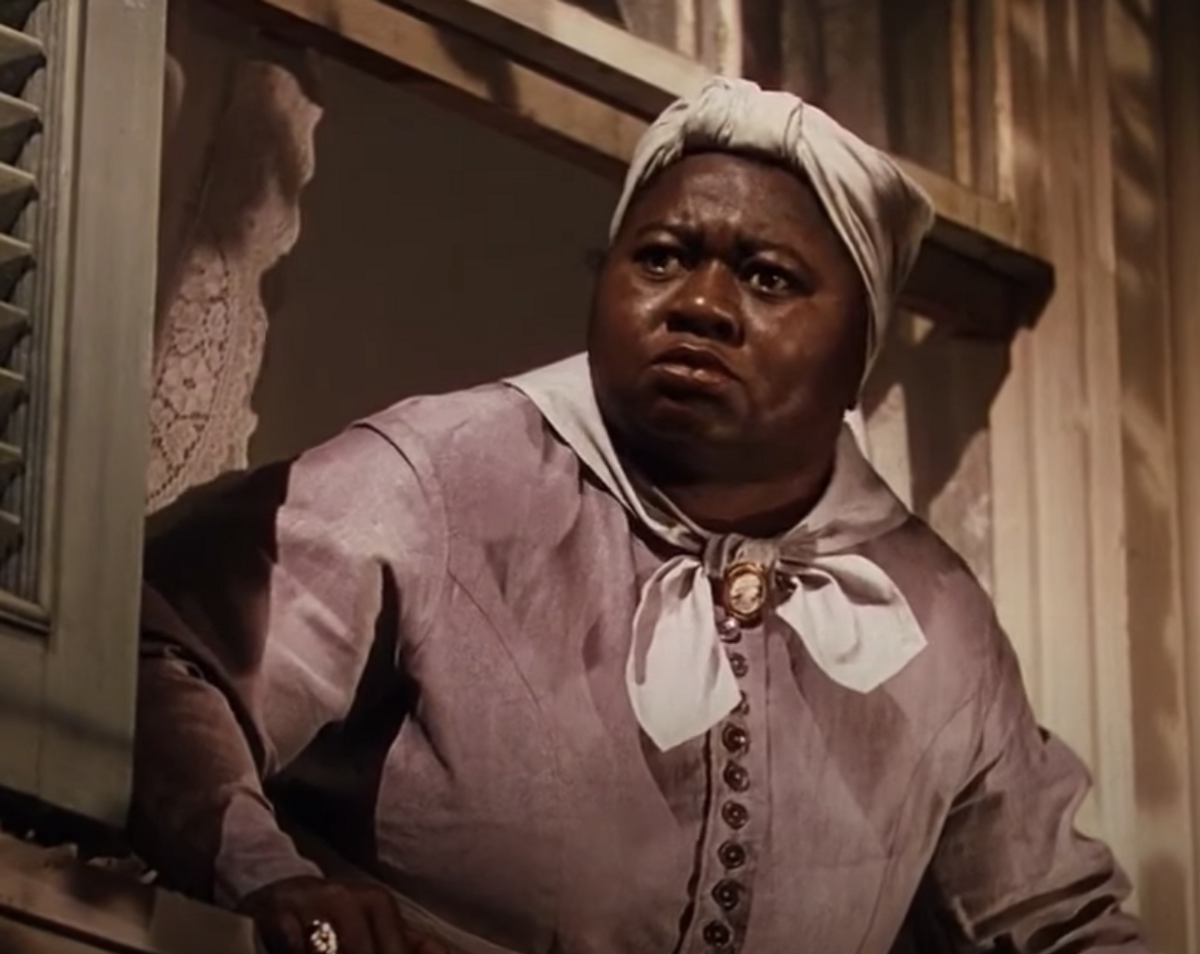
The Mammy is a middle-aged, often overweight black woman employed as a domestic servant to a rich white family, usually as a maid, cook, or nanny. Older Than Radio, Sub-Trope of Ethnic Menial Labor, Mammy was born in the Deep South of Antebellum America, but continued to be a presence for a century after the American Civil War and is also "popular" in Cuba. During slavery, she was largely resigned to her enslavement, perhaps even finding Happiness in Slavery, likely owing to the fact that she lived and worked in "The Big House" rather than toiling in the fields. After Emancipation, Mammy continued to serve as a menial domestic to whites and continued to aspire to little higher (though she may have wanted more for her own children if more options were available to them). In her freedom, she may have also moved north, although her position and character are largely unchanged whether she lives in rural Georgia or Chicago.
Mammy is often very plain in appearance, with no expressed sexuality. A white mistress was supposedly secure that having Mammy about the house was no threat to her husband's fidelity as opposed to a younger, prettier maid. In terms of character, Mammy is poorly educated but has abundant common sense and is competent in her domestic duties. She is servile toward the whites, but may be an Apron Matron toward her own family, or even toward her masters' children if she's in a position of authority over them. Her earthy common sense may, if her white masters or employers become sufficiently zany, lead her to become the Only Sane Man of the household and develop some characteristics of a Sassy Black Woman, perhaps even being driven to deliver a Whoopi Epiphany Speech.
Compare Magical Negro and Almighty Janitor. May also be the maid of a Maid and Maiden duo. The white family she works for may fall under Bad Boss or Pointy-Haired Boss, but don't expect the story to call them on it.
The Other Wiki has a page on the archetype here.👁 Image
Given the character's association with Minstrel Shows and racist stereotypes, many people find Unfortunate Implications in it, especially if she expresses Happiness in Slavery or not shown to have a life of her own outside of serving white people. However, more complex works may interrogate the type further by making her more well-rounded as a person or showing how she strives to be a positive mother figure in a bad situation.

While the archetype originates in the American Deep South, it can be invoked in other settings. In more modern times, she might be an immigrant, often Hispanic or Afro-Caribbean. In stories set in The Raj she might be Indian or Chinese (and more likely than not referred to as Ayah or Amah, respectively). The archetype can also be applied to characters that are simply "black coded": that is, people who are treated in the setting the same way real life black people are.
Not to be mistaken for someone referring to their actual mother as Mammy. "Mammy" and "Mam" are the usual familiar terms for one's mother in Ireland, as well as parts of Wales and the North of England, rather than "Mum" or "Mom". In Mrs. Brown's Boys, for instance, Agnes Brown is always addressed as Mammy or Ma.
Examples:
- Aunt Jemima from the Quaker Oats Company's brand, primarily their line of pancake mixes and syrup, was originally a character from Minstrel Shows in the late 1800's and became one of the oldest advertising trademarks in American history. After the Civil Rights Movement saw massive changes in how African-Americans were treated and represented in the media, Jemima was redesigned in the early '80's to nix the "Mammy" imagery, giving her a natural hairstyle and pearls to insinuate that she is a homemaker rather than a servant. But in 2021, following the race riots the year before, Quaker retired Aunt Jemima altogether and rechristened their pancake line after its original parent, the Pearl Milling Company. While some decried the change as needlessly politically correct since Aunt Jemima had been portrayed tastefully for almost 40 years, there was no undoing her racist origins, and Quaker thought it best to finally put the brand to rest.
- Mrs. Butterworth, the pancake syrup mascot, is a debatable example, as she's often seen as a Mammy due to her dark-colored, human-shaped bottles and her closest "rival" being Aunt Jemima. However, the character had been consistently portrayed as a white woman going all the way back to male comedian Cliff Arquette in her very first (and only live-action) appearance, and ConAgra, owners of the brand since 2018, indicate that the bottle design was intended to simply represent a loving grandmother👁 Image
. Since the 70s, she has only been shown in advertisements as an animated bottle in an attempt to tone down perceptions of this trope.
- Hannah from Tales of Little Women (an anime version of Little Women) was given a Race Lift from Irish to African-American, and is stylized this way (without Blackface fortunately). The show gives her a bit of a snarky but loving personality, and she is terrified of cats.
- Eufrosina, the mother of "Memin Pinguin" is a poor Cuban-Mexican woman that worked as a maid before getting married to Guillermo Pinguin. After his husband´s dead, she migrated to Mexico City and live with her son in poor conditions, washing clothes from other people for a living. In old editions she doesn´t know how to read or write, while her knowledge improved in the newest editions, even barely to understand Memin's low notes after the exams.
- Eve Sisulu from the South African cartoon strip Madam & Eve is a black live-in maid/housekeeper who does not always show the approved degree of respect for her white employer.
- In the Discworld of A.A. Pessimal, Johanna Smith-Rhodes is married with children and lives in Ankh-Morpork. Well-meaning relatives have provided her with servants, as befits a Woman of Status. All of them are Black Howondalandian and used to service to white people. Johanna's long-standing cook, Dorothea, fits the Mammy stereotype in all respects.note Or at least, the "South African" version of the Mammy, the black employee of a White Afrikaaner. Elsewhere, Johanna's relationship with her black servants makes her a Discworld reflection of Madam Anderson in Madam & Eve. Johanna even finds herself cleaning the kitchen one day at Dorothea's implicit request. note An interesting bird has got itself trapped in the kitchen. Birds have no bowel control. Dorothea knows her employer is an academic zoologist and knows all about birds and guano. Therefore, Madam, the cleaning materials are in the cupboard underneath the sink.
- Cameron's Mammy from The Birth of a Nation who defends her white master's home against black and white Union soldiers.
- Parodied in The Campaign, which features an Asian maid who is forced by her boss to talk like this, only occasionally slipping up/dropping it for her regular American accent.
- In Hallelujah! Zeke's mother is actually called Mammy, and she looks and dresses the part. But it's subverted to some extent as she is the mother of a family of poor cotton farmers, not a servant to a white person.
- Eulabelle from the B-movie The Horror of Party Beach. She's condescended to by most characters and the hero goes the extra mile by putting on a Southern Gentleman patois exclusively when speaking to her. She's also the only main character with any real personality or charisma, and every time the plot stalls out, it falls to her to go back and give the starter cord another tug. She even figures out how to kill the monsters!
- Delilah in both film versions of Imitation Of Life, but especially the 1934 original. The 1959 version by Douglas Sirk is a Deconstruction. In both versions she is the best friend of Bea and they raise their children together. Unlike most "mammy" type characters she has her own storyline and character development.
- In Master, Gale is the first Black woman to be appointed as "master" of a residence hall at the prestigious Ancaster University. When she is unpacking, she finds, of all things, a mammy figurine, reminding her of how far things have not come.
- Hattie McDaniel made a career out of playing these kinds of roles, including Malena Burns in Alice Adams, Fidelia in Since You Went Away, Callie in They Died with Their Boots On, and most famously as Mammy in Gone with the Windnote For which she won the Best Supporting Actress Oscar.. She's also in Disney's Song of the South. She played a mammy for Shirley Temple's character in The Little Colonel. In Saratoga her character says she'd go after Clark Gable's character if only he were the right color. When asked if she felt degraded taking so many gigs as a domestic, McDaniel replied, "Why should I complain about making $700 a week playing a maid? If I didn't, I'd make $7 a week being one." She also played Beulah on radio and TV.
- Inverted in White Man's Burden (1995), which is set in an alternate America where blacks are the dominant ethnic group and whites are the minority. Wealthy businessman Thaddeus Thomas has a white live-in maid who otherwise fits the physical description of being older, overweight, and servile exactly.
- Dividend on Death: An amazingly racist scene has private detective Michael Shayne meeting a "fat Negress" in the Brighton kitchen. It gets even worse when he actually addresses her as "Mammy", and worse still when she answers his question about the gardener by saying "Dey ain' no gahdner heah dat I knows 'bout."
- Deconstructed in Kindred by Octavia Butler. The mammy-esque slave Sarah finds what happiness she can, but beneath that facade is bone-deep rage and pain over a lifetime of servitude in which all but one of her children were sold away from her. It's presented not as surrender but as one of the ways that the plantation slaves weather unendurable horror.
- Castalia from Oldest Living Confederate Widow Tells All is an examination and subversion. Yes, she's an obese (300 pounds), middle-aged to elderly domestic servant. But, as it turns out, she taught herself to read while still a slave (and reveals this fact while insulting her injured mistress after the plantation house burns down), raises minks, is the female protagonist's lover, and definitely does not qualify for Happiness in Slavery. (She also claims to have been born a princess in Africa, and Lucy relates a story that Castalia told her of her enslavement, though the princess bit is likely Unreliable Narrator.)
- The Southern Book Club's Guide to Slaying Vampires: Mrs Green is one and it's one of the most polarizing elements of the story. Is she a deconstruction because she's supposed to show how out of touch the wealthy white women are from Mrs Green's deprived "ghetto" life, or is she actually a reconstruction because she still forgives them and shows the mammy's caring for upper-class white society along with her extreme competence and domestic servitude?
- An Unkindness of Ghosts: Upper-class women hire Melusine to nanny and tutor their children in preference to a "proper" tutor, solely because she fits the stereotype. She dislikes the work, even though it's less physically demanding than her main job, but puts on a convincing façade nonetheless.
For some reason, people think I'm a motherly type. Because I'm brown and dowdy.
- Louanne in Boardwalk Empire, maidservant to the Commodore. He's abusive and racist towards her, and she eventually tries to poison him to death with arsenic. It's also revealed that he had left everything to her in his will, but it's unclear if she knew about that, and Jimmy destroys the will.
- In one episode of A Different World, the school holds an art exhibition dedicated to the mammy. Kimberly is quite opposed to this, and it is eventually revealed to be due to a bad incident from her childhood in which she dressed as an African queen for Halloween and won first prize — for her Aunt Jemima costume.
- Deconstructed with Nell from Gimme a Break!, as this trope was hard to sell in the 80's when the Mammy archetype was long outdated. She was initially the housekeeper for a widowed police chief and mother-figure to his three teenage daughters, but she was a friend of the late wife/mother before taking the job. And since she's the central character of the series, she is shown with her own friends, family, and dating life. When the Chief's actor Dolph Sweet passed away between Seasons 4 and 5, The Character Died with Him and the show was retooled to focus more on Nell. Eventually the daughters were written out as they moved on with their adult lives, and in the final season Nell moved to New York City and took a desk job at a publishing company.note At one point late in the 6th season, Nell visited the youngest daughter at her college. The showrunners considered having Nell take a job at the girl's boardinghouse as the House Mom, but it was decided to instead have her leave domestic work altogether to be more in line with the growing trend of sitcoms focusing on Black professionals. In fact, this trope was lampshaded as early as the third season when Nell's friend Addy, a college professor, appears at the family house and meets the daughters. She tells them that she's proud to have a successful career and to show the world that black women aren't just "a bunch of Aunt Jemimas"...and in walks Nell carrying a basket of laundry while wearing a kerchief.
- Betty Draper of Mad Men grew up raised by her family's black housekeeper and then hired one for her own children.
- Nanna, in Mike & Molly is Carl's grandmother who brought him up after his mother went missing. By degrees she becomes everybody's adored - and sometime feared - Nanna.
- Scream Queens (2015) had Ms. Bean, a sorority housekeeper given the nickname "White Mammy", who was ordered to say "I don't know nothing about birthing babies" by sorority president Chanel Oberlin.
- Berta in Two and a Half Men is a subversion of the typical Mammy: while she is a competent housekeeper, obese, and full of common sense, she also takes shortcuts, does drugs, and insults the main characters. Oh, and she's white.
- Tom Lehrer wrote the song I Wanna Go Back to Dixie with Deliberate Values Dissonance in order to draw attention to the pervasiveness of country songs with racist subtext.
"Won'tcha come with me to Alabammy?/ Back to the arms of my dear ol' Mammy/ Her cookin's lousy and her hands are clammy/ But what the hell? It's home"
- This character type was a stock presence in Minstrel Shows, often named "Aunt Jemima", and was frequently performed by a man in Blackface and Incredibly Conspicuous Drag for maximum racist and misogynist mockery. Such a portrayal falls extremely far into Dude, Not Funny! territory today.
- The aptly named Macha from Chrono Cross, which is odd given the lighter complexion and lack of African features in her son Korcha (her daughter Mel is adopted).
- Subverted by Lenora "the natural born mama" from Pokémon Black and White. She's not a mammy in profession (she's an archeologist), but definitely by character design, and she's the Team Mom of the Gym Leaders. Part of the reason she drapes her apron (which makes her look rather round) over her back instead in the US release (revealing a slimmer but still much more full bodied figure than the standard Pokemon woman). The apron was also edited out of the anime and the Pokémon Adventures manga in the US. Also may be part of the reason she was one of the replaced gym leaders in the main story of Pokémon Black 2 and White 2, and the only one that can't be battled outside of the World Tournament.
- Classic Disney Shorts: A Mammy was seen in the Silly Symphony short Three Orphan Kittens and the Pluto the Pup short Pantry Pirate. In Three Orphan Kittens the Mammy is about to throw the kittens out into the cold when the white child she's watching insists that they keep the kittens.
- In Drawn Together, prolonged exposure to Captain Hero's X-ray vision causes Foxxy to develop a brain tumor on her stereotype gland, turning her into a Mammy, which makes her a target for the Bureau of Cartoon Political Correctness.
- Family Guy: In "The Juice Is Loose" a Mammy makes her appearance in a Cutaway Gag, complete with stereotypical accent and speech patterns, as the loving caretaker of the horribly neglected son of a wealthy - and white - investment banker.
Millie: Me sorry, mister Sir. Get out da room, dim dere, you bodda your fadda. Him unhappy him had you in the first place.
- Jorel's Brother was based on the show creator's family, so one of the main characters was based on a housemaid he knew. The character, named Rose, was a middle-aged overweight black woman, which fit this trope and thus got censored from the show. Due to the series already using several magical surreal elements, the character was changed to a talking octopus (referencing the fact she has to multitask and use several hands at once) and got her role greatly reduced, in order to avoid this trope.
- Zig-zagged with the unnamed woman commonly (and erroneously) known as Mammy Two-Shoes from the Tom and Jerry shorts, voiced by Lillian Randolph. While she's never depicted as being servile towards white people, William Hanna and Joseph Barbera specifically designed her as a housekeeper. But when the Civil Rights Movement led to demands for the removal of offensive stereotypes in the media, Mammy was repainted white and dubbed by June Foray in an Irish accent. This lasted until the late 80's when Tom and Jerry was acquired by TBS. They made Mammy black again, but implied that she was the homeowner (and Tom's owner) by having her wear jewelry around the house instead of an apron, and her voice was dubbed by comedian Thea Vidale with a more tasteful accent and speech patterns. For people born in the 80's and later, this is the version of her they're most familiar with, causing many to wonder what was controversial about her when they hadn't seen her original portrayal. And Values Dissonance applies: overseas viewers, who simply didn't know the original context, always took Mammy to be the householder (who just happened to be black) and not a lowly servant.