


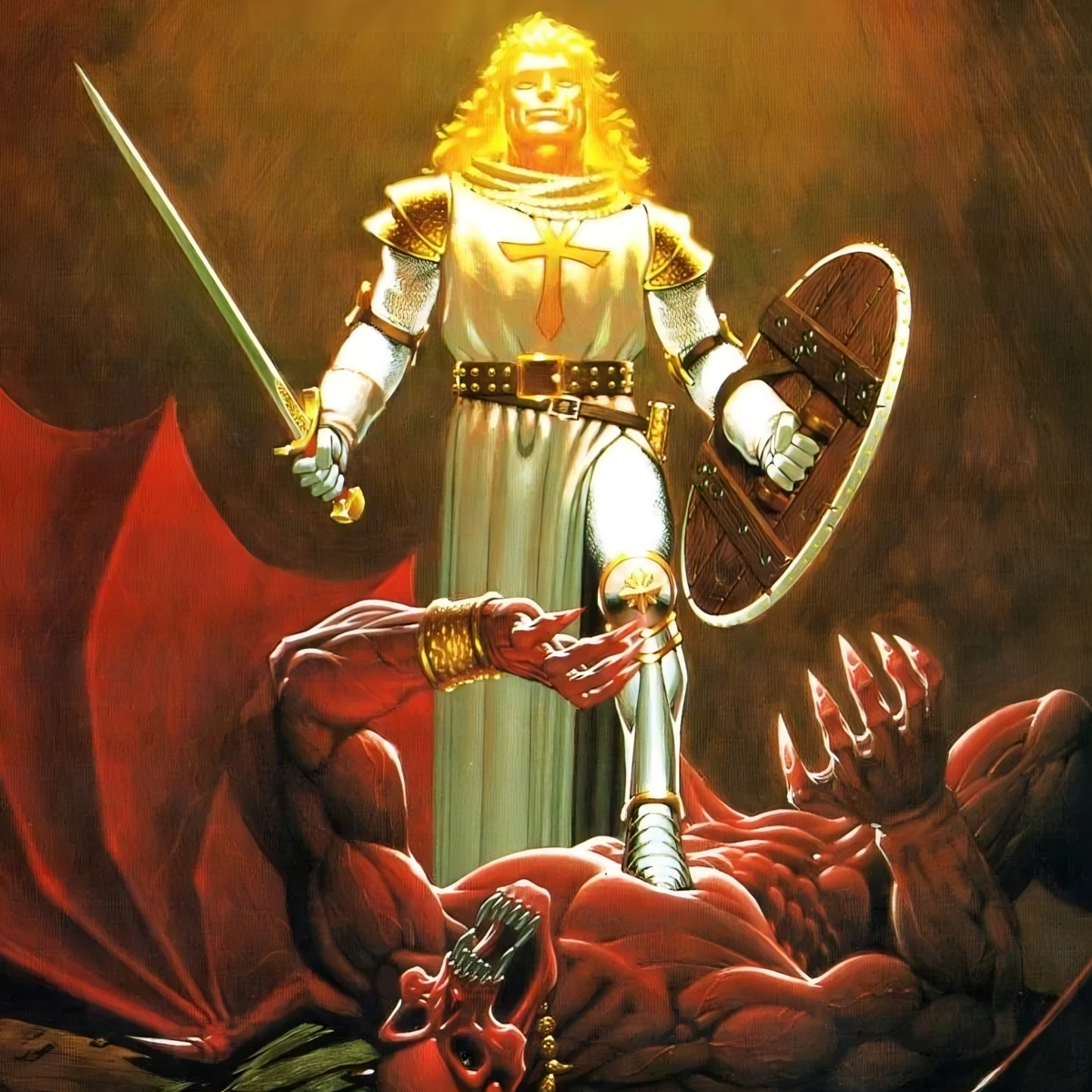
My tough lance thrusteth sure,
My strength is as the strength of ten,
Because my heart is pure.
Paladins are warriors dedicated to furthering the cause of all that is good. Holy crusaders, they combat the forces of evil wherever they are found, and defend the helpless as much as possible. Above all else, paladins are good. An evil paladin is a literal contradiction of terms; a paladin that turns evil ceases to be a paladin.note Though in settings with Grey-and-Gray Morality, antagonistic paladins may still exist. As holy warriors, they're almost always associated with The Order, which is usually religious, or at least spiritual, in nature. While their Order may be tied to a specific church worshiping a God of Good, they are just as often dedicated to a more general power (frequently The Light). As such, paladins are frequently Church Militants and may have aspects of the Warrior Monk. Paladins are often The Chosen Many, with new paladins just beginning to learn about their powers being found and taught by older, more experienced paladins. When not part of The Order (or if their order is disbanded), a paladin will usually be a Knight Errant instead. Their weapon of choice will typically be a long sword (usually with shield) or else a hammer (maybe two-handed).
Paladins tend to fall in the middle of the Sliding Scale of Idealism Versus Cynicism. They certainly believe that Humans Are Good, but they tend to deal with most evil by killing it rather than trying to redeem it. The archetypal paladin is a Lawful Good Knight in Shining Armor for whom Right Makes Might, but this isn't always the case. Though always good, paladins are not always nice. (And even when they are nice people, underestimating their capacity for violence is still a potentially lethal mistake.) They may even be a Knight in Sour Armor — but never a Well-Intentioned Extremist or a Knight Templar. When faced with a To Be Lawful or Good dilemma, a paladin's best option is to choose to do Good. If their order were to lapse from virtue, a true Paladin would leave, but continue to follow the rules of the uncorrupted order, even if they have to consider themselves the very last member.
Some games skirt the whole "Paladins must be good" requirement by defining them as any Magic Knight devoted to a specific religion or deity, in which case the Paladin identifies with the alignment and ideals of that religion. This is often used to explain Dark Paladins following a Religion or God of Evil, though other options exist as well. Equally common is giving the archetype an Evil Counterpart that is always wicked in the same way a traditional paladin is always good and often has abilities that invert those of the paladin. Depending on the setting, such warriors may be known as "blackguards", "antipaladins", etc.
A popular Character Class in both digital and tabletop Role-Playing Games, Paladins tend to be Magic Knight variants who focus more on White Magic and defense compared to the Magic Knight's offensive spell-slinging (but can do offense as well with Holy Hand Grenade magic). As such, they usually fill the role of the tank in groups, though they may be able to function as a Combat Medic as well; when not working with a party, they're usually a Mighty Glacier. Paladins in games are usually very effective against evil enemies, particularly The Legions of Hell and The Undead — they almost always have the ability to use Detect Evil and Smite Evil against such foes.
Compare Magic Knight (the more generalized and/or offensively-oriented counterpart to this trope), Combat Medic (who has healing as first priority and combat second), The Paragon (who seeks for others to be as courageous), Good Shepherd (a priest who has the traits of this trope), The Cape (a superhero who has many of the traits of this trope) and Royalty Superpower (when this trope meets The Good King). Contrast with the Black Knight, who may be this character's Evil Counterpart.
Not related to C. J. Cherryh's stand-alone book The Paladin (1988). This trope does have thematic relations to the video game Paladins (see below for its entry). Also has no relation to the Paladin's Quest game.
Just because something is NAMED a paladin doesn't automatically make it an example of this trope.
Examples:
- Digimon: The Royal Knights of the wider canon are this, an order of immensely powerful knight Digimon convened to serve the god of the Digital World (whoever that may be in that particular universe); the order was founded by, appropriately enough, Imperialdramon Paladin Mode. All members of the Royal Knights are very different from each other and have very different sets of powers, so they fit the related powers tendency only to varying degrees. The most prominent members of the order include Omegamon, Magnamon, Dukemon, Dynasmon, and LordKnightmon.
- The Faraway Paladin: The titular paladin William G. Maryblood was raised from infancy by a trio of legendary heroes made undead. In his time of need, Gracefeel, the goddess of light and reincarnation intervened and saved him and his adopted family. So the boy declared a lifetime oath of service to the goddess using his training as a wizard and warrior-priest. Soon for his deeds of heroism, he would be given the title of paladin (which is a huge deal in this world) by the royal prince of Whitesail alongside the bishop of that city.
- Hellsing:
- Father Alexander Anderson of the Vatican's Iscariot Section XIII is almost always referred to as Paladin Anderson or somesuch variant. Interestingly, he's a rare Hero Antagonist variant, as the actual protagonist is both an Ax-Crazy Blood Knight Protestant-enslaved vampire and a Sociopathic Hero. Not that they're all that different in that respect.
- Also interesting is Section XIII's Badass Creed, which we hear when they show up in force. In it, they self-identify as God's assassins, violating all of the Church's Commandments in the name of Judas Iscariot in the hope both of furthering the Church's cause and damning their souls as a way of passing on to and invading Hell. They're still probably paladins in comparison to the rest of the Church's militant orders... which says something about those.
- Ishura: The Wordmaker is The Creator god of the world and the Order is the religious order that teaches his tenets. However when the Order proved powerless against the True Demon King, the people and the government turned on the Order and oppressed them. So the pacifist Order declared one of their members Kuze the Walking Disaster, as Paladin, a revived title of militant knights protecting members of the Order. Unlike other examples here, Kuze has no holy magic or whatnot. What he has is an invisible and immaterial Guardian Angel that will One-Hit Kill with her short sword.
- The Unholy Paladin: Kai has all the demeanor and attitude of a Paladin, but the wrong skillset. He's empowered by dark energy making him stronger and tougher than the average knight, but Heal hurts him and when he tries to cast Bless, the ground turns into a toxic swamp instead.
- The Ghent Altarpiece: The figures in the "Knights of Christ" panel are clearly intended to represent the ideal warrior who fights for the Christian God.
- Priam Agrivar from DC's Advanced Dungeons & Dragons and Forgotten Realms titles back in the 80s, one of the better fleshed-out examples of the classic D&D-style (AD&D 2nd Edition in particular) paladin — complete with all-too-human failings (like lingering alcoholism) and doubts but ultimately the determination to prove himself worthy as well. Interestingly, he seems to owe formal allegiance to no specific faith or other organization, or if he does, it's never shown; he always appears as essentially his own man trying to do good as best he understands it, and his powers seem to work well enough regardless. note His character write-up in the Dragon article "Rogues Gallery: The Crew of the Realms Master" says he's a paladin of Torm, god of duty, although other sources say he follows Tyr, god of justice. Which just proves the point that it never came up in the comics.
- Black Moon Chronicles: Lord Parsifal, the Grand Master of the Knights of Justice, is a completely devout and heroic warrior who fights on the emperor's side in various wars, though he specifies that he serves God alone. His counterpart Frater Sinister of the Knights of Light is both corrupt and ambitious.
- Pathfinder: As a scimitar-wielding cleric of the sun goddess Sarenrae, Kyra is about as close to a paladin as you can get without actually having levels in the tabletop class. She readily joins in slaying monsters and single-handedly defeats a ghoul ambush of the party via Turn Undead, but though demanding of people's moral standards, she's also a capable and gentle healer with a soft side.
- Chance Encounter: Balian of Ibelin. One of his nicknames is "The Perfect Knight" and he goes down to hell to fight the Devil for the soul of his dead wife (while he does get smashed around by Satan with ease, he is assisted by the recently-canonized-by-the-Archangel-Gabriel Prince Hector of Troy. Yes, it is very strange.). He is also something of a Woobie, as it is pretty much guaranteed that he will be maimed at least once every 4-6 chapters. As well as being possessed by a dark version of himself.
- Harry Potter and the Knight of the Radiant Heart👁 Image
by Raven 3182: The paladin Keldorn Firecam from Baldur's Gate II is inserted into the Harry Potter story. He goes on to train Harry to be a paladin as well. - The Keys Stand Alone: The Soft World: A line in the mysterious poem the four find when they first return to C'hou mentions "the Paladins, rightfully so." John hopes the line doesn't refer to themselves. (It turns out to refer to the Guardians.)
- The Tale of Solaron: Sloane is a paladin of Pelor and plays it straight, being honorable and brave in the face of danger, though it often blinds him to subtleties and complicated motivations.
- In Allronix's Tin Man (2007) fanfic, the Tin Men themselves are of this trope, created by Empress Dorothy to honor the original Tin Man, Nick Chopper, sworn to serve and protect the citizens of Oz "from the greatest monarch to the smallest insect."

- Dungeons & Dragons: Honor Among Thieves: Xenk, a kindly, steadfast, reserved warrior for peace and justice... who especially stands out compared to the rest of the party, who are all, in their own ways, hot disasters.
- Star Wars: Jedi knights are Samurai Taoist Buddhist Space Police keepers of the peace IN SPACE! The best example is wise Master Yoda. They also share the trait that if they go bad they go immediately from pure-heartedness to For the Evulz.
- TRON: Alan hadn't intended to create a de-facto holy warrior who fights for the oppressed User-believers, but his creation turned out that way. Too bad about the sequel...
- Something similar to this exists in Russian byliny about the druzhina of Prince Vladimir of Kyiv, who defend Holy Russia against the pagan Tatars. The most famous member of these bogaryri is Ilya Muromets.
- Adventure Hunters: Artorius used to be one of these, but was branded with the Sigil of Disgrace for a mysterious reason. Now he works as a treasure hunter.
- The Balanced Sword: Some of the gods of Zarathan have dedicated holy warriors who are granted enhanced abilities by their patron god; the trilogy features the Justiciars, dedicated to Myrionar, God of Justice and Vengeance. A major plot driver is the revelation that the Justiciars have become corrupt and now secretly serve and gain their powers from a demonic patron (who is also apparently managing to fool Myrionar Itself, or at least prevent It from denouncing them and/or smiting them where they stand).
- The matière de Bretagne centering on King Arthur for a long time evolved in competition with the matière de Francenote Arthurian works were often written for or sponsored by supporters of the Norman and Plantagenet kings of England, who were seen as Arthur's successors, while their French Capetian rivals were descended from Charlemagne., so many scholars believe that the Knights of the Round Table were an attempt to outdo the Twelve Peers. They certainly soon did this as far as their numbers were concerned; not being bound by the Paladins' Rule of Twelve, the number of active Knights of the Round Table at one point rose to 1600 (in the 13th century Brut by Layamon).
- The Crimson Shadow: A paladin is sent by King Greensparrow against Luthien. He fights honorably, giving Luthien a fair chance to beat him. After learning Greensparrow is really an evil sorcerer who's in league with demons, the knight immediately switches sides and goes down fighting a demon that attacks Luthien as he sings praise to God, having sworn that he'd fight evil.
- The Death Mage Who Doesn't Want a Fourth Time: The adventurer Heinz is framed as one, seeking to uphold justice in the name of his patron god. Unfortunately for the Hero Antagonist, his god is Alada, who calls entire races "evil" for daring to exist without his permission, even if Alda himself states that they are no morally different, or less capable of being morally upright. Heinz himself has a a concept of "justice" that is heavily biased in favor of the "human" races, seeing the humans as "innocent until proven guilty" and the races Alda hates as "guilty until proven innocent" but by the time their innocence is proven, he's either already killed them, or delivered them to those that did. When he's challenged on it, he gets defensive and goes full-tilt Never My Fault.
- Dragonlance: The Knights of Solomnia are the closest equivalent, and their Dungeons and Dragons tie-ins provide rules that essentially make this character a paladin equivalent (though there are different orders with different emphases in terms up fighting skill, leadership, and divine power).
- The Dresden Files: The three Knights of the Cross are paladins, complete with holy swords, each of which has had a nail from the crucifixion of Jesus incorporated into it and respectively reflects the ideals of Faith, Hope, and Love. Taking up one of the Swords of the Cross means accepting a Mission from God to go where they are most needed and help those who need to be saved. The Mission isn't always a lifetime commitment. Many Knights are one-offs. They are the Right Person in the Right Place at the Right Time and are able to wield the Sword to its full power.note One temporary Knight was a mother who is also a monster. In the past when trying to grab the Sword of Faith so it didn't fall away from the hero, despite her good intentions, she was shocked by the Sword, leaving her arm numb for a month. Later, when on a quest to save her daughter, the Sword of Love permits her touching it after she swears to use it only this time and not hurt innocents.Michael Carpenter, the most often-seen Knight in the series, even wears plate armor specifically because it fits the classic paladin style (though his armor is reinforced with kevlar). They're also notable for being one of the most positive portrayals of paladins in all of fiction, being good, honest, kind-hearted people who don't force their beliefs on others and help anyone who truly needs itnote In fact, Michael is the only devout Christian of the three; Sanya is a Flat-Earth Atheist, while Shiro was converted because he thought the offer to "meet the King" meant a chance to meet Elvis Presley, and the Knight of Faith since Skin Game is Jewish. In fact, they're even more idealistic than the trope description would suggest — their primary mission is dealing with a group of Fallen Angels possessing humans — to redeem them, not destroy them. Despite that being on paper an Impossible Task, it has been successful at times, at least once to the point where one of the current knights got his start via Heel–Face Turn.
- The Elenium by David Eddings: The Church Knights are Paladins, although it can be hard to see through their worldly tarnish on the Pandion, Genidian, and Alcione knights. Cyrinic Knights are closest to the ideal, being the most religious and having shiny armour to boot. The manner of their Preceptor Abriel's death — charging a 300+ foot monster — is very Paladin.
- The Faraway Paladin: Its right there in the title. William G. Maryblood is absolutely a Paladin in the Dungeons & Dragons mold. A Holy warrior-priest sworn to upload the cycle of life and death in opposion to a god of the undead, always seeking to see and act on the good in others, and inspiring others to be better than they are.
- Forging Divinity: Lydia is secretly a Paladin of Sytira, a goddess of knowledge.
- Heralds of Valdemar: The eponymous Heralds are essentially paladins without the religious aspects. They're The Order of The Chosen Many, with Functional Magic and/or Psychic Powers and 100% guaranteed pure-heartedness due to their Companions — Cool Horses with human-level intelligence that share a psychic link with the Heralds they've Chosen — and they never Choose anyone who is less than heroic.
- Knights of Doom: The hero is a heroic knight and paladin serving the kingdom of Ruddlestone, under the Order of the Templar Knights of Telak.
- Legends of Ithyria: Shaa'din, holy warriors serving Ithyris the God of Good against God of Evil Ulrike, her brother. They are gifted by her with magical abilities to do this. Shaa'din also are her lovers too. Ulrike has his own shaa'din, who are impregnated by his essence.
- Overlord (2012): Paladin is a class in the fantasy setting of the New World with its RPG mechanics.
- The Paladin Order of the Holy Kingdom is entirely made up of paladins. It was led by the Lawful Stupid Remedios Custodio although most other Paladins are much more level-headed than her.
- Goblin Paladin-Knight Squad is a squad of paladins entirely made of Goblins that is part of Enri's Goblin army. They were summoned by Enri using her Horn of the Goblin General and has the second strongest paladin in the entire new world.
- Ruin of Angels: Played with. The nation of Camlaan has an order of knights who are nominally these, but it's kind of an open secret that underneath the inspiring gloss of honor and heroism, they're just a tool of the crown's (often exploitative and corrupt) power. One of the protagonists is a Camlaander Knight who genuinely believes in the professed values of her order and is deeply committed to doing her patriotic duty even though she's very aware of the organization's dark underbelly.
- Saint George and the Dragon: The Red Cross Knight is heroic warrior on a quest to slay an evil dragon, having the eponymous symbol on his tabard and shield which denotes that he's a specifically Christian hero (being the future Saint George).
- A Song of Ice and Fire:
- The Kingsguard are an order of celibate knights sworn to protect the king and his secrets with their lives. They always number seven, representing the Seven Gods —a theme inspired by the original Twelve Paladins of Carolongian legend, numbered after one of Christianity's holy numbers— wear snow-white cloaks and armor, and are expected to embody the absolute highest ideals and conduct of knightly culture. As a result, they are widely seen as incorruptible heroes, and famous Kingsguards like Gerold Hightower and Arthur Dayne were already Living Legends in their day and afterwards came to be seen as essentially the Platonic ideal of perfect, heroic, virtuous knights, while Jaime Lannister, the Kingslayer, is considered a dishonor to his order for having turned on his oath to protect the king. In practice things are a little more complicated — perfect obedience and loyalty is one thing when sworn to a legendary hero-king and another when sworn to a cruel, insane tyrant, the historic hero-knights ultimately had their own human motivations under the snowy cloaks, and Jaime's killing of Aerys and his cronies likely saved the capital city from being destroyed in a fit of spite.
- The Warrior's Sons, also called the Swords, were an order of knights who gave up their lands and titles in order to serve the Faith and the Seven alone. They wore engraved silver armor, hair shirts, rainbow-striped cloaks, and swords with star-shaped crystals in their pommels, the last two being major religious symbols in the Faith. They were, depending on who you ask, either paragons of piety and virtue or else unreasoning zealots. The order was disbanded following an uprising against the Targaryen kings.
- The Trope Namer is, of course, the Paladins or "Twelve Peers", the foremost Christian warriors of the court of Charlemagne. They were first described in The Song of Roland, and the eponymous Rolandnote Roland was loosely based on Ruotland, a count in charge of the Breton March (i. e. the Frankish province bordering on Brittany) who was killed in the battle of Roncevalles. was said to have eventually become the leader of the Paladins. As the number of Paladins was fixed at twelve (possibly in analogy to the Twelve Apostles or the Twelve Tribes of Israel), their names tend to vary from work to work within the matière de France as different authors would obviously want to include their pet character in the number.
- So This is Ever After: Rion is a righteous knight and strictly abides by his oath to aid Arek, who admits he's the most moral person among his companions.
- Spells, Swords, & Stealth:
- Tim starts out playing a paladin at the start of NPCs, but is forced to roll a more mundane warrior by the other players so he wouldn't get in the way of their being murderous bastards. Tim gets to play a paladin again in Split the Party and is a natural at it.
- Thistle finds himself given the offer to become a paladin for his god, Grumble. Thistle is reluctant, given the limitations and requirements that come with the position, but ultimately agrees to save his friends' lives.
- Over the course of Split the Party, Timuscor, the knight Tim had played during NPCs expresses a desire to be a paladin but is disheartened to find he lacks the kind of devotion the job requires since the gods only make paladins of their followers. Before going into the climax of the story, he says a prayer offering himself as a paladin to any god who will take him, and this desire also spurs his Heroic Sacrifice near the end of the book. The third and fourth books suggest that there is an alternate way to become a paladin, one that existed before the gods started handing out the position: offering an oath of pure devotion to the greater good and becoming a "free" paladin. In the climax of the fourth, Timuscor finally realizes this, makes his oath, and gains all the powers of a paladin while being beholden to no god.
- The Stormlight Archive: The Knights Radiant are powerful Magic Knight warriors who literally get their powers by behaving with various flavors of honor (protecting the helpless, being truthful, etc). The Knights as a whole are a Badass Army, but they're divided into ten separate Orders (explicitly called such in-universe), which swear different oaths and gain different powers. They disbanded and disappeared thousands of years before the story begins, but those with the power of the Radiants seem to be appearing again, which seems likely to lead to the reformation of the Knights.
The Recreance, the event where the previous orders of the Radiants abandoned their oaths, their Blades, and their Plate, was ultimately caused by the Radiants learning that their powers had destroyed the world humanity originally came from. In order to avoid the same fate befalling the world, they abandoned their oaths and powers and refused to explain why (lest someone else follow in their wake), condemning them to being named traitors and villains by subsequent generations. - Sword Art Online:
- Heathcliff is known as The Paladin. His skills are light based and he leads the campaign to free the trapped players from the game. Subverted; his true identity is none other than Kayaba Akihiko himself, and he plans to betray the players and become the final boss at a dramatically-appropriate moment.
- In Alicization, the Integrity Knights are described as Holy Warriors summoned from the heavens to defend the Human Empire. While their backstory is ultimately revealed to be a lie and they unwittingly served a Corrupt Church, their values and purpose still remain the same and are firmly on the side of good.
- Tales of Inthya: The Order of the Sun has knights sworn to never tell lies, drink alcohol or gamble while protecting people against evil gods and monsters. Orsina clarifies that it's just actually drunkenness that's forbidden, not drinking overall. They have light-based, mostly protective magic.
- That Time I Got Reincarnated as a Slime: The paladins of the Western Saints Church and the Holy Empire of Ruberios fit this to a tee, being humans trained in warfare and blessed by both the power/contract with spirits and wield Holy Magic derived from their faith in the god Luminous. Their duty is to spread Luminous' faith through their deeds and protect humans wherever they might be from evil and especially monsters. This is something of a concern to our protagonist, who is not only a slime but finds himself the head of a rapidly expanding nation of varied and powerful monsters with hope of establishing peaceful cooperation with humanity, which leads him to fear their Church doctrine could lead to a horrible ideological clash. The irony is that it's only known to the highest members of the Church and Empire (including the head paladin Hinata Sakaguchi) that their "god" is in fact the True Demon Lord Luminous Valentine, whose motives are the selfish but helpful intent of preserving human and vampire lives and comforts for mutual benefit.
- Threadbare: As a Knight (mounted combat) and a cleric (slayer of the undead), Missus Fluffbear unlocks the Paladin class by slaying an evil cultist.
- Three Hearts and Three Lions, by Poul Anderson: Holger Carlson, who travels into the Matter of France and becomes one of Charlemagne's paladins, Olgier the Dane, was an inspiration for the D&D character class.
- Villains by Necessity: Sir Pryce was a heroic knight, one of the Six Heroes, who is now the exemplar for all paladins. Later another is introduced, Sir Reginald. According to what's shown, they fight by a Code of Honor, such as letting an opponent take up their weapon again when disarmed instead of simply killing them while helpless. Blackmail it turns out is Sir Pryce, so truly heroic he abandoned the forces of Good after they turned Knight Templar, to save the world from his former comrade Mizzamir, since his forces would ignorantly destroy the whole world if not halted.
- The War Gods by David Weber: Champions of the Gods of Light have many of the aspects of this archetype, including honor, integrity, great fighting skills, a passion for defending the innocent and helpless, and certain magical abilities including Healing Hands. Champions of Tomanāk, the God of War and of Justice, are senior commanders in his Order. However, they tend not to have the typical paladin personality. Quite the opposite, Bahzell Bahnakson and his fellow champions tend to be cheerful, snarky, aggressively individualistic, and determined to do the Right Thing according to their beliefs — which match the beliefs of their god (that's part of why they're champions), but may or may not match the beliefs of those around them, or of the local laws.
- Beric Dondarrion is the closest thing to this trope in Game of Thrones as a noble and idealistic warrior with supernatural powers sourced by one of the local religions. The setting, being such it is, makes him fall short of the standard compared to other examples in this page, such as when circumstances make him sell out one of his proteges to a sinister witch. Nevertheless, he is still driven to fight for those that can't protect themselves and ultimately meets his end pulling an Heroic Sacrifice to save his allies.
- The protagonist of Have Gun – Will Travel is an example of the personality type, if not the power set. He is a gentleman gunfighter who works as a problem-solver for disputes of all sorts — preferably without resorting to violence, but not ashamed to get his hands dirty if he has to. The fact that he goes by the name Paladin helps.
- Arthurian Legend stories are the Ur-Example. The Knights of the Round Table set the example of the Knight in Shining Armor, but Sir Galahad and Sir Percival are the ones that specifically act like The Paladin.
- Friends at the Table: In the Hieron setting, being built on Dungeon World, paladins are the standard holy warriors empowered by (a) god... but the term originates from the pala-din (pronounced palah-DEEN), stone golem automata that existed in the old days, which carried out the will of the gods without thought or complaint, especially when it involved killing. Implicitly, the ideal paladin should aspire to be the same.
- Anima: Beyond Fantasy: While paladins and dark paladins there are just archetypes based on Final Fantasy ones, the former good at tanking and leadership and the latter at attacking and coertion, and nothing stops someone of playing a paladin who behaves in the opposite way to the standard one and viceversa, the game's setting features several paladinesque characters most notably Khaine D'elacreu, Lilian Virgil, and even the Empress herself -the three having "Paladin" as character class-.
- Demon: The Fallen: Surprisingly, Devils would probably be the closest to the Paladin equivalent in Old World of Darkness. When they aren't Evil Overlords out to conquer the universe, they tend to be literally shining warriors of honor and virtue, if a touch jaded. Even when they do go bad they still usually retain their sense of honor and duty. That duty just tends not to be to help humanity anymore.
- Dungeons & Dragons: The paladin class is the Trope Codifier of the "Magic Knight with holy powers" variant of the Paladin (and the Trope Namer for its signature attacks, Detect Evil and Smite Evil before it was renamed to Holy Hand Grenade). As such, D&D has a ton of paladins, paladin variants, and not-quite-paladins. Generally speaking, paladins are aligned with specific deities and act as a mix of holy crusaders and unorthodox priests on their behalf— the Church Militant to clerics' Saintly Church, in a sense. In the core rules paladins are presented as drawing power from the raw forces of Law and Good via their nature as The Fettered, and gravitate strongly towards organised religion but aren't strictly required to belong to one in the sense clerics are; however multiple settings change this to them instead being champions directly appointed by a god.
- 2nd Edition: Paladins are designed to be a rare and special character class. This is achieved by giving them the most onerous required stats of the game, most notably a 17 or better in Charisma (a measure of physical appearance, leadership skills, and ability to influence others).
- Editions 3.0 and 3.5: Paladins have stats similar to fighters, plus half-strength versions of the cleric's divine spellcastingnote The actual list of spells they can select from is modified somewhat, including spells which improve their mobility or imbue a weapon with holy power; like the ranger a number of these are quick Nitro Boosts rather than the long-duration Status Buffs associated with dedicated spellcasters. and Turn Undead, and their signature Detect Evil and Smite Evil abilities. They also gain Divine Grace (a bonus on all saving throws),note Giving them a higher chance of shrugging off Area of Effects and special attacks like poison or mind control Lay on Hands, immunity to disease, an Aura of Courage which makes the paladin immune to fear and their allies more resistant to it, and the ability to summon a celestial special mount which functions as a weaker but more intelligent and magical version of the druid's animal companion. Aside from their spells (which are based on Wisdom), most of their special abilities are based on Charisma.
Paladins must follow a Code of Conduct in order to retain their special abilities. Once lost, these abilities can only be restored by a high-level cleric or druid casting atonement (which is free if the violation was accidental, but becomes Cast from Experience Points if it was deliberate). Notably, these restrictions are unaltered even in morally greyer settings like Eberron where evil clerics can be empowered by good religions.A paladin must be of lawful good alignment and loses all class abilities if she ever willingly commits an evil act.Additionally, a paladin’s code requires that she respect legitimate authority, act with honor (not lying, not cheating, not using poison, and so forth), help those in need (provided they do not use the help for evil or chaotic ends), and punish those who harm or threaten innocents.While she may adventure with characters of any good or neutral alignment, a paladin will never knowingly associate with evil characters, nor will she continue an association with someone who consistently offends her moral code. A paladin may accept only henchmen, followers, or cohorts who are lawful good.—Player's Handbook 3.5e (reproduced under Open Game License)- In addition, the paladin's devotion to their path is represented by special multiclasssing rules (shared with monks); paladins who take levels in another class can never raise their paladin level again.note With exceptions for certain paladin-targeted Prestige Classes and characters with the Knight Training feat which removes this restriction
- Besides your standard Knight in Shining Armor paladins as a core class, sourcebooks eventually added variants of the class that do not follow this trope.
- Paladins also have the exclusive ability to draw out the full power of Holy Avenger swords, causing them to become +5 weapons that deal more damage to evil creatures, and granting an Area of Effect Dispel Magic attack that scales by the paladin's level, as well as minor spell resistance to the paladin and nearby allies.
- 4th Edition: Paladins in this edition do not follow the trappings of this trope, being a more generic Church Militant class with no restrictions on alignment or behaviour.
- 5th Edition: This edition ditches both the alignment restrictions and the "have to be bound to a deity" angles. Instead, it switches to an "Oath" that a Paladin chooses at 3rd level. The Oaths are written flexible enough that both player and DM can come to an agreement of what counts as "breaking the oath". If you break your Oath and do not repent, you become an Oathbreaker. Xanathar's Guide then introduced the Oath of Conquest for players who want the name of paladin without following this trope.
- Exalted: Dawn and Zenith caste Solar Exalted tend to put on a lot of the trappings of this trope, such as holy light and golden armour. As for how well they actually embody it, that's a matter of individual choice and the nature of one's Limit Break.
- In Nomine: The Malakim are angels that behave as Heaven's own paladins. They sense honor in others. They all must take at least four vows, two of which are common to all of them: they may not allow evil to live unless specifically told to show mercy or retreat, and they cannot surrended to Hell. Unique among angels, they cannot Fall and become demons — but they can still very much go down the slippery slope to being a Knight Templar.
- Kings of War: Basilean elites include the Paladin Knights (also including Paladin Infantry) and the High Paladin hero unit, who goes so far as to have healing magic, although given his Crushing Strength and Thunderous Charge rules, you may not actually get to use it. Basileans are very much a Good-aligned human army.
- Magic: The Gathering frequently uses "paladin" to name several knight cards. Depending on the setting they can be fairly accurate descriptors to simply knights called paladin for some reason. A notable example are the Legion of Dusk paladins, which are decidedly on the Light Is Not Good side of this trope since while they are faith powered knights they are also vampire conquistadores. Also of note are the cycle of cards (Northern👁 Image
, Southern👁 Image
, Western👁 Image
and Eastern👁 Image
paladins); while not much is known about these characters, being the first two being heroic and the latter two monstrous and evil, apparently being a paladin required all of them to lose an eye👁 Image
. - Pathfinder:
- As a continuation of the d20 System D&D line, this game also has the classic paladins. They're a bit beefed-up compared to what they were in 3.5. Optional rules give them different versions of the paladin code depending on what god they follow.
- Speaking of gods, Golarion has an actual paladin deity: The goddess Iomedae was formerly a high-level paladin herself who was so Lawful Good in life, she became one of only three mortals to pass the Test of the Starstone and ascend to godhood as a divine patron of all paladins and other lawful good warriors.
- Pendragon: A character can aspire to be a Religious Knight by raising the traits associated with his particular religion to famous levels. That nets him some subtle advantages from divine favour, as well as a nice bit of extra Glory per year.
- Princess: The Hopeful: The Champion calling is designed to fit this trope. Their Duty as a Noble is to help the helpless and protect the innocent, their oaths bind them to never abandon those who need their help and to always use their strength for good, and they have an affinity for Charms that can be used in combat or to boost themselves or others.
- Rifts:
- Glitter Boys are a Knights in Powered Armor. They're named after their suits of Powered Armor, which date back to the destruction of the 21st-century world hundreds of years ago, when they played an important role in protecting the fragments of civilization during the ancient apocalypse, and have been passed down from parent to child since. The modern Glitter Boys have a shared culture that emphasizes honor, heroism, and being the shields of civilization, and are often viewed as protectors of hope and civilization in a perilous world.
- In the Wormwood supplement, the Apok's literal class description is incorruptibility. They get absolute immunity to all manner of effects, but in classic Rifts style, they look like demon hobos. Also interesting because they are required to have been evil and truly repented, rather than being good from the start.
- Rocket Age's Order of the Sacred Hamaxe, a Martian crusading order, might be the most heroic faction in the setting, protecting innocents, fighting dangerous animals, and stopping evil organizations at every turn. They have a strong code of honour and welcome any Martian caste into their order, an amazing thing to do on Mars.
- Urban Arcana: The Holy Knight is basically what happens when you take a Paladin, give him/her a motorbike, a Forced Entry armor, a Riot Shield, and a shock baton, and remove their need to be Lawful.
- Vampire: The Masquerade has a few comparable examples:
- The Ventrue antitribu. Most Ventrue are reserved lords who hold to antique ideals of honor, but they're also viewed as power-hungry manipulators; they can take a blow, but they're more likely to make you kiss their feet than hit back. The antitribu, on the other hand, draw on the knightly tradition, to the point that they are often called "Crusaders," and still hold to those classical models of honor and duty. Problem is, you're most likely to find them in the Sabbat...
- The Warrior Salubri were this, once, dedicated to using their unique Disciplines to fight against the infernal. However, when the clan was slandered as infernalists by the Tremere and most of them were destroyed in the ensuing genocide, the Warrior Salubri's goals shifted towards "Kill all the bastards responsible." You can also find them mostly in the Sabbat.
- Warhammer 40,000:
- Space Marines in general arguably have this flavour if seen sympathetically, with their existence being militaristic and fighting in the most important warzones where needed, and generally their devotion to the cause of the Emperor and the Imperium (and by that extent, humanity in general) is encouraged to border on religious fanaticism (though also generally just off the mark from religion). Played dead straight by the Salamanders chapter, who are especially protective of Imperium citizens whenever the Salamanders see them, have their own chapter-personal cult which extols the values of self-reliance, loyalty, and self-sacrifice, and mostly utilize flame weapons and Thunder Hammers — fire and hammers being fairly common iconography of The Paladin.
- As the military arm of the Ecclesiarchy (the Imperial state church), the Sisters Of Battle also fit this role, being fanatically zealous and relentless in stamping out heresy and the enemies of the Emperor.
- Warhammer Fantasy: Bretonnian Grail Knights. Having drunk from the Holy Grail, each Grail Knight represents the flower of Bretonnian chivalry and has been judged, body and soul, to be a paragon of virtue true to the ideals of Gilles le Breton and his original Companions and will fight for the preservation of honour and humanity to the last breath... Just don't necessarily expect them to treat the peasantry as "human".
- Age of Empires II:
- Paladins are a subversion, as they are merely upgraded Heavy Cavalry, the next step up after Knights and Cavaliers.
- The Definitive Edition introduces the Warrior Priest, an Armenian unique unit that's a heavy infantry with the Monk's ability to heal friendly units and carry relics (though he can't convert units), playing this trope straight.
- Artix von Krieger from AdventureQuest, DragonFable, and other games of the same company subverts the concept. He has a compulsive need to smite any undead creatures he comes across, and AdventureQuest Worlds reveals that Artix is the Champion of Darkness, and as such cannot use the light-based magic of a Paladin. Instead, he was trained in the ways of the Undead Slayer, whose power and purpose is to free the souls of those enslaved by undeath. Paladin is also an available class in pretty much any Artix Entertainment fantasy game, though at least one version is member-only.
- Baldur's Gate:
- Baldur's Gate:
- You can take Ajantis into your party, but given the game's limited NPC interactions, he doesn't have anything to say except typical Paladins words about doing good, serving his God or deciding that X reeks of evil (and WOULD strike out against evil party members unprovoked).
- Similar to Mazzy, Caelar, the Antagonist of Siege of Dragonspear, cannot be a paladin because she's an aasimar, and only humans can be paladins. But she is one in all but name, and unlike Mazzy where this was a plot point, here the narrative outright ignore this and she is given a backstory being an apprentice Paladin and She can even fall and become a Black Guard.
- Baldur's Gate II:
- There's Keldorn and the Order of the Radiant Heart. For the most part, Keldorn is much calmer and reined in terms of smiting evil, but if he has enough proofs of evilness, he will strike out with extreme prejudice against evil. (Also, he's not very pleased with Drows no matter what, that's the only race that could make him attack an allied one without too much provocation.)
- The squire Anomen (who is technically a fighter/cleric dual-class, but aspires towards the paladin's role and attitude).
- There's a group of fallen paladins who got kicked out of the order and are now common criminals.
- Mazzy Fentan can't be a paladin because the second edition rules didn't allow it for halflings yet... but she's a Lawful Good, knightly servant of her deity who gives her special powers, so basically it's just a matter of terminology and minor differences in special abilities, and of her being bothered that she's not official.
- The Player Character can also be one, with the option to join The Order after successfully completing a series of quests. S/he and Keldorn are the only two playable characters who can wield Carsomyr, the Holy Avenger. Comes in four distinct flavors: the standard paladin (with Turn Undead, Detect Evil, saving throw bonuses, and the ability to wield any weapon); the Cavalier (no ranged weapons, but has special resistances and bonuses against demons and dragons); the Inquisitor (trades in standard features for powerful Anti-Magic), and the Undead Hunter (special bonuses against undead). Of course, those bonuses are conditional upon maintaining a decent Reputation and upholding Never Hurt an Innocent.
- Baldur's Gate III
- Minthara, one of the leaders at the Goblin Camp and a potential companion, is an Oath of Vengeance Paladin.
- When recruiting Karlach, you are asked to find a group of Zariel's enforcers who are passing themselves off as Paladins in service to Tyr.
- The Player Character can be a Paladin, with one of three Oaths to take as a subclass which dictates which abilities they learn and how they are expected to act: Oath of the Ancients (basically "Be a Hope Bringer"), Oath of Devotion (show mercy and compasion to those in need), and Oath of Vengeance (exact justice against wrongdoers). Paladins who fail to uphold their Oath will lose their powers and must pay a tithe to regain them, but this also opens an opportunity for players to become an Oathbreaker Paladin.
- Baldur's Gate:
- The Paladins of Battle for Wesnoth are Warrior Monk types who, like the White Mages of the setting, serve the philosophy of good itself, with no religious connotations. They start out as regular Horsemen who later level-up to Knights, and can then choose to either maximize their combat power by becoming Grand Knights or to acquire basic healing skills and Smite Evil abilities to become Paladins. While they are not as strong in melee as the Grand Knights, and not as good healers as White Mages, they are fast, can still hit very hard with their lance charges, and have "arcane" anti-magic damage and resistances that make them very good at fighting the undead.
- Borderlands:
- Roland the Soldier and his various expies throughout the series are usually coded to be this, albeit filtered through the Crapsack World of the Six Galaxies. Rafa and Moze play the trope relatively straight, and even Axton, who is more of a Jerkass Hero Glory Seeker, still has multiple knight-themed cosmetics and a body cosmetic called "Lord of Justice".
- In Borderlands: The Pre-Sequel!, Athena is the most morally upstanding member of the team, though that isn't saying much because it's a spin-off where you play as the bad guys from Borderlands 2.
- Amon the Forgeknight from Borderlands 4 is a warrior poet and The Comically Serious who can summon drones that shape themselves into medieval weaponry, and on a one-man crusade to exterminate every vault monster from the face of the universe. Though, of course, the other playable characters are along for the ride by sheer happenstance. The game files even give Amon the designation "Paladin."
- Castlevania: Lords of Shadow 2: The Golden Paladin that leads the Brotherhood against Dracula in the Action Prologue. He's a badass holy warrior who wears winged golden armor that gives him an angelic appearance. It's too bad that Gabriel is still God's chosen champion, so the Paladin's holy powers are useless against him.
- Command & Conquer: Generals: The Paladin tank has the personality (no surprise considering that the USA faction is Lawful Good in this game) and has the ability to tank missile shots with a defensive laser.
- Darkest Dungeon: Crusaders are religious knights with a particular knack for killing undead and inspiring their allies (they're one of the few classes with a reliable stress heal, even if it isn't on par with the Jester's, and their healing spells aren't anywhere close to the Vestal's).
- Dark Souls:
- There are two covenants in the game: Way of White and Sunlight Warriors, which have this vibe to them. Generally any player who uses a Faith Build with suitably fancy armor will invoke the classic Paladin image.
- Paladin Leeroy, a character in the game who is a member of the aforementioned Way of White and wears a suit of gold armor actually called Paladin Armor.
- Solaire of Astora, probably the most iconic character of the franchise, is a Paladin through and through. He leads the Warrior of Sunlight covenant, wears classic templar armor, is summonable as an ally in boss fights, uses light-based miracles such as "Sunlight Spear", and if he lives to the end, he will sacrifice himself in his own reality, throwing his soul on the First Flame to continue the Age of Fire.
- Destiny: Guardians are resurrected, Light-empowered individuals who were brought back to life by a mysterious benevolent entity that defends humanity from alien threats as well as the Eldritch Abomination that is responsible for nearly destroying humans and is revered/worshiped by some of the aliens.
- Devil May Cry 4: "The Order", unusually for this trope, actually venerate a demon (specifically, the Legendary Dark Knight Sparda). 'tis a shame that their commanding officers are all either trying to take over the world to vanquish all the demons, or humans-turned-demons themselves.
- Diablo series:
- Diablo II has the Paladin as one of the selectable classes. He left the Corrupt Church of Zakarum and seeks to destroy the demons responsible for its corruption. III makes it clear that there are many Paladins of Zakarum that remain with the church and have become far more in-name-only individuals.
- The Templars of the Templar order from Diablo III also qualify as paladins, but they take a more Knight Templar-ish stance because of their brainwashing by the order. Kormac, the Templar who accompanies you, is quite fervent about protecting the innocent, but he's not forgiving of betrayers of the order and even less forgiving about betrayal by the order itself.
- The Crusaders of the Reaper of Souls expansion, who seek to purify and restore the Zakarum faith to its former glory. The conceptual similarities between the Crusaders and Blizzard's paladins of Warcraft led to them making the Crusader character Johanna riff on Uther (the Warcraft Paladin) in Heroes of the Storm.
- Dota 2: Purist Thunderwrath the Omniknight is modeled after hammer-wielding Paladins in many medieval stories. He's a pious warrior monk who utilizes the power of light to heal and buff allies, debuff and harm enemies and generally protects his team from foul magic, actually using more of the light than his own hammer. He serves the all-seeing 'Omniscience' as his deity of choice and generally is one of the most virtuous heroes in the game, acting as a guardian support for his allies.
- Dragon Age:
- The Grey Wardens, who are very paladin-like in flavor, but mostly in the backstory. Wardens aren't locked into any given mechanical build or into any moral alignment, as long as they are willing to fight the darkspawn. It's impossible to be cast down, though: once you're a Warden, you're In It for Life.
Grey Wardens are actually quite similar to Gray Guards, one of the Prestige Classes in D&D. A Gray Guard is a Paladin who swears an oath that allows him to make minor violations of the Paladin's Code as long as it's in the service of Good and their deity. As such, they're able to take more drastic and morally dubious measures than regular paladins, which is pretty much the Grey Wardens' MO in a nutshell. - More fitting the classic Paladin role are the Templars, who hunt down demons and errant, usually evil, mages, and are associated with the Chantry. However, Templars are rather un-paladin-y in that they're sadly prone to becoming Knight Templars and running into Light Is Not Good, and often invoke Good Is Not Nice due to the game's Crapsack World.
- Alistair, being both a Grey Warden and an ex-Templar with tank combat abilities, anti-magic, and (eventually) Smite Evil, is Dragon Age: Origins' best example of the trope; he manages to combine Light, Good, and (mostly) Nice, though he's certainly willing to Shoot the Dog if you harden his heart during his personal sub-quest.
- Dragon Age: Inquisition has Cassandra Pentaghast as a playable party member. She's a sword'n'board Warrior class, later gets the Templar specialization, was formerly a Seeker for the Chantry, held to the group's ideals when the rest succumbed to dogmatism in the Mage/Templar War, and (initially) unknowingly is communed with a Spirit of Faith.
- The Grey Wardens, who are very paladin-like in flavor, but mostly in the backstory. Wardens aren't locked into any given mechanical build or into any moral alignment, as long as they are willing to fight the darkspawn. It's impossible to be cast down, though: once you're a Warden, you're In It for Life.
- Dragon Nest has The Paladin role filled by... the Paladin class. Although he's more of a white mage tank than a white mage DPSer.
- Dragon Quest:
- Paladin is a common Prestige Class in titles that involve a Job System (Dragon Quest VI, Dragon Quest VII, Dragon Quest IX, and Dragon Quest X), and it plays like a typical paladin would: high defense, healing magic, and abilities that focus on protecting their teammates. When unlocked by mastering basic vocations, the Paladin requires the combat experience of the Martial Artist and the healing skills of the Priest.
- Dragon Quest II: In the GBC version, The Prince of Cannock's vocation is Paladin. He has decent attack power and learns curative and fire spells. That said, his focus on attack magic over defense places him closer to the Armamentalist (Magic Knight) vocation, and later remakes reclassify him as such.
- In Dragon Quest XI, Hendrik is a Paladin, a righteous and honorable knight — who is nonetheless a deadly enemy, hunting the Luminary because he believes he's a threat to the world and because those are his king's orders. He slowly realizes the truth of the situation and eventually joins the party, where he displays the requisite defensive and healing abilities, though he learns a number of offensive sword and axe skills too.
- In Drancia, the Paladin is a blonde girl with a Hime Cut. Her class focuses on offense at the risk of being a Glass Cannon, she gets two fairies escorting her once she's maxed up her melee skills, and she has a single-use spread shot per stage (rechargeable via level up).
- Elden Ring:
- The Confessor, one of the starting classes, is a darker take on this trope: they are armed warriors with knowledge of Faith-based incantations and work under the orders of the church of the Two Fingers; however, instead of being righteous knights, they are sneaky assassins who use their magic to strike the enemies of the church unaware.
- D, Hunter of the Dead, is a fanatical undead-slayer who is covered from head to toe in a heavy gold-and-silver armor and his weapon deals Holy damage. He can also teach you Incantations meant specifically to slay the undead, though they require both Faith and Intelligence.
- The Cleanrot Knights are tall, valorous knights clad in blessed golden armor, have spells that allow them to send out golden holy rings or cause light spears to come out from the ground, and are under the employ of a Demigod. They are also completely rotting from the inside due to the Scarlet Rot and their blessed armor is meant to slow down the process; one of their less glamorous attacks has them vomit on you and infect you with the Rot.
- The Elder Scrolls:
- Until the series did away with classes, Paladin (sometimes called "Crusader") was one of the standard pre-made classes, with a focus on knightly combat (heavy armor, swords, blunt weapons, shields) and Restoration magic.
- Daggerfall splits the difference between the spiritual and the questing-knight sides of paladinhood. It has separate Templar Knightly Orders you can join instead of the corresponding Temple, but it only caters more to paladinhood than simply joining their Temple by the name of the factionexplanationAs implemented, the Templar Orders have the same ranking system, desired skills, quest-givers and quests as the associated Temple, and rank in a Templar Order gave every right and privilege as holding the same rank in the Temple in question. Daggerfall also has regional knightly orders, with a suitable set of desired skills for a paladin absent magic, quests that are almost all about confronting evil and doing good, and the title of paladin as the top rank.
- Morrowind not only has the Crusader class but allows you to join both the Tribunal Temple and Imperial Cult in order to serve a religious institution. One of the most damaging weapons in the game is Chrysamere, a massive BFS which is actually referred to as "The Paladin's Blade". In addition to dealing immense damage, it provides its wielder with defensive bonuses including health restoration and Reflect Magic.
- The Knights of the Nine expansion to Oblivion is all about being a paladin, complete with recreating a lost order of knights dedicated to the Divines, and including the Relics of the Crusader, an equipment set that significantly buffs paladin-style skills (defense, healing, and melee combat) and cannot be used if the player has two or more infamy points.
- Skyrim:
- The Vigil of Stendarr can be seen as this or as knights templar, depending on one's point of view. They serve Stendarr, the Aedric Divine of Mercy and Justice, and selflessly protect mortal life from the Daedra and other supernatural threats, like vampires and werewolves.
- Champions of Meridia, one of the more benevolent Daedric Princes, also tend toward a paladin outlook — Meridia's quest will give you the unique weapon "Dawnbreaker", which lights undead on fire and has a chance to cause a short-range explosion that sets other undead on fire, which gives paladin-y players a useful Smite Evil-type weapon.
- From the series's backstory comes Pelinal Whitestrake, the legendary 1st Era hero of mankind/racist berserker. He technically qualifies, having been on a mission from the Divines and wore full plate armor blessed by them. However, as you may guess from that whole "racist berserker" statement, he was not inherently good. Believed to have been a Shezarrine, physical incarnations of the spirit of the "dead" creator god Lorkhan (known to the Imperials as "Shezarr"), Pelinal came to St. Alessia to serve as her divine champion in the war against the Ayleids. Pelinal would fly into fits of Unstoppable Rage (mostly directed at the Ayleids) during which he would be stained with their blood and left so much carnage in his wake that Kyne, one of the Divines, would have to send in her rain to cleanse Ayleid forts and village before they could be used by Alessia's forces. He is remembered as a great champion of mankind, though the nastier parts of his legacy are glossed over, if mentioned at all, in modern times.
- The Elder Scrolls Online has the Templar as one of the playable classes, with skills that focus on light, fire, and healing and with lore that strongly links it to Stendarr, the god of justice and mercy and all around the most "paladin-ish" of the setting's gods. One of the companions, Isobel Velois, is a Breton Templar and knight-errant dedicated to Stendarr and is one of the most morally-upstanding companions.
- Zerith-Var, another companion, is a noble, brave, altruistic, warrior and devout worshiper of Azurah whose magic mostly focuses on healing and protecting his allies. The only part of the trope he doesn't fit is that he's a Necromancer, though even that is explicitly used with the intention of redeeming lost souls by having them aid the living, and he disapproves of necromancy in pretty much any other context.
- The Etrian Odyssey series:
- Etrian Odyssey I: The Protector class (actually called Paladins in the Japanese version). They can equip the heaviest armor and most of their abilities revolve around protecting the rest of their party from harm. Their offensive power is decent at best compared to other classes, being bolstered by a Shield Bash skill, and they possess some basic healing abilities.
- Etrian Odyssey IV: Legends of the Titan: The Fortress class focuses on defending the other members of their guild by receiving enemy damage in their place, though they also have more offensive versatility than the Protector from previous games.
- Fall from Heaven, a Civilization IV mod, has paladins. The player must be good to use them. Given the Crapsack World the game is, Good Is Not Nice.
- Fallout: The Brotherhood of Steel has a rank called Paladin. Depending upon whether you're talking about the West Coast or Mojave Brotherhood, the Midwestern Brotherhood, or the Eastern Brotherhood, a paladin may or may not act as a knight in shining armor.
- Fantasy Life has the paladin as a Life that the player can use. They're a combat class focusing on defense — they get bonus vitality and equip a one-handed sword with a shield — and in story terms, the paladins are the City Guards for Castele and follow the Knight in Shining Armor ideal... though in reality, with the exception of named characters, the average paladin is well-meaning and loyal, but none-to-bright and somewhat easily frightened.
- Final Fantasy:
- The Fighter/Knight class in the original Final Fantasy plays closer to a paladin than a true knight, as once the Fighter class is upgraded to a Knight they have the ability to use low-level White Magic. The Knight can be seen as the prototype for the later Paladin class that would be codified by Cecil.
- Cecil in Final Fantasy IV, once he casts off his Dark Knight mantle, loses his Cast from Hit Points offensive magic and becomes a Paladin Lightning Bruiser with healing magic. The DS remake makes him even more of a tank, with the (passive!) ability to draw attacks to him and counter. Unusually for the archetype, he can also equip bows.
- General Leo Cristophe from Final Fantasy VI is the Token Good Teammate of the Evil Empire: a chivalrous and honourable knight, A Father to His Men, an idealist who wants what's best for all people and who is the first to point out and condemn his own role as an Accomplice by Inaction in the Empire's atrocities. He eventually makes a Heel–Face Turn and, though he cannot use Magic for plot related reasons, he is very tanky and uses the Shock ability, which would go on to become one of the signature abilities of the Paladin from Final Fantasy IX. Speaking of which...
- Beatrix from Final Fantasy IX. Each character in the game represents a class from the previous games and Beatrix, while she is never outright called one, can use White Magic and the equipment of a paladin. She actually starts out as a villain in the game and a Hopeless Boss Fight, but over the course of the game she begins to have doubts about her queen and eventually joins the heroes' side as an ally.
- While in Final Fantasy X, all the "warriors" (Tidus, Wakka, Auron, Kimarhi) are capable of going down this route depending on how you use the sphere grid, Tidus is the most oriented to becoming a Paladin. His sphere grid intersects with Yuna's early on, allowing him to learn healing and holy magic. He's got a bunch of support magic on his own Sphere Grid. Give him a weapon with Piercing and he can hit like a ton of bricks on just about any non-magical mook in the game.
- Paladins in Final Fantasy XI are an advanced job class designed to be the designated tank. They also have limited access to healing, protective, and holy spells, along with abilities that specifically weaken the undead. The order was founded by the Elvaan, the setting's most religious race.
- Final Fantasy XII: Revenant Wings gave Basch protective spells and Light-themed attacks. The mission that unlocks his Limit Break forces him to face a hoard of undead.
- Final Fantasy XIII has a non-traditional version in Snow Villiers. Gameplay-wise, he excels as a Sentinel, the role that draws enemy attacks and protects party members from damage. In terms of character, he's a freedom fighter opposing the military forces of Cocoon, who vows to Nora Estheim to get her son home as her Last Request, and throws himself off of a building to catch someone mid-fall and shelter them from the impact with his own body, even after said person tried to kill him. One of his coat emblems shares its name with the Job, and his Infinity +1 emblem is named after the series' iconic Paladin weapon, the Save the Queen.
- Paladins in Final Fantasy XIV are a specialized upgrade to the Gladiator class. They are once again a designated tank class with limited access to healing magic. In terms of lore, they originated as the personal bodyguard of the sultan of Ul'dah, hence their alternate title of Sultansworn.
- Paladins exist in Final Fantasy Tactics, though not by name. They include Agrias Oaks (Holy Knight), Meliadoul Tengille (Templar Knight), and of course, Cidolfus "Thunder God Cid" Orlandeau (Sword Saint). In a twist, all of the abilities they gain from being Holy Knights are purely offensive in nature, though you can reclass them as White Mages to pick up the defensive side of this trope as a secondary skillset; Agrias has already started to do so when she joins.
- The Paladin class is used by human units in Final Fantasy Tactics Advance and Final Fantasy Tactics A2. The class has two abilities that dish out Holy damage to enemies, but the rest of the skills involve healing allies of injuries and ailments, protecting them from enemy attacks, and convincing enemies to leave the battle. It is worth noting that the title "Paladin" only seems to describe the general skillset of the class, and not the personality, as there are at least a couple of missions in Final Fantasy Tactics Advance in which you fight a bad guy whose job is Paladin.
- Played as straight as possible with Optional Party Member Frimelda Lotice in Final Fantasy Tactics A2. Not even dying and being revived as a zombie can stop her from being good.
- Fire Emblem:
- The Paladin class is more similar to the classical meaning of the term than normally seen. These paladins have nothing to do with holy warriors and cannot use any sort of magic beyond that afforded by magic weapons. Members of the class (allied ones, anyway) are generally upstanding, moral, and loyal knights, but are not holy by any means. The exceptions are Fire Emblem: Genealogy of the Holy War and its midquel Fire Emblem: Thracia 776, wherein the female variant of Paladins can wield healing staves.
- In Fire Emblem: The Sacred Stones, L'Arachel, who is absolutely not the undercover princess of Rausten, certainly fancies herself the part, having made it her mission to travel across Magvel smiting evil and dispensing justice in the name of the gods. However, her hamminess, poor judgement, and general oddity tend to make her come off more as a parody than anything. As a Troubadour she also starts with no combat ability whatsoever, though thanks to Magikarp Power she can become a rather potent Glass Cannon once she promotes and learns light magic.
- While not explicitly spelled out as one, "Marth" from Fire Emblem: Awakening fits the trope rather well on inspection. Parallel Falchion can even be used to heal.
- Fire Emblem: Three Houses
- The Holy Knight is the best example of the trope, combining skill in white magic with a nasty lance arm. Rodrigue and Daphnel both bear the class, while Marianne's proficiencies make her well-suited for it.
- Near the end of the first act, Byleth gains the unique Enlightened One class, which most closely fits the literal trope definition. It is granted to Byleth by the setting's Top God and provides boons to the Sword and Faith skills, while Byleth's personal spell list includes a strong healing spell and a strong offensive Light spell.
- For Honor: While they don't necessarily possess magical abilities, the Lawbringer and Warden classes reflect the ideals of the usual paladin, particularly with their oaths to defend and protect the weak and to bring justice to wherever they are traveling.
- Gems of War: The Paladin is one of Whitehelm's units, fitting that region's piety-and-honour theme. However, they appear as opponents in the Whitehelm questline, being sent to arrest (and really, kill) Sapphira. In fact, they're under malign influence.
- Grim Dawn: Oathkeepers are essentially paladins, carving their way through the post-apocalypse and its otherworldly menaces in the name of the deities they serve. It bears mentioning that, while many follow the good god Empyrion and his light and protection, many others serve the much more morally-ambiguous Witch Gods, and nothing stops the player character from dipping into both their services and gifts. It's also explicitly mentioned some of them follow more malevolent divine figures.
- Ground Control: Paladin is a title given to any Order of the New Dawn general who is permitted to act with autonomy. The Paladin Magnus is one, and despite not having any divine personal powers, he does have an arsenal of Order troops, aerodynes, and hoverdynes at his disposal, and has the personality of a paladin, always choosing the "good" option over the lawful.
- Guild Wars 2 introduced into the Guild Wars universe the class known as the Guardian, which is the spiritual successor to the Paragon and the Monk and which has elements of the Ritualist, as it is a white magic-wielding warrior who can, if using the appropriate abilities, summon spiritual weapons to do his bidding. Unlike many Paladins, however, he does not draw his powers from the divine, as the Nay-Theist Charr can use the class.
- Heroes of the Storm, starring characters drawn from each Blizzard universe, has characters who fill the archetype. Uther the Lightbringer, the first paladin in the Warcraft series, is a tanky Support hero who keeps his team alive while standing as a bulwark himself.
- Journey On: If the Holy Sword is obtained, Selena gains the Holy Warrior class, which gives her a bigger MP bar than Shirley and gives her several holy spells that cover offense, defense, and healing. These spells are meant to give her an advantage against Darkness-aligned enemies, and she'll need it, since this path will result in Selena fighting the Avatar of Darkness and her minions alone.
- Kindergarten has the Monstermon card Holy Knight. He used to be a priest before he found out those weren't allowed to court women.
- Mickey Mouse in Kingdom Hearts has every aspect of this trope but the title.
- Knights of the Old Republic: Being a Star Wars game, it has a lot of Jedi, which are pretty much Space Paladins. Poster girl Jedi Bastila will fall to the Dark Side, but can be saved. Of course, Knights of the Old Republic II: The Sith Lords thoroughly deconstructs this vision of the Jedi along with everything else about the Star Wars universe. The trend is continued with the Jedi Knight class in Star Wars: The Old Republic. The other Jedi class is more like a priest with magic powers than a Paladin.
- League of Legends:
- The game's universe features an unusually secular take on the archetype with The Sentinels, an ancestral order of heroes committed to protecting the world from the undeath of the Shadow Isles, and does so using magical guns made of stones on handles that fire blasts of light. While the Sentinels are considered a major faction, they don't own any sovereign territory, and are instead spread around bases across Runeterra, with each nation having a base and several Sentinels appointed to keep the peace. Several playable Sentinels include Lucian, Senna, Akshan, and Vayne.
- Illaoi is the "Truth Bearer" of the Buhru, an islander culture that worships the sea god Nagakabouros. The Buhru above all value motion and the pursuit of desire, meaning Illaoi's job is to ensure life can go on at all costs and people can continue to live and die pursuing passion. In combat, she channels the powers of Nagakabouros to summon spectral tentacles to attack. They can also heal her by damaging enemies and, as shown in Ruined King, cleanse and heal bystanders too.
- Leona is the sword and shield-wielding paragon of a monastic order known as The Solari, and an embodiment of The Aspect of the Sun. In gameplay, she's a very powerful tank/support champion who acts as a wall between her opponents and allies, and can call down The Power of the Sun to lead her team into the fray. Leona is also a bit of a Reconstruction of the trope as she discovers that the Solari are a militant, somewhat corrupt order, but her morals in wanting to achieve peace through understanding are genuine, and knowing her order's corruption motivates her to reform it from the inside.
- The Legend of Zelda: Official Nintendo artwork👁 Image
shows Link kneeling before a crucifix of Jesus Christ. The first two games in the Legend of Zelda franchise directly portray Hyrule as a Christian land, and Link as a Christian warrior👁 Image
. He has both an obvious crucifix emblazoned on his shield👁 Image
◊, and a Bible in his inventory (which was localized in the West as a "Book of Magic"). Later games changed Hylian religion to an utterly fanciful one with multiple goddesses, but the overtones remain: Link is a warrior who was chosen by the goddesses to reincarnate continually to protect the Kingdom of Hyrule from the ongoing curse of an evil demon. He is utterly pure of heart, and wields the Master Sword: a holy weapon specifically forged by the goddesses to destroy evil. - Lunar: Eternal Blue: Leo, who's basically a cop. Once he joins your party, he proves himself to be an irregular paladin due to his propensity for Earth-based magic.
- Majesty: Paladins become available if you build a Temple to Dauros, God of law and justice. They're Always Female, strong against undead, and have some defensive magic.
- Master of the Monster Lair: Owen. He's not involved with any church, but he does hold true to the trope of combining physical combat with healing and anti-evil magic.
- MARDEK has Vehrn, a Paladin of YALORTnote The god who created Belfan (Mardek's home), Anshar (Rohoph's home), and several other planets.. He is devastating against the undead, but is insufferable if you allow him to get on the subject of Yalortism.
- Mass Effect:
- The asari have a rough equivalent to the paladin in the form of Justicars. They are Warrior Monk asari who devote their entire lives to living by an unbending - but Crazy-Prepared - code of honor that demands they behave like paladins: protecting the innocent and striking down the unjust. The code is also very ruthless: for example, offering her a bribe obligates the Justicar to kill the one trying to bribe her. Opposing a Justicar or obstructing her from completing her task are also grounds for her to respond with violence. The Justicars are also unique in that they stick heavily to asari-controlled space because asari culture and norms are heavily weighted in their favor; no asari ever questions a Justicar-sanctioned killing because, in their culture, Justicars are above reproach. The harshness of their life and the unbending nature of their code tends to root out anyone within their order who would abuse their power.
- Mass Effect 3 has the multi-player class N7 Paladin, who is arguably the most versatile class in the game. Capable of setting and detonating any tech power in the game, restoring shields with energy drain, and placing a shield that can negate Turret fire, the Paladin often inspires others who know what this class can do, especially against the Geth.
- Might and Magic: Some of the games have a Paladin class. VII is a bit interesting in that the sign of being a proper Paladin as this trope defines it is not being called a Paladin — the Paladin class (and its first promotion, the Crusader class) is morally undefined, and is simply a merging of Knight and Cleric. It is only at the final promotion that the class is defined as dedicated to good and gains some Light Magic (or, if you aligned with the Dark, evil and Dark Magic) when you become a Hero (or, for the anti-Paladin, Villain).
- Mother: The protagonists of the series (Ness of EarthBound (1994) and Lucas of Mother 3) embody this trope. Despite looking like ordinary American kids from the suburbs, both of them serve as their party's resident combat powerhouse (they have the highest offensive stats of any character in their party), most of their psionic and psychokinetic abilities are focused on healing other party members, and they both have a special attack ability called "PK Flash" that unleashes a blast of light. To really hammer it home, Lucas' name is derived from the Latin word "luce", meaning "light".
- The Neverwinter Nights series:
- Neverwinter Nights: Aribeth is one of the major NPCs in the game. And becomes an Anti-Paladin halfway through the story.
- Neverwinter Nights 2: Casavir stands out from most paladins by placing a much higher emphasis on Good instead of Order. When his superiors and fellow knights were unwilling to take action, he left and became the leader of a guerrilla vigilante band that fights marauding orcs.
- A Dance with Rogues, a NWN mod, deconstructs paladinhood with the character of Christiano: a paladin by class, he is a Jerkass who adheres to the letter of the Lawful Good Code of Honour, but not its spirit. He would never, for example, actually force himself onto a woman, but will gladly pressure her into having sex as long as she does not say "No" loud and clear—and it doesn't hinder him in the slightest that he is already in a relationship with another woman, as long as the latter is too insecure about herself to actually call him out on cheating. Towards the end of the game, a possible reconstruction occurs: Christiano finally gets what he had coming and goes to hell in a woman's body to be abused and raped for the rest of his/her existence (if you leave him there).
- Nexus Clash: Half of all Angels are Paladins. They get magic armor, an arsenal of Holy Hand Grenades (figuratively or literally depending on one's build), and the power to Smite Evil, but they can lose it all if they don't keep up their moral standing. Given what the god in charge of judging morality is like in this universe, the easiest way to do this is through Knight Templar tendencies.
- Ogre Battle: The series of games commonly has Paladins as a class. Then tend to be among the strongest Melee fighters, with minor healing magic. They promote from Knight class and generally require high Alignment score so they do have to keep up doing 'good' to be eligible as a Paladin in the first place, showing their moral fibers to become worthy. In Tactics Ogre, Paladin is the special class belonging only for Lanselot Hamilton (who appeared in the game above). It's basically a souped up Knight while being able to Heal, but you don't see him much, as he's only appearing for the first two maps (a grislier fate prevents him to appear more often). In the PSP remake, normal Knights also gain access of healing magic, making them mini-Paladins, and if certain actions are taken post-game, you can bring Lanselot to your party and his Paladin class remain the same as a souped up knight with healing magic.
- Overwatch has a sci-fi variant in the form of Brigitte, an armored knight who acts as a support/off-tank hybrid for the team, whacking away enemies with her rocket-powered flail and shield, while also tossing armor packs for her allies before rallying them together for powerful advances. In a bit of cross-company referencing, her design directly references Blizzard's own Diablo, visually and mechanically resembling a Crusader from Diablo III in specific.
- Paladins: You play as a "Champion" of the realm, with their allegiances varying. Champions are either part of the Resistance, the Magistrate, or are not part of either faction. One seeks to allow magical crystals to be used by all, while the other seeks to keep order and ban crystals due to their destructive consequences. All of the champions are explicitly magical in some way or another, with some unique skill that they bring to the battlefield. Interestingly, the champion Furia is the only character who fits the traditional description of a paladin, being a holy knight who uses divine magic to harm and heal.
- Pillars of Eternity: Paladins are individuals that are devoted to causes and are not necessarily dedicated to gods. There are a number of known paladin orders that emphasize certain virtues and personality traits in their paladins. For example, the Goldpact Knights are stoic and rational professional soldier-for-hire types, the Kind Wayfarers are a paladin sect dedicated to protecting travellers and caravans out in the wilds and generally well-liked by commoners for their kindness and compassion, and by contrast, the Bleak Walkers are dreaded crusaders known for their single-minded aggression and take-no-prisoners policy. As for specific examples:
- The resident paladin companion is Pallegina, an Avian godlike who belongs to the Brotherhood of the Five Suns order (not available to a Player Character paladin), which serves more or less as an elite enforcer arm of the Vailian Republics' ducal council, so her duties are mostly political, diplomatic, and commercial in nature.
- Demonstrating how wildly Eoran paladins can deviate from the typical "Knight in Shining Armor" model, Captain Furrante maintains a reputation as a Noble Demon Pirate who sails the Deadfire, charming even the merchants he robs and pointedly avoiding bloodshed when he is given the "tariffs" he so politely demands. He is also willing to work with slavers, a crime that goes against one of the few rules the Principi follow.
- Quest for Glory: The Paladins are the standard version trope; the Paladin mentor Rakeesh even steps away from his rank and tradition to uphold a greater law and his personal code of honor (as the tradition was narrow-minded and would only cause a needless war). The Paladin class is unlocked at the end of Quest for Glory II if you finish the game with high enough Honor and is effectively a Fighter with nice bonuses like Healing Hands, protection from evil, and a danger sense, plus some optional quests that go above and beyond the main plot. In Quest for Glory III he becomes an outright Magic Knight when unlocking the Heal ability adds the Magic skillnote Quest for Glory IV takes it a step further thanks to a programming oversight: because Paladins have points in the Magic skill, the game hands them all of the spells a Wizard would have at that point in the game.
- Rift: A paladin is a warrior "defensive soul" with some White Magic abilities. While Amardis Mathos (the original in-universe paladin) certainly fits the usual profile, it's implied that not every paladin does.
- Soul Series:
- Sophitia Alexandria, the tall, blonde, and beautiful Nice Girl heroine of the series. She is on a holy mission from the god Hephaestus to destroy the Evil Weapon Soul Edge.
- Siegfried Schtauffen certainly evokes the image following his Heel–Face Turn in III. By IV, he even gets a suit of crystalline armor to go with his Unholy Holy Sword to help him fight against Soul Edge.
- Sword of Paladin: The twelve Paladins are a group of knights with light elemental powers who helped the Hero King, Charlemagne, save the world from Demon King Sandraham. Unlike most fantasy Paladins, they all have unique powers that don't necessarily involve healing, defense, or light elemental damage. Their souls can be used to replicate their unique abilities, but only another Paladin can bring out the full power of another's soul. In the present, the role of the Paladin is changed so that there's only one, who acts as Asgard's commander-in-chief to protect the world from evil. The protagonist, Nade, passes the Paladin trial and becomes the current Paladin, but needs to find the souls of his predecessors to unlock his true potential.
- Symphony of War: This is a tier 3 upgrade for militia classes. In terms of a personality associated with this archetype, Diana is devoted to enforcing true justice even if it goes against an unjust law of the Empire.
- Tales of the Drunken Paladin has Anebriate, who is the titular paladin. Unlike most paladins, he uses lightning-based attacks, heals via junk food summoning spells, and starts the game as a Punch-Clock Hero and a Hedonist. After some Character Development, he's still not the ideal paladin, but he's more willing to do good for its own sake regardless of rewards.
- The Tales Series:
- Tales of the Abyss:
- Van Grants is a downplayed example. He's got the skills for it, (being a Magic Knight capable of healing as a seventh fonist) and is in service to the Order of Lorelei as the Commandant (read: as the head of their military). However, as noted below, he's not a true example, mostly because he's the Big Bad and he wants to kill the one venerated by the Order, not to mention take down the Score, which is key to the beliefs and tenants of the Order of Lorelei.
- A better example from the same game would be Natalia, the final party member you get. While not a Church Militant, her powerset (healing and buffing magic mixed with incredible bowmanship she can augment) matches a Paladin's to a T, and she's easily one of the purest characters in the game, especially once every party member's backstory starts getting revealed. Natalia, Luke, and Tear are the only people who haven't done or have been planning to do something horrible and self-centered, and of the three, Luke's devotion to Van kills thousands of people, and Tear's refusal to so much as spell things out for Luke exacerbates the problem. Natalia is as honest as she can be to the party and helps shoulder their burdens, all while remaining a beacon for her people. She's so loved and such a symbol of goodness that the people of Kimlasca nearly throw a rebellion when the King tries to kill her when it's revealed she was adopted, and it becomes clear when Natalia comes back from exile that if King Ingobert tried to get her killed again no one would listen to him anyway.
- Tales of Vesperia (especially the PS3 version): Flynn is the first true paladin-style character in the series, due to his light elemental artes, healing artes, sword skills, and goal of reforming his corrupt country. His Paladin qualities are even lampshaded by the rest of the cast.
- Tales of the Abyss:
- Tavern Talk: Tia is a seraph knight with holy magic and spectacular healing capabilities.
- Tibia: Paladins are one of the four classes and originally introduced as the games designated Ranged class, but was later also given access to class exclusive Holy magic. Allowing them to also act as healers and spellcasters to some extent.
- The Ultima series:
- There is a Paladin class (at least until the later games where it gets merged into Fighter), which is the class associated with the virtue of Honor.
- The Avatar himself also fits most of the criteria for the Paladin trope and is the page image. Though in the context of the game it's from, the image is actually a Kick the Dog moment for the Avatar.
- Dupre the paladin is one of the Avatar's companions. He makes the Heroic Sacrifice to restore the Chaos Serpent in Ultima VII Part II: Serpent Isle, but is brought back to life in Ultima IX.
- Vampyr: William Marshal is revealed to be this trope in the game's epilogue, in spite of being a vampire. He was actually a noble Monster Knight devoted to do good, protect the innocent, and perceived his gifts to be divine in origin. In fact, his faith was so strong he could actually wear a crucifix around his neck without being harmed (unlike most vampires in the setting, who are paralyzed when confronted with cross).
- Warcraft:
- Paladins, whom are introduced in Warcraft II, are the Trope Codifier for good but not Lawful Good paladins that follow "the Light" instead of a specific deity. They also tend to retain their powers as long as they think they're doing good, which can lead to some unpleasant things. Originally, they were members of The Knights of the Silver Hand until said order got decimated after the fall of Lordaeron. They later served the Argent Crusade, and their respective factions, the Alliance or Horde in general.
- WarCraft II: Tides of Darkness, the Paladin order of the Silver Hand was created by the few survivors of the Northshire Clerics, to teach the Knights of Lordaeron to heal, minister the people and fight the orcish Horde all at once. In gameplay, the Paladin had the only healing spell and could easily kill undead units with the spell, Exorcism. Paladins also fight just as well as the Knight units they were upgraded from. Their Horde counterpart, was not the Death Knight, but the Ogre Mage. Whilst most Paladins are heroes, the traitorous nation of Alterac, also has access to Paladins.
- The WarCraft III: Reign of Chaos paladins are defensive/supportive hero units that supported their allies through healing, and armor-boosting aura, and a mass resurrection ability. They also had the ability to personally become completely invincible for short periods of time and their healing spell could heavily damage enemy undead units and most demons. Death Knights, originally introduced in Warcraft II, are retooled as their Evil Counterpart, with most of them being fallen Paladins.
- The World of Warcraft Paladin is a melee class with healing and auras, with specs that allow them to be a dedicated shield-bearing guardian type (Protection), a Combat Medic (Holy), or a more light-focused Magic Knight (Retribution). One of the signature abilities of the Paladin class is Divine Shield, which makes the paladin totally immune to all damage for 6 seconds.note Ironically, Divine Shield also allows the paladin to be a craven coward if he so chooses. Normally, a character cannot use his Hearthstone to teleport out of combat because it has a 10-second casting time, and any damage taken while casting the Hearthstone interrupts it. But a paladin with the Glyph of the Righteous Retreat can cast his Hearthstone in 5 seconds while Divine Shield — which prevents the Hearthstone from being interrupted — is active. Since the visual effect for Divine Shield resembles a bubble around the paladin, this maneuver is known as "Bubble Hearth". The class is available to humans, dwarves, blood elves, Zandalari trolls and — as of Cataclysm — any race with hooves and a tail (Draenei and Tauren). Since the game's launch, it has played around a lot with the concept of paladins and how they achieve their powers.
- First there was the Scarlet Crusade, a group of highly racist and paranoid human paladins who thought any non-human race was infected by the undead taint, along with any human who wasn't a member of their ranks. Despite being insane and clearly not doing the Light's work, they maintained their power because they believed they were, as mentioned above.
- There is also Sir Zeliek, an undead paladin and one of the Four Horsemen who in spite of being undead continues to wield the power of the Light due to his undying faith. Unfortunately, while Zeliek retained his sanity and morals, the forces of the Scourge control his undead body, forcing him to slay legions of heroes with the light powers he retained.
- In The Burning Crusade, the Blood Elves developed their own sect of paladins called the Blood Knights. Unlike any of the above-mentioned paladins, the Blood Knights stole their power directly from a powerful being of Light called a Naaru. Their attitude was initially haughty and self-important, taking pride in their ability to bend the Light to their will, with some Blood Knights even saying they were "true" paladins compared to the Alliance paladins. However, the Blood Knights eventually had the source of their power taken away from them, and they turned to the Naaru of Shattrath for help. They pledged themselves to help the Naaru during the assault on the Sunwell, and after it was re-invigorated by the holy energies of the very same Naaru they had originally captured, they started drawing their power from the Sunwell itself. It has been implied that they are since heading down a path of Light worship much more akin to traditional Alliance paladins.
- In Cataclysm, Tauren began their own sect of paladins called Sunwalkers, who draw their power from the sun god An'she in the same way the night elves draw power from the moon goddess Elune. Despite being granted similar powers to paladins, however, it's implied that the source of their power isn't drawn from the Light in the same way it is for other paladins and are seen more akin to Druids. Rather, the Sunwalkers embody the power of the sun and represent a kind of exemplar of their people, much like how human paladins embody the power of the Light and are exemplars of their own.
- Similarly, the Zandalari Trolls have their own sect of paladins in the form of Prelates, who draw their power from their veneration of Rezan, the Loa of Kings (or any loa in general, seeing as they continue to exist after Rezan's death, though it did cause some of them to lose their powers).
- In Warlords of Draenor, the raid boss Tyrant Velhari was designed as a Shadow Archetype to the paladin player class, drawing her power from the fel magic of the Burning Legion and employing several debuffs which absorb or prevent healing as well as auras which harm the party. Each of her three phases is patterned after one of the three paladin specs.
- Zig-Zagged Trope with Anduin Wrynn. He originally started out as a priest, but as of Battle for Azeroth (when he began wearing a full suit of armor and wielding his fathe's sword(s)) he matches the archetypical appearance of the fantasy paladin being a knight who wields Holy magic, in spite of Blizzard going back and forth over whether or not he is now as a paladin or is still a priest (as seen in his Heroes of the Storm portrayal where despite being based off his Battle for Azeroth appearance he wears less armor and has Priest abilities). It is worth stating that he would still qualify as a paladin in-universe as the original Knights of the Silver Hand were either knights who were taught Holy magic or priests who were given armor and weapons, of which he is the latter.
- The War Within brought us the Hallowfall zone, which is an underground cave deep beneath the surface of Azeroth where a human army from Arathor ended up stuck. A giant cristal lights it like a sun, allowing life and crops and thus settlements there, and said army converted to the Light and became the Hallowfall Arathi warriors, constantly fighting against Nerubian invaders from the kingdom of Azj-Kahet just below them. Paladin players feel just at home among them.
- Warhammer 40,000: Rogue Trader has your companion Henrik, a Sanctioned Psyker with the Inquisition who joins your party to enlist your aid in protecting The Empire from Chaos. He wields a Force sword in combat that's amplified by his Psychic Powers, with his powers partially stemming from the Sanctic discipline which revolves around protecting allies and smiting heretics. His questline revolves around his struggle over whether To Be Lawful or Good.

%20(Rev%201).jpg)
- RWBY: Jaune Arc is one of the few shield-wielding and armor-wearing characters in the setting, which complimented by his strong Aura lets him tank hits for his allies. His Semblance allows him to boost his allies' Aura, boosting their own Semblances as well as serving as Healing Hands.
- Unforgotten Realms: Roamin, the Crime-Solving Rank 11 Paladin.
- Drowtales: Clan Kyorl'solenurn, whose modus operandi revolves around exterminating the Demonic Taint from Drow Society. The problem is that a good chunk of the population is tainted thanks to the efforts of one group who has infiltrated nearly every clan, including the ruling one, and the local Wizarding School, where they encourage people to undergo the procedure. So they have their work cut out for them.
- Goblins has paladins of various roles. Most of them tend toward Lawful Good or Lawful Stupid, but Big-Ears is a straight example of the trope; he chose his class to defend the weak and is prone to Tender Tears.
- Heart Core: Syranon Glaed, the beloved beastman Paladin from New Ayers who has become a celebrity amongst the people due to his battles against demons.
- The Order of the Stick has a city teeming with paladins, Azure City. They give us the whole range of paladins, from the Lawful Stupid Knight Templar Miko to the more balanced Hinjo, who, while still a bit of a stickler for the rules, is willing to hear both sides and try to be as fair as possible, all the way to resident Memetic Badass O-Chul, who exemplifies "always take the good option."
- The Players Guide To SISU features Veitsi, a Paladin who leans toward the warrior side.
- Rusty and Co.: Dame Madeline Goodlaw is not the smartest (a Running Gag has her believing that a variety of gardening implements are actually powerful magic weapons), but she's a complete sweetheart... who is also one of the most dangerous characters in the comic (if you're evil).
- Sombulus: Sydney Treuno introduces herself as a Paladin of the Order of Kansen👁 Image
on a god-given mission to defend the Myriad Worlds from evil. With her armor, blade, and parkour-esque skills, she is zealously devoted to her god Madir and his angelic followers, the Kanites. - The Water Phoenix King has Commander Corva, who fits this trope very well. She's not Lawful Stupid by any means, and though often The Quiet One, a Deadpan Snarker when she does say anything — fitting, as her deity is a storm god who likes to make bad electricity-related puns.
- Nodwick features them occasionally, generally blond, square-jawed dudes in gleaming white armour. The most notable example is Sir Pervical, who Piffany got to join the group as a good example to the guys, and who proved to have absolutely no concept of "sneaking" or "hopelessly outnumbered", resulting in them all nearly being killed several times before they finally faced Count Repugsive. Who, being an anti-paladin, mutually annihilated with Pervical they touched each other.
- Leeroy Jenkins Video: The original Leeroy Jenkins was of the Paladin class. On the other hand, Leeroy as actually played was more Chaotic Neutral than Lawful Good.
- URealms Live:
- There is a Paladin Class that's more of a combination of this and Military Mage.
- Virgo Sunsword was a devout follower of the light and was the head of the Sunsword Elven Family. Although he was also rude to everyone that wasn't his family and tended to hurt allies as much as his enemies. Eventually he was killed by Bopen, the Pirate Skeleton King.
- KPop Demon Hunters: HUNTR/X is a team of pure-hearted women with a strong connection to Ancient Tradition and a duty to fight preternaturally evil foes. They kill demons, and do it very well, but the most important part of their job is inspiring everyone around them to hope for a better tomorrow. In one scene, a member of HUNTR/X halts mid-battle to ask a mook whether they're being Forced into Evil (and goes back to fighting when the answer is no).
- My Little Pony: Friendship Is Magic has its own paladin in the form of Shining Armor. The captain of the royal guard, and the protector of Canterlot with a giant shield bubble powered by his faith in... love, apparently?
- Every incarnation of Optimus Prime is this type of character (the exception being Transformers: Shattered Glass, which has Megatron instead), but this has never been more obvious in his characterization than in Transformers: Prime. He even slays a robotic demon (Unicron) in the Season 1 finale.
- The word "Paladin" comes from the Palatine Hill in Romenote also the source of the word "palace", which in ancient times was where the Emperor and his highest officials officiated. Being a palatinus was about official authority, not about skill as a warrior or devotion to righteousness. The origin of the term, as well as the root of its eventual association with martial prowess and Christian faith, can be found during the realm of Constantine the Great: with the reorganization of the armies, Palatini became a term used for the elite units of the new army, with a variation of the term used by the replacement of the Praetorian guard, the Scholae Palatinae, who were used by the Christian Emperors through Late Antiquity and survived in the East until the rise of Alexios Komnenos; as the years passed and Late Antiquity gave way to the Early Middle Ages, the term palatinus became "paladin"note although words like "Palatine" and "Palatinate" continued to be used, and in chivalric epic poems became applied to Twelve Paladins or Twelve Peers of Emperor Charlemagne. In the cycle of epics known as the matière de la France ("matter of France"), which includes the French The Song of Roland, the German Willehalm by Wolfram of Eschenbach, and the Italian Orlando Furioso, where the paladins became idealized symbols of courage and purity.
- The word "paladin" is sometimes used to refer to the top tier of advisors and officials of a ruler. As an example you can look at this 1871 magazine illustration depicting The Three Paladins of the German Emperor👁 Image
◊ at the victory parade after the Franco-German War: minister of war Albrecht von Roon, chancellor Otto von Bismarck, and chief of the general staff Helmuth von Moltke riding ahead of Emperor Wilhelm I. Of course in the real world there is less likelihood of people agreeing on whom to see as an embodiment of chivalry and good; a contemporary Frenchman would have been much more likely to describe the three as a Dragon, an Evil Chancellor, and a Dragon-in-Chief. - At least on a conceptual level, the Sant Sipahi ("Saint-Soldier") are the equivalent of paladins in Sikhism as a group of holy warriors who were meant to not only defend the faith, but also fight against tyranny and religious persecution (which also included persecutions of religions who are not Sikh, such as the Hindus who were persecuted under the Muslim Moghul Empire rule). On a technical level, all Sikhs are holy fighters and the religious uniform includes the Kirpan, a sword/dagger, meant to symbolize the Sikh's willingness to use it to defend the innocent.
