


Adaptations and Remakes of old stories will frequently move them closer to the production date in time, space or both, even if the original is only a couple of decades old, in a Derivative Works kind of Creator Provincialism. Some updates bring an ancient or medieval story into the modern day and set it in America.
Distinct from Recycled with a Gimmick in that the purpose is to make the story more familiar and accessible (as well as cutting production costs), whereas the Recycled with a Gimmick trope is often based around transplanting a story into a less familiar setting such as a moon colony or alien galaxy. Also, by its nature, a Setting Update is typically made long after the original, whereas a Recycled Premise is usually a copy made to cash in on hot demand. Sometimes, especially with the more radical changes, it can be a genuinely clever analogy. As well, if the source work has Zeerust or dated offensive references, this is a good time to update these too.
Please do not describe examples in the Recycled IN SPACE! style. Also, please do not just state the name of the work, as that is a Zero-Context Example, and zero context examples are not allowed on the Wiki. Please explain how the example demonstrates this trope.
Related to Comic-Book Time for long running series. Also related to Retcon. Compare Adaptational Location Change. Contrast Revival which continues the story with updated elements. Super-Trope to Modern AU Fic, which is a sub-trope of this applied to fan-works. Attempted aversion of this trope sometimes results in Present-Day Past anyway.
Examples:
- There's an older Hungarian TV commercial👁 Image
from the 2000s that briefly adapts and updates the medieval legend of Saint Hubertus👁 Image
to a contemporary setting (complete with modern hunting crossbow). Granted, it might not be entirely literal, as the elderly storyteller in this brief ad is implied to be an Unreliable Narrator spinning a cautionary yarn. - The Myth of Orpheus and Eurydice takes the tale from Ancient Greece to modern-day New York City, with modern fashions to match.

- Mischievous Twins: The Tales of St. Clare's: The original St. Clare's books were written in 1940, so they presumably take place there. However, the anime is explicitly stated to take place in the 1920s.
- The original Pollyanna book by Eleanor H. Porter took place in the early 1900's. The World Masterpiece Theater anime adaptation takes place in 1920.
- Sailor Moon Crystal is Sailor Moon IN 2014! Compared to the manga and original anime's 1992 setting, it features updated tech. Though a cellphone is seen in Act 1, it's much more noticeable in Act 2, where the computers are much more modern than those in the manga and '90s anime (in particular, Usagi has a pink laptop with a bunny decal on it). Crystal does retain the original Game Center Crown, (2003's tokusatsu version updated it to a karaoke bar) but though the industry is contracting👁 Image
, arcades remain relatively popular in Japan, unlike the west. However, the actual Sailor V video game is something of an aversion, looking like an early '90s platformer, which is somewhat odd considering the reason the game was created. Maybe it's supposed to be Retraux in-universe? - While Hunter × Hunter isn't set in any discernible time period (since it's a fantasy series), the 2011 remake features updated technology. Flip-phones are changed to smartphones, and VHS tapes are changed to DVDs. It's extremely noticeable when comparing it to the 1999 adaptation and earlier parts of the manga.
- This happens whenever a manga from The '70s or The '80s gets new adaptations. For example the Dear Brother manga is from the early 70s, while the TV series is from the early 90s; the "Oniisama" Takehiko Henmi is seen writing his thesis in a typing machine in the manga, but he uses an early desktop computer (floppy disks included) in the anime.
- A very subtle one in Death Note where the anime is set three years later than the manga, only really noticeable through the use of dates in the series.
- The anime adaptation of Parasyte has the characters using modern technology such as laptops and touch-screen phones and wearing modern hair/clothing styles. The original manga was serialized from 1988 through 1995, while the anime aired in 2014-2015.
- Ranpo Kitan: Game of Laplace is Ranpo Edogawa novels in 2015.
- Black Jack:
- Young Black Jack is Black Jack AS A BISHOUNEN IN THE '60s! (Note this one zigzags this trope by going backwards chronologically, but specifically changing the protagonist to make it marketable by the 2015 trend of female Fanservice.)
- The series of the late '90s already used this trope, being set in these years and using technology to match like the internet, smartphones, computers, etc. i.e., a case involves two ill boys lying to each other about their accomplishments, which they did through letters in the original and through e-mails in the '90s series.
- The Wandering Son anime changes the story from the mid-to-late 2000s to the early 2010s. It's not that noticeable besides cellphones being more common and some technology changes. For example, Nitori and Mako recording their voices using a tapeplayer is changed to them recording their voices on their cellphones.
- The New Adventures of Gigantor takes place in the early 21st century while the original takes place shortly after World War II.
- The Sgt. Frog anime updated the manga's initial setting from 1999 to 2004. Notably, this changes Angol Mois' time for waking up from right on schedule to five years late. The English dub of the anime updated it from 2004 to 2009, purely to comically contradict the dates shown in-series.
- To celebrate the Case Closed anime's 20th anniversary, there was an one-hour anime special re-telling the first episodes. It included some changes to reflect the actual times, like Sherry (the still-not-shrunk Ai Haibara) using a very modern computer to analyze the effects of the Fountain of Youth drug or Gin taking pictures with a smartphone rather than an actual photo camera.
- The Laughing Salesman second anime adaptation, Laughing Salesman NEW, is set around 2015 note In Episode 8, the bartender has a bottle of wine that was made in 2015, according to the bottle's label. as the original adaptation didn't have computers or smartphones. NEW also retells some of the episodes from the original and places them in a modern setting with some changes.
- Durarara!!: The original light novels are set in the early 2000s, when the first few novels were published. The anime updates the setting to the early 2010s.
- Devilman: The manga takes place in the 1970s, while DEVILMAN crybaby, one of the more faithful adaptations, updates the setting to 2018. And as a cautionary tale of war and man's capacity for cruelty, it still resonates just as strongly.
- The Banana Fish anime takes place in The New '10s rather than 1985 when the manga began.
- Minor example in Magical Girl Lyrical Nanoha Reflection, which takes place about 15 months later than Gears of Destiny did. Of course, the movie takes place within an already established timeline, so they could only move it so far forwards.
- Manga Romeo and Juliet is Romeo and Juliet set in 2000s JAPAN!
- The Japanese novel Run with the Wind was published in 2006. The 2018-9 anime adaptation is appropriately set much later and incorporates the use of modern technology into the story, such as using mobile phones to video-call each other and the creation of their internet homepage.
- The F-Zero games take place in the 2500s but F-Zero: GP Legend takes place in 2201.
- Nozomi in the Sun: The manga took place in 1953 but the anime takes place in 1954, and even changes Nozomi and Miki's birthdates to reflect this.
- Pokémon the Series hints at this by Pokémon Journeys: The Series, where Ash is given a smartphone to double as his Pokédex. Before then, calls were usually done at Pokemon Centers and telephone booths. This is lampshaded by Team Rocket, who are shocked to learn that Goh has no clue what a telephone booth is despite being the same age as Ash when he started his Pokémon journey back in 1997.
- Digimon Adventure: (2020) updates the setting to 2020 instead of 1999, which means smartphones are everywhere and Izzy's signature laptop now doubles as a tablet.
- The Wonderful Galaxy of Oz is set in the mid-21st century instead of in the early 20th century.
- Tokyo Godfathers is John Ford's 3 Godfathers relocated to modern-day downtown Tokyo, with three homeless people replacing the Western outlaws.
- The original Japanese edition of AKIRA sets the date of Tokyo's destruction to December 2, 1982, which happens to be the date in which the manga itself made its debut on Weekly Young Magazine. In the English adaptations this was moved to 1992 in order to keep the story futuristic. As a result, the actual date of the story was also moved from 2019 to 2029.
- Ranma ½: Averted. The 2024 remake of the 1989 anime opens by establishing the story is still set in the 1980s.
- Shoshimin: How to Become Ordinary: The anime series takes place in 2024 and 2025, unlike the original novels early-2000 setting.
- Urusei Yatsura: Downplayed. The 2022 remake of the series follows up on the story and seems to still be set in the '80s, however, the OP of the series is distinctively upgraded to reflect The New '20s, featuring things like Ataru using Tinder and Lum making TikTok videos, as well as dressed in modern fashion, which is shown to be a dream Ataru woke up from near the end of the OP.
- YⱯIBA: The 2025 anime remake updates the setting so the story takes place in modern times, but this mostly just shows as characters using smartphones and mentioning social media on some occasions.
- Katri, Girl of the Meadows: The original novel was set in the 1930s, but the anime bumps it up one decade later amongst a World War I backdrop.
- Hello Jadoo: The original manhwa was set somewhere between the year 1978-1980. The animation is apparently set in a more modern time since a computer (though not an advanced looking model) can be seen in the opening.
- Caravaggio's Calling of saint Matthew👁 Image
sets the biblical scene into the time of early 17th century.
- Anne: An Adaptation moves Anne of Green Gables to the modern era and from the fictional Avonlea on Prince Edward Island to an apartment building named Avon-Lea in an unstated city in Canada.
- Anne of West Philly moves Anne of Green Gables from Avonlea on Prince Edward Island to West Philadelphia, Pennsylvania, and also updates the time to the Present Day of 2022. This also means that rather than a farm, the family lives in the city—but they do live in a Victorian style home.
- In Marvel Comics or DC Comics superhero lines, almost any retelling of a character's origin will fall into this category, especially as regards technology, the status of minorities and who the President is. The only exceptions are characters whose origins are fixed in history, e.g., Captain America. (That said, compare the versions of Cap's awakening in the modern day from the original in Avengers #4-10 (when he was only 20 years out of date, and most of the changes to the world would have been at least just barely understandable), and the Captain America: Man Out of Time miniseries for a perfect example of this trope.)
- DC and Marvel update their universes gradually since they've been publishing comics continuously for decades, and because the Marvel Universe doesn't reboot as often its continuity is maintained in Broad Strokes, sometimes resulting in modern stories where characters recall events from issues written in the 1960s. It's generally accepted by readers that most of the stories from both companies take place during the time they were written, unless noted otherwise.
- A number of Marvel heroes have their origins in The Vietnam War, and while adaptations would often change this to later conflicts, the main line of comics itself never did, even as the time gap between the war and the present day grew longer and longer. ... Until 2019, when writers introduced the fictional Siancong War as these heroes' new origin stories. The broad strokes are similar to Vietnam - a former French colony turns into a proxy battlefield between America and Russia, which turns into a hot war (which is then extended through the schemes of Asian supervillains like Iron Man archenemy the Mandarin) - but the war exists in a sort of floating timeline, set in the recent-but-not-too-recent-past of whatever the current comic book is.
- X-Men: The 1999-2000 mini-series X-Men: Children of the Atom is a remake of the formation of the original five X-Men: instead of the 1960s, the work updates its events to a late-1990s context.
- Ultimate Marvel imprint is early(ish) Marvel Comics in the '00s. Earlier Marvel Adventures comics (formerly known as Marvel Age) were the same thing, only child-friendly, and they directly adapted older Marvel comics.
- Jeff Lemire's The Nobody is The Invisible Man transplanted to The '90s.
- The Mighty Morphin' Power Rangers (Boom! Studios) comic is a Broad Strokes adaptation of the original TV show, but with the setting changed from the early '90s to 2015.
- Tintin:
- Each book is set in the year it was first published, despite the title character not aging much, if at all. The result is that Tintin himself looks just about the same from 1931's The Blue Lotus right through to 1976's Tintin and the Picaros. Other recurring characters take it even further - most notably General Alcazar, who resembles a formal-style 1930s military dictator in The Broken Ear, but in Tintin and the Picaros his dress sense resembles that of Fidel Castro or Che Guevara.
- The fictional nation of Borduria is given a update between King Ottokar's Sceptre (1939) and The Calculus Affair (1956). In the earlier book, it was an allegory for Nazi Germany and Fascist Italy, with their plot to conquer neighboring Syldavia an allegory for Hitler's annexation of Austria and Czechoslovakia. In the latter, it's now a Stalinist regime locked in a cold war with Syldavia, with both nations competing to scoop up scientists and cutting-edge military technology as the United States and the Soviet Union did in the actual Cold War.
- Little Orphan Annie had a reboot in the early 2010s that updated the series to taking place in modern times.
- Jem and the Holograms (IDW) is a reboot of the very '80s Jem that takes place in the 2010s (particularly 2015 at the start).
- Jo: An Adaptation moves the story of Little Women from the 1860s to the Present Day of 2020 (as well as moving it to Canada).
- Meg, Jo, Beth, and Amy moves the story of Little Women from the 1860s to the Present Day of 2019, along with changing the race of several characters including Meg, Beth, and Amy.
- Archie Comics uses Comic-Book Time, however the 2015 reboot modernizes the series in a way even the newer 'classic universe' comics don't.
- The Secret Garden on 81st Street both moves the location from England to the US and is updated to the modern era of 2021.
- The Sweet Valley Twins graphic novels update the initial 1980s settings to the 2020s. Examples include how one of Jessica's three tasks to get into the Unicorn Club is updated to be stealing her teacher's tablet and moving it to her bag without getting caught (the original was stealing her physical lesson plan), and the girls initially share one smartphone they both must use to let their parents know where they are. They later each get smartphones they use to communicate with friends and their parents.
- Tamara Drewe is Far from the Madding Crowd at a writer's retreat.
- By the same author, Gemma Bovery is Madame Bovary with a British ex-pat in modern France.
- Vertigo Comics' Greek Street was Classical Mythology in modern London.
- Buffy the Vampire Slayer (Boom! Studios) is a Continuity Reboot of the TV-series that retells the adventures of Buffy and the Scoobies, this time set in the early 2020s instead of the late 1990s.
- Zorro: Man Of The Dead👁 Image
is an adaptation of the classic tale from nineteenth-century California to present-day Mexico, with Zorro reimagined as a folk hero battling The Cartel.
- Dream of Acedia (Be Your True Mind): The events of OMORI aren't given an exact year, but there are some details (such as the presence of virtual pets and Sunny's computer being based on Windows 95/98} that place them somewhere between The '90s and the Turn of the Millennium. Due to crossing over with Persona 5, they are instead set in 2019.
- Gonjiki Yasha – Meiji Onmyōji Tales👁 Image
is a retelling of Onmyoji in the Meiji period. - Harry and the Shipgirls had the first war against Voldemort last an additional 20 years before its conclusion, meaning Harry Potter's generation was born around 2000 instead of 1980.
- Harry Potter and the Ice Princess relocates the events of Frozen (2013) to approximately the present day, allowing Elsa to attend Hogwarts at the same time as Harry Potter and his friends.
- JoJo's Bizarre Adventure: Sunshine is Unbreakable👁 Image
: As a Fusion Fic between JoJo's Bizarre Adventure: Diamond is Unbreakable and Love Live! Sunshine!!, the girls Aquors and their school Uranohoshi move from The New '10s Numazu City to 1999 Morioh Town. It's also mentioned that the events of their predecessor idol group "µ's" took place between 1987 and 1988. - The Legend of the Princess is a Zelda fic set in a 1870s equivalent, rather than in a Medieval Stasis.
- The Murderer is Among Us Now👁 Image
is a Poirot fic is set in the modern day, specifically in 2020 during the COVID-19 Pandemic. - Ma Fille: Punch-Out!!'s Wii reboot, which this fic is based on, is presumably set in its release year of 2009. Since Katrina (the titular fille) was born in 2008, this means that the events of canon Punch-Out!! instead occur in 2022.
- Pontypandy Theatre: The Brothers Grimm's adaptation of Sleeping Beauty is set in the fourteenth century. Pontypandy's "Sleeping Beauty" is instead set in the early nineteenth century, around when the loom was invented.
- Steal the Truth, Reach Out For Your Heart: In order to have Nanako Dojima join the Phantom Thieves, the events of Persona 5 are set in 2021 rather than being ambiguous, albeit implied to be set in 2016.
- Two Kinds (Danny Phantom/Ladybug) updates the Danny Phantom half from its early 2000s setting to the more modern setting of Ladybug.
- The Princess and the Frog updates the medieval fairy tale to take place in The Big Easy during The Roaring '20s.
- Judging from the Victorian-looking fashions, Cinderella takes place at some point in the 19th century. The opening credits say that the film is adapted from the version written by Charles Perrault, who lived two centuries earlier. And, of course, the original folk tale is older even than that.
- The Road to El Dorado is Rudyard Kipling's The Man Who Would be King in 16th-century Central America.
- The plot of The Book of Life is very similar to "Orpheus and Eurydice", though transplanted to turn-of-the-century Mexico, with an added focus on a cultural holiday - the Day of the Dead.
- Guillermo del Toro's Pinocchio relocates the 1883 novel to the Fascist period.
- Disney's Oliver & Company is a very loose adaptation of Oliver Twist. Aside from most of the cast being talking animals now, the setting changes from 1830s London to 1980s New York City.
- Tarzan (2013) updates the novel's 1910s setting to the current modern era.
- The Toll of the Sea is a silent movie adaptation of Madame Butterfly, which is set in early 1900s Japan. The film moves it to the 1920s and relocates it to China.
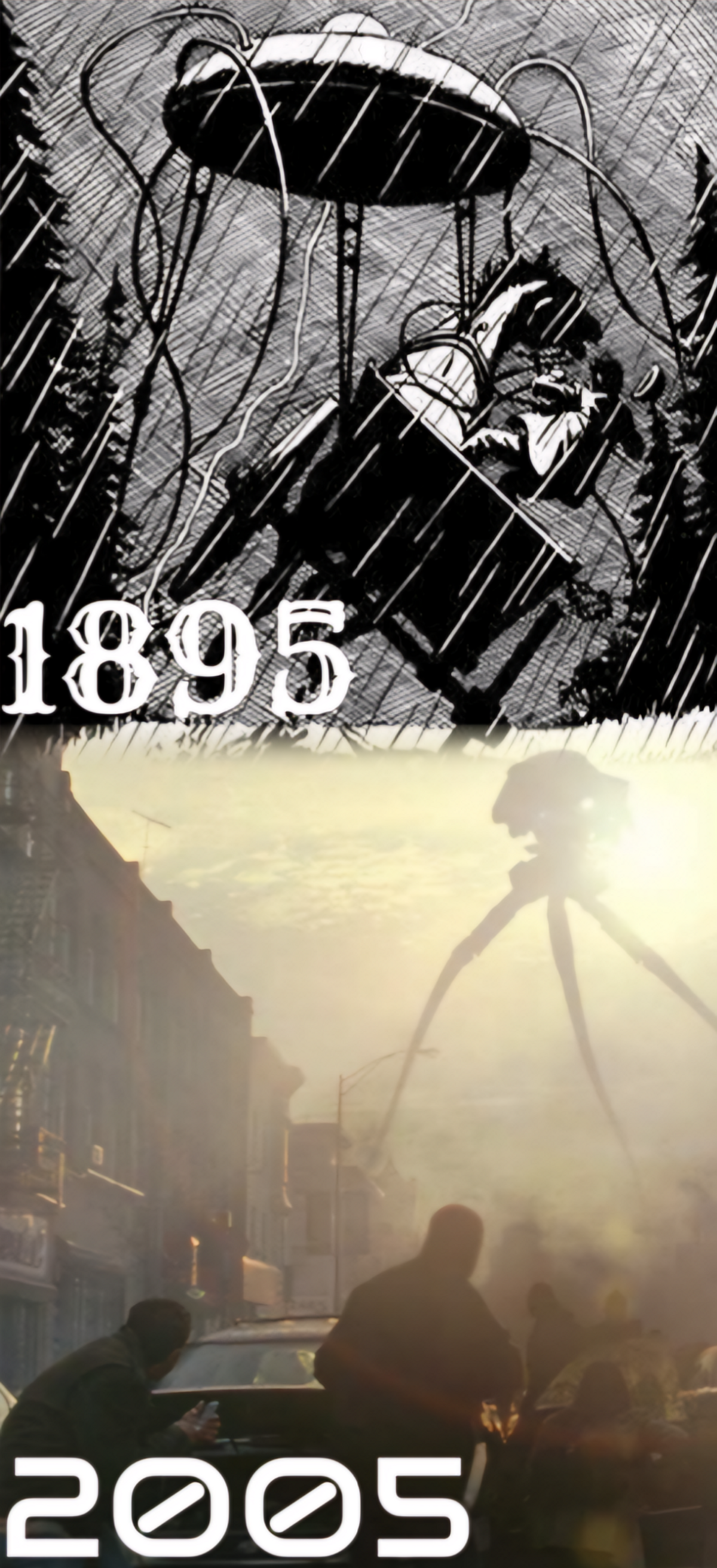
- The War of the Worlds is particularly prone to this in adaptations, with the 1938 radio play, the 1953 film, the 1980s TV series, the 2005 film by Steven Spielberg, the 2019 TV series, and the 2025 film moving the setting to the present day from the novel's 1902. Jeff Wayne's Rock Opera adaptation (and the PC game based on it), along with the third of the 2005 releases, are the only ones that keep the original setting.
- Bluebeard's Ten Honeymoons (1960) moves the true story of 1910s French Serial Killer Henri Désiré Landru to the 1940s.
- Birdy took place in the 1940s and as such had the boys fighting in World War II, but its film adaptation changed the setting to The Vietnam War.
- The 2007 film adaptation of Bridge to Terabithia changed the film from taking place post-The Vietnam War to being in contemporary times. This caused a lot of the film to be changed in order to fit 2000s standards. For example, Jesse's living conditions are changed, Leslie's design was revamped completely because her original look wasn't that "weird" anymore, Jesse was no longer Mistaken for Gay by his parents for being an artist, and a lot of the Values Dissonance was removed or edited. Despite the plot and character changes, the slang is still dated, someone forgot to tell the guy in charge of getting a school bus for the movie that it wasn't in The '70s anymore, and a few odd elements don't match well in a modern-day setting (Jesse's teacher going on a trip with him alone, Leslie's parents letting her run around in the woods unsupervised, the way Janice's abusive dad is glossed over, etc). Word of God is that they were going for a timeless feel, and as such, the movie doesn't have much that would date it to the 2000s.
- Casino Royale (2006) takes place in the 2000s instead of during the Cold War. Perhaps the most noticeable difference is the use of Texas hold 'em instead of baccarat due to the rise in popularity of poker at the time. It also helps that Texas hold 'em is a simpler game, more skill-based, and more directly competitive.
- Done in a meta-sense with Nineteen Eighty-Four; while the novel was published in 1949 and thus treats the events of the novel as a look into a (dystopian) future, the film of the book, released in the real-life year of 1984, instead stylizes the world of the movie into a pseudo retro (dystopian) present day. This is evident through the television monitors evoking that of the early twentieth century and rotary phone dials when touch tone phone dials were mainstream in the OTL eighties.
- Never Say Never Again: A remake of Thunderball set in the eighties rather than the sixties. SPECTRE still steals nuclear warheads and uses them to hold NATO to ransom, but this time, instead of planting the bombs in Miami, it plans to use them to wipe out the oil fields of the Middle East, evoking the oil shocks of 1973 and 1979. They're also shown to now be involved in the civil wars raging in Central America, impartially supplying both government and rebel forces. Bond, meanwhile, now has to deal with a younger M who's a by-the-book bureaucrat rather than a fellow World War Two veteran, while Q is shown complaining about both Thatcher-era budget cuts and union strikes disrupting supply chains, both of which play merry havoc with his workshop.
- James Bond: While the franchise often recycles its material, there are two basic plots in particular that have been updated repeatedly over the years:
- "Wealthy businessman tries to remove a bunch of his competitors from the board in order to increase his own market value."
- Goldfinger: The original. The villain is a gold magnate, who plans to irradiate the supply at Fort Knox (i.e. half the world's gold) in order to make the value of his own stockpile go up ten times or more.
- Live and Let Die: The seventies Blaxploitation version. The villain is an African-American drug dealer, who's planning to undercut his competitors in The Mafia until they're driven out of business, leaving himself with a monopoly on the country's drug market.
- A View to a Kill: The eighties, post-microchip-revolution version. The villain is a tech billionaire planning to destroy Silicon Valley, leaving himself with a monopoly on the market in microchips.
- The World Is Not Enough: The nineties, post-Soviet version. The villain is an oil heiress from Azerbaijan who plans to destroy Istanbul, the main transit point for her three Russian competitors, leaving herself the sole accessible supplier of Azerbaijani oil.
- "Criminal tries to start a world war between the superpowers in order to profit from it."
- You Only Live Twice: The original. SPECTRE is hijacking Russian and American spacecraft and letting the governments blame each other in order to push them into a full-blown nuclear exchange, leaving both the Western and Eastern Blocs in ruins and leaving Blofeld's employers (unstated, but heavily implied to be Red China) the sole surviving superpower and new world leader.
- The Spy Who Loved Me: The seventies version. The villain is a mad billionaire and Captain Nemo Copy who's hijacked Russian and American missile submarines in order to use them to trigger a world-ending nuclear exchange between them, after which he plans to build a new human civilization more to his liking in underwater cities. The movie addresses the easing in tension between the two sides of the Cold War by partnering Bond with a KGB agent.
- Tomorrow Never Dies: The nineties version, suitably updated for the Information Age and the takeoff of globalization. The villain is a media mogul who stages an incident in the South China Seas that leaves a British ship sunk and a Chinese plane destroyed in order to provoke a war between them, all to bring down the existing Chinese government and replace it with one more to his liking... so that it can grant him exclusive broadcasting rights in China, the last market in the world he hasn't tapped.
- "Wealthy businessman tries to remove a bunch of his competitors from the board in order to increase his own market value."
- The Bourne Series necessitated major changes to the plot of the original books, which were written in the 1970s, since the Ripped from the Headlines villains of the books were no longer relevant in the 2000s (one being just a teensy bit in prison for the rest of his life).
- The Saint and Mike Hammer have so far never appeared in film or TV adaptations in period pieces. The Armand Assante remake presented an updated story with Hammer as a Vietnam veteran instead of a Pacific Theater World War II veteran. Even though the last time Stacy Keach played Hammer aired over fifty years since the first appearance of Mike Hammer, it presented an updated story. Roger Moore's version of The Saint debuted over thirty years after the first appearance of the Saint in print in 1928, but presented an updated story, as did subsequent adaptations with Ian Ogilvy, Andrew Clarke, and Simon Dutton. The Val Kilmer film took place in contemporary times, arriving in theaters in 1997-almost seventy years after the Saint's debut.
- Superhero films tend to do this, often taking characters and concepts created during the Golden and Silver Ages and transplanting their origins to a contemporary setting. For example, the 2008 Iron Man took place during The War on Terror rather than The Vietnam War, and has Tony Stark kidnapped by an Afghan terrorist group instead of the Viet Cong, while the Fantastic Four reboot has the characters gaining their powers in 2015 rather than during the Cold War.
- The Spider-Man Trilogy is heavily inspired by the original Lee/Ditko run and stays true to the campy Silver Age tone of those comics, except instead of being set in the 1960s, it's the early-to-mid 2000s.
- The Spider-Man films update the technology but also address the changes in society since the initial publication of its source material, specifically in the way they handle Peter Parker; since being geeky isn't stigmatized like it was in the 1960s, the films (outside of the Spider-Man Trilogy since nerdiness still wasn't in the mainstream at the time) have changed Peter's social status accordingly, with The Amazing Spider-Man 1, which is set in 2012, initially portraying him as a moody, cool loner to retain his original misfit depiction from the comics, while Spider-Man: Homecoming, set in the late 2010s, mostly eschews the misfit thing entirely, portraying him as an easygoing kid who doesn't have as much trouble interacting with his peers and is even respected and valued for his smarts (as seen with his participation in the academic decathlon). Likewise, Flash Thompson goes from being a Jerk Jock who beats Peter Parker up, to a Nerdy Bully who still bullies him, just not in a way that involves violence or physical strength. Another change to the setting is that Peter's school, and New York itself, is much more racially diverse than the nearly all-white Monochrome Casting of the classic comics, and instead of the Daily Bugle newspaper, J. Jonah Jameson spreads his anti-Spider-Man propaganda through a controversial news site, TheDailyBugle.Net.
- The Spider-Man Trilogy is heavily inspired by the original Lee/Ditko run and stays true to the campy Silver Age tone of those comics, except instead of being set in the 1960s, it's the early-to-mid 2000s.
- Scrooged is Charles Dickens' A Christmas Carol in the 1980s. It works, though, because of the cleverness of using a Show Within a Show concept — the Scrooge analog is producing a live TV adaptation of the original A Christmas Carol, yet clearly misses the point until it happens to him.
- Spirited (2022) is a version of A Christmas Carol set in the modern day, albeit with the main difference being the former is a musical.
- This used to be commonplace for Sherlock Holmes movies. For instance, only the first two of the Rathbone/Bruce series in the 1930s-1940s (the 20th Century Fox ones) took place in the Victorian era, with the twelve Universal films ("The Baker Street Dozen") set firmly in World War II and later the post-war era.
- Carrie is set in the '70s but received two remakes that did this.
- Carrie (2002) is a Made-for-TV Movie that updates it to 2002, with the teen characters using cell phones and emails to communicate. Carrie uses the internet to research her powers, rather than books in the library, the testimonials from Carrie's peers are filmed with video cameras rather than transcribed from tape recorders. Additionally, the film adds a small detail where the culprits who killed the pigs get busted with CCTV footage.
- Carrie (2013) addresses cyberbullying, with Chris recording a video of Carrie's traumatic first period and later playing it at the prom — the video later being used to discredit Chris's father's attempted lawsuit. It's also said that social services stepped in to stop Margaret from home-schooling Carrie.
- Charlie and the Chocolate Factory: In particular, Mike Teavee's addiction is changed from gangster movies and westerns to violent video games! There are animatronic puppets that malfunction comically! (Strangely enough, when Teavee is confronted with a video game setting inside the factory, he claims that it is "lame".)
- Kamen Rider: The First and Kamen Rider: The Next are remakes of Kamen Rider and Kamen Rider V3, but with the setting changed from the 1970s to the Turn of the Millennium.
- The two Allan Quatermain films with Richard Chamberlain and Sharon Stone moved Quatermain forward to the World War I era, not the 1880s and earlier setting of the H. Rider Haggard novels.
- Phantom of the Paradise is The Phantom of the Opera and Faust in The '70s.
- The Lair of the White Worm was an old Bram Stoker novel updated to modern-day for the film adaptation.
- The A-Team is an adaptation of the original series with Iraq veterans.
- The 1998 film version of Great Expectations is set in Florida and New York in the Seventies and Eighties, and Pip's name is changed to Finnegan Bell, among other name changes.
- Click is "The Magic Thread", an old French tale, set in the modern-day United States. The premise of a tv remote control that can control time is taken from an old Buster Comics strip called Vid Kid.
- Huck and the King of Hearts is Adventures of Huckleberry Finn in the 1990s, with a truck instead of a raft.
- The original sci-fi story Who Goes There? was written in the 1930s. The Thing (1982) gave the year as 1982, the same year it was released.
- Hedda Gabler's 2004 American film adaptation moves the setting to present-day Wenatchee, WA.
- You've Got Mail is The Shop Around the Corner in modern-day America. (It's even given an Inspiration Nod with the name of Meg Ryan's bookstore.)
- The Live-Action Adaptation of Dudley Do-Right was updated to The '90s.
- Weird Science (1985) was adapted from a 1950s comic book story and updated for The '80s' home computer age.
- Annie (2014) is set in The Present Day rather than The '30s, averting the Politically Correct History of Annie (1999). This produces several other changes, such as Miss Hannigan running a foster home instead of an orphanage.
- D-Day was a remake of Commando with the setting changed from 1985 to 2008. As such, some scenes were changed around, for instance a scene in the original where a henchman is desperately looking for a pay phone was swapped to a water park so the remake's henchman was in swimming trunks and doesn't have a phone on him.
- The Universal Horror films Frankenstein (1931) and Dracula (1931) are both based on books written in the 19th century, but the films take place in the then-present day.
- The 2001 Made-for-TV Movie Murder on the Orient Express is the original novel transplanted to the Turn of the Millennium.
- Matilda is the original novel transplanted to 1990s America. Miss Trunchbull, however, remains British.
- The Children's Hour is subtle in its update from the 1930s to the early 1960s. The major difference is that television exists.
- Jem and the Holograms (2015) is a very loose adaptation of the 1980s Jem cartoon taking place in the 2010s.
- Apocalypse Now is a loose adaptation of Joseph Conrad's Heart of Darkness, which is set during the Scramble for Africa period in the Congo, showing the savageries carried out in the name of imperialism. The film updates this setting to The Vietnam War when the U.S. intervened in Southeast Asia, showing that War Is Hell.
- The Manchurian Candidate (2004) is set in the time period during and after the first Gulf War, as opposed to the original Korean War setting.
- A 1998 Made-for-TV Movie of Through the Looking-Glass on Channel 4 had a contemporary setting, although the nature of Looking Glass Land is such that this was only obvious in the Framing Story (where Kate Beckinsdale's Alice is a grown woman reading Through the Looking-Glass to her daughter) and the costuming decisions.
- Inverted in Mary Poppins, which moves the story back in time from the 1930s to the 1910s. Mary Poppins Returns takes place 20 years after the first movie, meaning the stories it adapts actually take place in the same decade featured in the books.
- Scarface (1983) is a modern remake of the classic 1932 film, maintaining a contemporary setting that reflects the time of its release. While the original was set in The Roaring '20s of Chicago and focused on The Mafia, the 1983 version shifts the narrative to early 1980s Miami, prominently featuring Cuban immigrants. This update not only recontextualizes the story but also infuses it with the cultural and social dynamics of that era, showcasing the rise of drug cartels and the complexities of the immigrant experience in America.
- She (1965) updates the story from "18—" to 1918 and makes the heroes a group of recently-demobbed British soldiers.
- Not that it matters much (since the updated setting is destroyed), but in The Hitchhiker's Guide to the Galaxy (2005), Arthur is from an era of videophones rather than one when people "still think digital watches are a pretty neat idea".
- Inverted with Blood of Beasts, which is Beauty and the Beast in Norse times.
- Ivansxtc is a loose adaptation of the Leo Tolstoy novel The Death of Ivan Ilych. The original was set in 19th-century Imperial Russia, the film is set in 21st century Hollywood.
- Wonder Woman (2017) inverts this, changing the setting from World War II to World War I.
- The original book It, written in 1986, has "The Losers Club" meeting in 1957 as teenagers, then reuniting in 1984 as adults. It (2017) has them meeting as teenagers in 1988, with a Sequel Hook at the end identifying the movie as It: Chapter One. Considering the entity "It" is supposed to awaken every 27 years, It: Chapter Two takes place in 2015.
- Harry Potter takes place in the '90s, but the film adaptations ignore this and set them in the years they were made. For example, Harry Potter and the Philosopher's Stone is set in 2000-2001. It becomes noticeable from the third film onwards, in which the fashions are those of the early 2000s rather than the '90s, Mr. Weasley is fascinated by an Oyster Card reader (established in 2003), and the Millennium Bridge features in the sixth film.
- The Magnificent Trio is a very loose adaptation of Hideo Gosha's Three Outlaw Samurai, but the setting has been updated from feudal Japan to Ming Dynasty China.
- Mighty Morphin' Power Rangers was set in the '90s. The Continuity Reboot Power Rangers (2017) sets it in The New '10s.
- The Paddington Bear books were written in the 1950s and '60s. Paddington (2014) is set in the modern day, although it leaves the exact time period vague. The biggest change involves Mrs. Bird; she's a live-in housekeeper in the books. Naturally not likely for a modern middle-class English family, so she's said to be a relative.
- I Know What You Did Last Summer is based on a book that was written in the 1970s, but the film takes place in the late '90s... not that this is the only difference.
- Bride and Prejudice is naturally Jane Austen's novel in modern-day India. The Culture Clash between the Bennets and Bingleys is achieved by making the Bennets Indian, while the Bingleys are second-generation Indians in England. Darcy becomes an American WASP.
- It's a testimony to how long ethnic Russians have been fighting the peoples of the Caucasus that Prisoner of the Mountains, set in the 1990s First Chechen War, is actually an adaptation of a 120-year-old Leo Tolstoy short story, "Prisoners of the Caucasus".
- Both adaptations of Red Dragon — 1986's Manhunter and 2002's... erm... Red Dragon — update the story from 1979 to an ambiguous point in the mid-'80s. In the case of Manhunter, this was simply a case of making the plot more contemporary, though not without the minor anachronism of Dolarhyde still seeking out his victims from the 8mm and 16mm home movies he develops for them, which revolved around a method of technology that was quickly rendered obsolete by the rise of camcorders around the same time. In the 2002 film, the change in setting is more to preserve continuity with the 1991 film adaptation of The Silence of the Lambs, which itself also changes the setting to 1990, the intended year of its release before it got pushed back in favor of Dances with Wolves (the book version of Lambs never specifies when it's set but is quietly implied to take place in or just before its publication year of 1988). The 2002 film also better updates the story to fit the new setting by changing the circumstances of Dolarhyde's job so that he now edits families' camcorder recordings onto a single tape.
- A Little Princess is set during Victorian England. A Little Princess (1995) sets it in New York during World War I. As a result, the reason Sara's father leaves her with Miss Minchin is to fight in the war. Becky in the book is a Victorian-era cockney maid but becomes an African-American slave instead.
- Who Censored Roger Rabbit? takes place in a Retro Universe version of The '80s (when the book was published), however, its 1988 film adaptation inverts this trope by placing it in The '40s.
- Pan takes place during World War II as opposed to the original play and book's Edwardian setting. As this is an origin story for Peter, those events took place in Victorian times.
- Ebenezer (1998) transplants A Christmas Carol to the Canadian frontier.
- Summer Camp Nightmare adapts The Butterfly Revolution to take place in The '80s, complete with music and technology from that era.
- The Muppets' Wizard of Oz, in addition to being an Anthropomorphic Animal Adaptation, is set in the present day with Dorothy as a would-be pop star, a nightclub called Poppyfields, the Wizard as a Hollywood effects guy, and so on.
- An American Christmas Carol transplants the setting from 1843 London to Depression-era America.
- All the Troubles of the World: References to Baltimore and DC have been removed, creating a more timeless story that would translate better to other areas.
- Whilst the Mortal Engines books were implied to take place roughly 10000 years or more from the present day, comments from the film adaptation's production designer place the movie at approximately 1700 years from now.
- Pet Sematary (2019) has Gage and Ellie watch an episode of SpongeBob SquarePants instead of The Muppet Show.
- William Shakespeare's Romeo + Juliet does Romeo and Juliet in the modern day... with guns.
- About a Boy's literary counterpart is set in the 1990s, but the film adaptation is in the 2000s. This majorly changes the last part, which in the book deals with Kurt Cobain's suicide.
- A 2000 adaptation of Hamlet by Michael Almereyda updates the Shakespeare play to the year 2000, with it now concerning a business empire.
- Inverted in Dumbo (2019). The original animated film was made and set in the 1940s (there's even a brief gag referencing World War II), but the live-action remake takes place in the 1920s.
- Shortcut to Happiness is a setting update of The Devil and Daniel Webster, with the action moved to the publishing world of modern-day Manhattan.
- The Who's Tommy is set in pre-WWI, but the movie changes it to post-WWII — explicitly shown by the song "1921", being changed into "1951".
- King Ralph was loosely based on a novel by Emlyn Williams titled Headlong. The book took place during the 1930s, while the movie took place during its time of release in 1991.
- The Fly (1986), being an In Name Only adaptation of the 1957 short story anyway, is set in the then-present day of 1986, with many of the various technological, scientific, and social advances that happened in the interim proving key to the plot. For instance, the main character is genetically fused with an insect in a Teleporter Accident rather than having his head and hand proportionally swapped with it, and his love interest's videotapes of his work come in handy at one point. When the film was given a Screen-to-Stage Adaptation into an opera in 2008, the trope was inverted in its original Paris and Los Angeles stagings to reset the story in the 1950s, although the libretto is vague enough that it can be set in The Present Day without alterations (as a later staging in Germany did).
- The original Cats musical is depicted as taking place contemporarily to the production (which means it was originally set in The '80s). The 2019 Cats film is set in the Genteel Interbellum Setting of the original poems.
- Roxanne is Cyrano de Bergerac relocated to small-town America in The '80s, with C. D. Bates (Cyrano) and Chris (Christian) as firemen.
- The Italian Job (1969) has a British heist crew organized in London to pull off a caper in Turin. The Italian Job (2003) has an American heist crew pull off a caper in Venice only to be betrayed by one of their members. They follow him to Los Angeles to perform another caper out of revenge.
- The 2002 film adaptation of Tuck Everlasting moves the setting from the book’s year 1880 to 1914 in order to make the movie closer to the present day. Among the changes included are the Fosters owning a Ford Model T, Winnie having to wear a corset (which was outdated by then) and going on a tour of the world. Unfortunately, this last-mentioned change is very problematic, as World War I was just around the corner...
- The Island of Dr. Moreau (1996) moves the events of the original novel to the then-present day of the 1990s. Among other things, tech like radios, computers, and ceiling fans are in use; the music used; Edward Douglas (Edward Prendick in the book) working for the UN; and (in an element shared with the 1977 film) going with genetic engineering for the creation of the hybrids.
- Shredder Orpheus takes the Orpheus and Eurydice myth from Ancient Greece to a futuristic American dystopia with 1980s flair.
- The 1978 film adaptation of The Big Sleep moves the setting from the 1940s to the present day.
- Dark Heritage moves the action of The Lurking Fear to the Present Day (i.e., 1989) and changes the locale from Lovecraft Country to The Savage South.
- Fire Island is a modern, gay retelling of Regency romance Pride and Prejudice.
- The Bennet family is reimagined as a five-man friend group of gay men and their lesbian friend/mother figure Erin. Mr. Darcy and Mr. Bingley are now Will and Charlie, rich guys who are staying in a huge house on Fire Island. The desire for Jane to marry Bingley translates to Howie wanting and getting a genuine connection with Charlie, even as Elizabeth analog, Noah just wants Howie to get laid and get it over with.
- The subplot of Lydia's defilement by Wickham becomes Luke getting a sex tape uploaded to the internet without his consent by Dex, which Darcy analog Will solves with his legal expertise rather than a Shotgun Wedding.
- Five Nights at Freddy's 1 is set in November of an unknown year, with the most commonly accepted timeframe for the game's events being The '90s. The film is established by security footage to take place during April 2000.
- The Red Shoes was set in 19th-century Denmark. The 1948 film adaptation by Michael Powell and Emeric Pressburger moved the setting to post-WWII Europe.
- From Les Visiteurs to its remake Just Visiting, the medieval part is changed from early 12th century France under Louis VI the Fat to late 12th century England under Henry II, and the modern-day part from early '90s France to the United States in the early 2000s.
- Coriolanus changes the setting from Ancient Rome to the present and evokes the Balkan wars without being specifically set during them.
- Quasimodo d'El Paris is a comedic version of The Hunchback of Notre Dame and moves the story from the 15th century to The '90s.
- Both film adaptations of Leo Tolstoy's The Death of Ivan Ilyich move the setting from 19th-century Russia to the early 1950s and move the location to match where they were produced. The first, Ikiru, takes place in Tokyo, while the second, Living, takes place in London.
- Inverted with The Blue Lagoon (1949), a notable departure from its source material, presenting a distinct alteration in a temporal context. While the original literary work emerged and unfolded within the contemporary milieu of The Edwardian Era, encompassing an extensive timeframe spanning from 1896 to 1907, the film uniquely transposes the chronology by over five decades. Specifically, the movie relocates the narrative's temporal scope to a duration of eleven years commencing from 1841 and culminating in 1852.
- You Are So Not Invited to My Bat Mitzvah: The book takes place in 2005, while the film is set in 2023.
- Chitty Chitty Bang Bang inverts this trope, the book takes place in the 1960s, but the movie adaptation takes place in The Edwardian Era.
- Anyone but You is loosely based on Much Ado About Nothing, transferring the setting from Renaissance Italy to 2023 Australia.
- Night of the Eagle moves the events of Fritz Leiber's Conjure Wife from the early 1940s (contemporary to when the novel was written) to the early 1960s (contemporary to when the film was made). It also undergoes an Adaptational Location Change from America to England.
- Moonlight is a retelling of Paul and Virginia with an African-American gay couple.
- Pan Kleks Series: The films are set in the years they were made and the children dress according to the fashion of the time. In hospital room in "Travels" they are hanging posters of e.g. Michael Jackson, Iron Maiden, Duran Duran and Bajm, while the crippled boy wears a pajama with Captain America. Fairy tales are not limited to literature, because among the invited fairy tale characters in first film there is Mickey Mouse, while Wolf and Hare from Nu, Pogodi! appear at fairy tale festival in Bajdocja in the movie's sequel.
- Cymbeline is a setting update of the William Shakespeare play of the same name. In this version Cymbeline is a drug kingpin who rules his bike gang, the Britons, with an iron fist and a large arsenal. He dotes upon his alluring Queen, who encourages him to defy a "tribute" from the Roman Police Force, there by setting a deadly turf war into motion.
- The 1996 filipino film Kristo👁 Image
is a retelling of the Life of Jesus Christ, set in ancient Philippines instead of the Middle East. - The Hound Of The Baskerviles 2002 is set in the time period the original tale was published as opposed to when it was originally set, and so it is set in early Edwardian era rather than 1889.
- Up Pompeii!: The original series was set around 55 BC (the second episode, "The Ides of March", involves Julius Caesar's assassination). The film is set in 79 CE, in order to end with the eruption of Vesuvius.
- Inverted with The Producers. While the original movie was presumably set around the time it was released (1967), the 2005 musical movie is set in 1959.
- Anne of Green Gables: Both the 1985 film and the 2016 Breakthrough Entertainment trilogy move the setting from the Victorian era to the Edwardian era.
- The films based on Jack Ryan novels will sometimes do this.
- Clear and Present Danger: A fairly minor one. In the book, published in 1989, the villains are the Medellin Cartel, with their leader Ernesto Escobedo being a transparent expy of the real life Pablo Escobar. However, the movie didn't come until 1994, by which time Escobar was dead and the Medellin Cartel in ruins. So Escobedo is instead turned into the leader of the Cali Cartel, Escobar's main rivals who had pretty much taken over the Colombian drug trade at this point.
- Much more infamous is The Sum of All Fears, best remembered for not only moving the story from the early 1990s to the early 2000s, but changing the villains from Palestinian Muslims to European neo-Nazis in what was widely assumed to be a response to the 9/11 attacks (the film was actually done filming before then). Probably not appreciated by most viewers is that the book was so tied to then-current events that a faithful adaptation couldn't possibly have been set in any year other than 1991.note The book is set after The Gulf War but before the collapse of the USSR, both of which are fairly plot relevant. The villains aren't just Palestinian Muslims, but a number of far-left radicals left despairing at their abandonment by the Soviets, including several West German terrorists from the Red Army Faction, and an East German nuclear scientist, whose involvement is critical to success. The story portrays Soviet-American relations as being at a high point - which is what the terrorists are trying to reverse - which was accurate enough for 1991, not so much for ten years later, when the post-Cold-War friendship had already cooled significantly due to American and Russian outrage at their counterparts' behavior in Chechnya and Serbia respectively, something that becomes a major plot point in the movie. Finally, the sort of terrorists that were responsible for the book's events were largely extinct by the time of the millennium, precisely because of the loss of Soviet support (critics often miss that even the Palestinians in the book were affiliated with the PFLP - a Marxist-Leninist group founded by a Palestinian Christian - rather than the jihadist groups like al-Qaeda and Hamas that were making headlines when the movie came out). Changing the villains from a far-left communist group to a far-right islamist one would have been no less egregious than turning them into far-right European fascists.
- Cindy moves the story of Cinderella to Harlem in the 1940s, with a a Black cast.
- Stephen Fry's The Star's Tennis Balls is The Count of Monte Cristo IN 1990s BRITAIN!
- James Joyce's Ulysses is The Odyssey IN DUBLIN WITH ORDINARY PEOPLE! And REALLY CONFUSING!
- And Jacob M. Appel's The Biology of Luck is Ulysses IN NEW YORK!
- Harry Turtledove's Confederacy series Timeline-191 is The Great Patriotic War IN AMERICA! Featherstone is Hitler, Houston/Kentucky is Austria/Sudetenland, Morrell is Rommel, and Pittsburgh is Stalingrad.
- Jane's Smiley's A Thousand Acres is King Lear ON A FARM IN IOWA! FROM GONERIL'S POV!
- Reginald Hill's Pictures of Perfection is Pride and Prejudice Oop North IN THE 1990s! AS A GAY ROMANCE!
- Will Self's Dorian is The Picture of Dorian Gray IN THE TWENTIETH CENTURY
- Older Than Print: The Middle English poem Sir Orfeo is Orpheus and Euridyce IN MEDIEVAL WESSEX, WITH THE KING OF The Fair Folk INSTEAD OF THE GOD OF THE DEAD AND A HAPPY ENDING!
- The Austen Project is all Jane Austen's novels (but not Lady Susan or Love and Freindship) IN 21st CENTURY BRITAIN! Starting with Sense & Sensibility by Joanna Trollope, which is Sense and Sensibility WITH SOCIAL MEDIA!
- Looking Glass Girl by Cathy Cassidy is Alice's Adventures in Wonderland WITH ALICE IN A COMA FOLLOWING AN ACCIDENT (OR WAS IT?) AT A SLEEPOVER! Written for the 150th anniversary of Alice.
- Conversational Troping in "Pierre Menard, Author of the Quixote" by Jorge Luis Borges, which declares Menard's identical-to-the-original version of Don Quixote to be a far superior reinterpretation than "those parasitic books which situate Christ on a boulevard, Hamlet on La Cannebière or Don Quixote on Wall Street".
- Katy by Jacqueline Wilson is What Katy Did UPDATED TO THE 21ST CENTURY, WITH KATY'S ACCIDENT LEAVING HER PERMANENTLY, NOT TEMPORARILY AS IN THE ORIGINAL, PARALYSED.
- Area 51: The 2012 e-book version of the first book updated references to reflect time passing since it was published in 1997. Turcotte reference 9/11, and Von Seeckt no longer states that his birth year was 1918-while fairly plausible then as 79, he'd be 94 when the e-book came out. Of course, the reference to joining the SS in 1940 remains, so if he'd been younger it raises questions. There's only so far a character's age can be pushed (yet the next book says his birth year is 1918 anyway).
- A rare example of an author doing this with her own work, Lois Duncan started writing in the '50s and her books were usually Unintentional Period Pieces. As they were aimed at the YA demographic, she opted to give most of her stories an update in the 2000s - changing the slang and fashions for the most part. She incorporated modern technology, while still finding reasons for characters not to have anything that would have broken the plot.
- Minor example with Goosebumps, when the series was re-released. The Time Travel book Cuckoo Clock of Doom originally took place in 1995, while the protagonist's younger sister was born in 1988. The newest edition changes those dates to 2015 and 2008, respectively. Nothing else is changed, though, so for some reason, only one of the family's computers has internet access.
- The Princess Trilogy, by writer Gabrielle Charbonnet, turns the story of A Little Princess into a trilogy titled Molly's Heart, The Room in the Attic, and Home at Last. The setting updates to the 1990s (with multiple references to that era), moves the story to Boston, and changes Sarah's name to Molly as well as many other characters; here, she loses her movie director father to cholera while he's in Brazil.
- Late 1980s / early 1990s reprints of the Jennings books updated some of the details, for example "Hey, you guys!" for "I say, you chaps!", with original author Anthony Buckeridge's but it didn't really work because they would change to decimal currency and adjust for inflation, while in the same paragraph retaining shop practices (food being sold loose and weighed and packed into parcels) which had largely disappeared by then, and even more so in the years that followed. Later reprints have tended to accept the books as period pieces and kept the original text unaltered, partially because the demographic shift in British pop music in the early 21st Century, and subsequent and related shifts in the leadership of the Conservative Party, made it much harder for people to accept private schools in the present tense as shut off from contemporary culture.
- In the same era, Enid Blyton books (see also below for a TV adaptation of this era) had The Famous Five on the cover wearing then-current clothing. Subsequent editions have tended to depict them wearing period clothing, and a 2010 revision to use more contemporary language has since been reversed, accepting that they cannot practically be updated without the internal logistics crashing down.
- The Meant To Be books adapt the Disney Princess movies (which have quasihistorical settings) as romance novels set in 21st century America.
- The Bear and the Dragon does this to the earlier Tom Clancy novel Red Storm Rising. The most powerful communist nation in the world (China instead of the USSR) faces a major economic crisis (due to a collapse in demand for their exports rather than their oil industry) and decides to seize the nearest foreign oil fields (Siberia instead of the Persian Gulf) in order to reinject some wealth into their economy. In the process, they start a Third World War against NATO (because Russia is now a member of NATO, as opposed to the original novel where breaking up the Western alliance structure was supposed to hamper American aid to its Persian Gulf allies). When the war goes badly (because the Chinese army was spectacularly unprepared to face both Russian determination and American technology, whereas in the original novel the war was an extremely close thing would have gone the other way if the Soviets had managed to sink just a couple more convoys bringing supplies to Europe), the Politburo starts contemplating the use of nuclear weapons rather than seeking peace, eventually leading to a coup that overthrows them before they have a chance to start a global nuclear war.
- Bosch: Both the original Harry Bosch novels and the TV series are Like Reality, Unless Noted, but the novels were set and published beginning in the 1990s. The TV series moves the timeline up to the mid-2010s, which among other things results in Bosch being changed from The Vietnam Vet to a Persian Gulf and War on Terror vet. The Internet and social media also plays a much larger role, having barely existed when the novels first came out.
- Cat's Eyes goes from '80s Tokyo, Japan in the manga and anime to 2020s Paris, France.
- Moon Lovers is Scarlet Heart IN GORYEO-ERA KOREA!
- Mr. Queen is Go Princess Go IN JOSEON-ERA KOREA!
- Miss S is Miss Fisher's Murder Mysteries IN 1940S CHINA!
- Shakespea Re-Told [sic] is blatantly this:
- Much Ado About Nothing takes place in a modern tv studio.
- Macbeth IN A MODERN DAY RESTURANT!
- The Taming of the Shrew WITH POLITICIANS!
- A Midsummer Night's Dream IN CENTER PARCS!
- ITV did a TV production of Othello AS A MODERN DAY COP DRAMA, WITH OTHELLO AS A NEWLY PROMOTED POLICE COMISSIONER AND IAGO AS HIS JEALOUS FORMER PARTNER! Worth checking out for Christopher Eccleston emanating pure malice as Jago, before being cast as the Doctor in Doctor Who.
- A lot of Agatha Christie adaptations reverse this trope — Christie kept publishing new works from 1920 to 1973, and in many of her stories describes contemporary clothes, etc.. But most adaptations of her work have a 1930s design sensibility.
- Too Many Suspects, the pilot film for Ellery Queen, is set in 1946 despite being based on a 1965 novel — The Fourth Side of the Triangle—set roughly in the present. While both book and movie have a solution deriving from the victim's TV set, it's more of a novelty in the latter that she even has one.
- Brazilian soap opera O Cravo e a Rosa👁 Image
(lit. "The Carnation and the Rose", after a local song) is The Taming of the Shrew IN 1920s SÃO PAULO! - Spoofed in a Channel 4 documentary about Hamlet, which reinvented it as AS A GLOSSY AMERICAN SOAP! to make a point. The Ghost was replaced by a Video Will, and the Oedipal undertones rapidly became text.
- Kings is the biblical story of King Saul and David IN SOME SORT OF PARALLEL UNIVERSE CLOSELY RESEMBLING MODERN AMERICA!
- There are two unrelated Russian TV miniseries, Graf Krestovsky (Count Krestovsky) and Favorsky, both of which are The Count of Monte Cristo IN PRESENT-DAY RUSSIA! And now there's a third one, aptly named Montekristo...
- Cosmo and George is Mork & Mindy IN SINGAPORE! WITH MINDY AS AN INDIAN GUY!
- Shasta McNasty is The Monkees IN 1999! WITH RAP-ROCK INSTEAD OF BUBBLEGUM POP (AND A LOT MORE PERVING ON THEIR NEIGHBORS)!
- There's a BBC Macbeth, made in 1997👁 Image
and starring James Frain and Ray Winstone, set in A PRESENT DAY SLUM! - SeaQuest DSV is effectively Star Trek: The Next Generation OUT OF SPACE!, much more pronouncedly so after the end of TNG's run. (In the first seaQuest episode after TNG ended, an alien race arrives in a ship whose design was quite obviously lifted from that of the Borg Cube.)
- Currently making waves across east Asia, the Korean revenge drama Cruel Temptation is The Count of Monte Cristo IN MODERN TIMES WITH GENDERFLIPS!
- Chōjinki Metalder is Android Kikaider SET IN THE The '80s WITH A World War II BACKDROP!
- Channel 4 schools programmes about Shakespeare often did this: Julius Caesar AS A MODERN DAY POLITICIAN! WITH MARK ANTHONY'S FINAL SPEECH BEING TELEVISED!; Macbeth ON A COUNCIL ESTATE! WITH TEENAGE WITCHES ON ROLLERBLADES!; Twelfth Night WITH THE ROUND SUNG BY SIR TOBY AND FESTE AS A RAP! Since they only did a couple of scenes, they didn't have to maintain the concept for the whole play.
- Channel 4 again, Macbeth IN MODERN DAY SCOTLAND, ONLY IT'S STILL AN INDEPENDENT COUNTRY!
- The BBC did a version of Twelfth Night IN THE MID 20TH CENTURY! WITH SEBASTIAN AND VIOLA AS ILLEGAL IMMIGRANTS!
- Sherlock is Sherlock Holmes IN THE TWENTY-FIRST CENTURY!note Sadly, one of the things which need no change was Watson's military service in Afghanistan. The only nod to current events was Sherlock bringing up the possibility that he could have served in Iraq instead.
- Elementary, one-ups Sherlock by moving the action to New York and making Watson an Asian woman.
- Daimajin Kanon is a remake of the original film, but with the setting changed to The New '10s.
- The 1991 prime time revival of Dark Shadows was essentially the same as the classic series with the modern story arcs updated from the mid-to-late 1960s/early 1970s to the early 1990s. The aborted 2004 WB version would have once again updated the modern portions of the series to the then present day.
- Pretty Guardian Sailor Moon still takes place in Tokyo, but in 2004 rather than 1992 like in the original manga. As such, the technology and fashion are updated accordingly, with the communicators and Disguise Pen replaced by magical cell phones that served the same purpose. The original anime had the Local Hangout as an arcade, which had fallen from popularity in the 2000s, so Crown becomes a karaoke parlor, with the girls getting mission briefings from a private room.
- With Law & Order: UK's episodes being based off of episodes from the original series, not only did the dialogue need to be "translated" into British English, but it also needed to be updated to reflect modern times; technology, cultural references, et cetera.
- Little Women (2022), like the book it's loosely based on, focuses on a family of daughters with financial difficulties. Moving the setting from 1860s America to modern South Korea differentiates the reason for their poverty (hypercapitalism and unsupportive parents vs wartime) as well as the results of this in the girls, and provides other immediately available avenues for financial security besides marriage.
- The 2000 unaired pilot M.3.K is The Three Musketeers IN MODERN AMERICA! ONLY THERE'S A KING AND GUNS ARE ILLEGAL SO EVERYONE FIGHTS WITH SWORDS! WITH A GENDERFLIPPED D'ARTAGNAN!
- Smallville is the original Superboy comics with a Hotter and Sexier tone and the setting changed from the 1950s to the Turn of the Millennium (The Present Day when the series was made).
- In-Universe example in the Red Dwarf episode "Better Than Life":
Lister: They've remade Casablanca! Philistines! How can you remake Casablanca? The one starring Myra Binglebat and Peter Beardsley was definitive!
Holly: I saw that. Knockout. "Of all the space-bars in all the worlds, you had to rematerialise in mine." - Selfie is My Fair Lady set in a modern-day pharmaceutical company. Lowly flower girl Eliza Doolittle is now Eliza Dooley, a self-absorbed Plucky Office Girl obsessed with social media, while Prof. Henry Higgins becomes PR spin doctor Henry Higgs, who takes it upon himself to make Eliza into a better person.
- Only a borderline example as the original is very vague about when it's set, but The Day of the Triffids (1981) moves the setting from "20 Minutes into the Future from the perspective of The '50s" to Next Sunday A.D. in The '80s. The Day of the Triffids (2009) might also count, although it also diverges so far from the source material that it's probably beyond the remit of this trope.
- The Father Brown stories were written and set between 1913 and the mid thirties. The 2013 TV series is set in the fifties.
- Paul Merton in Galton and Simpson's... was Hancock's Half Hour and Comedy Playhouse IN THE 1990s!
- When the character of Harry Bosch debuted in novel The Black Echo in 1992, he was a Vietnam veteran. 23 years later, when the TV series Bosch premiered, Harry Bosch was a Gulf War and Iraq War veteran.
- Agatha Christie's The Clocks is originally set during the Cold War. The ITV adaptation moved the year back to a pre-WWII era to keep the setting in line with the previous episodes, which were explicitly set in the 1930s. Likewise Third Girl; the central concept of the 1966 novel was "Hercule Poirot meets Swinging London", but the TV version is, again, set in the thirties.
- The BBC adaptations of the later Miss Marple novels. At Bertram's Hotel (1965) is an interesting example; the hotel is specifically described in the book as determinedly old-fashioned, so moving the setting back a few decades doesn't require altering it much, it just becomes somewhat less old-fashioned in context.
- The Arrowverse series are decades-old comic books adapted for The New '10s. Smartphones are ever-present (Supergirl even somehow manages to carry one around in her suit), popular brand names are mentioned (such as Barry having to call for an Uber when his powers fail). Social media is also key, and Iris West now publishes online articles instead of physical newspapers. Even the nature of Barry's powers is changed from Lightning Can Do Anything to a Magical Particle Accelerator.
- The Netflix Marvel Cinematic Universe series are updates of comics that premiered decades ago. The shows that faced the most challenges with this were Daredevil (2015) and Iron Fist (2017). Daredevil had the problem of taking place in the Hell's Kitchen neighborhood of Manhattan, which at the time the comics were written was a Wretched Hive full of crime and gang violence; however, today the neighborhood has long since gentrified. The show explained the crime as being due to the events of The Avengers (2012) destroying Hell's Kitchen and causing an increase in crime. Iron Fist faced this at a more meta level, as major criticism even before the show came out was the Mighty Whitey plot (some critics even calling for a Race Lift to an actual Asian), with some critics noting that this premise was acceptable when the comic first came out in the '70s, but now seems dated.
- The Handmaid's Tale updates the 1985 book to the 21st century, although it's unclear if it's an alternate present, Next Sunday A.D., or 20 Minutes into the Future. Modern technology is mentioned, for example, Offred (then known as June) meets her husband Luke when Moira randomly stops him on the street to ask what he thinks of Offred's Tinder profile.
- Sons of Anarchy is deliberately structured as Hamlet as an outlaw motorcycle gang!
- Wonder Woman (1975): Season 1 was set in World War II with Wonder Woman posing as Yeoman Diana Prince to get leads on where she was needed. Season 2 and 3 were in the 1970s and focused on Agent Diana Prince fighting Mad Scientists, Corrupt Corporate Executives, and other contemporary foes.
- The PBS special An Empire of Reason updates the setting of the time the Constitution was signed to the present day — in a sense, at least. Despite the modern-dress updates to the characters that appear, and the format resembling segments from television broadcasts of the aptly-named fictional Continental Television Network (CTN for short), the setting remains the late 1780s, with present-day public affairs personalities such as celebrated anchorman Walter Cronkite, ABC World News This Morning anchorman Forrest Sawyer, NBC journalist John Chancellor, NBC weatherman Al Roker, NewsHour host Robin MacNeil, NBC chief congressional correspondent Andrea Mitchell, syndicated talk show host Phil Donahue, and Firing Line host William Buckley interacting with period players such as Alexander Hamilton and Robert Livingston.
- ITV's A Christmas Carol, made in 2000, is A Christmas Carol WITH ROSS KEMP AS A LONDON GANGSTER SCROOGE!
- James Garner described his character in The Rockford Files as a modern-day Bret Maverick, echoing his role in the latter.
- The BBC miniseries Nick Nickleby is Nicholas Nickleby WITH RALPH NICKLEBY AS A GANGSTER AND A CARE HOME INSTEAD OF A BOARDING SCHOOL!
- Chilling Adventures of Sabrina is a Period Piece set in The '60s. In contrast, its live-action adaptation is set in a Retro Universe.
- The Outer Limits (1995): Inverted in "Sandkings". While the 1980 novelette of the same name by George R. R. Martin takes place on the planet Baldur hundreds of years in the future, the adaptation takes place in the United States in the present.
- In His Dark Materials, Lyra's world is the same Retro Universe as the books, but Will's world has been updated from 1995 to 2019, with the first thing Lord Boreal does on crossing over being to check his smartphone.
- The Ghost and Mrs. Muir: The original novel and the movie are set (initially) in The Edwardian Era. The series is set in the (then) present day: the late 1960s.
- The Vampyr: A Soap Opera is Der Vampyr WITH YUPPIES! AND SEX!
- The Twilight Zone (1985):
- In "A Message from Charity", Peter Wood's native time is 1985. In the short story by William M. Lee, it is 1965.
- "Night of the Meek" takes place on Christmas Eve 1985 and features an unflattering depiction of yuppies in the store owner Mr. Dundee. The original episode takes place on Christmas Eve 1960.
- "Devil's Alphabet" takes place from November 2, 1876 to November 2, 1898. The short story "The Everlasting Club" by Arthur Gray is an account of the activities of the titular society from 1738 to 1766.
- In "Lost and Found", Jenny Templeton is visited by two 22nd Century time travelers in her dorm room in 1986. In the short story by Phyllis Eisenstein, Jenny's native time is 1979.
- Inverted in "The Cold Equations", which takes place in the late 2050s. The short story by Tom Godwin takes place in 2178.
- Good Omens came out in 2019 and is set in modern times, whereas the original novel was published in 1990. The ubiquity of computers in the 2010s makes Newton Pulsifer’s Walking Techbane tendencies an even bigger problem, and the cassette tape Crowley uses to trap a fellow demon is lampshaded as being old-fashioned. A more subtle change is that in the book, the New Aquarian was a photocopied amateur zine, but (since that sort of thing would simply be a website nowadays) it becomes a glossy Fortean Times-type publication in the show.
- The Baby-Sitters Club (2020): While the literature franchise takes place in whichever years the books were published (the late 1980s to early 2000s), the Netflix adaptation is set in 2020 and so includes a lot of modern updates, such as the girls owning mobile phones and the frequent use of the internet.
- Hannibal takes the plot and lore of the Hannibal Lecter franchise and updates it for the first half of the 2010s, which results in the show's take on Red Dragon being far removed from both the original book and the film adaptations as a result of the newer technology. Among other things, Freddie Lounds now writes for a blogging site instead of a tabloid paper, smartphones are ever-present, and Dolarhyde is now established to be one of the only people left who still knows how to develop film, thanks to it being an even more specialized field in 2015 than in 1986.
- Cursed (2020), a retelling of the Arthurian legend, though it's more noticeable to history buffs. Most Arthurian adaptations (unless they go full-scale epic fantasy and take place in another world) seem to take place in the 5th or 6th centuries (the historical figure or figures that may have inspired the Arthurian legends is believed to have lived around this time and fought the Saxons). Cursed appears to take place a few centuries later, after the Viking raids began in Britain in the late 8th century but before the Norman conquest in 1066. As such, there are several Viking characters who play large roles in the story, such as Cumber and the Red Spear, who either have no counterpart in the legends or deviate greatly from the source material. Uther is also described here as being the king of England; the Kingdom of England was founded in 927 AD by King Aethelstan, which would put the time period in the 10th century.
- When Michael Connelly debuted the Harry Bosch novels with The Black Echo in 1992, Bosch was a Vietnam veteran. For the Amazon adaptation of Bosch that debuted in 2015, the series has been moved up 20 years, and Harry is now a Gulf War veteran who re-enlisted after 9/11. In both versions, Bosch is a Tunnel Rat.
- The novel Angels Flight was published in 1999, and concerns the death of Howard Elias, a civil rights attorney who is about to bring a lawsuit to trial against several LAPD detectives who tortured a man wrongly suspected of being involved in the kidnapping and murder of a young girl. When the novel was adapted for the fourth season of Bosch in 2018, police departments in the United States were falling under public scrutiny for several high-profile police-on-black shootings. This tension was thus written into the season, with a subplot involving a Black Lives Matter protest going on outside the police station where the investigators for the Elias murder are working.
- The Worst Witch received two; the first was an ITV series in 1998 that updated the book's 1970s setting to the present day, even inserting an original character who has the most up-to-date technology and is constantly at odds with the traditional Miss Hardbroom. The second was a CBBC/Netflix series, now incorporating things like iPads and other 2010s media.
- Sparkhouse is Wuthering Heights in mid-21th century Yorkshire.
- The modern day stories in the Netflix adaptation of The Sandman (2022) take place in the 2020s as opposed to the late 1980s-early 1990s, the time period the comic book was first published in.
- She's Gotta Have It: The series starts out in 2016, thirty years on from the original film. Gentrification in Fort Greene is a recurring theme, while modern events like the election of Donald Trump or Black Lives Matter are featured too. Additionally, Nola Darling is now pansexual, and a woman is among one of her many lovers.
- Interview with the Vampire (2022):
- The past scenes in the book begin in 1791, but in the series, they start in 1910. The show also invents a second interview between Daniel Molloy and Louis de Pointe du Lac, so the Framing Device is set in 2022 (the COVID-19 Pandemic is ongoing In-Universe) instead of 1973.
- In The Vampire Lestat novel, Lestat de Lioncourt is a rock star in the 1980s, but his TV counterpart releases his debut single👁 Image
in the 2020s (Daniel's Interview with the Vampire book has already been published by this point👁 Image
).
- The Last of Us (2023): In the original game, the Cordyceps outbreak took place in 2013 and was originated in South America with the main events occurring twenty years later in 2033. In the show, the first outbreak is moved back ten years to 2003 in Jakarta, Indonesia, such that the main events will occur in 2023 instead.
- All of Us Are Dead: The webtoon happens in 2011, while the show happens in 2021. Therefore, characters make mentions of events like the COVID-19 Pandemic and Train to Busan.
- The Power (2023): The original book came out in 2016. In the series, the COVID pandemic was mentioned as having occurred, setting it past 2019 and probably into the present day now.
- ABC miniseries The Beautiful Lie: Anna Karenina IN SUBURBAN AUSTRALIA CIRCA 2015, starring Sarah Snook, Rodger Corser, Benedict Samuel and Sophie Lowe.
- Robyn Hood (2023) is a reimagining of the medieval folk tale of Robin Hood set in the modern-day Canadian town of New Nottingham and concerning a gang of anti-authoritarian black women and men.
- Rebus (2024) stars the young Detective Sergeant Rebus from the first Rebus novel, published in 1987, rather than the Inspector Rebus of the later books and previous shows, but is firmly set in the 2020s.
- Presumed Innocent (2024): The book came out in 1987. It's film adaptation followed in 1990. Here, things have been updated to be 2023.
- Earth Abides: The series is set in the 2020s, while the original novel echoes its 1949 publication date in depicting things.
- American Gods (2017) has a localized example with The Technical Boy, the modern god of modern technology, especially the internet. He's broadly characterized as a "nerd", but in the original 2001 novel, he specifically takes a very late-90's idea of one, being an overweight, pimply Basement Dweller. The 2017 adaptation instead characterizes him as a fashionable, but insufferable Tech Bro, and also vastly more arrogant, obnoxious, and even more powerful, reflective of an equally more powerful and toxic internet of the 2010's.
- Enid Blyton had two of these before the strain became too great: the 1978/79 Famous Five TV series was updated to the then-present, as was the 1990 series of her The Castle of Adventure, with her original characters playing computer games, the SAS included in the storyline, etc. There were definite problems though (the given name Dinah had become very rare by then, though ironically the given name Jack would subsequently have a huge resurgence in popularity) and by 1996 a later Famous Five series was set in 1953. The 1990 Castle of Adventure, though promoting its modernity at the time, also still has boys and girls attending separate boarding schools, whereas since that time more and more of these schools in the UK have become co-educational and single-sex boarding schools have become much rarer.
- Lupin (2021) is both this and a Homage towards the classical Arsène Lupin books, focusing on Assane Diop who is inspired by Lupin to become a Gentleman Thief in modern day France.
- Donald Bellisario'' has recycled one particular plot in at least three settings: "U.S. intelligence officer is dealing arms to Iran, but it turns out to be a con approved by Washington and meant to provide Iran with defective weaponry."
- In the Airwolf episode Fight Like A Dove, the plan is to provide Iran with advanced surface-to-air missiles via an international arms dealer based in South America (who's also an escaped Nazi war criminal), and who boasts of his products' recent success in The Falklands War. The missiles are actually tampered with so that they can be remote-detonated if they ever face an American pilot.
- In the JAG episode Smoked, the plan is to have an F-14 conveniently crash-land in Cuba, whose government will then sell all of the plane's avionics to Iran, which is eager to update its own twenty-year-old F-14 fleet. The plan is especially sure to work because Iran, the only other nation in the world to operate F-14s,note after they sold them to the Shah only to see his country, and his state-of-the-art planes, fall into the hands of a violently anti-American revolutionary government only a couple years later, the Americans were in no hurry to sell them to anyone else is the Cubans' only possible buyer, while Cuba, strapped for cash after the fall of its Soviet patron, is in desperate need of the oil the Iranians can provide. Naturally, the avionics are bogus.
- In the fourth and fifth seasons of NCIS, the team investigates the operation of international arms dealer "La Grenouille"... and in the process, nearly ruins a con by the CIA to funnel faulty weapons systems to Iran through him. This is also part of an overall scheme to help him take center stage in the international arms business, thus allowing the CIA to run the same con again and again against its many other enemies in The War on Terror.
- Basshunter's "Now You're Gone" is his previous "Boten Anna" IN ENGLISH! Ditto this for "All I Ever Wanted"/"Vi Sitter I Ventrilo Och Spelar Dota".
- Peter Schickele claims to have updated for contemporary audiences the references in P.D.Q. Bach's "Classical Rap," whose alleged original was about 18th-century Viennese yuppies.
- !HERO: The Rock Opera sets the story of Jesus' first coming in an alternate early 21st century with a One World Order known as I.C.O.N. subbing for the Roman Empire and New York City as the setting's metaphorical Jerusalem.
- Fall Out Boy's cover of Billy Joel's "We Didn't Start the Fire" covers events from 1989 (when the original song was released) to 2023 (when the cover was released).
- Youtuber Nickster has made remixes of "Face to Face👁 Image
" and "Frontier Psychiatrist👁 Image
," where the samples are replaced with newer sources. - "1952 Vincent Black Lightning" by Richard Thompson is written like a traditional ballad of the format "woman falls in love with outlaw, outlaw gets killed by the authorities, woman mourns", except that the outlaw rides the eponymous motorbike.
- Petula Clark's 1953 recording of A. A. Milne's 1924 poem "Changing Guard at Buckingham Palace" replaces " the King" (George V) with "the Queen" (Elizabeth II) throughout.
- The Israeli 1992 song "At Aunt's and Uncle's" by Danny Sanderson was Covered Up by Noa Kirel in 2017. The clip of the old version had a person calling some friends to have a Wild Teen Party using a rotary phone. The new version used a smartphone. And that's👁 Image
just the start👁 Image
(although there are serious Mythology Gags toward the end) Of course, the song itself required no adjustment.
- In early 2016, Stern Pinball announced plans to release Ultimate Spider-Man, a visually-updated Physical Pinball Table. The original 2007 game was based on Sam Raimi's Spider-Man Trilogy, but Ultimate updates the art, backglass, dot-matrix animation, and playfield toys with a more Comic Book-style design.
- The BBC Radio 4 series of Afternoon Plays New Metamorphoses was Ovid's Metamorphoses IN MODERN BRITAIN!
- The BBC Radio 4 Woman's Hour drama The Way We Live Right Now, was Anthony Trollope's The Way We Live Now RIGHT NOW!
- The Green Hornet was The Lone Ranger IN MODERN TIMES!
- The BBC Radio 4 Afternoon Play The Patience of Mr Job was the Biblical story of Job IN MODERN AFRICA! WITH "FAITH" IN FREE-MARKET ECONOMICS INSTEAD OF GOD!
- The BBC Radio 4 comedy series Brian Gulliver's Travels is Gulliver's Travels WITH THE SATIRE UPDATED TO BE ABOUT MODERN BRITAIN!
- The BBC Radio 4 series of Afternoon Plays (they like this trope) Arabian Afternoons is Arabian Nights IN THE MODERN MIDDLE EAST!
- The BBC Radio 4 serial The Mumbai Chuzzlewits is Martin Chuzzlewit by Charles Dickens IN MODERN INDIA!
- The BBC Radio 4 Stanley Baxter's Playhouse episode "Two Desperate Men" is "The Ransom of Red Chief" by O. Henry (1907) IN 1930s PERTHSHIRE!
- The BBC Radio 4 comedy special The Twelfth Night Show was supposedly made by stitching together clips of various performances of Twelfth Night from the archives, including a Film Noir and a cheesy '80s musical called The Chick Wears Pants.
- The BBC Radio 4 series of Afternoon Plays Fault Lines: Money, Sex and Blood is Les Rogugon-Macquart by Emile Zola IN MODERN BRITAIN! (The novel series was adapted more directly in the same slot as Emile Zola's Blood, Sex and Money. Both versions star Glenda Jackson.)
- Radio 4 did a series of William Shakespeare plays like this, keeping the dialogue and changing the setting (for example, The Merchant of Venice set in London during the 2008 financial crisis). Being radio, this largely consisted of sound effects like mobile ringtones. They also kept the dialogue the same when it didn't really make sense (the aforementioned The Merchant of Venice kept all the Italian place names and talks about ducats rather than pounds), making it all seem rather pointless.
- The 2021 Radio 4 adaptation of The Jungle Book is set in present day Mumbai, with all the animal characters turned into humans with Animal Motifs. Mo's adopted parents are members of a crime gang called the Wolves, Tiger Khan is a powerful politician, and so on.
- Pleasant Green Universe: The Lovecraft Investigations subseries are setting updates of Cthulhu Mythos stories, from the perspective of a true crime podcast called The Mystery Machine.
- Dead Ringers:
- The BBC's habit of doing this is spoofed with one continuity announcer asking the audience if they've ever wondered what the Nativity would look like on a '70s council estate. "Me neither."
- One sketch has a new version of Murder on the Orient Express which thanks to crippling rail strikes has become Murder on the Replacement Bus Service.
- The Charles Paris Mysteries novels by Simon Brett began in 1975. The Audio Adaptation began in 2006, not in the same order, and with the setting updated to the time of recording. There's a bit of a a Mythology Gag on this in the 2023 adaptation of the second novel, set at the Edinburgh Fringe, where Paris claims that the last time he did the Fringe was in the seventies, with much discussion of how things have changed since then.
- Denmark Hill is a dark comedy radio play by Alan Bennett in which a girl named Harriet, writing an essay on Hamlet in suburban London (Denmark Hill is a real street in Southwark), slowly realises the similarities between the play and her own life, in particular a family friend's involvement in her father's illness.
- Conversational Troping in Mitch Benn's That Was the Future show, where he says that there will never be a setting update of Back to the Future 1 with a The New '10s Marty going back to The '80s.
Because what would be the equivalent of Johnny B. Goode and "Your kids are gonna love it"? "Today / Is gonna be the day / That they're gonna throw it back to you..." "I don't know about my kids, I think my dad might like it."
- d20 Modern takes the basic rule system of Dungeons & Dragons 3rd edition and applies it to a modern setting. The base setting is strictly mundane things, but Shadow Chasers adds D&D monsters to the modern setting, while Urban Arcana is straight-up Urban Fantasy, allowing characters to learn spells and use magic items much like D&D.
- Delta Green is Call of Cthulhu WITH SPECIAL FORCES! It doesn't make much difference.
- Delta Green received an overhauled edition, with specialized rules. Additionally, the game updated the setting from where it began in the 1990s to modern times; as the players are federal agents and federal law enforcement has changed dramatically since then.
- In-Universe examples in a Transhuman Space:
- In Teralogos News a review of a new production of The Tempest says "Over the last few years, Shakespeare's final complete play has suffered the most tragic fate which can overtake a classic text; it has become relevant. I swear, if I see one more InVid staging which transmutes Prospero's island into an L-5 station, with Ariel as an infomorph and Caliban as an experimental bioroid, I'll claw out my implant." Doesn't count as Recycled In Space, because it's the present day from the perspective of the reviewer.
- Toxic Memes mentions a 2042 remake of Mr. Smith Goes to Washington, in which Smith expresses the opinion that democracy is all a big con, and a 2097 remake of the German silent film Alraune under the title Mandrake, with the Things Man Was Not Meant to Know updated from artificial insemination to computer generated genomes.
- In general, many Gilbert and Sullivan productions have extra/altered lines inserted into their songs to make them more relevant to a contemporary audience. One of the most popular examples is adding an extra verse to the Major General Song that pokes fun at whatever is currently newsworthy. "I've Got a Little List" from The Mikado is practically designed for this, putting whoever the current Acceptable Targets are on the list.
- The Mikado, specifically, is often set somewhere other than Japan due to the Unfortunate Implications of having actors in Yellowface. One production was set in Milan, titled Il Ducato; another was set in Scotland, titled The McAdo. Since the Japan presented in the original libretto bears almost no resemblance to the real Japan (or anywhere really), this is as easy as changing the pseudo-Japanese gibberish names into pseudo-other language gibberish names that fit the meter.
- Pan is Peter Pan in the modern day, in nightclubs. And it was performed in an abandoned power station.
- West Side Story is a musical retelling of Romeo and Juliet in Manhattan in The '50s.
- There are a bunch of examples of Shakespeare plays portrayed in an unconventional setting, but with the same dialogue.
- Hobson's Choice (a play, later filmed) is King Lear in a 19th century industrial town in the north of England.
- Orson Welles first did Macbeth with an all-black cast in Haiti.
- Avid to play the main role but not willing to blacken up, Patrick Stewart starred in Othello in an African state and with the races reversed.
- In 2012, Seattle's Intiman Theatre did a production of R & J in a present-day setting, but retaining some Elizabethan elements such as the sword fights.
- The 2011 Much Ado About Nothing production👁 Image
in the '80s, at a tastless vacation resort. - These Paper Bullets! is Much Ado About Nothing in '60s London, with Benedick as the lead singer of a popular The Beatles spoof band, and Don John as their embittered former drummer.
- The 2017 West End production of Hamlet, directed by Robert Icke, changes the setting to modern-day Denmark. The ghost of King Hamlet is spotted on security cameras, Hamlet uses a gun to kill Polonius, and characters eavesdrop on Hamlet by placing a wire on Polonius.
- The Public Theatre's 2024 production of Comedy Of Errors has a Hispanic cast and a setting suggestive of contemporary Latin America.
- Shakespeare pulled one himself; Hamlet is Amleth👁 Image
, but the protagonist is a prince, rather than a governor's son. - Miss Saigon is the Opera Madame Butterfly during The Vietnam War (and with a more sympathetic male lead).
- RENT is the Opera La Bohème but in the late '80s, with AIDS and LGTBQ themes. In turn, the off-Broadway revival updates the setting to the "end of the millennium" (early 2000s).
- Examples from Bertolt Brecht's dramatic oeuvre:
- The Threepenny Opera is The Beggar's Opera in Victorian or Edwardian times (and Darker and Edgier).
- Die Heilige Johanna der Schlachthöfe takes Schiller's Jungfrau von Orleans and transports her to the 20th century Chicago of Upton Sinclair's The Jungle.
- Schwejk im Zweiten Weltkrieg (The Good Soldier Shvejk in World War 2) transports Jaroslav Hasek's Good Soldier Svejk from World War One to World War Two.
- The Caucasian Chalk Circle takes an Chinese play based on a story of Judge Bao (which had already been translated into European languages, adapted into various plays and operas, and which Brecht himself had also transposed to his native Augsburg at the time of the Thirty Years' War in The Augsburg Chalk Circle) and transforms it into a play within a play performed just after the end of World War 2 in Georgia (the one in the Caucasus, obviously).
- Brigadoon borrows its plot (without acknowledgment) from the obscure 19th-century German short story "Germelshausen", setting it in the Scottish Highlands.
- Oscar Hammerstein II adapted Carmen Jones from the opera Carmen (1875), keeping the Bizet score but resetting the action in the American South during World War II with an all-Black cast.
- When Stephen Sondheim and George Furth musicalized the play Merrily We Roll Along, they reset the action between 1980 (about when the musical was produced) and 1955. (Kaufman and Hart's original play went from 1934, when it was written, to 1916, and was also Back to Front.)
- Hero, possibly the ballsiest adaptation on this list, is the story of Jesus 20 Minutes into the Future!
- Jesus Christ Superstar is the Crucifixion of Christ in whatever modern setting the director feel like (it tends to involve guns and drugs).
- Carousel is Liliom DOWNEAST!
- Inverted with the Sister Act musical, which was set in 1978, with Alan Menkin's disco-style songs.
- Thanks to censorship at the time, Rigoletto is Victor Hugo's Le Roi s'amuse in Italy, and Un ball in maschera is the story of the assassination of king Gustav III of Sweden in colonial Massachusetts.
- There was a 1994 Scottish tour of The Odd Couple in 1990s Glasgow.
- Similarly Neil Simon's own Felix & Oscar: A New Look At The Odd Couple is The Odd Couple in the 21st century.
- The 2013 stage musical version of Charlie and the Chocolate Factory updates the story much the way the 2005 film adaptation did with regards to Mike Teavee's technology fixation, and updates Violet's vice of Pride to have her parlaying her non-talent of gum chewing into a lucrative entertainment career (ala socialites and certain reality show stars). That said, while it's set in The Present Day, Purely Aesthetic Era applies, with the songs drawing upon many different styles (and eras) of music — British music hall, jazz, disco, rap, techno, etc.
- Uncle Varick by Scottish playwright John Byrne (the one who did Tutti Frutti, not X-Men) is Uncle Vanya in 1960s Scotland.
- One Man, Two Guvnors by Richard Bean is the Commedia dell'Arte play Servant of Two Masters in 1960s Brighton. With gangsters.
- Sondheim's The Frogs (1974) is Aristophanes's The Frogs updated to the 20th or 21st century, with the shades of George Bernard Shaw and Shakespeare instead of Euripides and Aeschylus.
- The Wiz is The Wonderful Wizard of Oz in the 1970s. Except for The Wiz Live, which seemed to be based in the early 20th century.
- The musical version of School of Rock takes place in the early 2010s instead of being in the early 2000s like the film.
- One English-language translation of Die Fledermaus, first produced by Opera Australia in 1997, moves the action from 1870s Vienna to Manhattan in The Roaring '20s.
- The Green Pastures is a series of Bible vignettes (Adam and Eve, Cain and Abel, etc) staged in modern-day (that is, the 1920s) Louisiana with an all-black cast.
- Stupid F%&$ing Bird is The Seagull in the 21st century, with No Fourth Wall and lots of swearing.
- The 2016 revival of A Streetcar Named Desire with Gillian Anderson keeps New Orleans as the setting but updates it to the post-Katrina present.
- Shakespeare in the Park does an annual summer show of Julius Caesar with Jules as the current President of the United States of America!
- The 2017 opera Fausto is Faust with Virtual Reality and artificial intelligence.
- The Musical of Mrs. Doubtfire updates the setting from the pre-Internet '90s to The New '10s, with contemporary technologies such as Wi-Fi, PlayStation, Facebook, iPads, and Google Assistant, along with one of the kids mentioning Shrek at one point.
- Old Possum's Book of Practical Cats is a 1931 book. The 1981 Cats musical updates it to The '80s.
- Harlem Duet, written by Canadian playwright Djanet Sears, is a modern re-telling of the love story from Othello, and takes place in three settings: modern (late 1990s/early 2000s) Harlem, a cotton plantation in 1860, and Harlem in 1928.
- Some productions of L'Orfeo are set in contemporary times or the recent past, often with anachronistic clothing, sets, and instruments to enhance the timeless feel.
- Some Orfeo ed Euridice productions are set in modern or semi-modern times, often replacing Orpheus's lyre with a guitar and mixing clothing from different eras.
- Eurydice is implied to be set sometime in the 1950s rather than Ancient Greece.
- Many adaptations of Orpheus in the Underworld place it in the modern day or close to it, with humorous additions like Mercury arriving on rollerskates and Juno displaying photos of Jupiter's many lovers.
- The Big Life: The Ska Musical is based on Love's Labour's Lost, but set in 1950s Britain, with Preince Ferdinand and his companions as four friends who arrived from Jamaica on the Windrush: Ferdy, Bernie, Lennie and Dennis.
- Matthew Bourne's adaptation of The Sleeping Beauty moves the story from the Baroque era to a new start date of 1890 (which is the year that Tchaikovsky's original ballet premiered). Aurora pricks her finger in 1911, and is awakened by True Love's Kiss in 2011.
- The Batman: Arkham Series and Batman: The Telltale Series indulge in this a bit, which is especially noticeable since the '90s animated series, a touchstone for most modern Bat-fans, famously made Gotham an anachronistic hodgepodge of contemporary and early 20th century styles to evoke the early comics.
- Arkham: Most noticeable in Origins, where Riddler employs cybercrime, Anarky resembles modern street protestors, and on and on.
- Telltale: Instead of their more classic personae as gangsters, Two-Face and Penguin are reimagined as a borderline-fascist politician and a terrorist who spouts class warfare rhetoric, respectively.
- Castlevania: Bloodlines moves up from the typical 17th century era in Castlevania and jumps up to the 20th century where one of Dracula's followers starts World War I in an attempt to resurrect him using the countless souls of the war's victims.
- Fallout 3 has a lot of similarities with Bethesda's previous game The Elder Scrolls IV: Oblivion, both of which were made with the same game engine. Although the former is post-apocalyptic sci-fi and the latter is Medieval European Fantasy, the games are structured similarly. The main quest of both games involves the player starting in an area they need to escape from and find a certain character, with this character making a Heroic Sacrifice to defeat a major villain late in the story. Most indoor areas in both games function as either towns to restock supplies and sleep or as "dungeons" where the player fights enemies of a specific faction and finds loot. Each game also has a variety of skills that determine how good the player character is at nearly everything there is to do in the game, from talking to NPCs to using specific types of weapons.
- The 2010 remake of the original Goldeneye (released 1997 and plotwise close to the 1995 film) had several details changed to account for the fifteen year gap, beyond advances in technology such as smartphones and changes in personnel like using Daniel Craig's likeness for Bond rather than Pierce Brosnan. For example, while the Big Bad Friend Alec Trevelyan is still a former MI6 agent who turns on Britain at least partly out of a grudge, the grudge's basis is changed from being the son of Lienz Cossacks whom the UK betrayed to the Soviet Union at the end of World War II — it made sense for the original story but would have made Trevelyan over 60 years old by 2010 — to a more contemporary (and more likely for the average player to relate to) grievance of anger at the big banks getting massive bailouts during the Great Recession while the common man was left to fend for themselves, even though it was the banks' fault they were in that mess because they were too big to fail.
- Leisure Suit Larry: Wet Dreams Don't Dry, moves the setting of the Leisure Suit Larry games up to the 21st century, with Larry having to deal with modern culture, modern technology, and his utter refusal to accept that no one wears leisure suits anymore.
- Metal Gear Solid features the same premise and events as the first two Metal Gear games for the MSX2, but moves the setting to early 21st century Alaska.
- Played with in Octopath Traveler II, which takes place in Solistia; a completely different continent than Orsterra and at most only shares the same overarching religion The Order of the Sacred Flame and its pantheon. As opposed to Orsterra's Medieval European Fantasy setting inspired by The Canterbury Tales, Solistia has a more modern setting ranging between the late 1800's with the western region housing a mining community out of Cowboy Western stories neighbouring the desert Hinonuema region mainly ruled by the Ku empire, while the eastern region had their Industrial Revolution with steam engines being marvelous new powerhouses of the industry with the general architecture and music evoking The Roaring '20s. It's still a Low Fantasy overall however, with fantastical creatures like Froggits and Ratkin still being a common threat to travelers and Solistia's legal proceedings fully acknowledge that magic exists and can be used to commit crimes, as shown is Osvald's Chapter 1 during his flashback to his trial where he was (falsely) found guilty of murdering his family when their house burned down, but the prosecution notes that no fire-starting tool was found, so magic must have been the murder weapon like Osvald is known to be able to use.
- Pokémon takes place in a world parallel to our own world, with the setting usually being 20 Minutes in the Future to when the games are released. The remakes typically modernize the clothing and technology, though they keep the games place in the overall timeline stationary. For example, the remakes of Pokémon Ruby and Sapphire replace your player character's Nintendo GameCube with a Wii U. However, it's still canonically concurrent with the remakes of Pokémon Red and Blue that were released just after the original Ruby and Sapphire. There are heavy implications that ORAS is in an Alternate Universe from the older FRLG continuity though.
- Played with in Rosenkreuzstilette, which is Mega Man (Classic) set in 16th century Germany (and the Holy Roman Empire) instead of 20XX with the same eight-bosses formula with the entire cast being female and magic is heavily favoured over technology.
- The original Japanese PC versions of Snatcher, which were released in 1988, had the Catastrophe (an event in which the 80% of the Eurasian population was destroyed) occur on June 6, 1991, and the present date of the game's story as December 2042. Later Japanese console ports tend to keep these dates as Zeerust Canon, but the English-localized Sega CD port released in 1994, changes all the dates in the story by five years, moving the Catastrophe to 1996 and the present year to 2047.
- The Britannia Campaign in the Kingdoms Expansion Pack for Medieval II: Total War is effectively an update of Viking Invasion, the expansion of the Medieval: Total War, which concerned the Viking invasion of Britain. Here, the setting is moved from the late 8th century to the mid-13th century, with the Kingdom of Norway occupying the outer Scottish islands.
- Warhammer 40,000: Rogue Trader: The game is a loose adaptation of a 2009 Tabletop RPG, Rogue Trader. The original game was released during 40k's 5th Edition and is set in the early 800s.M41. The video game came out in 2023 and is set about 200 years later at the dawn of the 42nd Millennium, during the events of the transition from 7th to 8th Edition: a tooltip links the disturbance in the Warp making the passage to the Imperium impassable to the formation of the Cicatrix Maledictum.
- X-COM: Terror from the Deep changes the alien invader setting to an underwater invader, with combat generally taking place under the ocean or at water-based locations.
- Xenonauts is another adaption (this time spiritual) of X-COM: UFO Defense set in the late early '80s. This change has some gameplay implications: the starting aircrafts are much more short ranged and your soldiers starts with conventional Cold War firearms. However, this is compensanted by the widened roster of enemies. Early ufos are small fighters and light scouts, while the aliens are mostly non-combatants armed only with sidearms.
- Penny Arcade's A Christsmas Carol: The comic is set in a contemporary period, probably the 1990s or 2000s, with several desktop computers and a microwave. Also, some iMac G3s appear👁 Image
in the comic as Jacob Marley's chained objects.
- The Tattúínárdœla👁 Image
saga, which is Star Wars as an Old Norse Saga! - The Lizzie Bennet Diaries, which reimagines Elizabeth Bennet as a modern day vlogger. So it's Pride and Prejudice IN CALIFORNIA IN THE NEW TENS!
- Welcome to Sanditon A spin-off of The Lizzie Bennet Diaries, set between LBD and Emma Approved. Based on Jane Austen's final, unfinished novel Sanditon IN CALIFORNIA IN THE NEW TENS!
- Emma Approved is Emma IN CALIFORNIA IN THE NEW TENS! with Emma as a professional matchmaker and lifestyle guru.
- Frankenstein M.D. is Frankenstein IN THE NEW TENS WITH A FEMALE DR. FRANKENSTEIN!.
- The March Family Letters is Little Women
- The Autobiography of Jane Eyre is directly inspired by The Lizzie Bennet Diaries, this time based on Jane Eyre where Jane is a young Canadian woman and she vlogs.
- Tamanous of the Brackenwoods is The Hound of the Baskervilles in the Hoh Rainforest during the New Tens. With werewolves.
- Nothing Much To Do, also inspired by The Lizzie Bennet Diaries, is Much Ado About Nothing IN A NEW ZEALAND HIGH SCHOOL!
- Carmilla the Series is Carmilla IN A MODERN UNIVERSITY!
- All For One is The Three Musketeers IN A MODERN UNIVERSITY!, by the same channel as Carmilla the Series.
- Northbound Web Series👁 Image
is Northanger Abbey set in modern-day New York. - Both Green Gables Fables👁 Image
and Project Green Gables are Anne of Green Gables IN THE NEW TENS! - Broke Patrick Bateman is an update of American Psycho moved up from 1989 to the mid-2010s. Patrick Bateman is still a shallow, trend-obsessed Serial Killer in his mid-twenties, but instead of an Idle Rich yuppie working on Wall Street, he's a bitter Impoverished Patrician millennial.
- In-universe example in Look to the West, in which Der Rillischkaiser Und Die Welt Von Morgen👁 Image
is a 1987 musical based on the political situation of Germany in the Black Twenties, but given a contemporary setting, with the Bundeskaiser as the leader of an autopede (motorbike) gang. - Textify: Generally, the iOS layout dates the videos to the 2020s, when dark mode was widely used.
- "The SCARIEST Text Chat EVER!!👁 Image
", their adaptation of It (2017), takes place at least in the early to mid-2020s, given the layout of the iOS message app. The original film took place in the summer of 1989. - "The Man In The Suit | Godzilla Analog👁 Image
", their adaptation of the analog horror series of the same name, also updates the setting from the 1950s to the 2020s.
- "The SCARIEST Text Chat EVER!!👁 Image
- the chilliad, a reimagining of The Iliad as a college Escalating Prank War. The Framing Device is Homer, a hungover college student who wasn't even there for any of it, being interrogated by the cops. It all started when Dité convinced Helen that it would be funny to sleep with that Paris guy, and then everything spiraled out of control.
Dité: Oh my god. Oh my fucking god. This is going to be so bad. I didn't realize it was going to be this funny and this bad when I told you to do it.
- Blue's Clues & You! is set some time after the original series, so Josh's notebook now doubles as a smartphone (with the old landline phone completely absent).
- Hey Arnold! was set in the present day, while Hey Arnold! The Jungle Movie was also set in the present day... but made 13 years later. About a year is supposed to have passed In-Universe, but for some reason people now have modern cell phones and Big Bob's Beepers is belatedly going out of business.
- The HBO Storybook Musicals adaptation of The Little Match Girl takes place in NYC on New Years 1999. The titular heroine (named Angela) doesn't die in that version.
- The 1937 Columbia Cartoons adaptation also takes place in NYC, but during The Great Depression instead.
- The Looney Tunes short "Señorella and the Glass Huarache" is a retelling of Cinderella set in a sterotypical version of turn-of-the-century Mexico.
- The Magic School Bus took place in the early-to-mid 1990s. The Soft Reboot The Magic School Bus Rides Again takes place in the late 2010s.
- Night Hood is Arsène Lupin IN THE INTERWAR PERIOD.
- The Animaniacs episode "Video Revue" updates the 1946 Looney Tunes short "Book Revue", this time with tapes instead of books.
- The Powerpuff Girls (2016) takes place in the 2010s instead of the early 2000s of the original The Powerpuff Girls (1998). For example, the girls' phone (which was dated even in the original series because it was a toy phone) was replaced with a smartphone. This means that the girls can be called even when away from home.
- Scooby-Doo! Mystery Incorporated is Scooby-Doo, Where Are You! IN THE 2010s. It's in a Retro Universe so it doesn't look too different from the original.
- And before that, What's New, Scooby-Doo? updated the setting to the early 2000s, but unlike Mystery Incorporated, it updated the Mystery gangs' choices in fashionnote Meaning no more ascots for Freddy, for starters. and the overall aesthetic of the show itself, instead of making it a Retro Universe.
- In fact, pretty much every iteration of the franchise updates the setting of the original to whatever time a new production is made. Going back further, Zombie Island is set in the late '90s, and most of the Scooby and Scrappy related stuff is set in the '80s.
- Thomas & Friends takes place in an indefinite time period during the mid-to-late 1900s. Its Continuity Reboot Thomas & Friends: All Engines Go takes place in the modern day 2020s, given the addition of smartphones and tablets.
- DuckTales (2017) is a setting update of DuckTales (1987), which in turn, is kind of a setting update of the Disney Ducks Comic Universe, which — at least as far as Don Rosa is concerned — is always set in the 1940s.
- Quack Pack was an Revisiting the Roots attempt on Donald Duck, being an Animated Sitcom that transports the characters and themes from the Classic Disney Shorts into the 90s.
- Urban Legends which last long enough will often see their details updated to fit the times. For example, the legend about the woman with spiders in her bouffant hairstyle began during the 1950s, when the Beehive Hairdo was popular. Thus, early versions portray the victim as a young fashionable woman, perhaps a High School student. As the years went by, later retellings changed her into an older woman with an outdated hairstyle. Once that stopped sounding credible, new variations were introduced, including one where the victim is a man with dreadlocks.
- Political campaigns will sometimes invoke this trope to appeal to nostalgia for some figure from the past whom they will present themselves as the modern equivalent of:
- George W. Bush, for instance, tried to present himself as the 2000s version of Ronald Reagan, a comparison that picked up steam after the 9/11/2001 attacks, when he invoked the image of a strong president facing down foreign threats, and the war on terror as an ideological struggle between democracy and totalitarianism in the vein of The Cold War (which Reagan is often credited for having won).
- His successor Barack Obama, on the other hand, presented himself more as the twenty-first century version of John F. Kennedy, a young and dynamic president heralding a new era of liberal reforms and more representative of the nation's changing demographics, not to mention the similar glass-ceiling-breaking event of being the nation's first black (or, indeed, non-white) president much as Kennedy was the nation's first Catholic (or, indeed, non-WASP) president.
- Not all these invocations are positive ones. Descriptions of French President Charles de Gaulle as the twentieth century's Napoléon Bonaparte were generally invoked by De Gaulle's enemies, who accused him of helping to kill a troubled but democratic republic in order to institute a much more personalist regime (or even a straight military dictatorship).note Ironically, De Gaulle himself intensely disliked Napoleon, for the reason that he "left France smaller than he found it"... though a critic could point out that, by granting Algeria its independence and abandoning the argument that it was part of the French homeland, this is exactly what De Gaulle did as well.
- The person who did try to present himself as the Napoleon of the modern world (i.e. the mid-nineteenth century) was his nephew, Napoleon III, who founded the Second French Empire. After his reign, his critics were only too happy to point out all the ways he was, indeed, exactly like his uncle: some genuine early military successes, followed by an ill-conceived war that bogged him down fighting guerrillas in a Spanish-speaking country (Mexico instead of Spain), followed by an even more ill-conceived war against an enemy that proved much more prepared for it than he was (Prussia instead of Russia), followed swiftly by the fall of his regime.
- In wartime (or even just times of high international tensions), propagandists also often behave this way, positioning the current conflict as a repeat of an earlier one in order to bolster patriotic imagery rooted in the past.
- In Alexander Nevsky, Soviet filmmaker Sergei Eisenstein retells the story of the title character leading the fight to repel The Teutonic Knights invading Russia (actually Novgorod) from the west during the 13th century, with less than subtle comparisons between the enemy and the Nazis of the modern day. The comparison is exceptionally appropriate because the Nazis also viewed themselves as heirs to the Teutonic Knights, who considered their conquest of territories east of Prussia a forerunner of their own plans to expand and seek "breathing room" in Poland, the USSR, and elsewhere.
- If the Nazis considered themselves modern heirs to the Teutonic Knights, Mussolini's Fascists, on the other hand, considered themselves the latest coming of The Roman Empire. For their opponents, this trope was more likely to be mocked than invoked, given Mussolini's rather paltry conquests compared to the Romans', and the fact that he needed help from his much more successful German allies to even hold on to those.
- In the Iran–Iraq War, Saddam Hussein's propaganda invoked the imagery of the Muslim conquest (and conversion) of Persia👁 Image
, equating his own invasion of Iran with a holy crusade from the earliest days of Islam... and therefore himself with, if not quite the Prophet Mohammednote who died the year the war started, then at least his first successor. While the comparison is easy to read as a monument to Saddam's titanic ego, it was also intended to blunt the appeal of Iran's new revolutionary government, which presented itself as the leader of the fight to restore Islam.note This was especially important given that Saddam - an Arab Socialist i.e. a secularist modernizer, and in no way a devout practitioner of Islam - needed something to boost his cred among believers. And also, given that Saddam was a Sunni with a long history of mistreating Iraq's Shi'a majority, who shared the same denomination as Iran, and that he therefore feared might be more loyal to their religion than their country.