


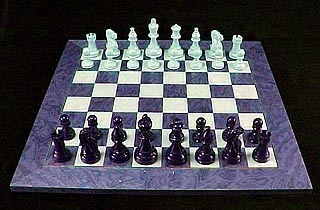
This article is about the Tabletop Game. See Chess for The Musical.
For the rules of the game and definitions of the most common terms, see the useful notes.
Chess is an Abstract Strategy Game, and is one of the most influential games in history. It is Older Than Feudalism at the very least; it has more scholarship and study devoted to it than any other game, with only Go coming close; it contains more possible directions for a match to go than there are atoms in the entire universe; and it has a play named after it.
The game of chess originated in ancient India, likely in the 6th Century, possibly as a teaching tool for educating royalty in the practice of leading an army. Its exact origins are Shrouded in Myth; at least one legend attributes the very first game of chess as a reenactment of an actual battle. Whatever its exact origins, the game quickly spread westward into Persia, and then to the Islamic Middle East, with several changes made to the rules along the way. From there, the game spread further west to Europe. The game as it exists now came into being in the 15th Century, when it was overhauled to increase the maneuverability of the pieces and reduce the amount of time it took to play a single game. The most notable changes were the queen changing from being able only move one square at a time diagonally to being the strongest piece on the board, Pawns being able to move two squares on their first move, and Bishops now being able to move any number of squares diagonally rather than being limited to exactly two (a debilitating limitation which restricted it to only 8 squares on the whole board, even if it leaped over an intervening piece of either colour).
The analytical and strategic nature of chess has led to the popular assumption that being good at chess is a sign of unusual intelligence. The Chessmaster gets their name from their ability to manipulate people and events as if they were pieces on a chessboard as well as their ability to "think three moves ahead." Shows with a rather cerebral and complex plot may employ Chess Motifs to abstract the details of the unfolding story. Finally, it just so happens to be the preferred game of The Grim Reaper (except in the Discworld, where he can never remember how the little horse-shaped pieces move).
There is a great deal of scholarship on how to play chess, including ideas on the best way to respond to a kingside pawn, a rook, the Nimzo-Indian Defense, or an opponent who's just had a cheeseburger. Without boring you, there are several basic ways to figure out who's winning at any given moment. The player with the material advantage has, simply, more or better pieces ("material") to their name. The player with the positional advantage has more control of the board. The player with better development has more pieces in position to strike or defend, an important consideration when your stronger pieces start way back at home row and (even worse) have their movement options limited by your own pawns. And the player with "initiative" is the one trying to win, while the other is forced to react to their opponent's plans and threats—they're struggling to keep up and avoid becoming their opponent's Unwitting Pawn. (Or make their opponent into one...)
Here's where the real insanity comes up: advantage in one area can make up for disadvantage in the others. Worse, in some cases, having any of these "advantages" can actually be a disadvantage: there are situations in which you lose because you have an extra pawn,👁 Image
or because it's your turn.👁 Image
So you gotta pick and choose — especially since it's difficult to have an advantage in all these areas at once (unless you're way better than your opponent). That said, chess has an Unstable Equilibrium and once a side gets too far behind, they can only hope their opponent blunders the game away. Accordingly, experts frequently resign before an inevitable checkmate.

Chess gives us the oft-misunderstood word "gambit". In chess parlance, a "gambit" is an opening strategy in which material is offered in exchange for positional advantage. While all strategy is about taking risks, a gambit has nothing to do etymologically with something being a gamble. It's actually derived from an Italian wrestling term, dare il gambetto, which describes a type of leg tripping motion. A gambit is a strategy which trades an advantage of one type for an advantage of another type—and not a bet, wager, or crazy stunt with a Million to One Chance of success. In games that start out as a Mirror Match, a gambit instantly makes the situation highly asymmetrical, but it remains unclear which player's advantage will ultimately prove stronger. If a plan gains a clear overall advantage for one player over the other, that's not a gambit, it's just a mistake on the part of the losing player and/or superior play from the winner.
More infoAlso note that one player cannot force a gambit on another. To "offer" a gambit, one player deliberately flaunts a piece (typically a pawn, but not always) as bait, where it can be taken freely, but at the risk of causing the other player to get out of position and be subsequently outflanked. Once the gambit is offered, the opponent can either accept the gambit, trading positional disadvantage for material advantage, or decline the gambit, maintaining (rough) parity of material and position, or even offer a countergambit — responding to the gambit by offering a gambit of their own while still leaving the initial gambit offer on the table. So we can all use it correctly now. (Also, keep in mind that experience has nothing to do with this; because chess is Serious Business, competitive players are Crazy-Prepared on most common gambits, and can probably recite to you from memory the sequence of moves you hoped to use on them. This is why The Chessmaster is named the way they are: they not only can see your plan coming from a mile off, they've probably used it themself a time or two. Or six. Hundred.)
There are, of course, many other tactics. Others include forks (where one piece, often a knight, is in a position to attack two pieces or more without being threatened himself, so if you save one, you lose the other),*A particularly devious one involves forking both a valuable piece and the king, which removes the choice of who to keep entirely and leaves the victim down a piece with nothing to show for it. pins (when a piece cannot move, as if it did, a better piece behind it would be captured,)*When the piece behind it is the king, the "cannot move" is literal, since moving would put the king in check. This is known as an "absolute pin". When the piece behind it is a different but valuable one, such as the Queen, this is known as a "relative pin", because moving the pinned piece would be legal but generally a very bad idea. skewers (a variation of a pin where a valuable piece is attacked and forced to move out of the way, leaving room for an attack at a less valuable piece behind it) and sacrifices (extreme gambits in where a strong piece, even the queen, is given away for a decisive advantage, usually for an attack against the enemy king), which generally take advantage of overloading and interference among the opponent's pieces. Chess strategy has a language all of its own.
Though the modern game has long been dominated by players from the former USSR, and while there are still many strong players from Russia, there is (as of 2020) a wide variety of nationalities among the world's top players. At present, the World Champion is Indian Grandmaster Gukesh Dommaraju, who became the youngest undisputed chess champion in history by winning the title at age 18 in December 2024. The current world #1 player is Norwegian Grandmaster and five-time champion Magnus Carlsen, who also has the highest Elonote not ELO — it's a surname, not an abbreviation rating in history. But also note that 2005 was the last year any human was able to beat the best chess-playing computer in the world (draws have still been managed on occasion, although even that is getting rarer).
Related games include Xiangqi, Makruk, and Shōgi. See Queens Puzzle for a Stock Puzzle that consists of arranging eight queens on a chessboard so they can't capture each other.
Shatranj
Shatranj or Persian Chess is considered the predecessor to chess. The rules have the following differences:- The Queen (called Fers) moves one square diagonally.
- The Bishop (called Pīl) moves two squares diagonally, jumping over the square between.
- The Pawn (called Baidaq) cannot move two squares on the first move. When they reach the eighth rank, they are promoted to Fers.
- There is no castling.
- The player who initiates a stalemate wins.
- Capturing all the opponent's pieces except the King results in a win (unless your opponent can capture your last non-royal piece on the following move, in which case it's a draw).
The game provides examples of:
- Abstract Strategy Game: Play is set on a plain grid as players alternate moving pieces in a pre-defined manner. Though pieces bear a slight resemblance to kings, castles, and such, the theming is overall very light.
- Action Girl: The queen is the strongest piece on the board, able to move both orthogonally like the rook and diagonally like the bishop. Very much a case of Characterization Marches On since the original equivalent piece, the ferz, wasn't even a monarch to begin with and had a much weaker moveset (one diagonal move.)
- A.I. Breaker: Given their computational power and knowledge databases, defeating most computer programs in chess requires you to take advantage of these: defeating the best chess engines requires you to utilize anti-computer tactics and have a grandmaster level of skill in chess... but even then, a draw is considered impressive. Take a look at the Brains in Bahrain👁 Image
for an example of anti-computer play. Simpler chess programs usually have more easily exploitable weaknesses. At the very least, you want to take trades early and often unless there's an obvious reason not to. This is less about the computer's weaknesses and more about your own as accelerating the game prevents you from getting tired and impatient against an opponent with infinite stamina and patience. Chess masters could beat chess playing programs by selecting suboptimal moves, which would often confuse the computer which was predicting a different course of action. However, as programming improved, this flaw has been completely removed. - Always Accurate Attack: Once one piece is in position to attack another, the attacker always wins.
- Anti-Idling: In professional matches, a chess clock limits the total amount of time a player can take to make their moves. If the player takes too much time they lose the match.
- Anti-Rage Quitting: A special case, as resigning hopeless games is a common and accepted practice. However, chess sites like chess.com👁 Image
and Lichess👁 Image
still require you to make a sincere attempt to win every game (so no rage resigning because you don't feel like playing against your opponent's chosen opening). They also require you to actually resign if you want to abandon a hopeless game — you'll be penalized for spitefully running down your clock instead. - Anyone Can Die: Even the queen can easily be captured by the pawns, the king or the opponent's queen if the player is careless.
- Arbitrary Mission Restriction: Odds Chess is a variant of chess in which more experienced players will give themselves an arbitrary restriction, to give amateurs a better chance. For example, two of the stiffest traditional handicaps are known as the "capped knight" and "capped pawn". These challenges specify that the odds-giving player (the more experienced one) must checkmate their opponent with their queen's knight or king's bishop's pawn; otherwise, they lose, even if they checkmate their opponent with a different piece.
- Attack! Attack! Attack!:
- While gambits in general tend to lead to sharp attacking lines, the Danish Gambit,👁 Image
Halloween Gambit👁 Image
and Fried Liver Attack👁 Image
exemplify this trope, as they usually leave White's position hopeless if the attack fails. - Novices tend to give pointless checks solely because they can, under the impression that they're pressuring the opponent when in fact they're not advancing the game state at all. It's also not uncommon for novices that actually know the en passant rule to always seize the opportunity to capture en passant, without first considering if it's beneficial for them to do so.
- While gambits in general tend to lead to sharp attacking lines, the Danish Gambit,👁 Image
- Attack Pattern Alpha: Chess openings are given names. For example, the game might open with the Queen's Gambit, leading to the Slav Defense, then the Exchange Variation, and so on.
- Awesome, but Impractical:
- The queen is generally the most powerful piece on the board, but she is at risk of being harassed by pawns and minor pieces if she is brought out too early. Bringing the queen out as soon as possible is referred to as the "Wayward Queen Attack" — a very poor opening that allows the player's opponent to bully their queen around by simply developing their pieces.
- Choosing to promote to a queen instead of underpromoting to another piece when underpromotion would have won an otherwise drawn game, drawn an otherwise lost game, or (in some cases involving knight underpromotion) won an otherwise lost game.
- The Scholar's Mate is a checkmate in four utilizing the above-mentioned Wayward Queen Attack... but it's also extremely easily defended against and/or countered by all but the most inexperienced players. The defending side (usually Black) can quickly gain a massive advantage if they see it coming; especially if the attacking side gets flustered and blunders badly after it fails.
- Awesome Moment of Crowning: A pawn gains a crown, along with significant power, upon promoting to a queen.
- Balance Buff:
- The queen and bishop were originally the ferz and alfil, pieces which can move one square diagonally and jump two squares diagonally, respectively. In the 15th century, they gained their modern movements, drastically increasing the power of both.
- The pawn has seen a variety of additions to its abilities. Its two-square starting move was introduced to speed up games, and its ability to capture en passant was introduced as a response to the previous, preventing using the two-square move to safely skip past an enemy pawn's attack. Promotion has seen a variety of incarnations, but its modern form gives more freedom and is therefore more powerful than most previous forms. Due to promotion, buffs to other pieces are also indirect buffs to the pawn.
- In earlier forms of chess, people devised many different ways to make it easier for the king to get to safety. One form was called the king's leap, allowing the king to leap two squares on its first move. This eventually became castling.
- Batman Gambit:
- Chess players often try to bait their opponent into playing a bad move. A swindle👁 Image
is when a player pulls off such a gambit from a losing position. - Inexperienced players can sometimes win very easily by (non-forcibly) sacrificing the queen in order to make a piece that's preventing checkmate move away. This tactic will not work on an experienced player, however.
- A large amount of theory on chess traps👁 Image
has been developed.
- Chess players often try to bait their opponent into playing a bad move. A swindle👁 Image
- Bolivian Army Ending:
- Checkmate causes the game to end in this way. The king has no way to escape being attacked, but you'll never see him getting captured.
- Formerly averted in certain circumstances under previous blitz tournament rules: One was once allowed to capture the king (and win immediately) in blitz tournaments if one's opponent put or left themselves in check.
- Boring, but Practical:
- Pawns. Not as exciting as the other pieces, but pawn positioning is very important, to the point that whole schools of strategy have been made on optimal use of pawns to control the board. As individual pieces, they cost very little material-wise for being able to deny (usually) two squares and are often important for protecting other pieces. They are also the focus of endgame play due to the ability to promote being so strong that even low level chess players who manage to do a promotion while avoiding a major blunder will commonly win the game, and in high level games once a player calculates they can't stop a promotion, a resignation will often follow.
- The standard design, material and color of chess sets used in serious competition is all about practicality. Boring practicality. The exact opposite of the fancy, flashy, elaborate chess sets you generally see in fictional media or those that are sought after by art collectors.
- Queening as opposed to underpromotion. The latter is sometimes better than the former, but in practice, underpromoting is usually done just to show off when a queen promotion would've been at least as strong.
- But Thou Must!: The concept of zugzwang, a position where any move is objectively bad and you would much rather leave your pieces as they currently stand, but you are not allowed to skip your turn and so you have to make a bad move. Forcing your opponent into zugzwang is a very important endgame principle.
- Calling Your Attacks:
- In some amateur-level competitions, it is considered mandatory to announce checks. However, this is not a rule in tournament play; in fact, it's considered rude to do so because it implies your opponent is too stupid to see it, and it can actually be seen as a form of annoyance, which is prohibited.
- Blindfold chess is played by announcing one's moves. The same applies to correspondence games played remotely via Snail Mail, email, over the phone, or the like. An example of this playing style can be seen in an early scene of Blade Runner.
- Changing Gameplay Priorities: In the opening and middlegame, it's important to keep the king protected, to avoid being checkmated. However, in the endgame, when there aren't enough pieces left to checkmate, it's important to get the king active, to chase down enemy pawns/support the advance of one's own pawns.
- Chekhov's Gunman: The kings. From opening to middlegame, they're total MacGuffins that serves as nothing but an obstacle that you need to protect for whatever reason. In the endgame they become much more useful, leading the pawns to promotion when long range pieces are not around.
- Cherry Tapping: High.level chess is usually played with a restricted number of viable openings.
- An opening that is not viable and is usually not found in manuals, opening databases and theory books is the Bongcloud👁 Image
(also known as Ke2) and its many variations (like the much more seriously-named King David's Opening). Against a player with any semblance of skill, the only thing this family of openings does is waste time and bring your king ahead into danger and unable to castle. Born as a joke and eventually becoming a meme in the Chess community, the opening has restricted uses: as a handicap for the stronger player (in a didactic setting or otherwise), for confusing your opponent (especially at an amateur level), as a viable strategy in variants such as King of the Hill, or this trope. Here👁 Image
is GM Hikaru Nakamura demonstrating its potential for humilitation. - Many chess beginners refuse to ever resign, no matter how badly they are losing. More experienced players often find this annoying, since it needlessly prolongs the game when the result is a foregone conclusion. In the face of such defiant opponents, some players decide to humiliate them by not checkmating them as fast as possible, but instead doing something silly like giving away most of their pieces (since they have a huge advantage anyway), promoting all of their pawns to knights or bishops, and checkmating the opponent with a ridiculous - looking formation of half a dozen knights or something similar. However, one has to be careful attempting this maneuver, as you could easily end up losing on time or stalemating.
- This may be the effect of leading with an... unorthodox opening like the Barnes or the Bongcloud👁 Image
.
- An opening that is not viable and is usually not found in manuals, opening databases and theory books is the Bongcloud👁 Image
- Color-Coded Armies: The factions use the same pieces for both sides but in different colors to distinguish whom they belong to. Traditionally, they are "black" and "white".
- Color-Coded Multiplayer: The leading player is the white side, while the other player is the black side.
- Cool Old Guy:
- Many strong chess players continue to compete into their 60s, 70s and even 80s, such as Korchnoi, Smyslov or Lasker.
- It has been theorized that the king is this, explaining its slow movement.
- Cosmetically Different Sides: Many designer chess sets show striking differences in the appearance of the chess pieces between the the opposing sides. Their functionality, however, remains the same as for standard black/white chess pieces.
- Crippling Overspecialization: The main reason the bishop is weaker than the rook. While both can move as far as they like along one set of directions (rows and columns for the rook, diagonals for the bishop), bishops can only ever move to squares of the same color as they start the game on, and thus can't threaten opposing pieces stationed on an opposite color square. This makes it very difficult to use them to finish off an opposing piece that can move onto such a square. They can breakout onto the field faster than the rook, and are formidable when one side retains both of them aka "bishop's pair". Together they are stronger than a single rook, but losing one, leaves the piece weaker than the knight.
- Decapitated Army: Checkmate means an instant loss for the receiving player, independently of any advantages they might have at the moment.
- Decoy Leader: A chess variant known as Tamerlane chess (named after Timur the Great) works broadly similarly to modern chess rules, with some differences. The goal is still to checkmate the enemy king, however there is a rule where once per game the king may swap places with any friendly piece on the board to evade check, thus turning the swapped-in piece into a Decoy Leader who until this point behaved like a king.
- Defensive Feint Trap: A valid tactic to use against overly aggressive players, as pieces that become isolated from support are vulnerable.
- Denial of Diagonal Attack: Rooks and Bishops are this to each other. Pawns can only attack diagonally.
- Difficult, but Awesome:
- The game is notoriously difficult to learn and play well, but it’s one of the most famous games of all time for a reason.
- Achieving checkmate against a lone king with a bishop and a knight. Unlike two knights, a bishop and a knight can force checkmate against a lone king in at most 33 moves with the support of their own king, but it requires very precise play since even a single mistake can lead to the lone king slipping out of the mating net. The method involves forcing the lone king to the edge of the board and then to one of the two corners that the bishop can attack.
- Digital Tabletop Game Adaptation: The game has numerous digital implementations, both in dedicated games and as a Mini-Game. The preferred platforms for digital chess are Chess.com👁 Image
and its open-source competitor Lichess👁 Image
. - Dragon-in-Chief: The queen is the most powerful and active piece on both sides of the battle. It has the most dangerous, dynamic and far-reaching moves, and its capture can be a brilliant coup by the opposing player. Still, the game is not over nor lost until the relatively passive king surrenders or is immobilized via checkmate.
- Dub Name Change: As chess has spread around the world, regional differences between the pieces' names have appeared:
- Pawns are also known as peons, peasants, or farmers.
- Knights are also known as horses, jumpers, or donkeys.
- Uniquely among the pieces, the bishop has a different name in almost every language:
- In French, it's called fou, which means "jester" in the game's medieval context.
- In German and Dutch, it's respectively called läufer and loper, which mean "runner".
- In Italian, it's called alfiero or alfiere, which means "flag bearer".
- In Russian, it's called slon, which means "elephant".
- In Finnish, it's called lähetti, which can mean "messanger" or "courier".
- In Spanish, it's called alfil, which is derived from the old Persian pil, meaning "elephant".
- In Hebrew, it's called ratz, which can either mean "messenger" or "runner".
- In Croatian, it's called lovac, which means "hunter".
- In Romanian, it's called nebun, which means "madman".
- In Greek, it's called axiomatikos, which means "officer".
- In Polish, it's called goniec, which means "messenger".
- In Czech it's called střelec, which means "marksman"
- Rooks are also known as towers, castles, fortresses, ships, bulwarks, chariots, or elephants.
- In French, the queen piece is called the dame, which means "lady".
- Epic Fail:
- Losing to Fool's Mate or Scholar's Mate where you're checkmated in two or four moves, respectively. Scholar's Mate is a little less embarrassing since it can be set up on anyone who doesn't see it coming (although it is very easy to see coming), but Fool's Mate requires the loser (White) to open in a specific way which probably won't happen unless they're either playing along or simply have no idea what they're doing.
- Even high-level chess players are not immune to game-losing blunders👁 Image
, including ones that result in them immediately being checkmated or losing their queen. - Forty minutes of thought--for a colossal blunder!👁 Image
- It's entirely possible to blunder when you are one move away from checkmate and set your opponent up to checkmate you on the next turn at the same time. One player👁 Image
managed to take this even further by putting their opponent in a position where their only legal move was to deliver checkmate.note Additionally, this moved missed a mate in one.
- Escort Mission: Even though pawns are the weakest pieces on the board, because of the potential of a pawn promotion, many chess games becomes an exercise in both sides trying to protect their own pawns while capturing their opponent's pawns.
- Middlegame is where this first becomes apparent, since at this point both sides' non-pawn pieces are active, and the kings are likely safely hiding behind a couple of pawns. Meaning the bishops, knights, rooks, and queens can worry less about protecting their own king and start hunting/protecting pawns.
- Notice that in the case of the pawns protecting a castled king, the king is ALSO protecting the pawns.
- Because pawns can protect adjacent pawns that are diagonally ahead, the pawns that most need protecting are the ones at the back of the formation, known as "Backward Pawns". Expect to see someone protecting these guys somewhere, somehow.
- This is even more obvious for a special type of pawn, the "Isolated Pawn". This pawn no longer has neighboring friendly pawns to protect it, so now only the non-pawn pieces can help it. This can both be a strength and a weakness. When the Isolated Pawn still has all its minor pieces allies, it becomes much easier to protect because there are more hands on deck, and the pawn being isolated means it's easier to reach. But once there are only two minor pieces left it becomes much more difficult to keep an eye on the Isolated Pawn.
- In the endgame, where there isn't enough pieces to easily threaten checkmates (since not even a queen can checkmate an opposing king without aid), it is now the king's job to escort their own pawns forward. In many cases kings are even the best at this. Since while kings are slow, so are the pawns, so no one is slowing anyone down. And because a king protects all adjacent squares it can very easily protect a couple of pawns all by himself.
- Even the Subtitler Is Stumped: In chess annotation, ! and ? symbols mark good and bad moves (sometimes with !! for amazing/game winning moves and ?? for blunders/game losing moves), with ?! specifically meaning "dubious but not completely bad" or "inaccuracy."note A mistake that's not serious enough to significantly alter the game. However, !? has the general meaning of "interesting," which usually means that the annotator can't figure out whether it's good or bad, but it is interesting. One grandmaster joked that it's the mark of a lazy annotator who doesn't want to work out whether the move was good or bad. (It's also sometimes used for Crazy Enough to Work plans in a losing game, which is not quite this trope.)
- "Everything Explodes" Ending: Entirely possible in atomic chess.👁 Image
When a opposing piece is captured, both it and the capturer are gone; so are the surrounding pieces besides pawns. Therefore, the game only ends when the opposing king is obliterated, which also happens to the capturer. - Excuse Plot: The game has light war theming, but it has little to do with the actual gameplay, and mostly serves as an excuse for the gameplay (and to make the pieces more memorable).
- Failed a Spot Check:
- Frequently novices (and sometimes even experienced players) will declare checkmate... only to notice a distant bishop that hasn't been moved in dozens of moves that can snipe the attacking piece.
- Chess.com has a symbol for this: A "miss" (pink circle with the letter "X") is used to denote a move that, while not necessarily bad, overlooks a far better move; usually one that punishes a bad mistake.
- Failure Is the Only Option: It is not uncommon to end up in a situation where you would be at a great advantage... if only it weren't your turn. Instead, making any move at all (as you are forced to) would cause the enemy to gain an advantage or cause you to lose yours. This specific scenario is called zugzwang, German for "compulsion to move".
- Field Promotion: Pawn promotion: a pawn that reaches the opposite side of the board is promoted to any same-colored non-king piece of the player's choosing. Naturally, most players take advantage of promoting to a queen. Anything else is designated "underpromotion". Underpromoting is sometimes taken as a grave insult, since it implies you don't see your opponent as dangerous enough to bother with a queen promotion.note More advanced players occasionally choose to promote to a knight due to its atypical movement. And of course, given the complexity of the game, an underpromotion can occasionally be a quicker way to a checkmate than promoting to a queen.
- First-Player Advantage Mitigation: The game has a well-documented first-player advantage. Tournament matches get around this by giving each player an equal number of games as White and Black rather than changing the game, but there's an exception for Armageddon rules, which are designed to force a decisive result and can't go this route. Instead, they give both sides a bonus, with Black's draw odds being stronger than White's time advantage to compensate for White's first-move advantage.
- Fog of War: At least two variants, with sub-variants:
- Kriegsspiel: you don’t see your opponent’s pieces at all.
- Dark chess: you only see those pieces you can attack.
- From Nobody to Nightmare: Pawns can promote and become much stronger. They can even become queens.
- Glass Cannon: The Knight fulfills this role in an interesting way. Every chess piece is a One-Hit-Point Wonder, but Knights have a unique move that allows them to capture pieces without fear of threat and hop over normally-reliable defenses. It's the only piece in the game that can threaten a Queen without being taken in return. However, that unique move happens to be the Knight's only style of movement — meaning if another piece aside from another Knight threatens it, the Knight has no way to fight back aside from fleeing.
- God Save Us from the Queen!: God save us from the enemy's queen, the most powerful and dangerous piece on the board. Taking her head-on is usually a death sentence for any piece foolish enough to try.
- Godzilla Threshold: One of the basic rules. If the king is threatened, it must be protected at all costs.
- Golden Snitch:
- Even though there are so many pieces on the board, and players capture each others' all the time, the only win condition is "capture the opponent's King piece". The Surprise Checkmate trope is often based around reminding people of this— one player think they're winning because they've captured a lot of pieces, but the other player cleverly sneaks up on the first's King and wins.
- Some variants use different Golden Snitches. Three-check chess has the additional condition that the first player to deliver three checks wins. King of the Hill chess has the additional condition that the first player to get their king onto one of the four center squares wins.
- Gratuitous Foreign Language: Some chess terms are borrowed into other languages without a translation, such as Zugzwang (see Stupidity Is the Only Option below).
- Gratuitous French: English chess terms in particular borrowed quite a bit from French, including en passant ("in passing") and en prise (under attack).
- Guide Dang It!: Many chess-teaching resources fail to mention certain rules, and while the FIDE Handbook is the official standard, few beginners refer to it. Common omissions in said resources include:
- The en passant ("in passing") capture occurs when a pawn captures an enemy pawn that just moved past the pawn's capture zone by moving to the square the enemy pawn passed. This rule is omitted commonly enough that many novices are unaware of its existence.
- The "threefold repetition" rule—that either player may declare a game drawn if the same position occurs for the third time—is often misinterpreted. The rule refers to a position, rather than a move, repeated three times. At this point, a draw may be taken (this normally happens when moves are repeated but doesn't have to). There have been a few high-level cases where a player has unintentionally let this happen.
- If 50 moves are played without a pawn move or a capture, either player may declare the game drawn. It was thought when this rule was added that all such positions must truly be drawn, but computer analysis showed that there are positions that are forced mates requiring more than fifty moves. This lead to the rule being adjusted multiple times with 75 and 100 moves allowed. As computer power found ever larger move counts, the idea of specific positional move counts became ridiculous and the rule went back 50 moves and has stayed that way since 2001.
- Fivefold repetition (which automatically draws the game after a position repeats five times) and the 75-move rule (which automatically draws the game after 75 consecutive moves without any pawn moves or captures), both added in 2014, are among the most obscure rules relating directly to the game itself.
- In at least two cases, actual grandmasters playing in a tournament asked the referee whether they can castle when the rook they want to use for castling is under attack. Yes, they can.
- As of 2023, if you resign or run out of time in a position where it's impossible for your opponent to checkmate you in any number of legal moves, you draw instead of losing.
- Because the United States decided it needed its own set of Chess rules, players need a guide to compare the differences between FIDE and the US Chess Federation rules. The differences include very different rules regarding claiming draws or them being automatically drawn with no claim required, USCF having less types of illegal moves and being less punishing when they happen, USCF defaulting to players being allowed to arrive up to an hour late while FIDE rules default to no lateness allowed, FIDE disallowing any electronic devices on penalty of forfeit while USCF only needs them switched off and doesn't automatically forfeit a player if it happens to ring anyway, USCF allowing the proxy of an upside down Rook to count as a Queen when a pawn is promoted while FIDE would force the arbiter to turn it back to the right way and have it play as a Rook. The biggest differences involved what counts as insufficient material when a game ends via timeout, USCF having a rule that allows castling after touching the rook first and not requiring moves to be made one handed except in blitz. Those differences created a storm in 2015 when Hikaru Nakamura's muscle memory caused a technical break in the FIDE rules by rook first, double handed castling, which is legal in America, in a FIDE rules Armageddon game vs Ian Nepomniachtchi.
- Hamiltonian Path Puzzle: The Knight's tour is a chess puzzle where a knight visits all 64 squares on the chess board, exactly once.
- Heroic Sacrifice:
- It's generally only seen in games between advanced players, but sacrificing a piece to gain an advantage or even force checkmate is a very real thing. Just make sure it's not a Stupid Sacrifice.
- A piece that is being threatened with capture and has no escape will almost always be used to take a piece if it can; especially one that undermines the safety of the opponent's king. This is called a "Desperado" attack.
- Highly Defensible Death Trap: The infamous Smothered Mate, which arises when the King is completely surrounded by his fellow pieces and is shielded from straightforward attack; however, the Knight can simply hop over the defenders and Checkmate the King.
- Highly Specific Counterplay:
- The castling move was specifically developed to counter the threat created by having the critical king jeopardized when the central pawns are deployed to control the board's center. This leaves the king vulnerable to diagonal pieces such as the bishop or queen. Castling is allowed once per game, which moves the king to one side, usually to safety behind a wall of pawns.
- The en passant capture prevents an enemy pawn from sneaking past a pawn's capture zone.
- Horse Jump: The Knight piece (which has the appearance of the knight's horse) is the only piece that can jump over other pieces.
- "Instant Death" Radius: Two pieces have a no-go zone around them for an opposing king, as they are not allowed to move into check. The first is the queen, whose movement includes all 8 surrounding squares around them. The second is the other king, as they threaten all 8 squares surrounding them. In the late-game where several threatening pieces have been taken out, a king can assist another piece in checkmating by using his own capture radius to block off the opposing king's movement.
- Instant-Win Condition: If a king is put in a position of certain doom, the game ends, even if that king's team didn't lose a single piece the entire game. This is very nicely demonstrated by this position👁 Image
, where, despite Black having literally its entire army at its disposal against a lone pawn, it can't stop a mate in two. Solution Promote the pawn to a knight; it doesn't matter what black does, as nothing can stop nf7#. - Interface Spoiler: Part and parcel of chess problems and studies. The problem's caption outright tells that there's a checkmate in a set amount of moves (or, in the case of studies, that there's a way to win or draw) by force in this position, and you only have to find it.
- Irrevocable Order: The touch-move rule. Once you pick up a piece with the intention of moving it, you have to move it if possible. However, by first saying "I adjust" (or "J'adoube" in French), you can touch a piece on your turn to adjust it (move it closer to the center of the square) without having to move it.
- I Surrender, Suckers!: The game isn't over until you checkmate your opponent's king. You need to be careful if you have few pieces between you both endgame — a king is forbidden to move into check, so you can accidentally trap the enemy king on your turn. If your opponent has no other piece they can legally move, it causes a stalemate that ends the match in a draw.
- Joke Character: The queen was originally this, moving only one space diagonally at a time, like a worse version of the bishop.
- Keystone Army: Each of the opposing sides, as they lose when the King is placed in checkmate.
- The Kingslayer: The checkmate. Alternatively, there can also be general regicide if a queen dies first.
- Know When to Fold 'Em: It's called "resigning" when you throw in the towel, and it's generally considered proper etiquette to resign a lost cause rather than fight to the bitter and bloody end.
- Large and in Charge: Usually the king is the largest piece on the board (as the most critical piece), followed by the queen (as the most free-moving piece.)
- Literal Wild Card: A promoted pawn can be turned into any non-king piece. 99% of the time you'll make a queen — the strongest option — but you do have the option to go for a weaker piece in the niche situations where it's useful.When?Occasionally, a knight's move will be necessary on a congested board, or a rook or bishop will be summoned to prevent stalemate. Alternately, a player confident in their position may do it to show off.
- Loophole Abuse: A very obscure example, to the point it's nearly unheard of outside of chess problems, is vertical castling (also known as "Staugaard castling" or "Pam–Krabbé castling"). Normally, the only possible way to perform castling is horizontally, because castling requires both the king and rook to have never moved. However, a promoted pawn is technically a new piece, so by promoting a pawn to a rook in the same file as the king, one can perform vertical castling so long as all other conditions were fulfilled. It's such an obscure example it's often incorrectly stated that it was banned after one such problem appeared in 1973, when it was never allowed in FIDE rules to begin withnote At least since 1930, castling requires both the king and the rook to be in the same rank, and it's not known if any prior rulesets allowed it either.
- Lost in Translation: The pieces' names have changed as chess has spread around the world.
- Magikarp Power: The Pawns start off as the weakest pieces, moving only one space (except when they move the first time, where they can move two) and capturing diagonally. However, once they reach the other side of the board, they can promoted to any of the other pieces, putting this trope into effect.
- Mechanically Unusual Class: The Knight. Every other piece moves orthogonally and/or diagonally, and their movement can be blocked by other pieces in the way. The Knight instead moves in an L-shape and is not obstructed by other pieces. Due to their unique way of moving, they're the only pieces who can threaten a queen without exposing themselves to said queen.
- Mechanically Unusual Fighter: Chess is a game made up of mechanically different fighters:
- The knight is the only piece that can move through occupied squares. Its attack pattern is also unconventional, so it can attack enemy pieces without leaving itself open to retaliatory attack by the targeted pieces, barring enemy knights.
- The pawn is the only piece whose movement differs from the attack pattern, and it is only allowed to move forward, never backward. No other piece gets a doubled normal move to start (the king can castle but not move two squares on a normal first move). It is also the only piece that can upgrade into other pieces. En Passant gives it the only capture move that doesn't end with the capturing piece taking the square of the captured.
- The king & rook can combine to "castle" which allows a player to move both of them at the same time and have the rook jump over the king while doing this. No other piece in the game can combine with another like this.
- Bishops only fight on half the board due to being colour restricted.
- The queen combines the power of two other pieces (rook & bishop) into a single piece, and is the only capturable piece that begins with just one of them per side.
- Metagame: Chess has a metagame, evolved over eons of play. One might say that the metagame is the game. If you have ever played in any organizationally-sanctioned tournament, held anywhere at all, at some point in your life, it is guaranteed that every move you made was dutifully logged via algebraic notation*Unless you're old enough to have played in tournaments back when descriptive notation was standard, and then almost certainly dissected down to numbingly exhaustive detail, so as to understand every available nuance of both how you played then, and potentially will now.
Garry Kasparov's famous rematch versus Deep Blue in 1997 involved a curious metagame factor. In the first game, Deep Blue made a puzzling play that was really just a hole in its heuristics — it is only as good as its program. This threw Kasparov for a loop. In the second game, Deep Blue made a second error, which Kasparov did not see and cost him the game. Some of the reports basically amounted to Garry being unable to believe the machine could screw up so badly. He attributed the moves to deep insight and thought himself out of a draw, turning it to a loss.NoteIn his 2017 book Deep Thinking on the match, Kasparov settles the debate over this game, admitting that Deep Blue's strong play and strength for calculation led him to believe that, despite a few late-game unusual moves (which turned out to be blunders), the machine couldn't possibly have failed to spot a draw by repetition. As a matter of fact, he adds, "Today, strong engines show that white was still close to winning... simply exchanging queens is crushing for white." - The Millstone:
- Many situations can arise where a player's friendly pieces can hinder them:
- The famous Smothered Mate (see illustration👁 Image
◊), where a single knight attacks a king surrounded by its own "protective" pieces who block out all escape squares, allowing this beautiful (and potentially embarrassing) checkmate. - Back-rank checkmates where the King is checked by the opponent's rook or queen, and its forward escape squares are all blocked by its own pawns or pieces.
- The famous Smothered Mate (see illustration👁 Image
- Subverted by pawns, which may seem merely to get in the way of one's powerful pieces but are actually vital to one's success.
- Many situations can arise where a player's friendly pieces can hinder them:
- Misère Game: One of the most popular variants is losing chess👁 Image
(AKA giveaway chess), which sees players try to lose all of their own pieces. Captures must be taken when available, and the king can be captured like any other piece. Unlike regular chess, losing chess has been weakly solved, with White being able to force a win with 1.e3.note Technically speaking, losing chess is not a true misère game; the win condition is to be left with no legal moves, not to get your king checkmated, and there are other rule changes besides. - Mook Promotion: A pawn, if it gets across the board, can become a queen, a bishop, a rook, or a knight.
- More Dakka: The fundamental principle behind formations such as Alekhine's Gun👁 Image
, the aim of which is to overwhelm an opponent's defenses with sheer firepower. - Morton's Fork: The most typical approach is using a knight to attack two piece at once (e.g. a queen and a rook), and they cannot be both saved.
- Mother Russia Makes You Strong: Between 1948 and mid-2000s, chess world champions represented either the Soviet Union or Russia, with the exception of 1972-75, when Bobby Fischer took the title from Boris Spassky. Even Fischer was called by some "the epitome of Soviet chess school", as he learned Russian specifically to study Soviet chess literature.
- Moving Buildings: Rooks, represented as towers, are able to zip around the board as they please.
- Names to Run Away from Really Fast: Claude Frizzell Bloodgood👁 Image
, chess player and matricide. - Never Say "Die": Despite chess being a strategy game with allusions to battle, your pieces (excluding, played properly, the king) are said to be "captured" but never "killed".
- No Fair Cheating: The professional chess community is very strict with cheating. Perhaps the most infamous example of this was when Grandmaster Isa Kasimi was caught cheating at a tournament in 2019. Though he openly admitted to it when confronted and did not attempt to use his illness (he had been battling cancer since the early 2000s) as an excuse, it nonetheless proved to be such a huge scandal that he became one of only three Grandmasters to be stripped of the title. He promptly retired from chess,note He made an appearance at a tournament the following year, but was recognized and immediately left. living a quiet life until he succumbed to his cancer on March 28, 2024.
- Non-Standard Game Over: Resigning before you're put into checkmate. Often symbolized by deliberately knocking over your own king's piece, though this is not required. Both players may also choose to agree to a draw if they realize that neither of them can reasonably checkmate the other. Draws can also occur under the threefold repetition rule in which both players end up in the same position three times.
- Noob Bridge: The Scholar's mate is one of the most common traps White can set at the beginner level, which punishes black for not seeing it coming with a mate in 4. One of the first steps to getting better at the game entails seeing the queen and bishop coming out and being ready to react accordingly.
- Not the Intended Use: Castling is a strategic move designed to get the king to safety and activate the rook. That hasn't stopped people from using it for quick tactical shots, such as in the Thornton castling trap👁 Image
. - No Unified Ruleset: Before the rules were properly formalized, different countries often had different rules. For instance, it was unclear whether pawn promotions were limited to your captured pieces or if they could promote into any non-king piece, and there were various ways to handle the king's single-use special move which became castling in the formalized rules.
- Obfuscating Stupidity: Arrogance is one of the deadliest weaknesses a player can have. Some people won't hesitate to take advantage of it.
- Some openings play out like this. For example, in Alekhine's Defense, Black uses their turns moving their king's knight to tempt White into building up a pawn structure in the center of the board after which Black attempts to take advantage of White's overextension.
- In a particularly notorious example, Tony Miles, a grandmaster, defeated World Champion Anatoly Karpov by psyching him out with the seemingly questionable St. George Defense.👁 Image
- Obvious Rule Patch:
- The 50-move rule: If both sides have consecutively made 50 moves without making a capture or moving a pawn, either player can declare the game drawn. This rule was added to prevent games from dragging on far too long. At one point, the rule was itself patched, patched again, and then finally unpatched.
- It used to be possible to promote a pawn to become one of the other player's pieces (only useful very circumstantially👁 Image
) or leave it as a pawn (only useful to avoid or induce stalemate). - The rule for castling specifies the rook must be in the same rank as its king. Otherwise, it would be possible to promote a pawn to a rook on the same file as the king, then use it to castle vertically (assuming the rook has not been moved since promotion)
- Kings could once move into triple check, as only single check and double check counted as check.
- En passant is a patch on the ability of the two-square initial pawn move (created to speed up the early game) to allow a pawn to evade an enemy pawn's capture zone.
- Chess tournaments enacted the "no talking" and "touch-move" (no taking back moves) rules because of players distracting each other or outright screwing with each other, such as making moves then immediately taking them back several times in a row. Further sportsmanship rules were added to deal with non-verbal means of getting under an opponent's skin.
- It is said that time limits for formal play were introduced after an opponent drove 19th century grandmaster Paul Morphy to frustration by spending several hours on one move.
- One Degree of Separation: Morphy number👁 Image
or how close you are to playing Paul Morphy👁 Image
, who is widely considered to be the best player of all time. For instance Carlsen👁 Image
played Kasparov👁 Image
who played Botvinnik👁 Image
who played Lasker👁 Image
who played Mortimer👁 Image
who played Morphy. Carlsen's Morphy number is 5. - One-Hit-Point Wonder: Any piece can capture any other enemy piece or give check or mate to the enemy king with a single attack. Rank doesn't matter; a pawn can capture a queen just as readily as a queen can capture a pawn.
- Perfect Play A.I.: The problem with playing against Chess computers is that the most powerful ones are capable of calculating millions of moves a second and therefore almost always know the most optimal move to make in any given situation, making any match against them an uphill battle (and the computers are always getting exponentially better at playing as we speak, too). The only cases in which this is downplayed are with Chess bots that have Difficulty Levels where you can intentionally adjust them to make them stupider.
- Pinned Down: Pieces can become trapped in a spot where they are not attacked but cannot be moved without placing them under threat of capture. There is also a tactic known as a pin, where a piece restricts an opposing piece from moving by forcing the opposing piece to shield a more valuable piece from attack, but that is not quite this trope.
- Place of Protection: A historical ancestor of modern chess known as Tamerlane chess (named after the Turco-Mongolian emperor Timur) includes safe squares known as husun (citadels), where at any time if the king manages to flee into there the game would be declared a draw no matter how close to being checkmated he is.
- Platform-Activated Ability: If a player manages to take a pawn to one of the tiles of the opposite row (where the other player's non-pawn army begins), they'll be able to summon a queen, rook, bishop, or knight of the same color. In the context of the game's theme, this is because the pawn is earning a promotion, allowing it to acquire a new hierarchic title and thus the attributes and mobility that are associated with it.
- Press Start to Game Over: The fool's mate👁 Image
, which puts the white king in checkmate in two moves. Not likely to pop up in practice unless (as the name suggests) your opponent is a special kind of stupid, but it is the fastest checkmate possible. To a slightly lesser degree is the Scholar's Mate👁 Image
, in which a player gives checkmate in a mere four moves and which does happen in practice with beginners. - Queens Puzzle: Other than the standard way to set up the puzzlenote putting nonmutually attacking 8 chess queens on an 8×8 board, additional chess pieces can be included. So, you gotta place one quantity of queens and another (equal or not) quantity of rooks in an n×n chess board so that they don't attack each other.
- Readings Are Off the Scale: A blunder (game-losing move) is represented by two question marks ("??"), while a brilliancy (a sacrifice or otherwise counterintuitive move that greatly benefits the person who played it) is represented by two exclamation marks ("!!"). Rarely, more than two may be used; Frank Marshall's unbelievable queen sacrifice in "The Gold Coins Game" occasionally receives three exclamation marks ("!!!"). On the other hand, Vladimir Kramnik's extraordinary blunder in his second game against chess computer Deep Fritz, sometimes referred to as the "Blunder of the Century", typically receives three question marks ("???"); Grandmaster Susan Polgár went even further and gave it six question marks ("??????").
- Recruit the Loser: One Variant Chess derivative, Bughouse Chess, has one player of a team capture pieces, and their partner can recruit and place those captured pieces.
- Refuge in Audacity:
- A move that receives "!?" from the annotator is typically this. While it's often used for moves that are too odd to calculate, it's also occasionally used for Crazy Enough to Work traps.
- Playing a bad move is a bad feeling. But sometimes, playing an absolutely awful move can leave your opponent dumbfounded; they could very well spend quite a while trying to figure out if you really just did that, or if it's a trap. This can potentially fluster them, leading to another bad move.
- Requisite Royal Regalia: The king and queen have a coronation crown and a celestial crown as their identifiers, respectively.
- Risking the King: A player can invoke this trope. One infamous example is the Bongcloud Attack, which is the joke chess opening 1. e4 e5 2. Ke2. The person playing White puts their king in unnecessary danger when they should be advancing the rest of their army.
- Roc Birds: An indirect appearance: the name of the bird in Persian (rukh) is the same as an old word for chariot.note The word is related to the "Ratha" (a Hindi chariot), the Latinate "rotor" (and variants), and the German "Rad" (a wheel). Had it survived into modern English it would've been "rath". This was applied to one of the pieces of chess in the Middle Ages, which became the rook in modern English.
- Roll-and-Move: There is some evidence that the game was played with dice between the 11th and 14th century in Europe. The dice determined which piece you would move, though you get to choose where it moves.
- Royals Who Actually Do Something: The king and queen are the most important and most powerful pieces on the board respectively. The king, despite only moving one square per turn, can be a strong offensive piece endgame. The queen is able to move any number of squares vertically, horizontally or diagonally, combining the power of the rook and bishop.
- Sadistic Choice:
- Forks (where one piece threatens two pieces) and skewers (where a valuable piece is threatened, but moving it would expose another piece to attack) are this; you're going to lose something unless you Take a Third Option, such as pinning the forking piece or giving a check with one of your forked pieces.
- A similar situation can arise as a result of pieces becoming overworked (used to provide critical defensive coverage to more than one other piece which both become threatened at the same time).
- Zugzwang is a situation where any move by the player to move will weaken their position—but they have to move.
- Schmuck Bait:
- Why the Scholar's Mate works so well against novices. They'll go for the seemingly exposed queen with their knight without thinking... and completely overlook the ensuing checkmate given by White's queen and bishop.
- The pawns on b2 and b7 are often left unguarded early in the game - and it is almost always a bad idea to try and capture them (it takes up valuable time and can easily lead to having an officer stranded behind enemy lines).
- A piece sacrifice that's not forced is basically this; a player "gives up" a piece (almost always the queen) in hopes that their opponent is stupid enough to take it, usually allowing checkmate.
- Screw This, I'm Outta Here!: Defied Trope. A king cannot castle to escape check. After all, an ace up your sleeve is worthless if you cannot or will not use it in time.
- Sealed Orders: A variant of this trope used to occur during adjournments when a chess match was suspended for the day (i.e., dinner time) to be continued at a later time. The player whose turn it is to move writes down what their move will be and then seals it up and hands it to the arbiter. When the match resumed, the order was to be revealed and the game would continue from there. Both players were free to analyze the position for hours, with the help of their seconds, during the adjournment period. The sealed move ensured that neither player could know what the other would do next during this lengthy analysis. Otherwise, the player next to move would get a huge advantage from having hours to consider what to do. Nowadays, the advent of powerful chess computers has made adjournments a thing of the past –- there would be no way to stop either player from firing up the latest chess software and just memorizing its recommendations. Instead, modern chess competitions simply speed up the time limits so that adjournments aren't necessary.
- Sheathe Your Sword: As mentioned by I Surrender, Suckers! earlier, if it's someone's turn but they no longer has a legal move while not in check, the game is drawn by stalemate. Because of this, someone who is losing can shoot for a draw by removing their options to move. Typically this is done by forcefully sacrificing their own pieces.
- The Slow Walk:
- Kings are actually pretty strong, a single king is considered to have an equivalent fighting power of 4 pawns👁 Image
, but they spent most of the game hiding in a bunker because even though their "power" is worth 4 point, their value is infinite. And they are as slow as pawns. However, there are times in a chess game where neither of those limitations matter. And when that happens expect to see kings marching towards each other for a showdown. This is most common in the endgame where most fast/long ranged pieces are already taken or busy because both sides are shorthanded as is. - In the late middlegame of a closed game(meaning a lot of pawns are in the way of everybody), king moves can unintuitively be the right call. The other wiki calls this the "king walk👁 Image
".
- Kings are actually pretty strong, a single king is considered to have an equivalent fighting power of 4 pawns👁 Image
- The Smurfette Principle: There's only one female character, the queen, which makes sense since the names are inspired by medieval warfare. However, she is also the most powerful piece.
- Stone Wall:
- Depending on how they're deployed, pawns can become this. Although they're slow and not dynamic in attack, their numbers and ability to support each other in adjacent rows can be used to create defensive formations that are impossible to penetrate with more dangerous attacking pieces at anything less than self-defeatingly high costs.
- A prophylactic move is one that, rather than playing to improve your attacking chances, limits the opponent's opportunities. The former world champion Tigran Petrosian is a notable example; while he had fewer wins than other world champions, he had almost no losses, even going through 1962 without losing a single tournament game.
- Straight for the Commander: Because both sides are a Keystone Army, your only win condition is to checkmate the enemy king. Taking out other enemy pieces doesn't directly matter, although it tends to make life easier for you.
- Stupidity Is the Only Option: Zugzwang (German for "compelled to move") occurs when any move you make will weaken your position, yet you must make a move because passing your turn is not allowed.
- Suicide Attack: Frequently a key tactic. Pieces can be used in sequences of moves which will culminate in their capture in order to improve positioning on the board or create a weakness in the opponent's defenses.
- Surprise Checkmate: It's technically possible to get your own king out of danger and completely trap the opposing king simultaneously, but this is very rare. It usually requires your opponent to not be paying attention or to be running so low on time that they can't really afford to think about strategy.
- Switch-Out Move:
- Formerly. One of the various forms in which castling used to exist involved the king and chosen rook switching places. In the current iteration of castling, the king and rook move towards and past each other, but they don't end up actually occupying each other's starting squares.
- Fischer random chess (a chess variant with randomized piece placement) can turn castling into this trope given the right starting position.
- Themed Stock Board Game: In addition to many sets where the pieces appear as more or less detailed representations of what they're supposed to be, there're lots of others where they are modelled after characters of different franchises.
- Time Dilation: Technically speaking this is how the en passant capture effectively plays out; although the opposing player has already made the pawn double-move, it can be retroactively captured for the intervening square under attack which it passed through.
- Timed Mission: Most organized competitions give each player only a certain amount of time to make all of their moves. If a player's time runs out, the game automatically ends in a loss if the player can be checkmated or a draw if they cannot.
- Too Dumb to Live:
- The Scholar's Mate and (especially) the fool's mate rely on Black being a shining example of this trope.
- Subverted with underpromotion. It's almost always an extremely stupid idea, but there are rare occasions where promoting to a lower piece is better; a knight can be used to fork pieces or force checkmate in ways that a queen cannot, while a rook or (VERY rarely) a bishop is used chiefly to avoid stalemate. Promoting to a queen in a situation where something else is better, however, is definitely this trope.
- Took a Level in Badass:
- Pawns, when promoted by getting to the opposite side of the board, are exchanged for any other piece (except for a second king).
- The king becomes much more powerful in the endgame, where it can march up the board without much enemy interference. A well-positioned king in the endgame is better at attacking and defending than a minor piece, and many endgame positions revolve around the king protecting or intercepting pawns as they advance.
- Rooks, to a lesser extent. In the beginning of the game, they're in an area that's rather difficult (and simply not recommended) to open early. This effectively makes them useful for defense (mostly to prevent back-rank checkmates) and not much else, and also leaves them open to being captured easily in a manner similar to the smothered mate. But when everything's out of the way, the game can change dramatically as these two Lightning Bruisers come crashing in.
- Trapped Behind Enemy Lines: Over-aggresive play can result in this situation if the opponent moves their pieces so as to cut off escape routes. Knights and bishops are especially prone to this situation, especially earlier in the game, since their move set is relatively limited.
- Uniqueness Rule:
- The game has historically had the rule that a pawn could only be promoted to a captured piece, which makes it impossible to have more than one queen at a time. As the queen is a powerful piece, some people disliked the idea of having two at once. However, this rule has since been removed, and promotion is unrestricted by which pieces have already been captured.
- Castling is a special move that moves both your king and a rook, and is only available if neither of the involved pieces has ever been moved. This means that it's only usable once per game and can't be repeated even if the king and rook somehow return to their original positions.
- Unstable Equilibrium: A player who gets behind in the opening development will have a very hard time catching up with their opponent. In a similar way, if one player manages to get a material advantage ("material" as in "combined value of all pieces"), that player will likely be able to exploit and increase said advantage. This means that, for advanced players, winning a game of chess is often a matter of getting that first advantage while preventing the opponent from doing so. This is the reason professional-level chess games almost never end in checkmate, with one player conceding when they determine their situation to be hopeless; not because Chess players are quitters, but because they understand how key the unstable equilibrium is in the game.
- Unintentionally Unwinnable:
- A player should never focus on defense only, otherwise a "smothered checkmate" can occur where their king is put into checkmate by their opponent's knight and unable to move because he is literally smothered by his own pieces.
- Stalemate is this for the winning player. What should have been a guaranteed win is suddenly a draw, because you didn't pay attention.
- Unwinnable by Design:
- Once one player has lost everything except the king, there's no possible way to win the game for this player, because a lone king cannot give checkmate under any circumstances. Even if the opponent runs out of time, it still will only be considered a draw.
- A draw by insufficient material happens when this occurs for both sides, resulting in a scenario where neither player can possibly checkmate the opponent with their remaining pieces (such as a bare king for each player or each player having a bishop on the same colored squares and nothing elsenote It is theoretically possible to checkmate if the bishops are on opposite colors, but it requires one player to block their own king in the corner using the bishop so the position is almost always drawn in practice).
- Updated Re-release: The new chess rules adopted in the 15th century and currently in use.
- Violation of Common Sense: Chess engines have gotten so advanced that calculating the theoretical optimal move for a situation will frequently output something that makes little or no sense to human sensibilities, even for highly skilled players, such as intentionally sacrificing a queen for positioning. The reason is that computers can and will calculate many moves in advance, better than even the most accomplished human players can, so they will forsee a solid path to checkmate further than them and start this path with a seemingly illogical move(s).
- Warrior Prince: The king and queen both take part in the battle, though the king usually stays tucked away until the endgame.
- We Cannot Go On Without You: The lynchpin to both sides is the King. Whenever either King is threatened with capture (Check), the threatened side has no choice but to spend their next move getting the King out of danger, whether by moving the King out of the way, interposing another piece into the path of the checking piece (which works on every piece except the Knight), or by capturing the checking piece. Oddly, the King is never captured - the game ends when the King has no way to escape impending capture (Checkmate), with the King (and his side) surrendering. It's then thrown the complete opposite direction with stalemates, where none of the pieces can make a move without putting the King into check, but they themselves are also not presently in check. Since the King isn't in check, they're not presently in danger, and since every other move would move them into check, those moves are illegal, so it's a draw. In other words, your army can't go on without you, but suddenly neither can the enemy's!
- We Win, Because You Didn't:
- Whenever a player finds themselves in the endgame with insufficient material to checkmate, they might try to force a draw by deliberately manuevering towards stalemate. Like other draws, a stalemate is counted as half a win, and drawing a much stronger opponent is considered a great accomplishment.
- The Armageddon blitz works by this trope. White gets an extra minute on their clock, but if White doesn't win the game outright, Black wins.
- Weak Boss, Strong Underlings: The King is the ultimate authority: the game is over with his implied capture. But in terms of fighting power he is behind a single Rook/Queen. And while he is stronger than a single pawn/minor piece due to his being able to move in any direction; a king can still only move a single square away each time, which makes him very vulnerable to most pieces that can cover longer distances and can effectively gang up on the King. This will eventually be subverted in the endgame, as mentioned by the Took a Level in Badass entry above, but until then the King needs to rely on his underlings more often than not.
- Withholding the Big Good: One of the first things novice players learn is to not rush forward with their strongest piece, the Queen, simply because it is such a valuable target and the Queen gains its offensive power from its sheer maneuverability while being no harder for any other piece to actually remove if they get the opportunity. In an early-game board cluttered with other pieces it is thus relatively easy to trap a Queen in a situation where it will be at risk, or possibly even a liability to the player controlling it — but later in the game, when the board is less cluttered from pieces being removed, the Queen can run amok and be nigh-impossible to trap, threatening multiple pieces at once.
- Wrap Around: This is a feature of at least two variations of the game. Cylinder Chess posits a board which the players need to view as a cylinder — i.e., the two sides of the board are visualised as wrapping round into a cylinder, so that a piece may apparently leave the board on one edge and return in the appropriate square on the other side as one continuous move. In the Discworld continuum, this is further refined in the specialised game of Assassins' Chess - two extra files are added so the board is eight squares long by ten across. Specialised rules cover transitions across opposite sides, but the new Assassin piece may more or less move where it wants and the Assassin's Pawn has extra abilities. (as befits an Assassin's assistant and operating back-up). Although intended only as a throwaway aside in the books, clever people have codified the rules and made it playable.
- Xanatos Gambit: In general, the way that players push towards a win is by analysing their opponent's possible moves, and ensuring that, whichever one is chosen, they still have follow-ups that lead to good outcomes.
- Xanatos Speed Chess: Bullet and Blitz formats can allot as little as one minute total time to each player, making thinking at lightning speed necessary. Opponent made a move you weren't expecting? Think fast!
- Yin-Yang Clash: As the king can only maneuver in ways where they are not placing themselves in check, two kings for this reason can never occupy adjacent squares. It's up to the other pieces to checkmate the enemy king, though endgame the king's importance as an offensive piece increases, so too does the risk of a stalemate if there are insufficient pieces remaining.
- You Are Already Dead: There are situations where no matter what you play, you cannot avoid being checkmated (or in Shatranj, having your King bared). There are also situations where you can only parry the immediate checkmate threat by allowing ruinous loss of material that will almost certainly leave you helpless against checkmate threats later on. This is where Know When to Fold 'Em comes into play; if you can see no way to salvage a draw, let alone a win, it is both sounder Metagame policy and better manners to simply resign and try to learn from your mistakes.
- Zerg Rush:
- Pawn storms, which are attacking sequences that involve sending several pawns toward an opponent's defenses at once. The most common variant occurs when both sides castle on opposite ends, allowing a few otherwise useless pawns to "storm" in and completely open up the king to attack.
- Dunsany's chess👁 Image
and its derivation Horde chess are chess variants featuring a standard chess army against 32 and 36 pawns, respectively.

Tropes about or derived from chess:
- Artistic License – Chess
- Chess Motifs
- Chess with Death
- Cosmic Chess Game (though it's not always chess per se)
- Crazy People Play Chess
- Human Chess
- Queens Puzzle
- Smart People Play Chess
- Surprise Checkmate
- Variant Chess
Works relating to chess:
Films — Live-Action
- Computer Chess, a mockumentary about software programmers competing in a chess tournament.
- Dangerous Moves, a thriller about a world chess championship competition.
- Knight Moves, in which a grandmaster has to juggle playing for the world championship and catching a Serial Killer at the same time.
- Pawn Sacrifice, a Bobby Fischer biopic.
- Queen of Katwe, about a chess prodigy living in dire poverty in South Africa.
- Searching for Bobby Fischer, about a chess prodigy trying to balance the game and real life.
Literature
- The Royal Game, by Stefan Zweig, is about a prisoner tortured by constant isolation, who eventually manages to secure a book of chess tactics. He ends up playing games against himself to pass the time, which make him very good but at the cost of his sanity.
- Classic Singapore Horror Stories: One of the stories, Checkmate, is about a Professor and chess expert who is dangerously obsessed with the game, to the point of abandoning his wife and daughters, and ultimately murdering a rival who is better at chess than him.
Live-Action TV
- The Queen's Gambit, based on a novel of the same name, starring Anya Taylor-Joy as an orphan who becomes a champion-level chess prodigy.
Theatre
- Chess, a Rock Opera Inspired by… the legendary Fischer-Spassky match.
Video Games
- 5D Chess With Multiverse Time Travel
- Battle Chess
- King of the Bridge
- LEGO Chess
- Shotgun King: The Final Checkmate
- Star Wars Chess
- In the Delicious Last Course of Cuphead, the parry challenge consists of a series of miniboss battles against anthropomorphic chess pieces, hosted by the King of Games. Each of them even has a quip relating to how they function on an actual chessboard if they defeat you:The Pawns: One by one by one by one, your chance at victory is done!
The Knight: A 'W' for me and an 'L' for you!
The Bishop: I've got you beat from every angle!
The Rook: Beating you was pretty straightforward!
The Queen: Too little, too late, I daresay that's checkmate!
Web Animation
- Chess Memes by Top Chess
- Stopmotion Chess
Web Original
- SCP Foundation:
- SCP-177👁 Image
is a standard looking chess board with chess pieces. Only the white pieces can be removed from the board while the black ones are not. When a legal move is made with a white piece, the black pieces start to move too by themselves and a standard game of chess can be played with it. - If a chessboard is placed into SCP-914👁 Image
(The Clockworks) on the 1:1 setting, it will make moves as if it is the opposing player. Further tests showed that it has an ELO between 500 and 800, though it is prone to doing a Rage Quit if it loses. - SCP-1875👁 Image
, a table with a magnetic chessboard and an AI that can play moves. It has a dial with multiple levels of AI difficulty, with the final setting causing the AI to make poor and illegal moves and become violent with the pieces. As for the parts of the AI and chessboard that don't directly involve the game, things get... very creepy, as per SCP standards. It turns out that the machine's intelligence is... not at all artificial.
- SCP-177👁 Image
Western Animation
- Geri's Game, a short film about a man named Geri who plays a game of chess with himself. (Presumably.)