The First Measurement of Spectral Lines in a Short-Period Star Bound to the Galaxy's Central Black Hole: A Paradox of Youth
Abstract
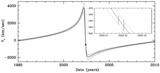
We have obtained the first detection of spectral absorption lines in one of the high-velocity stars in the vicinity of the Galaxy's central supermassive black hole. Both Brγ (2.1661 μm) and He I (2.1126 μm) are seen in absorption in S0-2 with equivalent widths (2.8+/-0.3 and 1.7+/-0.4 Å) and an inferred stellar rotational velocity (220+/-40 km s-1) that are consistent with that of an O8-B0 dwarf, which suggests that it is a massive (~15 Msolar) young (less than 10 Myr) main-sequence star. This presents a major challenge to star formation theories, given the strong tidal forces that prevail over all distances reached by S0-2 in its current orbit (130-1900 AU) and the difficulty in migrating this star inward during its lifetime from farther out where tidal forces should no longer preclude star formation. The radial velocity measurements (z>=-510+/-40 km s-1) and our reported proper motions for S0-2 strongly constrain its orbit, providing a direct measure of the black hole mass of 4.1(+/-0.6)×106(R0/8 kpc)3 Msolar. The Keplerian orbit parameters have uncertainties that are reduced by a factor of 2-3 compared to previously reported values and include, for the first time, an independent solution for the dynamical center; this location, while consistent with the nominal infrared position of Sgr A*, is localized to a factor of 5 more precisely (+/-2 mas). Furthermore, the ambiguity in the inclination of the orbit is resolved with the addition of the radial velocity measurement, indicating that the star is behind the black hole at the time of closest approach and counterrevolving against the Galaxy. With further radial velocity measurements in the next few years, the orbit of S0-2 will provide the most robust estimate of the distance to the Galactic center.
- Publication:
-
The Astrophysical Journal
- Pub Date:
- April 2003
- DOI:
- arXiv:
- arXiv:astro-ph/0302299
- Bibcode:
- 2003ApJ...586L.127G
- Keywords:
-
- Black Hole Physics;
- Galaxy: Center;
- Galaxy: Kinematics and Dynamics;
- Infrared: Stars;
- Techniques: High Anular Resolution;
- Techniques: Spectroscopic;
- Astrophysics
- E-Print:
- 14 pages, Latex, Accepted for Publication in ApJ Letters