Possible Signs of Water and Differentiation in a Rocky Exoplanetary Body
Abstract
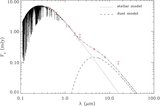
Spitzer observations reveal the presence of warm debris from a tidally destroyed rocky and possibly icy planetary body orbiting the white dwarf GD 61. Ultraviolet and optical spectroscopy of the metal-contaminated stellar photosphere reveal traces of hydrogen, oxygen, magnesium, silicon, iron, and calcium. The nominal ratios of these elements indicate an excess of oxygen relative to that expected from rock-forming metal oxides, and thus it is possible that water was accreted together with the terrestrial-like debris. Iron is found to be deficient relative to magnesium and silicon, suggesting the material may have originated as the outer layers of a differentiated parent body, as is widely accepted for the Moon.
- Publication:
-
The Astrophysical Journal
- Pub Date:
- February 2011
- DOI:
- arXiv:
- arXiv:1101.0158
- Bibcode:
- 2011ApJ...728L...8F
- Keywords:
-
- circumstellar matter;
- minor planets;
- asteroids: general;
- planetary systems;
- stars: abundances;
- white dwarfs;
- Astrophysics - Earth and Planetary Astrophysics;
- Astrophysics - Solar and Stellar Astrophysics
- E-Print:
- Accepted to ApJ Letters