Central Regions of Barred Galaxies: Two-dimensional Non-self-gravitating Hydrodynamic Simulations
Abstract
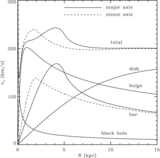
The inner regions of barred galaxies contain substructures such as off-axis shocks, nuclear rings, and nuclear spirals. These substructures may affect star formation, and control the activity of a central black hole (BH) by determining the mass inflow rate. We investigate the formation and properties of such substructures using high-resolution, grid-based hydrodynamic simulations. The gaseous medium is assumed to be infinitesimally thin, isothermal, and non-self-gravitating. The stars and dark matter are represented by a static gravitational potential with four components: a stellar disk, a bulge, a central BH, and a bar. To investigate various galactic environments, we vary the gas sound speed, cs , as well as the mass of the central BH, M BH. Once the flow has reached a quasi-steady state, off-axis shocks tend to move closer to the bar major axis as cs increases. Nuclear rings shrink in size with increasing cs , but are independent of M BH, suggesting that the ring position is not determined by the Lindblad resonances. Rings in low-cs models are narrow since they are occupied largely by gas on x 2-orbits and well decoupled from nuclear spirals, while they become broad because of large thermal perturbations in high-cs models. Nuclear spirals persist only when either cs is small or M BH is large; they would otherwise be destroyed completely by the ring material on eccentric orbits. The shape and strength of nuclear spirals depend sensitively on cs and M BH such that they are leading if both cs and M BH are small, weak trailing if cs is small and M BH is large, and strong trailing if both cs and M BH are large. While the mass inflow rate toward the nucleus is quite small in low-cs models because of the presence of a narrow nuclear ring, it becomes larger than 0.01 M ☉ yr-1 when cs is large, providing a potential explanation of nuclear activity in Seyfert galaxies.
- Publication:
-
The Astrophysical Journal
- Pub Date:
- March 2012
- DOI:
- arXiv:
- arXiv:1112.6055
- Bibcode:
- 2012ApJ...747...60K
- Keywords:
-
- galaxies: ISM;
- galaxies: kinematics and dynamics;
- galaxies: nuclei;
- galaxies: spiral;
- hydrodynamics;
- ISM: general;
- shock waves;
- Astrophysics - Astrophysics of Galaxies
- E-Print:
- Accepted for publication in the ApJ