Unveiling the First Black Holes With JWST:Multi-wavelength Spectral Predictions
Abstract
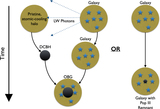
Growing supermassive black holes (∼ {10}9 {M}☉ ) that power luminous z> 6 quasars from light seeds—the remnants of the first stars—within a Gyr of the Big Bang poses a timing challenge. The formation of massive black hole seeds via direct collapse with initial masses ∼ {10}4{--}{10}5 {M}☉ alleviates this problem. Viable direct-collapse black hole formation sites, the satellite halos of star-forming galaxies, merge and acquire stars to produce a new, transient class of high-redshift objects, obese black hole galaxies (OBGs). The accretion luminosity outshines that of the stars in OBGs. We predict the multi-wavelength energy output of OBGs and growing Pop III remnants at z = 9 for standard and slim disk accretion, as well as high and low metallicities of the associated stellar population. We derive robust selection criteria for OBGs—a pre-selection to eliminate blue sources, followed by color-color cuts ([{F}090W-{F}220W]> 0;-0.3< [{F}200W-{F}444W]< 0.3) and the ratio of X-ray flux to rest-frame optical flux ({F}X/{F}444W\gg 1). Our cuts sift out OBGs from other bright, high- and low-redshift contaminants in the infrared. OBGs with predicted {M}{AB}< 25 are unambiguously detectable by the Mid-Infrared Instrument (MIRI), on the upcoming James Webb Space Telescope (JWST). For parameters explored here, growing Pop III remnants with predicted {M}{AB}< 30 will likely be undetectable by JWST. We demonstrate that JWST has the power to discriminate between initial seeding mechanisms.
- Publication:
-
The Astrophysical Journal
- Pub Date:
- April 2017
- DOI:
- arXiv:
- arXiv:1610.05312
- Bibcode:
- 2017ApJ...838..117N
- Keywords:
-
- cosmology: observations;
- dark ages;
- reionization;
- first stars;
- early universe;
- galaxies: photometry;
- quasars: supermassive black holes;
- Astrophysics - Astrophysics of Galaxies;
- Astrophysics - Cosmology and Nongalactic Astrophysics
- E-Print:
- 12 pages, 13 figures, accepted, in press, ApJ