Evidence of an Upper Bound on the Masses of Planets and Its Implications for Giant Planet Formation
Abstract
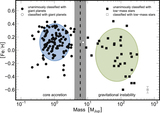
Celestial bodies with a mass of M≈ 10 {M}{Jup} have been found orbiting nearby stars. It is unknown whether these objects formed like gas-giant planets through core accretion or like stars through gravitational instability. I show that objects with M≲ 4 {M}{Jup} orbit metal-rich solar-type dwarf stars, a property associated with core accretion. Objects with M≳ 10 {M}{Jup} do not share this property. This transition is coincident with a minimum in the occurrence rate of such objects, suggesting that the maximum mass of a celestial body formed through core accretion like a planet is less than 10 {M}{Jup}. Consequently, objects with M≳ 10 {M}{Jup} orbiting solar-type dwarf stars likely formed through gravitational instability and should not be thought of as planets. Theoretical models of giant planet formation in scaled minimum-mass solar nebula Shakura-Sunyaev disks with standard parameters tuned to produce giant planets predict a maximum mass nearly an order of magnitude larger. To prevent newly formed giant planets from growing larger than 10 {M}{Jup}, protoplanetary disks must therefore be significantly less viscous or of lower mass than typically assumed during the runaway gas accretion stage of giant planet formation. Either effect would act to slow the Type I/II migration of planetary embryos/giant planets and promote their survival. These inferences are insensitive to the host star mass, planet formation location, or characteristic disk dissipation time.
- Publication:
-
The Astrophysical Journal
- Pub Date:
- January 2018
- DOI:
- arXiv:
- arXiv:1801.06185
- Bibcode:
- 2018ApJ...853...37S
- Keywords:
-
- binaries: spectroscopic;
- brown dwarfs;
- planets and satellites: formation;
- protoplanetary disks;
- stars: formation;
- stars: low-mass;
- Astrophysics - Earth and Planetary Astrophysics;
- Astrophysics - Solar and Stellar Astrophysics
- E-Print:
- 20 pages, 4 figures, and 2 tables in aastex61 format