Astrometric radial velocities for nearby stars
Abstract
Context. Under certain conditions, stellar radial velocities can be determined from astrometry, without any use of spectroscopy. This enables us to identify phenomena, other than the Doppler effect, that are displacing spectral lines.
Aims: The change of stellar proper motions over time (perspective acceleration) is used to determine radial velocities from accurate astrometric data, which are now available from the Gaia and HIPPARCOS missions.
Methods: Positions and proper motions at the epoch of HIPPARCOS are compared with values propagated back from the epoch of the Gaia Early Data Release 3. This propagation depends on the radial velocity, which obtains its value from an optimal fit assuming uniform space motion relative to the solar system barycentre.
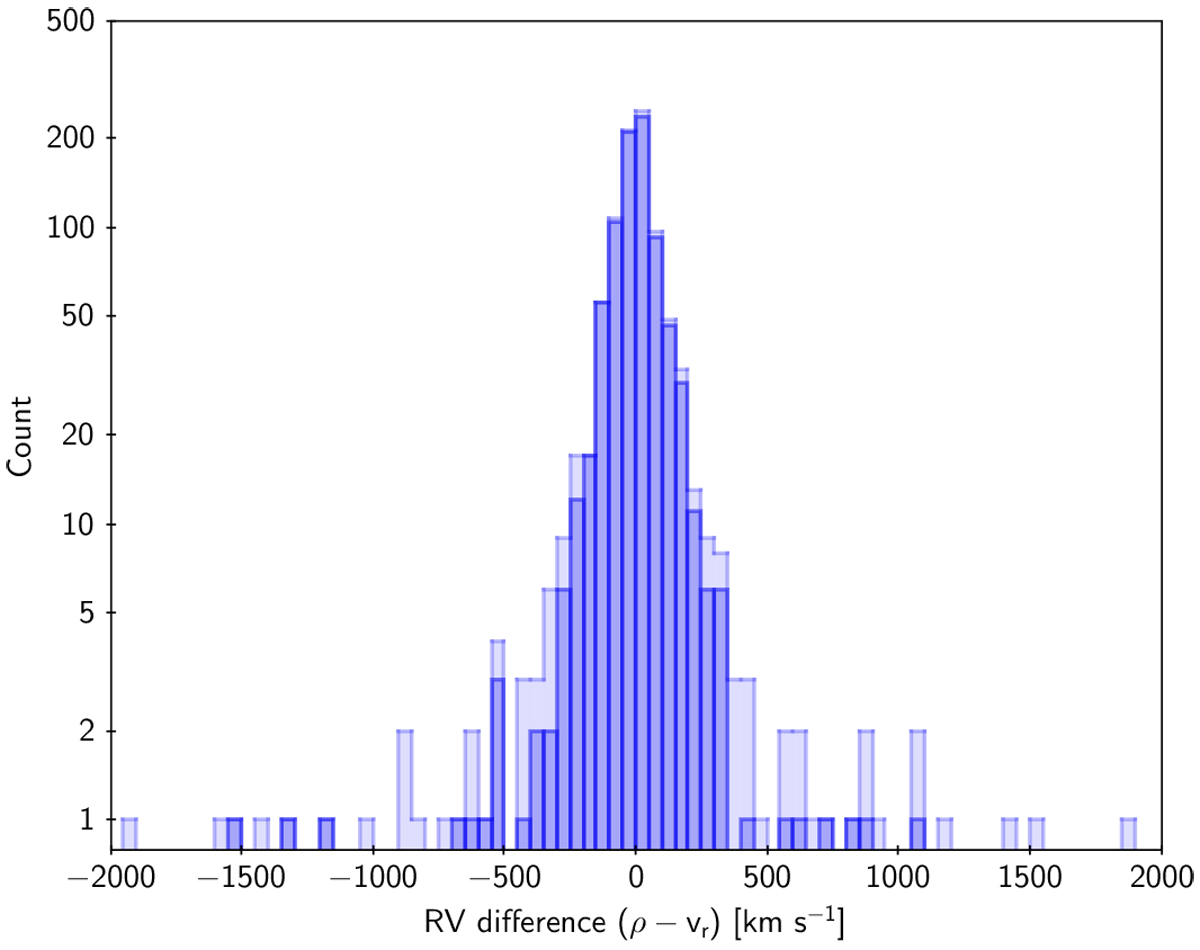
Results: For 930 nearby stars we obtain astrometric radial velocities with formal uncertainties better than 100 km s‒1; for 55 stars the uncertainty is below 10 km s‒1, and for seven it is below 1 km s‒1. Most stars that are not components of double or multiple systems show good agreement with available spectroscopic radial velocities.
Conclusions: Astrometry offers geometric methods to determine stellar radial velocity, irrespective of complexities in stellar spectra. This enables us to segregate wavelength displacements caused by the radial motion of the stellar centre-of-mass from those induced by other effects, such as gravitational redshifts in white dwarfs.
- Publication:
-
Astronomy and Astrophysics
- Pub Date:
- August 2021
- DOI:
- arXiv:
- arXiv:2105.09014
- Bibcode:
- 2021A&A...652A..45L
- Keywords:
-
- astrometry;
- proper motions;
- techniques: radial velocities;
- methods: data analysis;
- white dwarfs;
- Astrophysics - Solar and Stellar Astrophysics;
- Astrophysics - Instrumentation and Methods for Astrophysics
- E-Print:
- 7 pages, 2 figures, 2 tables. Compared with the original submission, systematic corrections to the Gaia data have been improved as detailed in Section 3. Resulting changes in Tables 1 and 2 are small and mostly insignificant. Accepted for publication in Astronomy &