MOA-2019-BLG-008Lb: A New Microlensing Detection of an Object at the Planet/Brown Dwarf Boundary
Abstract
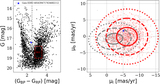
We report on the observations, analysis and interpretation of the microlensing event MOA-2019-BLG-008. The observed anomaly in the photometric light curve is best described through a binary lens model. In this model, the source did not cross caustics and no finite-source effects were observed. Therefore, the angular Einstein ring radius θ E cannot be measured from the light curve alone. However, the large event duration, t E ~ 80 days, allows a precise measurement of the microlensing parallax π E. In addition to the constraints on the angular radius θ * and the apparent brightness I s of the source, we employ the Besançon and GalMod galactic models to estimate the physical properties of the lens. We find excellent agreement between the predictions of the two galactic models: the companion is likely a resident of the brown dwarf desert with a mass M p ~ 30 M Jup, and the host is a main-sequence dwarf star. The lens lies along the line of sight to the Galactic bulge, at a distance of ≤4 kpc. We estimate that in about 10 yr the lens and source will be separated by ~55 mas, and it will be possible to confirm the exact nature of the lensing system by using high-resolution imaging from ground- or space-based observatories.
- Publication:
-
The Astronomical Journal
- Pub Date:
- September 2022
- DOI:
- arXiv:
- arXiv:2205.07522
- Bibcode:
- 2022AJ....164...75B
- Keywords:
-
- Exoplanets;
- 498;
- Astrophysics - Earth and Planetary Astrophysics;
- Astrophysics - Astrophysics of Galaxies;
- Astrophysics - Solar and Stellar Astrophysics
- E-Print:
- Accepted in AJ