When the horseshoe fits: Characterizing 2023 FY3 with the 10.4 m Gran Telescopio Canarias and the Two-meter Twin Telescope
Abstract
Context. The Arjuna asteroid belt is loosely defined as a diverse group of small asteroids that follow dynamically cold, Earth-like orbits. Most of them are not actively engaged in resonant, co-orbital behavior with Earth. Some of them experience temporary but recurrent horseshoe episodes. Objects in horseshoe paths tend to approach Earth at a low velocity, leading to captures as Earth's temporary satellites or mini-moons. Four such objects have already been identified: 1991 VG, 2006 RH120, 2020 CD3, and 2022 NX1. Here, we focus on 2023 FY3, a recent finding, the trajectory of which might have a co-orbital status and perhaps lead to temporary captures.
Aims: We want to determine the physical properties of 2023 FY3 and explore its dynamical evolution.
Methods: We carried out an observational study of 2023 FY3 using the OSIRIS camera spectrograph at the 10.4 m Gran Telescopio Canarias, to derive its spectral class, and time-series photometry obtained with QHY411M cameras and two units of the Two-meter Twin Telescope to investigate its rotational state. N-body simulations were also performed to examine its possible resonant behavior.
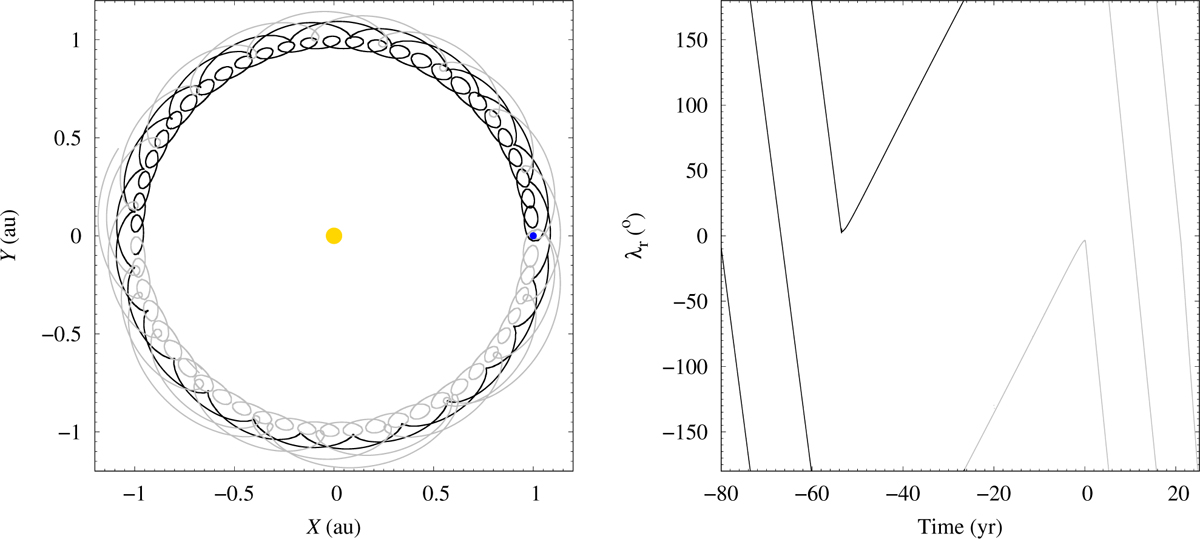
Results: The visible reflectance spectrum of 2023 FY3 is consistent with that of an S-type asteroid; its light curve gives a rotation period of 9.3±0.6 min, with an amplitude of 0.48±0.13 mag. We confirm that 2023 FY3 roams the edge of Earth's co-orbital space.
Conclusions: Arjuna 2023 FY3, an S-type asteroid and fast rotator, currently exhibits horseshoe-like resonant behavior and in the past experienced mini-moon engagements of the temporarily captured flyby type that may repeat in the future. The spectral type result further confirms that mini-moons are a diverse population in terms of surface composition.
- Publication:
-
Astronomy and Astrophysics
- Pub Date:
- January 2024
- DOI:
- arXiv:
- arXiv:2310.08724
- Bibcode:
- 2024A&A...681A...4D
- Keywords:
-
- minor planets;
- asteroids: general;
- asteroids: individual: 2023 FY3;
- techniques: spectroscopic;
- techniques: photometric;
- methods: numerical;
- celestial mechanics;
- Astrophysics - Earth and Planetary Astrophysics
- E-Print:
- 9 pages, 8 figures, 2 tables, accepted for publication in Astronomy &