JWST, ALMA, and Keck Spectroscopic Constraints on the UV Luminosity Functions at z ∼ 7─14: Clumpiness and Compactness of the Brightest Galaxies in the Early Universe
Abstract
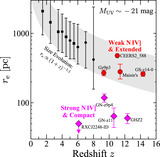
We present the number densities and physical properties of the bright galaxies spectroscopically confirmed at z ∼ 7─14. Our sample is composed of 60 galaxies at zspec ∼ 7─14, including recently confirmed galaxies at zspec = 12.34─14.18 with JWST, as well as new confirmations at zspec = 6.583─7.643 with −24 < MUV < −21 mag using ALMA and Keck. Our JWST/NIRSpec observations have also revealed that very bright galaxy candidates at z ∼ 10─13 identified from ground-based telescope images before JWST are passive galaxies at z ∼ 3─4, emphasizing the necessity of strict screening and spectroscopy in the selection of the brightest galaxies at z > 10. The UV luminosity functions derived from these spectroscopic results are consistent with a double power-law function, showing tensions with theoretical models at the bright end. To understand the origin of the overabundance of bright galaxies, we investigate their morphologies using JWST/NIRCam high-resolution images obtained in various surveys, including PRIMER and COSMOS-Web. We find that ∼70% of the bright galaxies at z ∼ 7 exhibit clumpy morphologies with multiple subcomponents, suggesting merger-induced starburst activity, which is consistent with SED fitting results showing bursty star formation histories. At z ≳ 10, bright galaxies are classified into two types of galaxies: extended ones with weak high-ionization emission lines, and compact ones with strong high-ionization lines including N IV]λ1486, indicating that at least two different processes (e.g., merger-induced starburst and compact star formation/AGN) are shaping the physical properties of the brightest galaxies at z ≳ 10 and are responsible for their overabundance.
- Publication:
-
The Astrophysical Journal
- Pub Date:
- February 2025
- DOI:
- arXiv:
- arXiv:2406.18352
- Bibcode:
- 2025ApJ...980..138H
- Keywords:
-
- Galaxy formation;
- Galaxy evolution;
- High-redshift galaxies;
- 595;
- 594;
- 734;
- Astrophysics - Astrophysics of Galaxies
- E-Print:
- 34 pages, 22 figures, Accepted for Publication in ApJ