Korean Peninsula Update, March 12, 2026
Toplines
North Korea may be expanding its nuclear enrichment facilities to support efforts to bolster its nuclear arsenal. The International Atomic Energy Agency (IAEA) reported on March 3 that satellite imagery shows that North Korea is in the process of expanding its nuclear facility at Yongbyon, which is believed to be a uranium enrichment site.[1] IAEA Director General Rafael Grossi stated that the new complex at Yongbyon is similar in terms of power supply and cooling capacity to North Korea’s Kangson nuclear enrichment facility, but did not confirm whether the new Yongbyon facility would be a uranium enrichment site.[2] South Korea’s Unification Minister Chung Dong-young stated on March 6 that North Korea likely has Uranium enrichment facilities at Yongbyon, Guseong, and Kangson, and claimed that North Korea extracted around 16kg of plutonium from the Yongbyon facility in 2025.[3] Modern nuclear weapons require around 3-5kg of plutonium for the fission core.[4]
The IAEA’s and Ministry of Unification’s (MOU) claims illustrate North Korea’s efforts to actualize Workers Party of Korea (WPK) General Secretary Kim Jong Un’s call for expanded production of large nuclear warheads and tactical nuclear weapons during the 9th Party Congress from February 19 to 26.[5] ISW-CDOT assessed that Kim is aiming to disperse North Korea’s nuclear deterrent across a wide variety of launch platforms and payload delivery mechanisms.[6] The observed expansion at Yongbyon could be intended to meet this increased demand for enriched uranium.
Russian technological assistance likely contributed to the development of North Korea’s Choe Hyon-class guided missile destroyers (DDG). North Korean state media released footage and images of the Choe Hyon (the lead ship of the Choe Hyon DDG class) conducting a cruise missile firing test on March 4.[7] Footage of the test shows Choe Hyon using a “cold launch” method at a slight angle from its vertical launch system (VLS) cells, which is characteristic of Russian naval technology.[8] The benefits of a cold launch system increase with the size of the missile, which could indicate that the Choe Hyon will carry ballistic missiles as part of its armament.[9] Images from the test also show a Pantsir-M naval air defense system, found on several Russian warships, on Choe Hyon’s aft.[10] These similarities with Russian naval armaments and the presence of a Russian weapon system on the vessel clearly indicate that Russian technological support and military equipment aided the production of North Korea’s Choe Hyon-class DDGs.
Images from the March 4 test indicate that the Choe Hyon’s VLS armament increased to 88 cells, compared to the 74 cells observed on the vessel during its April 2025 launch.[11] The images also show that the Choe Hyon’s aft VLS cells are smaller than the cells observed when the vessel first launched.[12] The smaller aft cells used during the March 4 test suggest that the vessel will not carry short-range ballistic missiles (SRBM), which likely require the larger cell design.[13] North Korea may intend to use its DDGs to form the “middle rung” on the deterrence ladder between its tactical nuclear weapons and ICBMs.[14] A nuclear-armed sea-launched cruise missile would give North Korea an escalation option below the threshold of a major strategic attack on the US mainland. Deploying nuclear warheads on sea-launched cruise missiles would also further disperse North Korea’s nuclear deterrent, increasing its survivability.[15]
The United States’ reported redeployment of parts of Terminal High Altitude Area Defense (THAAD) and Patriot PAC-3 missile interceptors to the Middle East may leave an air defense gap over South Korea. South Korean media outlets reported that C-17 and C-5 transport aircraft, reportedly carrying Patriot PAC-3 missile interceptors and launchers, left Osan Air Base in Pyeongtaek, South Korea for the Middle East on March 5.[16] The Washington Post reported on March 10, citing two US officials, that the United States has also moved parts of the THAAD anti-missile system from South Korea to the Middle East.[17] US Forces Korea (USFK) and the South Korean Ministry of National Defense declined to confirm these reports. The redeployment is likely intended to support the combined US-Israeli military operations in the Middle East.[18] The United States and Israel have responded to Iranian missile and drone attacks with Patriot PAC-3 and THAAD systems, and the United States has reportedly used “more than 800” Patriot PAC-3 interceptors over three days of fighting last week, surpassing Lockheed Martin’s annual production rate of roughly 600 units.[19] It remains unclear which components of the THAAD battery the United States has relocated. ISW-CTP reported that an Iranian missile struck and damaged the radar system for the THAAD battery at Muwaffaq Salti Airbase in Jordan in the first days of the conflict.[20]
The reported redeployment of THAAD and Patriot PAC-3 systems could create temporary gaps in South Korea’s integrated missile defense networks against North Korean missiles. The Patriot PAC-3 system serves as the final defense layer that intercepts short- and medium-range ballistic missiles during the terminal phase, when the missile is nearing its target, making it critical given the short flight times expected in a Korean Peninsula contingency.[21] South Korea has domestically developed M-SAM Block I and Block II short- to medium-range interceptors, which operate between Patriot PAC-3 and THAAD in the lower-to-mid layer within the Korean Air and Missile Defense (KAMD) architecture network.[22] The relocation of Patriot PAC-3 would therefore weaken the lower layer of KAMD against North Korean short-range ballistic missiles. THAAD remains the only high-altitude missile defense system currently deployed in South Korea and can intercept ballistic missiles at altitudes of 40 to 150 kilometers.[23] South Korea has yet to operationally deploy its indigenous L-SAM missile defense system to compensate for this potential gap.[24] North Korea currently has little incentive to conduct direct missile strikes to exploit this gap. Temporary gaps in the KAMD, however, could weaken US extended deterrence signaling and reduce the operational readiness of combined forces.
Key Takeaways
- North Korean Nuclear Capabilities: The IAEA claimed that North Korea may be expanding its nuclear facilities at Yangbyon, a possible uranium enrichment site. This would align with Kim Jong Un’s stated desire to increase North Korea’s nuclear deterrence capabilities.
- Russian Aid to North Korean Military Development: There are significant similarities between North Korea’s Choe Hyun guided missile destroyer and existing Russian technology, suggesting Russian aid in their development. Choe Hyun would provide North Korea with additional escalation options and increase the survivability of North Korean nuclear capabilities.
- US Posture Changes in South Korea: The US redeployment of THAAD and Patriot missile interceptors from South Korea to the Middle East has left a gap in the South Korean air defense umbrella.
North Korean Domestic Politics
North Korea announced the opening of the Supreme People’s Assembly (SPA) — the WPK’s rubber-stamp parliament — on March 15. The SPA may pass new legislation to reinforce its messaging toward the United States and South Korea. The SPA will convene its 15th session on March 15, during which 687 deputies representing North Korean constituencies will be elected to five-year terms.[25] The deputies then elect members of the Standing Committee, the leadership of the State Affairs Commission (SAC), and form the Cabinet.[26] The SPA functions largely as a ceremonial legislative body subordinate to the WPK. The upcoming SPA session follows the 9th Party Congress held from February 19 to 25, where North Korea intensified its rhetoric rejecting dialogue with South Korea and denuclearization.[27] North Korea has historically reinforced its policy messaging after Party Congresses by adopting related laws during SPA sessions. North Korea passed the Nuclear Policy Law in 2022, aimed at authorizing pre-emptive nuclear strikes, in line with statements made at the 8th Party Congress.[28] Pyongyang may consider additional legislation to reinforce the credibility of its nuclear deterrent during the upcoming SPA session, particularly given its expectations that the United States should accept North Korea as a nuclear-armed state. North Korea may also introduce amendments formally abandoning its unification objectives and codifying South Korea as an adversary, thereby institutionalizing its policy that the two Koreas are “hostile states.”[29] North Korea has fortified its side of the Military Demarcation Line (MDL) and severed inter-Korean roads and railways since Kim declared the “two hostile states” framework in 2023.[30] Kim further instructed the SPA in 2024 to add constitutional provisions defining North Korea’s territory, waters, and airspace.[31] North Korea’s efforts to antagonize South Korea align with its broader objective of pressuring the United States to abandon denuclearization demands by isolating Seoul from future negotiations.
WKP General Secretary Kim Jong Un aims to institutionalize and solidify his regime by distancing himself from the legacies of previous supreme leaders. Pyongyang’s perceived diplomatic and military successes have emboldened Kim to more aggressively assert his own political identity. Kim Jong Un omitted any mention of his grandfather, Kim Il Sung, or father, Kim Jong Il, for the first time at the opening ceremony of the 9th Party Congress on February 20.[32] Kim previously opened his speeches with tributes to the two late leaders at the 7th (2016) and 8th (2021) Party Congresses.[33] The South Korean MOU assessed that the 9th Party Congress marked the point where Kim decoupled his authority from his predecessors in an effort to establish his own legacy.[34] The MOU emphasized the codification of Kim Jong Un’s core “five-point party-building line” philosophy into the party rules in addition to the omission of his predecessors.[35] The WPK Central Committee resolution stated that Kim’s achievements over the past five years surpassed those of the previous two leaders during Kim’s re-election as the General Secretary.[36] The North Korean regime has accelerated the development of Kim Jong Un‘s cult of personality in recent years. North Korean state media unveiled pictures of the first statue of Kim Jong Un since he took power in 2011, and attendees of the Party Congress wore a Kim Jong Un lapel pin instead of the traditional pins featuring Kim Il Sung and Kim Jong Il.[37] Pyongyang also reorganized the Mosaic murals on the street in Pyongyang, which were previously arranged chronologically, to place Kim at the center and scaled down events for the birthdays of the previous leaders, which are North Korean national holidays.[38]
Pyongyang has expanded its diplomatic and military influence through a rapprochement with Russia, while maximizing state revenue through arms sales and cryptocurrency hacking.[39] Kim seized control over the party and military through a “reign of terror,” executing his uncle Jang Song Thaek in 2013 and provoking South Korea.[40] The North Korean public, however, appeared to view Kim skeptically, often dismissing him as an “immature leader” or blaming him for failed reform policies.[41] Kim may finally feel confident breaking from his predecessors by leveraging tangible strategic achievements and formalizing a more centralized power structure. Kim will also very likely pursue a US and South Korea strategy that deviates from those of his predecessors.
North Korean Military Developments
Kim Jong Un may be aiming to transform the KPA Navy (KPAN) into a “green-water navy,” which could improve North Korea’s sea lines of communication (SLOC) defense and allow it to increase military intimidation against regional rivals. Kim Jong Un called on North Korea’s shipbuilding industry to produce two new DDGs per year as part of the current five-year plan, hypothetically bringing North Korea’s total DDG count to 12 by 2030.[42] North Korea is also in the process of building an unknown number of guided missile frigates (FFG) that would add to its number of major surface combatants.[43] South Korean media claimed that North Korea is expanding its naval facilities at Chongjin Shipyard on the East Sea.[44] This expansion could indicate greater vessel construction capacity or the development of support facilities for longer-range deployments.
The KPAN has historically been a “brown-water” navy, or a navy designed to operate within its national littoral zone with a focus on coastal defense.[45] Brown-water navies typically field a mix of small surface combatants, patrol craft, and midget submarines.[46] Kim’s increasing emphasis on constructing a large number of capable surface combatants suggests he aims to reshape the KPAN into a “green-water” force. Green-water navies retain a littoral and coastal defense focus but also have the capability for longer-range deployments in neighboring sea areas.[47] A KPAN that fields several DDGs and FFGs could begin to undertake deployments beyond North Korea’s coastal waters.
North Korea could use a green-water force to conduct deployments in the East and Yellow seas in order to intimidate South Korea and Japan or secure SLOCs with the People’s Republic of China (PRC) and Russia. North Korea could also use a green-water fleet to harass shipping lanes and the maritime connections between its adversaries in the East Sea or East China Sea. North Korea likely lacks the infrastructure to support longer-range deployments at present, including auxiliary vessels needed to conduct replenishment at sea.[48] The KPAN also faces the limitation of having to deploy forces in both the Yellow Sea and East Sea, which cannot easily support each other as any vessel transferring from one coast to the other would have to circumnavigate South Korea. The expansion of naval facilities on the east coast of North Korea at Chongjin suggests North Korea would allocate most of its potential green-water fleet to the East Sea.
North Korean Foreign Relations
A dialogue between the United States and North Korea remains unlikely unless the United States shifts its position on recognition of Pyongyang’s nuclear status. The Trump Administration has signaled openness for dialogue with North Korea while refraining from responding to Pyongyang’s demands for recognition as a nuclear-armed state. White House Spokesperson Karoline Leavitt said during a March 4 briefing that there has been no change in the US position toward North Korea.[49] US Under Secretary of Defense for Policy Elbridge Colby said on March 5 that the US approach to North Korea is maintaining strength while remaining open to dialogue.[50] US officials did not indicate any shift in Washington’s nonproliferation commitment after WPK General Secretary Kim Jong Un suggested that dialogue with the United States could be possible if Washington recognized Pyongyang’s nuclear status during the 9th Party Congress.[51] ISW-CDOT assessed that Pyongyang’s economic conditions and security guarantees were the primary drivers of North Korea’s return to dialogue with the United States between 2018 and 2019.[52] North Korea has since expanded its security and trade relations with Russia since 2023 and likely sees little incentive to pursue dialogue with the United States at present. North Korea likely assesses that states lacking nuclear capabilities are vulnerable to attack, which is likely to impact its diplomatic positioning vis-a-vis the United States. Recent US actions abroad, including military operations in Iran and the arrest of Venezuelan President Nicolás Maduro, may have disincentivized North Korea from seeking dialogue with the Trump Administration. Pyongyang will likely continue prioritizing the expansion of its nuclear deterrent while deepening its alignment with Russia and the People’s Republic of China (PRC).
The recent resumption of full North Korean-Indonesian diplomatic relations aligns with WPK General Secretary Kim Jong Un’s stated desire at the 9th Party Congress to strengthen relations with “traditional allies.” Indonesian Ambassador to North Korea Gina Yoginda arrived in Pyongyang on February 21, the first time in over four years that an Indonesian ambassador was in Pyongyang.[53] Indonesian President Prabowo Subianto nominated Gina in December 2025, though the Indonesian embassy resumed its operations in Pyongyang in June 2025, following a four-year closure due to the COVID-19 pandemic.[54] Indonesia and North Korea established diplomatic relations in 1964 due to the close relationship of their respective founders, Sukarno and Kim Il Sung. Indonesian Foreign Minister Sugiono traveled to Pyongyang in October 2025, the first such trip since 2013, and renewed a Memorandum of Understanding between the two states that laid the groundwork for cooperation across sectors.[55] Sugiono reiterated Indonesia’s desire to facilitate engagement between North Korea and the Association of Southeast Asian Nations (ASEAN).
Kim Jong Un stated during the 9th Party Congress that Pyongyang should deepen its cooperation with “anti-imperialist and independent countries,” terms North Korea uses for Communist and “unaligned” countries.[56] Indonesia, a member of the Non-Aligned Movement, falls into this category. North Korea will likely continue to expand its engagement with Indonesia and other non-aligned states and continue to reap the diplomatic, economic, and military benefits from these partnerships.
South Korea reported that North Korea has supplied around 6,000 additional containers of artillery shells to Russia since July 2025.[57] Reports indicate that transfers have recently decreased, though North Korea may use a new land bridge with Russia to expedite future transfers. The South Korean Defense Intelligence Agency (DIA) reported on March 1 that North Korea has transferred a total of 33,000 containers of weapons to Kursk Oblast, Russia, since North Korea deployed ground troops to the region in 2024.[58] US-based media outlet NK News suggested that the decrease in weaponry container shipments at North Korea’s Rason port between January and February 2026 may indicate a shift to using railroads to transfer shipments.[59] North Korea and Russia are currently constructing the first road bridge over the Tumen River, which they expect to complete by June 2026.[60] ISW-CDOT previously reported that Pyongyang and Moscow may expand military cooperation with the completion of the new bridge.[61] The bridge could expedite the speed of shipments and allow North Korea to supply weapons directly to the Russian frontline.[62] North Korea can secure additional revenue, strengthen bilateral ties with Russia, and develop new weapons systems emphasized in the 9th Party Congress, such as the 240mm multiple rocket launchers (MLR) deployed along the MDL.[63]
North Korean Influence Operations
Nothing significant to report.
Inter-Korean Relations
South Korea’s Lee Jae Myung administration is unlikely to reverse its “peaceful coexistence” policy toward North Korea, despite WPK General Secretary Kim Jong Un’s rejection of inter-Korean dialogue. President Lee stated on February 26 that he would pursue peaceful policies in response to Kim’s February 21 declaration of “hostile” inter-Korean relations.[64] Lee argued that both Koreas must pursue peace and stability and undertake long-term mutual efforts to eliminate hostile sentiment.[65] Kim formalized permanent inter-Korean separation and abandoned North Korea’s policy of pursuing unification on February 21 at the 9th Party Congress.[66] Lee urged Pyongyang to engage in dialogue based on coexistence and trust during his March 1 speech.[67] Lee emphasized details of his coexistence policy, such as respecting each other’s systems, and ruling out unification through absorption to avoid provoking Pyongyang.[68] The MOU also announced plans to rename the “Korean-German Joint Consultation Committee on National Unification”, a group that shares unification issues with the German Ministry of the Interior, to “Committee on Peace Policy.[69] MOU aims to codify its peaceful coexistence policy, which excludes unification, to demonstrate the administration’s sustained commitment to Pyongyang.[70] Lee is unlikely to get a positive response from Kim. The Lee administration continues to position itself as a “pacemaker” for US-North Korea dialogue and inter-Korean dialogue, however.[71]
Kim may intend to disrupt US-South Korean policy coordination by exploiting potential objective differences between the two allies. Kim very likely seeks formal recognition as a nuclear state from Washington and is unlikely to engage with the United States as long as this policy position holds.[72] Pyongyang may perceive that Seoul cannot fulfill Kim’s demands, such as sanction relief, which will make inter-Korean dialogue unlikely. Kim expressed his willingness to negotiate on denuclearization directly with Washington instead of then South Korean President Moon Jae In to US President Donald Trump on September 21, 2018.[73] Kim may be adapting the “talk with the United States, block South Korea” strategy to hinder the US-South Korea alliance.
South Korean Domestic Politics
South Korean President Lee Jae Myung called for a cap on domestic oil prices on March 9 as conflict in the Middle East disrupts global oil shipping.[74] Global oil prices reached over 100 US dollars per barrel on March 9 following the combined US-Israeli military action against Iran starting on February 28.[75] The Korea National Oil Corporation stated that average gasoline prices in the Seoul metropolitan area increased by about 11 percent and diesel prices by over 18 percent compared to February 27.[76] South Korea’s economy heavily relies on imported energy from the Middle East, which accounts for roughly 70 percent of South Korea’s oil imports.[77] Over 95 percent of those shipments transit the Strait of Hormuz, through which about 20 percent of global oil shipments transit daily.[78] South Korea’s current reserves can sustain about 208 days of oil consumption, while natural gas reserves would last only one or two months.[79] Liquefied natural gas (LNG) shipments also transit the Strait of Hormuz. Shipping companies have already adjusted routes or are reviewing higher insurance premiums. South Korea may face the largest economic impact among major economies, with its consumer inflation rate projected to increase 0.06 percentage points and its economic growth rate expected to reduce 0.45 percentage points by 2027, if the global oil prices increase by around 10 US dollars.[80] South Korea has secured 6 million barrels of crude oil through alternative routes from the United Arab Emirates, which likely seeks to import the South Korea-developed “Cheongung” M-SAM air defense system to defend against Iranian missile and drone attacks.[81] Six million barrels exceeds two days of South Korea’s daily consumption rate of approximately 2.8 million barrels.[82] Prolonged conflict in the Middle East may weaken Lee’s economic policy targets, which prioritize stabilizing high inflation and exchange rates.
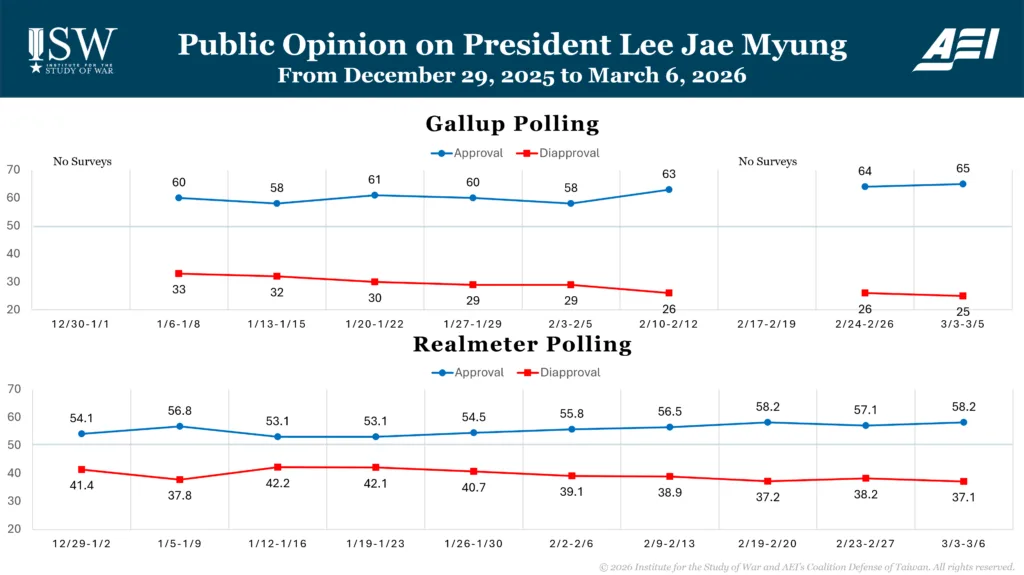
The South Korean President Lee Jae Myung’s approval ratings between March 3 and 5 reached their highest point since July 2025. Gallup reported on March 5 that Lee’s approval ratings increased to 65 percent in the first week of March, a one-percent increase from the previous week.[83] The figure marks the highest rating since it reached 65 percent during the first week of July 2025. 94 percent of respondents who identified as ruling Democratic Party (DP) supporters approved of Lee’s performance, while 70 percent of respondents who identified as moderates also expressed support for Lee.[84] Respondents attributed their positive evaluations to the Lee administration’s economic policies, including his real estate policies.[85] Realmeter also reported a slight increase (1.1 percent) to 58.2 percent between March 3 and 6.[86] Realmeter attributed the increase to Lee’s economic policies, including efforts to stabilize the stock market and manage risk following the Middle East conflict.[87]
Counter-North Korean Coalition Building Efforts
See toplines.

[1] https://www.nknews dot org/2026/03/north-korea-has-finished-new-facility-at-nuclear-complex-watchdog-says/
[2] https://www.upi dot com/Top_News/World-News/2026/03/03/IAEA-Rafael-Grossi-North-Korea-uranium-enrichment-Kangson-Yongbyon/3631772521945/
[3] https://www.chosun dot com/english/national-en/2026/03/06/PH43SJ5ZCFBVTNSC2KM6S4ACWM/
[4] https://ieer.org/resource/factsheets/fissile-material-basics/#:~:text=What%20is%20plutonium%20used%20for,plutonium%20in%20civilian%20inventories%20worldwide.
[5] https://nk.news1 dot kr/news/articles/6083545
[6] https://understandingwar.org/research/china-taiwan/korean-peninsula-update-march-3-2026/
[7] https://www.nknews dot org/2026/03/kim-jong-un-oversees-cruise-missile-test-from-new-warship-ahead-of-deployment/
[8] http://x.com/KPA_bot/status/2029320779456970995; https://www.twz.com/37109/russia-still-uses-this-cold-war-relic-of-an-underground-anti-ship-missile-system-in-crimea
[9] http://ptmts.org.pl/jtam/index.php/jtam/article/view/4453
[10] https://www.navalnews.com/naval-news/2019/02/russias-pantsir-me-air-defense-system-at-idex-2019/; https://tass dot com/defense/2095253; https://understandingwar.org/research/russia-ukraine/russian-offensive-campaign-assessment_7-8/
[11] https://www.nknews dot org/2026/03/kim-jong-un-oversees-cruise-missile-test-from-new-warship-ahead-of-deployment/; https://www.navalnews.com/naval-news/2025/04/heavily-armed-missile-destroyer-joins-north-korean-navy/
[12] https://beyondparallel.csis.org/north-korea-launches-the-choe-hyon-guided-missile-destroyer/; https://www.nknews dot org/2026/03/kim-jong-un-oversees-cruise-missile-test-from-new-warship-ahead-of-deployment/
[13] https://www.navalnews.com/naval-news/2025/04/heavily-armed-missile-destroyer-joins-north-korean-navy/
[14] https://www.heritage.org/defense/commentary/the-nuclear-sea-launched-cruise-missile-worth-the-investment-deterrence
[15] https://understandingwar.org/research/china-taiwan/korean-peninsula-update-march-3-2026/
[16] https://www.khan.co dot kr/article/202603091630001#ENT; https://www.donga dot com/news/Politics/article/all/20260306/133474796/2
[17] https://www.washingtonpost.com/national-security/2026/03/09/iran-war-cost/
[18] https://www.aljazeera dot com/news/2026/3/2/what-is-irans-military-strategy-how-it-has-changed-since-june-2025-war
[19] https://www.theguardian.com/world/2026/mar/09/ukraine-sent-drone-experts-protect-us-bases-jordan-zelenskyy?utm_source=chatgpt.com
[20] https://understandingwar.org/research/middle-east/iran-update-evening-special-report-march-6-2026/; https://www.cnn.com/2026/03/05/middleeast/radar-bases-us-missile-defense-iran-war-intl-invs
[21] https://www.boeing.com/content/dam/boeing/boeingdotcom/defense/pac3-missile-seeker/pdf/PAC-3_Seeker_ProductCard.pdf; https://www.armyrecognition.com/military-products/army/air-defense-systems/air-defense-vehicles/patriot-pac-3-mse-gem-t-air-defense-missile-system-data
[22] https://www.cfr.org/articles/south-koreas-revitalized-three-axis-system
[23] https://www.donga dot com/news/Politics/article/all/20260310/133501102/1
[24] https://en.sedaily dot com/politics/2026/03/08/south-korea-completes-indigenous-long-range-missile-defense
[25] https://www.hani.co dot kr/arti/politics/defense/1247547.html
[26] https://nkinfo.unikorea.go dot kr/nkp/pge/view.do;jsessionid=VgrDKK0JCvaJCxiqUsHed1QpEk1NEpvCbKWdiHYN.ins22?menuId=PO007
[27] https://understandingwar.org/research/china-taiwan/north-koreas-9th-party-congress-signals-confidence-in-nuclear-deterrence-rejects-denuclearization-and-inter-korean-talks/
[28] https://www.armscontrol.org/act/2022-10/news/north-korea-passes-nuclear-law
[29] https://www.bbc.com/news/articles/c1wnxlxxwq2o
[30] https://www.news1 dot kr/nk/politics-diplomacy/6089785
[31] https://www.news1 dot kr/nk/politics-diplomacy/6089785
[32] https://chosunsinbo dot com/2026/02/30-349/
[33] https://chosunsinbo dot com/2016/05/kcna_160507-4/; https://chosunsinbo dot com/2021/01/6-33/
[34] https://www.edaily.co dot kr/News/Read?newsId=04700246645354784&mediaCodeNo=257
[35] https://www.segye dot com/newsView/20260227510988
[36] https://chosunsinbo dot com/2026/02/23sk-31/
[37] https://www.nknews dot org/2026/03/north-korea-reveals-first-known-kim-jong-un-sculpture-boosting-personality-cult/; https://www.news1 dot kr/nk/politics-diplomacy/6088358; https://www.youtube.com/watch?v=JWbvtjhBvjI
[38] https://www.yna.co dot kr/view/PYH20250622068500042; https://www.ytn.co dot kr/_ln/0101_202601100505398071
[39] https://understandingwar.org/research/china-taiwan/korean-peninsula-update-january-22-2026/; https://www.chosun dot com/politics/diplomacy-defense/2025/04/09/M4UOBYILCVFOTEJYHJRO2N6PRU/
[40] https://www.bbc.com/news/world-asia-25312983
[41] https://www.rfa.org/korean/weekly_program/radio-world/radioworld-01042016091816.html; https://www.voakorea.com/a/nkorea-124341134/1341714.html
[42] https://www.nknews dot org/2026/03/kim-jong-un-oversees-cruise-missile-test-from-new-warship-ahead-of-deployment/
[43] https://beyondparallel.csis.org/nampo-guided-missile-frigate-unwrapped/; https://beyondparallel.csis.org/new-guided-missile-frigate-fitting-out-at-nampo/
[44] https://www.news1 dot kr/nk/politics-diplomacy/6089953
[45] https://naval-encyclopedia.com/cold-war/north-korean-navy.php
[46] http://www.jstor.org/stable/45371173
[47] https://cimsec.org/brazilian-navy-green-blue/
[48] https://www.warpowernorthkorea.com/navalpower.php
[49] https://n.news.naver dot com/mnews/article/032/0003431495; https://www.reuters.com/world/asia-pacific/white-house-us-is-open-dialogue-with-north-korea-without-preconditions-yonhap-2026-02-26/
[50] https://www.cfr.org/event/conversation-elbridge-colby
[51] https://www.bbc.com/news/articles/c0q3747jvnwo
[52] https://understandingwar.org/research/china-taiwan/north-koreas-9th-party-congress-signals-confidence-in-nuclear-deterrence-rejects-denuclearization-and-inter-korean-talks/
[53] https://www.nknews.org/2026/03/new-indonesian-ambassador-to-north-korea-takes-up-post-in-pyongyang/
[54] https://www.nknews.org/2026/02/photos-suggest-indonesian-envoy-not-yet-in-north-korea-months-after-appointment/
[55] https://www.lowyinstitute.org/the-interpreter/indonesia-makes-quiet-return-pyongyang
[56] https://understandingwar.org/research/china-taiwan/north-koreas-9th-party-congress-signals-confidence-in-nuclear-deterrence-rejects-denuclearization-and-inter-korean-talks/
[57] https://www.news1 dot kr/diplomacy/defense-diplomacy/6086837
[58] https://www.yna.co dot kr/view/AKR20260227112200504
[59] https://www.nknews dot org/2026/03/north-korea-has-sent-5k-containers-of-munitions-to-russia-since-august-seoul/
[60] https://www.yna.co dot kr/view/AKR20260112143200080
[61] https://understandingwar.org/research/china-taiwan/china-taiwan-weekly-update-september-15-2025/
[62] https://understandingwar.org/research/china-taiwan/china-taiwan-weekly-update-september-15-2025/
[63] https://kcnawatch dot org/newstream/1772076051-920827632/%eb%b6%88%ea%b5%b4%ec%9d%98-%ea%b0%9c%ec%b2%99%ed%88%ac%ec%9f%81%ec%9c%bc%eb%a1%9c-%ec%a0%84%ec%b7%a8%ed%95%9c-%ec%9c%84%eb%8c%80%ed%95%9c-%ec%8a%b9%eb%a6%ac%ec%99%80-%ec%98%81%ea%b4%91%ec%9d%84/; https://www.yna.co dot kr/view/MYH20260226013300038
[64] https://www.chosun dot com/politics/politics_general/2026/02/26/2QE3VWCRFRAAFHKQV7YIKTAD5M/
[65] https://www.chosun dot com/politics/politics_general/2026/02/26/2QE3VWCRFRAAFHKQV7YIKTAD5M/
[66] https://kcnawatch dot org/newstream/1772076051-920827632/%eb%b6%88%ea%b5%b4%ec%9d%98-%ea%b0%9c%ec%b2%99%ed%88%ac%ec%9f%81%ec%9c%bc%eb%a1%9c-%ec%a0%84%ec%b7%a8%ed%95%9c-%ec%9c%84%eb%8c%80%ed%95%9c-%ec%8a%b9%eb%a6%ac%ec%99%80-%ec%98%81%ea%b4%91%ec%9d%84/; https://www.yna.co dot kr/view/MYH20260226013300038
[67] https://www.bbc.com/korean/articles/cyv9gge4n8mo
[68] https://www.bbc.com/korean/articles/cyv9gge4n8mo
[69] https://www.segye dot com/newsView/20260304519213?OutUrl=naver
[70] https://www.nknews dot org/2026/03/seoul-seeks-to-build-blockchain-based-peace-trade-system-with-north-korea/; https://www.newsis dot com/view/NISX20260306_0003537497
[71] https://understandingwar.org/research/china-taiwan/north-koreas-9th-party-congress-signals-confidence-in-nuclear-deterrence-rejects-denuclearization-and-inter-korean-talks/; https://www.joongang.co dot kr/article/25361643
[72] https://www.yna.co dot kr/view/MYH20260228002200038
[73] https://www.khan.co dot kr/article/202209251142001
[74] https://news.kbs.co dot kr/news/view.do?ncd=8503197
[75] https://www.nytimes.com/2026/03/08/business/energy-environment/oil-prices-iran-100-dollars-barrel.html
[76] https://www.yna.co dot kr/view/AKR20260309125100003
[77] https://www.ytn.co dot kr/_ln/0102_202603031759000583
[78] https://www.ytn.co dot kr/_ln/0102_202603031759000583
[79] https://www.hani.co dot kr/arti/opinion/editorial/1248486.html
[80] https://www.ytn.co dot kr/_ln/0102_202603031759000583
[81] https://www.joongangenews dot com/news/articleView.html?idxno=499445
[82] https://www.ohmynews dot com/NWS_Web/View/at_pg.aspx?CNTN_CD=A0003212529
[83] https://www.gallup.co dot kr/gallupdb/reportContent.asp?seqNo=1624
[84] https://www.gallup.co dot kr/gallupdb/reportContent.asp?seqNo=1624
[85] https://www.gallup.co dot kr/gallupdb/reportContent.asp?seqNo=1624
[86] http://www.realmeter dot net/%ec%97%90%eb%84%88%ec%a7%80%ea%b2%bd%ec%a0%9c%ec%8b%a0%eb%ac%b8-%eb%a6%ac%ec%96%bc%eb%af%b8%ed%84%b0-3%ec%9b%94-1%ec%a3%bc-%ec%b0%a8-%ec%a3%bc%ea%b0%84-%eb%8f%99%ed%96%a5-%e6%9d%8e-%eb%8c%80/
[87] http://www.realmeter dot net/%ec%97%90%eb%84%88%ec%a7%80%ea%b2%bd%ec%a0%9c%ec%8b%a0%eb%ac%b8-%eb%a6%ac%ec%96%bc%eb%af%b8%ed%84%b0-3%ec%9b%94-1%ec%a3%bc-%ec%b0%a8-%ec%a3%bc%ea%b0%84-%eb%8f%99%ed%96%a5-%e6%9d%8e-%eb%8c%80/