Korean Peninsula Update, March 25, 2026
Toplines
Workers’ Party of Korea (WPK) General Secretary Kim Jong Un used the 15th Supreme People’s Assembly (SPA) session to reinforce North Korea’s “two hostile states” policy against South Korea. The SPA also formalized leadership changes observed during the 9th Party Congress. North Korea convened the first session of the 15th SPA on March 22.[1] The session re-elected Kim Jong Un as Chairman of the State Affairs Commission. Kim Jong Un stated during the SPA session that North Korea will reject any relationship with Seoul and officially designate it as the “most hostile state” towards the Kim regime.[2] Kim again described North Korea’s nuclear weapons state as “irreversible” and denounced US actions across the world as acts of state terror, likely referencing the ongoing conflict in the Middle East.[3] The session also elected Jo Yong Won as Chairman and Pak Thae Song as Vice Chairman of the SPA Standing Committee. Kim Jae Ryong, Ri Hi Yong, Jong Kyong Thaek, Kim Song Nam, Ju Chang Il, Choe Son Hui, No Kwang Chol, Kim Tok Hun, Ri Chang Dae, Pang Tu Sop, and Kim Chol Won – who all currently hold key positions within the party – were elected as members of the Standing Committee.[4] The Standing Committee is the highest decision-making organ of the SPA consisting of a chairman, vice chairman, secretary-general, and members. Jo announced six agenda items for the session, including amendments to the WPK Socialist Constitution.
The SPA functions largely as a ceremonial legislative body subordinate to the WPK. The 15th SPA session follows the 9th Party Congress, held from February 19 to 25, during which North Korea intensified its rhetoric rejecting dialogue with South Korea and denuclearization.[5] North Korea has historically reinforced its policy messaging after Party Congresses by adopting related laws during SPA sessions.[6] North Korea passed the Nuclear Policy Law in 2022, authorizing pre-emptive nuclear strikes, in line with statements made at the 8th Party Congress.[7] Pyongyang likely pursued legislation related to bolstering the credibility of its nuclear deterrent, particularly as it seeks US acceptance of its nuclear status. Pyongyang may have also introduced amendments that formally abandon unification objectives, thereby institutionalizing its policy that the two Koreas are “hostile states.”[8] North Korea has fortified its side of the Military Demarcation Line (MDL) since Kim declared the “two hostile states” framework in 2023.[9] North Korean state media has yet to report on the details of the announced constitutional amendments for the 15th SPA.
ISW-CDOT assessed that Jo’s removal from key party positions at the 9th Party Congress likely signaled his reassignment to the SPA.[10] The WPK did not re-elect Jo as the Secretariat as the Organization Secretary and Director of the Organization and Guidance Department.[11] The appointment aligns with a broader generational transition within WPK leadership, as aging officials are retired from key party roles and replaced with younger technocrats. Senior figures who supported Kim Jong Un’s early consolidation of power, including Choe Ryong Hae, Kim Yong Chol, and Ri Pyong Chol, no longer hold positions in either the party or parliament at time of writing. Jo’s move to the SPA is a reassignment instead of a purge, but SPA leadership roles are more symbolic than party positions. Jo’s career trajectory mirrors Choe Ryong Hae’s – from a central party decision-maker to SPA chairman and eventual retirement – suggesting that Jo may be on a similar track. ISW-CDOT assessed that Kim Jae Ryong has assumed Jo’s core party responsibilities, particularly within the Organization Department, which controls personnel appointments and removals.[12] The SPA excluded Kim Yo Jong from the State Affairs Commission for the first time since 2019.[13] Her removal likely reflects a reconfiguration of her role as the WPK Department Director, rather than a loss of power.
North Korea is likely integrating lessons from the war in Ukraine to improve its armored equipment and infantry tactics. These improvements will increase the threat that North Korean conventional forces pose to South Korea. North Korean state media released footage on March 20 of what it described as “new-type main battle tanks” conducting training exercises alongside infantry, armored personnel carriers (APC), and various unmanned systems.[14] The new tank appears to be a modified version of the Chonma-20 main battle tank that was last displayed during an October 2025 military parade.[15] The Chonma-20 is North Korea’s most advanced main battle tank, equipped with sloped composite armor, active protection systems, and several external sensors that could enhance the tank’s situational awareness and survivability.[16]
The “new-type” tank exhibited minor design changes from the Chonma-20 that likely resulted from North Korean observations of the vulnerability of armor to drone attacks in Ukraine.[17] The tanks shown in the March 20 exercise did not mount an anti-tank guided missile (ATGM) on the tank’s turret, unlike the Chonma-20, and instead featured two active protection systems that can cover the most vulnerable parts of the vehicle.[18] Active protection systems are designed to defeat incoming threats targeting a tank’s weak points, such as an ATGM or a drone.[19] North Korea may be integrating active protection systems onto its armored equipment to prepare for a combat environment saturated with unmanned systems that have proven extremely effective at destroying armor and stagnating armored offensives.
The March 20 training exercises also demonstrated North Korea’s interest in integrating unmanned systems into its tactical procedures for a combined-arms offensive. Footage from North Korean state media showed several unmanned systems striking targets that represented enemy command and control nodes and anti-tank positions.[20] A company-sized armored advance accompanied by several infantry squads followed the drone strikes to exploit the breach opened by the suppressive fire.[21] The exercise reflects North Korean intentions to use unmanned systems in tandem with armor and infantry to create significant breaches in an enemy anti-tank position to allow combined-arms elements to break through prepared defensive positions. Some elements of the exercise were not reflective of lessons from the Ukrainian battlefield, however, as the close concentration of dozens of armored vehicles and hundreds of infantry personnel would likely be targets for drones and drone-guided munitions that could significantly degrade a similar offensive in wartime.[22] North Korea’s integration of unmanned systems and changes in equipment aimed at addressing the saturation of drones on the modern battlefield, nonetheless, will likely increase the proficiency of the Korean People’s Army (KPA) in modern conventional conflicts.
South Korean Prime Minister Kim Min-seok stated on March 13 that US President Donald Trump expressed interest in meeting with WPK Secretary General Kim Jong Un during or after Trump’s trip to the PRC, which has since been rescheduled. Such a meeting is unlikely to occur without significant changes to the US’s North Korea policy. Kim Min-seok and Trump discussed North Korea policy during an unscheduled meeting at the White House.[23] Trump expressed willingness to speak with Kim Jong Un during his visit to the PRC. Trump was scheduled to travel to Beijing from March 31 to April 2 for a summit with Chinese Communist Party (CCP) General Secretary Xi Jinping at the time of his discussion with Kim Min-seok. The meeting has since been delayed “five to six weeks” at the request of President Trump.[24] Kim Min-seok stated that he viewed Trump’s comments as an indication that he placed greater emphasis on maintaining dialogue with Kim Jong Un than determining a set time for dialogue.[25] Kim Min-seok stated that he told Trump North Korea appeared to be slightly shifting in favor of dialogue with the United States. Trump’s comments align with similar statements made by US Secretary of State Marco Rubio on February 26, when Rubio indicated that the United States was open to dialogue with Pyongyang.[26] South Korean Unification Minister Chung Dong-young responded positively to Trump’s comments, aligning with Chung’s stated policy objectives of promoting engagement between North Korea, the United States, and South Korea.[27]
Kim Jong Un stated during the 9th Party Congress that North Korea would be open to dialogue with the United States if the United States abandoned its “hostile policies,” a phrase typically used to refer to US sanctions on North Korea, calls for denuclearization, and/or US defense posture around the peninsula.[28] ISW-CDOT continues to assess that dialogue between the United States and Pyongyang remains unlikely at this time, as the United States has made no efforts to change its North Korea policy to meet Kim Jong Un’s stated requirements.
Key Takeaways
- North Korean Domestic Policy: North Korea reinforced its “two hostile states” policy against South Korea and officially rejected the prospect of future relations between Pyongyang and Seoul during the 15th SPA session on March 22. The 15th SPA session also reinforced the generational transitions in WPK leadership seen in the 9th Party Congress.
- North Korean Military Development: North Korea is likely integrating lessons from the war in Ukraine to improve its military equipment and tactics. These improvements will increase the threat that North Korean forces pose to South Korea.
- US-North Korean Relations: US President Donald Trump expressed interest in meeting with Kim Jong Un when he visits the PRC for high-level talks. Such a meeting is unlikely to happen, as the United States has not changed its North Korea policy to meet Kim’s requirements for dialogue.
North Korean Domestic Politics
See toplines.
North Korean Military Developments
North Korea-affiliated hacker group “Lazarus” reportedly stole cryptocurrency from a Swedish crypto-based commercial website on March 1.[29] North Korea appears to be diversifying its hacking targets beyond South Korea and the United States. Swedish company Bitrefill reported that hackers stole an undisclosed amount of cryptocurrency from the company and accessed approximately 18,500 customer purchase records.[30] Bitrefill speculated that Lazarus was the main actor based on the similarities the case had to previous Lazarus hacking operations.[31] Bitrefill alleged that Lazarus hacked into an employee’s laptop to gain access to account information and files.[32] Lazarus operates under the Reconnaissance General Bureau, North Korea’s military intelligence agency.[33] North Korea stole approximately 2 billion USD in cryptocurrency in 2025 alone.[34]
ISW-CDOT assessed that cryptocurrency theft is rapidly emerging as a major source of North Korea’s illicit revenue, accounting for approximately 7 percent of its 2025 GDP.[35] North Korea is expanding its illicit income sources to bypass international sanctions. Pyongyang intends to accelerate its advanced military developments, using these illicit funds, to secure regime stability. The US Treasury Department claimed on March 11 that North Korea uses stolen cryptocurrency to fund its Weapons of Mass Destruction (WMD) programs, such as nuclear and missile development.[36] Cryptocurrency exchange Binance estimated that North Korea holds approximately 1.14 billion USD worth of Bitcoin as of March 2025.[37] This makes North Korea the third-largest Bitcoin-holding entity after the US and UK governments.[38] North Korea may intend to diversify its hacking targets to offset the losses caused by the cryptocurrency price drop, which began in the second half of 2025.[39] Lazarus may target smaller commercial sites and exchanges that may have lower security levels than their previous South Korean and US targets. North Korea is using artificial intelligence (AI) to expand its cryptocurrency income generation.[40]
The US Office of the Director of National Intelligence (ODNI) released its 2026 Annual Threat Assessment on March 14. The report assessed that North Korea will continue to expand its nuclear and conventional military capabilities, sometimes with assistance from Russia, and placed a greater emphasis on the threat of North Korean cyber activities than the 2025 iteration. ODNI’s annual threat assessment summarizes the most direct, serious threats facing the United States as assessed by the US Intelligence Community (IC).[41] The 2026 ODNI report identifies North Korea as a significant threat to the United States. ODNI assessed that North Korea is continuing to invest heavily in its military development, particularly its nuclear stockpile and advanced missile systems. ODNI reported that North Korea has tested ICBMs capable of striking the United States, and stated that North Korea is likely to continue developing new and more advanced systems capable of striking US territory and threatening US allies. These sections covered similar subject matter to the 2025 ODNI report, suggesting that North Korean intentions and priorities for military development have not changed significantly since 2025.
The 2026 ODNI report places a greater emphasis on North Korean cyber capabilities than the 2025 report, particularly their ability to disrupt US networks and critical infrastructure.[42] ODNI characterized North Korean cyber operations as “sophisticated and agile” and said that Pyongyang is capable of targeting a variety of states and actors for espionage and illicit activity. The 2026 report also views the North Korean economic prospects more positively than in 2025, assessing that economic and military cooperation with Russia, and to a lesser extent the People’s Republic of China (PRC), has allowed Pyongyang to reach its highest foreign currency reserve levels since extensive sanctions were placed in 2018. ODNI assessed that Russia-North Korea cooperation in 2025 resulted in significant benefits for North Korea’s military and partially enabled Russia to maintain its warfighting capabilities through 2026. ODNI cautioned against overemphasizing the extent of cooperation between the “axis of aggression” (Russia, North Korea, the PRC, and Iran) and said that while these four states shared some interests, the extent of bloc coordination was significantly overshadowed by bilateral cooperation among the four states.
North Korean Foreign Relations
North Korea has generated a maximum of 14.4 billion USD in revenue through arms sales and troop deployments to Russia since August 2023.[43] North Korea’s deepening alignment with Russia allows Pyongyang to offset economic hardship caused by international sanctions while accelerating its military development. The South Korean Institute for National Security Studies (INSS) revealed that North Korea earned 620 million USD from four separate troop deployments and between 7.05 billion USD and 13.78 billion USD from ammunition sales.[44] INSS assessed that Russia has yet to deliver anywhere from 80.4 percent to 96 percent of the total payment to North Korea.[45] INSS reported that North Korea might receive the equivalent of the remaining balance through transfers of sensitive military technologies or materials.[46]
North Korea’s strengthening ties with Russia appear to circumvent international sanctions, offsetting losses in foreign currency income and reserves. INSS estimated that North Korea’s foreign exchange reserves in 2025 would have dropped to 7.25 billion USD from 10.6 billion USD in 2016 without the payments from Russia.[47] The UN Security Council imposed and intensified the sanctions on Pyongyang in 2016 after two consecutive North Korean nuclear tests.[48] Another INSS report published in 2024 suggested that North Korea’s exports fell to 280 million USD, a nearly 90 percent decrease from 2016.[49] A decrease in North Korea’s revenue indicated that sanctions effectively curbed overall illicit income. Pyongyang likely intends to expand trade with Moscow, disregarding sanctions, while the PRC ostensibly adheres to international sanctions despite ongoing PRC-North Korean trade. ISW-CDOT cannot independently confirm Russia’s willingness to provide military technology to North Korea. Moscow may maintain an extremely cautious stance regarding the transfer of advanced technologies to North Korea.[50] ISW-CDOT previously assessed that the completion of the first road bridge between the two countries in June would facilitate further arms sales and troop deployments.[51] The bridge, which completed its deck connection in March, will also improve civilian trade, possibly assisting with additional illicit revenue operations in North Korea.[52]
North Korean Influence Operations
Nothing significant to report.
Inter-Korean Relations
The South Korean Ministry of Unification (MOU) has decided to terminate the inter-Korean plan set by the previous Yoon Suk-yeol administration before its official expiration in 2027. North Korea remains unlikely to accept South Korea’s diplomatic outreach, which may pressure Seoul to continue to make concessions to reopen dialogue. South Korea’s “Act on the Development of Inter-Korean Relations” required the MOU to establish a plan outlining a government strategy on developing inter-Korean relations every five years.[53] The early termination of the plan will undergo a legal review, after which the MOU will formalize a new plan before the first half of 2026. Minister of Unification Chung Dong-young said on March 19 that the new plan will reflect the policy of “peaceful coexistence” proposed by South Korean President Lee Jae Myung on August 15, 2025.[54] Chung said that the proposal seeks to eliminate the “negative legacy of hostile and confrontational” policies and reiterated the new administration’s principle of not pursuing absorption-based unification with North Korea, likely referencing the hardline Yoon administration approach.[55] Former South Korean President Yoon Suk-yeol’s goals included democratizing North Korea and achieving unification under South Korean rule, a position that contrasts with the 1991 Inter-Korean Basic Agreement.[56] Yoon is currently on trial for allegedly ordering the South Korean military to send drones to Pyongyang with intentions of inciting a North Korean attack against South Korea to create a pretext for declaring martial law.[57]
The MOU’s emphasis on non-hostility and the rejection of regime change appears intended to counter WPK General Secretary Kim Jong Un’s statement in February 2026 that South Korea’s ruling forces seek to induce regime collapse in North Korea under the guise of reconciliation and cooperation.[58] North Korea is likely using this narrative to justify its refusal to engage in dialogue and portray South Korea’s diplomatic outreach as deceptive. South Korea, lacking leverage to induce dialogue with North Korea, has urged both the United States and the PRC to facilitate inter-Korean communication. ISW-CDOT assessed that US-Israeli strikes on Iran may divert US attention from the Korean Peninsula, while the PRC remains unlikely to meaningfully influence North Korean behavior. South Korea may be constrained to relying on rhetorical signaling and economic proposals to shape conditions conducive to future dialogue. The MOU could pursue additional conciliatory measures to convince North Korea to come to the table.
South Korean Domestic Politics
South Korean President Lee Jae Myung’s approval ratings were at record high levels for two consecutive weeks. Lee enjoys positive views of his policies amid the Middle East conflict. Gallup announced that Lee’s approval rating reached 67 percent in the third week of March, a one percent increase from the previous week.[59] Lee received his highest approval ratings in the second week of March since his inauguration in June 2025 and sustained this record-breaking momentum in the third week of March.[60] Positive evaluations from progressive and moderate respondents, along with the support of over 70 percent of respondents in their 40s and 50s drove the overall increase.[61] Positive responses for the ruling Democratic Party-led judicial reform law also outweighed negative responses by 12 percentage points.[62] Realmeter also reported that Lee’s approval ratings rose by 1.9 percent from the previous week to 62.2 percent.[63] Realmeter stated that the administration’s proactive fiscal policies to address the Middle East conflict and the “rally around the flag effect” during a global crisis led this week’s surge.[64]
👁 Public Opinion on President Lee Jae Myung From January 12 to March 20, 2026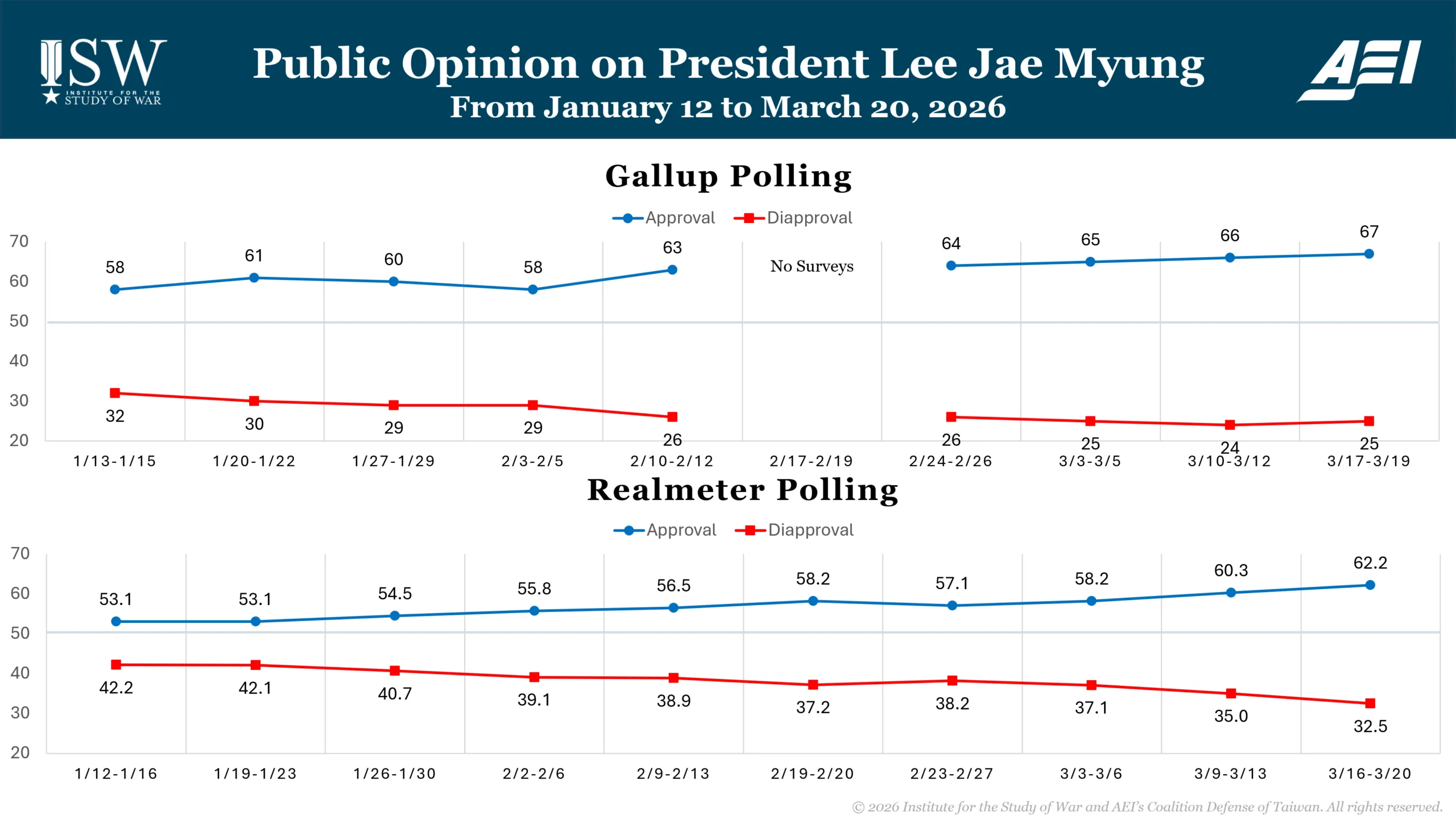
South Korea announced on March 18 that it was importing 24 million barrels of oil from the United Arab Emirates (UAE) following the delivery of South Korean air defense systems. South Korean-UAE cooperation will likely continue as the Lee administration works to secure South Korean energy supplies amid the ongoing conflict in the Middle East. South Korean Presidential Chief of Staff Kang Hoon-sik emphasized the strength of South Korea-UAE relations during a March 18 press conference and stated that South Korea was the UAE’s “top priority” for supplying crude oil.[65] Kang stated that South Korea and the UAE agreed to sign a Memorandum of Understanding on crude oil supply chain cooperation.[66] South Korea imports roughly 70 percent of its oil from the Middle East, with over 95 percent of the shipments transiting the Strait of Hormuz.[67] South Korea may face the largest economic impact from disruptions in global oil shipping through the Strait of Hormuz among major economies. Prolonged conflict in the Middle East may disrupt South Korean President Lee Jae Myung’s economic policy goals of stabilizing inflation and exchange rates. South Korea delivered 30 Cheongung-II Medium-range Surface-to-Air Missile (M-SAM) systems to the UAE to defend against Iranian missile and drone attacks, likely as part of an exchange for UAE crude oil.[68] The Cheongung-II was put into active service in the UAE for the first time on March 3.[69] South Korean-UAE defense and energy cooperation is likely to continue in accordance with the ongoing conflict in the Middle East.
Counter-North Korean Coalition Building Efforts
Nothing significant to report.

[1] https://nk.news1 dot kr/news/articles/6109796
[2] https://nk.news1 dot kr/news/articles/6111461
[3] https://nk.news1 dot kr/news/articles/6111461
[4] https://www.jajusibo dot com/69798
[5] https://understandingwar.org/research/china-taiwan/north-koreas-9th-party-congress-signals-confidence-in-nuclear-deterrence-rejects-denuclearization-and-inter-korean-talks/
[6] https://understandingwar.org/research/china-taiwan/korean-peninsula-update-march-12-2026/
[7] https://www.armscontrol.org/act/2022-10/news/north-korea-passes-nuclear-law
[8] https://www.bbc.com/news/articles/c1wnxlxxwq2o
[9] https://www.news1 dot kr/nk/politics-diplomacy/6089785
[10] https://www.aei.org/articles/korean-peninsula-update-special-report-north-koreas-ninth-party-congress/
[11] https://www.aei.org/articles/korean-peninsula-update-special-report-north-koreas-ninth-party-congress/
[12] https://www.aei.org/articles/korean-peninsula-update-special-report-north-koreas-ninth-party-congress/
[13] https://nk.news1 dot kr/news/articles/6110138
[14] https://www.nknews.org/2026/03/kim-jong-un-unveils-new-battle-tanks-oversees-war-preparation-drills/
[15] https://www.nknews.org/2026/03/kim-jong-un-unveils-new-battle-tanks-oversees-war-preparation-drills/
[16] https://militarywatchmagazine.com/article/nkorea-next-gen-tank-debut-exercises
[17] https://understandingwar.org/wp-content/uploads/2025/05/Ukraine20and20the20Problem20of20Restoring20Maneuver20in20Contemporary20War_final.pdf
[18] https://www.nknews.org/2026/03/kim-jong-un-unveils-new-battle-tanks-oversees-war-preparation-drills/
[19] https://www.twz.com/tank-active-protection-systems-could-be-used-shoot-down-drones
[20] https://x.com/DPRK_in_jp/status/2034897320228397190?s=20; https://www.nknews.org/2026/03/kim-jong-un-unveils-new-battle-tanks-oversees-war-preparation-drills/
[21] https://www.armyrecognition.com/archives/archives-land-defense/land-defense-2020/north-korea-unveils-new-main-battle-tank-using-design-of-russian-t-14-armata
[22] https://understandingwar.org/wp-content/uploads/2025/05/Ukraine20and20the20Problem20of20Restoring20Maneuver20in20Contemporary20War_final.pdf
[23]https://www.nknews.org/2026/03/trump-says-he-could-meet-kim-jong-un-as-early-as-this-month-rok-prime-minister/
[24]https://www.nbcnews.com/politics/trump-administration/trump-delays-china-trip-focus-war-iran-rcna263874
[25] https://www.yna.co dot kr/view/AKR20260318084800504?input=1195m
[26] https://www.koreatimes.co dot kr/foreignaffairs/northkorea/20260226/rubio-signals-us-openness-to-dialogue-with-n-korea
[27] https://www.mk.co dot kr/news/politics/11988900
[28] https://www.nknews.org/2026/02/kim-jong-un-leaves-door-open-to-talks-if-us-accepts-north-koreas-nuclear-status/
[29] https://www.nknews.org/2026/03/north-korean-hackers-linked-to-theft-from-crypto-gift-card-service/
[30] https://x.com/bitrefill/status/2033931580352221656
[31] https://www.nknews.org/2026/03/north-korean-hackers-linked-to-theft-from-crypto-gift-card-service/
[32] https://www.nknews.org/2026/03/north-korean-hackers-linked-to-theft-from-crypto-gift-card-service/
[33] https://home.treasury.gov/news/press-releases/sm774; https://understandingwar.org/research/china-taiwan/china-taiwan-update-december-5-2025/
[34] https://www.bbc.com/korean/articles/c1wgv04yvdqo
[35] https://understandingwar.org/research/china-taiwan/china-taiwan-update-december-5-2025/; https://eiec.kdi.re dot kr/policy/materialView.do?num=275165&pg=&pp=&topic=O; https://understandingwar.org/research/china-taiwan/korean-peninsula-update-march-18-2026/
[36] https://www.chosun dot com/international/us/2026/03/11/4XYTVIRLINAIFC6LVYB35OYAJQ/; https://home.treasury.gov/news/press-releases/sb0416
[37] https://www.joongang.co dot kr/article/25321208; https://www.binance.com/en/square/post/21634593578610
[38] https://www.joongang.co dot kr/article/25321208; https://www.binance.com/en/square/post/21634593578610
[39] https://www.reuters.com/business/bitcoin-slumps-with-key-70000-level-sight-2026-02-05/
[40] https://understandingwar.org/research/china-taiwan/korean-peninsula-update-march-18-2026/
[41] https://www.dni.gov/files/ODNI/documents/assessments/ATA-2026-Unclassified-Report.pdf
[42] https://www.dni.gov/files/ODNI/documents/assessments/ATA-2025-Unclassified-Report.pdf
[43] https://www.nknews.org/2026/03/north-korea-likely-earned-14-4b-from-military-deals-with-russia-report/
[44] https://inss.re dot kr/common/viewer.do?atchFileId=F20260313155057021&fileSn=0
[45] https://inss.re dot kr/common/viewer.do?atchFileId=F20260313155057021&fileSn=0
[46] https://inss.re dot kr/common/viewer.do?atchFileId=F20260313155057021&fileSn=0
[47] https://inss.re dot kr/common/viewer.do?atchFileId=F20260313155057021&fileSn=0
[48] https://press.un.org/en/2016/sc12267.doc.htm; https://press.un.org/en/2016/sc12603.doc.htm; https://www.armscontrol.org/factsheets/un-security-council-resolutions-north-korea
[49] https://www.inss.re dot kr/upload/bbs/BBSA05/202403/F20240306095838940.pdf
[50] https://www.yna.co dot kr/view/AKR20250919039700009
[51] https://understandingwar.org/research/china-taiwan/korean-peninsula-update-march-12-2026/
[52] https://www.yna.co dot kr/view/AKR20260314053200009
[53] https://www.law.go dot kr/admRulLsInfoP.do?admRulSeq=2100000187720&vSct=
[54] https://www.joongang.co dot kr/article/25413095
[55] https://www.joongang.co dot kr/article/25413095
[56] https://www.hani.co dot kr/arti/politics/defense/1153876.html; https://news.kbs.co dot kr/news/pc/view/view.do?ncd=5606089
[57] https://www.news1 dot kr/society/court-prosecution/6035898; https://www.joongang.co dot kr/article/25348682
[58] https://www.hani.co dot kr/arti/politics/defense/1250082.html
[59] https://www.gallup.co dot kr/gallupdb/reportContent.asp?seqNo=1627
[60] https://www.gallup.co dot kr/gallupdb/reportContent.asp?seqNo=1627
[61] https://www.gallup.co dot kr/gallupdb/reportContent.asp?seqNo=1627
[62] https://www.gallup.co dot kr/gallupdb/reportContent.asp?seqNo=1627
[63] http://www.realmeter dot net/%ec%97%90%eb%84%88%ec%a7%80%ea%b2%bd%ec%a0%9c%ec%8b%a0%eb%ac%b8-%eb%a6%ac%ec%96%bc%eb%af%b8%ed%84%b0-3%ec%9b%94-3%ec%a3%bc-%ec%b0%a8-%ec%a3%bc%ea%b0%84-%eb%8f%99%ed%96%a5-%e6%9d%8e-%eb%8c%80/?ckattempt=3
[64] http://www.realmeter dot net/%ec%97%90%eb%84%88%ec%a7%80%ea%b2%bd%ec%a0%9c%ec%8b%a0%eb%ac%b8-%eb%a6%ac%ec%96%bc%eb%af%b8%ed%84%b0-3%ec%9b%94-3%ec%a3%bc-%ec%b0%a8-%ec%a3%bc%ea%b0%84-%eb%8f%99%ed%96%a5-%e6%9d%8e-%eb%8c%80/?ckattempt=3
[65] https://www.joongang.co dot kr/article/25412660
[66] https://www.koreatimes.co dot kr/southkorea/defense/20260318/korea-secures-24-mil-barrels-of-oil-from-uae-presidential-aide
[67] https://www.ytn.co dot kr/_ln/0102_202603031759000583
[68] https://magazine.hankyung dot com/business/article/202603189450b
[69] https://www.mk.co dot kr/news/politics/11977670