Korean Peninsula Update, March 31, 2026
Toplines
North Korea’s test of a high-thrust solid-fuel intercontinental ballistic missile (ICBM) engine signals efforts to develop multiple independently targetable re-entry vehicles (MIRV). The MIRV program aims to complicate US and allied defense systems and secure a credible second-strike capability as part of North Korea’s deterrent strategy. North Korean state media reported on March 29 that Workers’ Party of Korea (WPK) General Secretary Kim Jong Un observed a high-thrust solid-fuel engine ejection test using carbon fiber composite materials.[1] North Korea claimed that the engine produces a maximum thrust of 2,500 kilonewtons (kN), an increase of over 20 percent from the 1,971 kN engine tested in September 2025, which was itself described as a 40 percent improvement over its predecessor.[2] The US Minuteman III, by comparison, produces approximately 891 kN, Russia’s Topol-M generates approximately 913 kN, and the People’s Republic of China’s (PRC) DF-41 produces an estimated 1,100-1,400 kN.[3] A 2,500 kN engine would thus exceed the thrust of any currently operational ICBM.
High engine thrust gives missiles long ranges even when equipped with multiple warheads, which increase the missile’s overall weight.[4] The use of carbon fiber composite materials could also reduce missile weight and improve payload capacity.[5] The Stimson Center’s 38 North publication assessed that North Korea’s solid-fuel ICBMs likely have a range of over 15,000 kilometers, which would allow them to strike targets in the United States.[6] North Korea likely aims to pursue MIRV capabilities, which would allow simultaneous nuclear strikes against separate targets, complicating missile defense.[7]
High engine thrust is an insufficient condition for a functional MIRV capability, however.[8] The June 2024 test reportedly dispersed three re-entry vehicles, but a decoy apparently failed before any objects were released, according to South Korea’s Joint Chiefs of Staff (JSC).[9] North Korea’s MIRV program likely remains technically immature and requires further testing before deployment.[10] South Korean defense analysts assessed that North Korea may conduct another MIRV test in the near term.[11] The eventual fielding of MIRVs would shorten decision timelines for US and allied missile defense for pre-emptive interdiction and increase demands on real-time intelligence, surveillance, and reconnaissance (ISR).
North Korean state media stated that the test supports a new five-year defense development plan unveiled at the 9th Party Congress, which emphasized expanding strategic strike capabilities.[12] The regime’s broader trajectory indicates an effort to secure a credible second-strike capability. Kim Jong Un, on May 23, condemned US actions as “hegemonic state terrorism,” likely referencing US-Israeli strikes on Iran, reinforcing North Korea’s narrative that its nuclear status is irreversible and necessary for deterrence against external attack.[13]
North Korea is continuing to expand the breadth and depth of its international engagement, strengthening its resilience against sanctions and its leverage in future negotiations. Belarusian President Alexander Lukashenko visited Pyongyang for the first time on March 25 and 26 and met with Kim Jong Un.[14] Kim invited Lukashenko to visit Pyongyang when they met in Beijing in September 2025, on the sidelines of the PRC’s Victory over Japan Day parade.[15] Kim and Lukashenko on March 26 signed a Treaty of Friendship and Cooperation that laid out a legal framework for North Korea-Belarus bilateral cooperation.[16] Neither side has disclosed the content of the treaty at the time of this writing, but it does not appear to be a mutual-defense treaty such as the one North Korea signed with Russia in 2024. The two sides also signed agreements on cooperation in education, culture, healthcare, agriculture, information and press, and other fields.[17] Such agreements may alleviate some of North Korea’s economic hardships and support its external propaganda. Lukashenko also invited Kim to visit Minsk and ordered the opening of a Belarusian embassy in Pyongyang on March 27.[18] Lukashenko reportedly offered to mediate on Kim’s behalf during Lukashenko’s upcoming meeting with Trump, to dissuade the United States from escalating tensions.[19]
Lukashenko’s visit to Pyongyang is part of a trend of North Korea deepening ties with non-Western-aligned states since the start of the war in Ukraine. Kim said that he and Lukashenko shared similar positions on international issues and criticized the “unlawful pressure on Belarus from the West.”[20] Both countries are close allies of Russia (Belarus has, in fact, largely been absorbed by Russia) and co-belligerents in Russia’s war in Ukraine.[21] North Korea also signed onto the Belarus-proposed “Eurasian Charter of Diversity and Multipolarity in the 21st Century” on February 3, a regional security framework that also includes Russia, Iran, and Myanmar.[22] North Korea’s international engagement aligns with efforts by Russia and the PRC to create a “multipolar” world order as a challenge to US or Western “hegemony,” and Kim himself in a March 24 speech promoted “the building of an equitable and just multipolar world” to overcome “hegemony-seeking forces.”[23] Kim held his first-ever multilateral meeting with CCP General Secretary Xi Jinping and Russian President Vladimir Putin during the PRC’s September 2025 parade, where Kim also met other heads of state.[24] North Korea has since enhanced ties with traditional allies Laos, Vietnam, and Indonesia.[25]
North Korea’s expanding international relations will allow it to better weather international sanctions, advance its military and nuclear development, and strengthen its leverage in future negotiations with the United States to secure recognition as a nuclear state. Russia has rewarded North Korea’s material support for its war in Ukraine by signing a new mutual-defense treaty with North Korea, blocking new UN sanctions on Pyongyang, dropping its opposition to North Korea’s nuclear program, providing technical support for North Korea’s missile and submarine programs, and enhancing economic cooperation. Russia’s foreign ministry condemned the recent annual US-South Korea Freedom Shield exercise as “clear war preparation,” showing the extent of Russian alignment with North Korean views on security issues.[26] The PRC also tacitly dropped its opposition to North Korea’s nuclear program in 2024.[27] North Korea likely hopes to engage with like-minded countries to alleviate its international isolation, bolster its economy and military development, and reduce the effectiveness of sanctions that have been the international community’s primary tool of leverage to force North Korea to end its nuclear program.
Key Takeaways
- North Korean missile development: North Korea claims to have developed a lightweight solid-fuel intercontinental ballistic missile (ICBM) engine with higher thrust than any other country possesses. The development of a high-thrust ICBM engine signals an effort to develop multiple independently targetable re-entry vehicles (MIRV), complicating US and allied defense systems.
- North Korea’s international relations: Belarus President Alexander Lukashenko visited Pyongyang for the first time and signed a cooperation framework treaty with Kim Jong Un. North Korea is continuing to expand the breadth and depth of its international engagement to strengthen its resilience against sanctions and its leverage in future negotiations with the United States.
North Korean Domestic Politics
Nothing significant to report.
North Korean Military Developments
North Korea’s national budget increased by its highest percentage since 2013, amid signs of economic recovery.[28] A portion of the new national budget will fund North Korea’s ongoing expansion of strategic weapons programs targeting South Korea and the United States. North Korea’s national budget grew by 5.8 percent in 2026, compared to a two percent increase in 2025.[29] North Korea’s annual budget growth declined from 3.7 percent in 2019 to below one percent between 2020 and 2023, before rebounding to around two percent in 2024.[30] The Supreme People’s Assembly (SPA), North Korea’s legislative body, reported that “socialist economic construction” spending — which likely refers to state-led industrial modernization efforts — accounts for 43.8 percent of the total budget, while defense spending accounts for 15.8 percent.[31] North Korea did not disclose the details of its budget line items. North Korean budget shares for its economic development projects and defense have remained largely unchanged since 2014.[32] North Korea’s self-reporting on its defense budget is an incomplete picture of North Korea’s actual military investment, however. The US Department of State in 2021 estimated that North Korea’s military expenditures in 2019 totaled around 4.3 billion US dollars, about 26.4 percent of North Korea’s GDP.[33] US estimates suggest that military expenditures dominate North Korea’s overall resource allocation. The true defense burden on the economy may be higher than what North Korea reports, given the regime’s ongoing expansion of strategic weapons programs. North Korea has reinforced policy narratives like its “people-first” principle, likely aimed at suggesting the regime’s prioritization of people’s livelihoods over other policy areas.[34]
North Korea’s budget increase rate aligns with signs of North Korean economic recovery, amid improving trade relations with the People’s Republic of China (PRC) and Russia. ISW-CDOT assessed that North Korea’s 9th Party Congress expressed greater confidence in Pyongyang’s economic growth than the 8th Party Congress did.[35] WPK General Secretary Kim Jong Un described North Korea’s economy at the time as a “serious failure” at the 8th Party Congress in 2021.[36] North Korea severed inter-Korean economic cooperation and entered a period of diplomatic isolation following its 2020–2023 border closure, which also suspended trade with the PRC, North Korea’s primary trading partner.[37] North Korea’s economic recovery likely began after Kim expanded relations with Russia in 2023, generating foreign currency through arms sales and the deployment of troops to support Russia’s war in Ukraine.[38] Russia and the PRC have helped North Korea evade sanctions through direct trade and by weakening United Nations (UN) Security Council enforcement abilities in 2024.[39] The Kim regime has also generated approximately 6.75 billion US dollars through cryptocurrency theft.[40]
Expanding the national budget would allow North Korea to better fund its military development initiatives. Kim ordered an expansion of the quality and quantity of North Korea’s nuclear capabilities, as well as the development of new weapons systems, under the 2026–2030 military plan outlined at the 9th Party Congress.[41] The new plan specifically requires North Korea to invest in naval surface and subsurface nuclear forces, submarine-launched intercontinental ballistic missile (SLBM) systems, artificial intelligence (AI)-enabled unmanned strike systems, satellite assets, and electronic warfare systems.[42] ISW-CDOT assessed that North Korea is developing an operating concept that combines nuclear and conventional strike capabilities to complicate South Korean and US abilities to neutralize potential North Korean offensive precision strikes.[43]
North Korean Foreign Relations
North Korea rejected Japanese Prime Minister Sanae Takaichi’s diplomatic outreach. North Korea will likely intensify anti-Japanese rhetoric while showing conditional openness to dialogue with the United States to erode trilateral security cooperation among the United States, South Korea, and Japan. Kim Yo Jong, Director of the WPK’s General Bureau and sister of Kim Jong Un, said on March 23 that North Korea does not intend to meet with Japan.[44] The statement came after Takaichi expressed on March 19, 2026, a “strong desire” to meet with Kim Jong Un.[45] Takaichi added that US President Donald Trump supported Japan’s efforts to resolve the issue of North Korea’s abductions of Japanese citizens between 1977 and 1983 during their meeting at the White House on March 19. The Japanese government maintains that 12 abducted Japanese citizens remain in North Korea as of 2026.[46] Kim Yo Jong described the abduction issue as a “one-sided” Japanese claim that North Korea does not recognize, however.[47] Kim Yo Jong also stated that Japan must break from its “outdated practices” for a meeting to take place, likely referring to North Korea’s longstanding rhetoric linking Japan’s military normalization efforts to its imperial rule over the Korean Peninsula from 1910 to 1945.[48] North Korean state media published commentaries on February 28 and March 20 that accused Japan of reviving militarism through its defense policy, including Japan’s plans to acquire long-range strike capabilities and revise its pacifist constitution.[49]
North Korea likely views trilateral cooperation between the United States, South Korea, and Japan as a security threat to the Kim regime and is likely attempting to divide US-aligned states. North Korea’s current diplomatic strategy reflects conditional openness to dialogue with the United States while rejecting engagement with South Korea and Japan. Kim Jong Un signaled openness to dialogue with the United States contingent on Washington abandoning its “hostile policies” toward Pyongyang, while framing North Korea’s nuclear buildup as a necessary deterrent against United States-led external threats.[50] North Korea is selectively engaging with regional actors, likely to prevent any formation of a multilateral coalition that may pressure the regime to pursue denuclearization. North Korea has used its engagement with Russia and the PRC to help it erode and evade international sanctions. North Korea likely perceives any revival of arrangements resembling the 2003–2007 Six-Party Talks — comprising the PRC, Russia, the United States, South Korea, Japan, and North Korea — as threatening its objective of securing recognition as a nuclear-armed state.[51]
PRC firms are exporting electronics and electric vehicles (EVs) to North Korea in violation of international sanctions. NK News reported that multiple PRC-based accounts have posted on PRC social media site Douyin promoting products with the hashtag “for North Korea.”[52] Individual sellers are offering export services to North Korea, and company personnel are openly posting about selling to North Korea, such as the Dandong-based manager of Guangdong-based Huaju Electric Appliance Company and the Shanghai-based manager of Jushi New Energy Technology Company.[53] PRC firms have exported a wide range of electronics to North Korea, such as televisions, smartphones, air conditioners, and cars.[54] North Korea is importing EVs and EV chargers to expand its EV infrastructure. Pyongyang is replacing aging trams with electric buses to update its public transportation system.[55] These EV exports to North Korea violate UN Security Council Resolution 2094, which prohibits the export and transfer of luxury vehicles, automobiles, and other motor vehicles except for those used for public transit to North Korea.[56]
The warming of PRC-North Korea relations has led to increased trade in 2026. Customs data for January and February 2026 showed that trade increased 22 percent year-on-year, and bilateral transportation links resumed after halting for over six years in March 2026.[57] The PRC has an extensive history of aiding foreign adversaries to evade US sanctions. A 2025 US-China Economic and Security Review Commission report stated that the PRC facilitates “barter trade and money laundering networks that help North Korean hackers fund the regime’s weapons development programs.”[58]
North Korean Influence Operations
Nothing to significant report.
Inter-Korean Relations
North Korea’s Foreign Ministry likely assumed responsibilities related to South Korean policy following organizational restructuring at the 9th Party Congress. This restructuring would reinforce North Korea’s “two hostile states” framework and signal Pyongyang’s shift away from seeking unification. North Korea reportedly informed foreign diplomatic missions in Pyongyang that Jang Kum Chol serves concurrently as First Vice Foreign Minister and Director of the WPK’s 10th Bureau, according to South Korean media.[59] The North Korean Ministry of Foreign Affairs manages state-to-state diplomacy and the execution of foreign policy. The 10th Bureau, formerly the United Front Department (UFD), is a ministry-level organization responsible for intelligence and influence operations targeting South Korea. Jang appears to have replaced Kim Yong Chol, who previously led the 10th Bureau. North Korea removed Kim Yong Chol from the directorship during the 9th Party Congress, likely indicating his retirement due to old age.[60]
Jang Kum Chol served as the Director of the UFD from 2019 to 2021.[61] Jang participated in the 2019 inter-Korean summit and acted as a spokesperson during the deterioration of inter-Korean relations in 2020.[62] The WPK excluded Jang from Central Committee membership at the 8th Party Congress in 2021 but reinstated him at the 9th Party Congress in 2026.[63] Jang is likely to serve as North Korea’s representative in future inter-Korean dialogue or exchanges, if any occur during his tenure.
Jang’s appointment as First Vice Foreign Minister indicates that the North Korean Foreign Ministry currently oversees a subordinate organization responsible for inter-Korean affairs. The foreign ministry previously did not manage inter-Korean relations because North Korea did not recognize South Korea as a foreign country. WPK General Secretary Kim Jong Un in 2023 directed the restructuring of South Korea-related organizations after declaring that the regime was no longer pursuing unification.[64] North Korea subsequently renamed the UFD to the 10th Bureau, removing the term “unification.”[65] The UFD historically functioned both as a counterpart to South Korea in inter-Korean dialogue and an intelligence apparatus.[66] North Korea’s current anti-unification policy indicates a shift toward treating South Korea as a separate state — likely assigning inter-Korean policy to the Foreign Ministry while allowing the 10th Bureau to focus on intelligence and influence operations targeting South Korea.
The South Korean Ministry of Unification (MOU) continues to pursue a pro-engagement strategy with North Korea, despite North Korea’s continued rejections of dialogue. Unification Minister Chung Dong-young publicly referred to North Korea as the Democratic People’s Republic of Korea on March 25, the first time a South Korean senior official has done so.[67] Kim Jong Un on March 23 stated that North Korea would recognize South Korea as the “most hostile state” and “ruthless[ly]” retaliate against any South Korean “provocation.”[68] Kim also declared that North Korea would solidify its status as a nuclear state in response to these hostile provocations.[69] South Korea’s Lee Jae Myung administration, in contrast, continues to project a “peaceful coexistence” policy. The Lee administration’s peaceful coexistence policy aims to build a trust-based coexistence between the two Koreas and promote bilateral exchanges while both parties halt any aggression.[70] Chung became the first senior-ranking South Korean official to refer to North Korea by its official name, the “Democratic People’s Republic of Korea (DPRK),” at a public event on March 25.[71] Chung added that the Lee administration is redesigning the Korean Peninsula policy paradigm to prioritize peaceful coexistence over unification, implicitly recognizing North and South Korea as two separate states.[72]
The Lee administration is continuing its conciliatory policies, despite Kim’s repudiation of engagement. The Blue House (South Korea’s Presidential Office) responded to Kim’s statement calling South Korea a “hostile state” by stating that it would “consistently pursue a peaceful coexistence policy with a long-term perspective.”[73] Chung’s use of the term “DPRK” may have been intended to signal the MOU’s desire for peaceful coexistence of both Koreas. No other members of the Lee administration, including Lee himself, have used that term at time of writing, so it is unclear if Chung’s verbiage reflects a broader South Korea policy shift. The Lee administration is unlikely to convince Pyongyang to engage in talks through rhetoric alone, however. Kim likely believes that engagement with Seoul may require undermining core factors of regime stability, such as nuclear capabilities, illicit revenue from arms sales and cryptocurrency hacking, and advanced military development. Kim likely sees little benefit from engaging Seoul due to closer ties with Russia.
South Korean Domestic Politics
South Korean President Lee Jae Myung’s approval ratings decreased in the fourth week of March after five consecutive weeks of increases. Gallup reported that Lee’s approval rating dropped two percent points from last week to 65 percent.[74] Lee had reached a record-high approval rating of 67 percent in the previous week since his inauguration in June 2025.[75] Lee’s disapproval ratings remained at similar levels despite the dip in approval. Both approving and disapproving respondents indicated that Lee’s economic policy was the most influential factor behind their choices.[76] Realmeter reported that Lee’s approval ratings stood at 62.2 percent, remaining unchanged from the third week of March.[77] Realmeter stated that negative economic shocks, including the surging USD exchange rate and the collapse of the 5,300-point mark on the KOSPI (Korea Composite Stock Price Index), impacted the ratings despite Lee’s proactive efforts to mitigate the Middle East crisis’s influence on the South Korean market prices.[78] The value of the US dollar has risen from 1,376.90 South Korean won for a dollar on Lee’s inauguration day of June 4 to 1,520.30 won as of March 30, marking the lowest value for the South Korean won since the Great Recession in 2009.[79]
👁 Public Opinion on President Lee Jae Myung From January 19 to March 27, 2026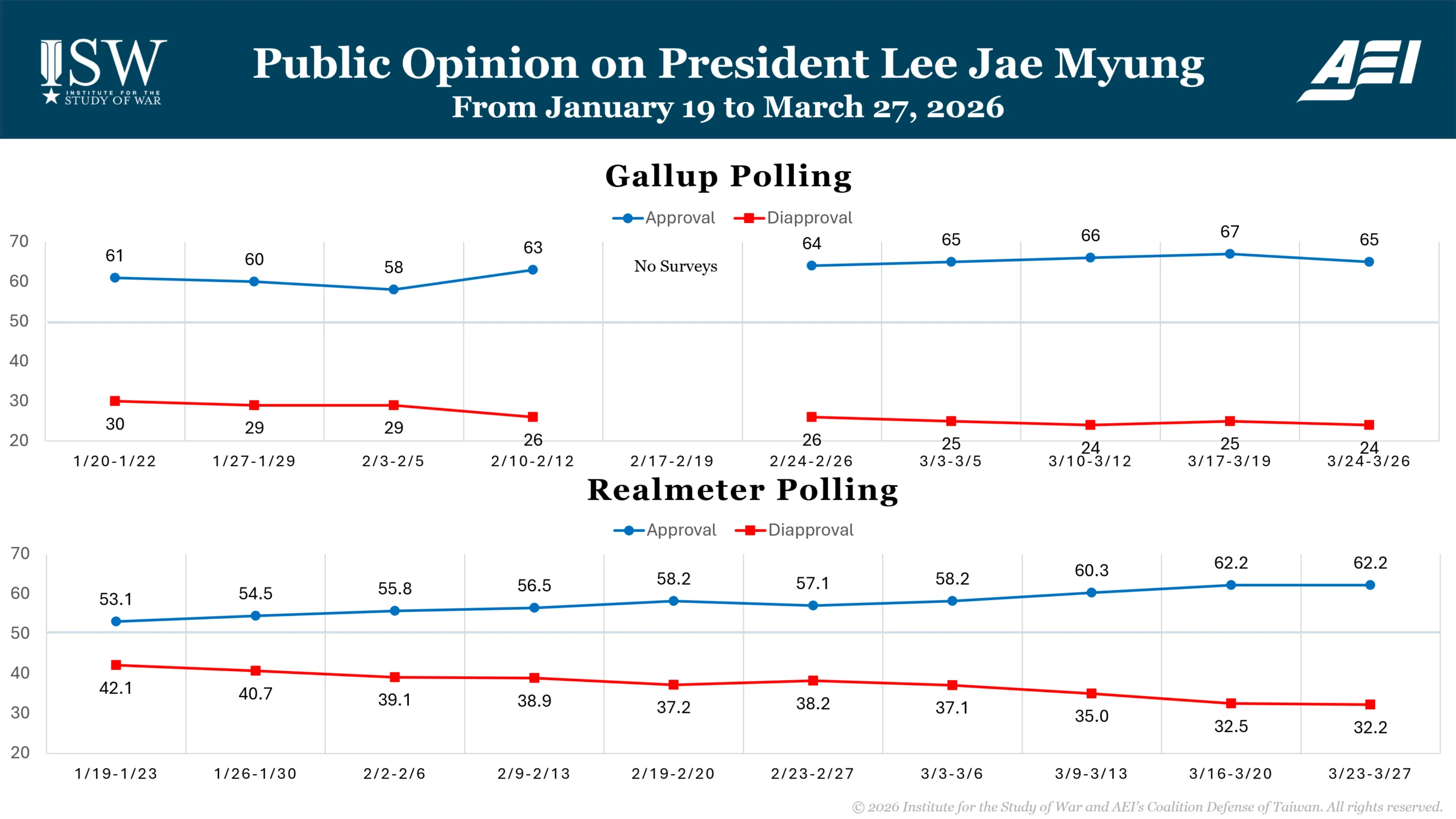
Counter-North Korean Coalition Building Efforts
Nothing significant to report.

[1] https://en.yna.co dot kr/view/AEN20260329000751315
[2] https://www.nknews dot org/2025/09/north-korea-conducts-engine-test-for-new-long-range-nuclear-missile/
[3] https://nk.news1 dot kr/news/articles/6117507
[4] https://www.nknews dot org/2026/03/kim-jong-un-oversees-engine-test-state-media-claims-higher-thrust-capabilities/
[5] https://www.nknews dot org/2025/09/north-korea-conducts-engine-test-for-new-long-range-nuclear-missile/
[6] https://www.38north.org/2026/01/assessing-north-koreas-five-year-effort-to-develop-13-new-nuclear-and-missile-systems/
[7] https://armscontrolcenter.org/wp-content/uploads/2017/08/MIRV-Factsheet.pdf
[8] https://www.congress.gov/crs_external_products/IF/PDF/IF10472/IF10472.39.pdf
[9] https://www.nknews dot org/2024/06/north-korea-fires-ballistic-missile-toward-east-sea-rok-military-2/; https://www.38north.org/2024/07/north-korea-reveals-a-multiple-warhead-payload-in-probable-failed-test/#:~:text=Thermal%20video%20of%20the%20test%20released%20by,test%20probably%20failed%2C%20and%20if%20so%2C%20North
[10] https://www.38north.org/2026/01/assessing-north-koreas-five-year-effort-to-develop-13-new-nuclear-and-missile-systems/
[11] https://nk.news1 dot kr/news/articles/6117507
[12] https://www.nknews dot org/2026/03/kim-jong-un-oversees-engine-test-state-media-claims-higher-thrust-capabilities/
[13] https://kcnawatch dot org/newstream/1774349063-661806221/respected-comrade-kim-jong-uns-policy-speech-at-first-session-of-15th-supreme-people%e2%80%99s-assembly-of-dprk/
[14] https://www.reuters.com/world/asia-pacific/putin-allies-lukashenko-kim-meet-north-korea-2026-03-25/
[15] https://apnews.com/article/north-korea-belarus-kim-jong-un-lukashenko-7b96ba10d853afbb4aa3cfe9f91f208f
[16] https://belta dot by/president/view/lukashenko-i-kim-chen-yn-podpisali-dogovor-o-druzhbe-i-sotrudnichestve-mezhdu-belarusjju-i-kndr-771859-2026/ ; https://en.yna.co dot kr/view/AEN20260327000552315?section=nk/nk
[17] https://belta dot by/president/view/lukashenko-i-kim-chen-yn-podpisali-dogovor-o-druzhbe-i-sotrudnichestve-mezhdu-belarusjju-i-kndr-771859-2026/
[18] http://belta dot by/politics/view/lukashenko-postavil-zadachi-otkryt-v-kndr-posolstvo-belarusi-i-uskorit-rabotu-nad-bezvizom-772178-2026/
[19] https://www.nknews.org/2026/03/belarusian-leader-seeks-to-mediate-between-us-and-north-korea-minsk/
[20] https://belta dot by/politics/view/kim-chen-yn-kndr-vystupaet-protiv-nepravomernogo-davlenija-na-belarus-so-storony-zapada-771858-2026/
[21] https://understandingwar.org/research/russia-ukraine/russias-quiet-conquest-belarus/
[22] https://understandingwar.org/research/china-taiwan/korean-peninsula-update-february-10-2026/ ; https://web.archive.org/web/20260304082432/https://eng.globalaffairs.ru/articles/eurasia-multipolarity-ryzhenkov/
[23] https://kcnawatch dot org/newstream/1774349063-661806221/respected-comrade-kim-jong-uns-policy-speech-at-first-session-of-15th-supreme-people%e2%80%99s-assembly-of-dprk/
[24] https://understandingwar.org/research/adversary-entente/adversary-entente-task-force-update-september-3-2025/ ;
https://understandingwar.org/research/adversary-entente/adversary-entente-task-force-update-september-10-2025/
[25]
https://www.nknews.org/2025/10/north-korea-vietnam-sign-deals-on-enhancing-defense-cooperation-other-ties/ ; https://www.nknews.org/2025/11/north-korea-laos-agree-to-boost-bonds-of-friendship-after-high-level-talks/ ; https://understandingwar.org/research/china-taiwan/korean-peninsula-update-march-12-2026/
[26] https://www.chosun dot com/english/world-en/2026/03/25/UH3DLTOHZ5CFXDOMXXAOLTS6XM/
[27] https://monitoring.bbc.co.uk/product/b0004p45
[28] https://nkinfo.unikorea.go dot kr/nkp/pge/view.do;jsessionid=CedT-ROTmY0udaBNAwhUE0ghzJhMzQTo2OxlhzE_.ins22?menuId=EC208
[29] https://www.nkeconomy dot com/news/articleView.html?idxno=14371; https://nk.news1 dot kr/news/articles/6112552
[30] https://nkinfo.unikorea.go dot kr/nkp/pge/view.do;jsessionid=CedT-ROTmY0udaBNAwhUE0ghzJhMzQTo2OxlhzE_.ins22?menuId=EC208; https://www.nkeconomy dot com/news/articleView.html?idxno=14371; https://nk.news1 dot kr/news/articles/6112552
[31] https://www.nkeconomy dot com/news/articleView.html?idxno=14371; https://nk.news1 dot kr/news/articles/6112552
[32] https://www.kdi.re dot kr/file/download?atch_no=ukxFzUgwp1MF1%2F2QnwDYxg%3D%3D
[33] https://www.state.gov/world-military-expenditures-and-arms-transfers-2021-edition
[34] http://www.rodong.rep dot kp/ko/index.php?OEAyMDI1LTA2LTA4LTA5MkAyQEBAMUA2==
[35] https://www.aei.org/articles/korean-peninsula-update-special-report-north-koreas-ninth-party-congress/
[36] https://www.yna.co dot kr/view/AKR20210106010553504
[37] https://trumpwhitehouse.archives.gov/presidential-actions/presidential-executive-order-imposing-additional-sanctions-respect-north-korea/; https://www.brookings.edu/articles/north-korea-is-addressing-the-pandemic-in-its-style-that-means-leaving-a-lot-of-people-hungry/
[38] https://nkinfo.unikorea.go dot kr/nkp/pge/view.do;jsessionid=gmc48-IOhAotLdjhhhGGRTFNNZRINXreRc0E_kbx.ins12?menuId=MENU_32
[39] https://www.yna.co dot kr/view/AKR20251219023600009; https://www.csis.org/analysis/russias-veto-dismembering-un-sanctions-regime-north-korea
[40] https://www.chainalysis.com/blog/crypto-hacking-stolen-funds-2026/
[41] https://www.sejong dot org/web/boad/1/egoread.php?bd=1&itm=4&txt=%EB%B6%81%ED%95%9C&pg=14&seq=12764
[42] https://www.sejong dot org/web/boad/1/egoread.php?bd=1&itm=4&txt=%EB%B6%81%ED%95%9C&pg=14&seq=12764
[43] https://www.aei.org/articles/korean-peninsula-update-special-report-north-koreas-ninth-party-congress/
[44] https://www.mk.co dot kr/news/politics/11996025
[45] https://www.mk.co dot kr/news/politics/11996025
[46] https://www.mk.co dot kr/news/politics/11996025
[47] https://www.mk.co dot kr/news/politics/11996025
[48] https://news.kbs.co dot kr/news/pc/view/view.do?ncd=8496328
[49] https://news.kbs.co dot kr/news/pc/view/view.do?ncd=8496328; https://www.khan.co dot kr/article/202603200801001
[50] https://understandingwar.org/research/china-taiwan/north-koreas-9th-party-congress-signals-confidence-in-nuclear-deterrence-rejects-denuclearization-and-inter-korean-talks/; https://kcnawatch dot org/newstream/1774349063-661806221/respected-comrade-kim-jong-uns-policy-speech-at-first-session-of-15th-supreme-people%e2%80%99s-assembly-of-dprk/
[51] https://www.cfr.org/backgrounders/six-party-talks-north-koreas-nuclear-program
[52] https://www.nknews.org/2026/03/chinese-firms-flaunt-export-of-electronics-and-evs-to-north-korea/?t=1774452285
[53] https://www.nknews.org/2026/03/chinese-firms-flaunt-export-of-electronics-and-evs-to-north-korea/?t=1774452285
[54] https://www.nknews.org/2026/03/chinese-firms-flaunt-export-of-electronics-and-evs-to-north-korea/?t=1774452285
[55] https://www.nknews.org/pro/north-korea-endorses-e-buses-over-outdated-trams-to-cut-costs-imagery/
[56] https://unscr.com/en/resolutions/doc/2094/
[57] https://www.msn.com/en-us/news/world/chinas-trade-with-north-korea-rises-22-in-january-and-february-as-ties-improve/ar-AA1Z2Kwi; https://koreajoongangdaily.joins dot com/news/2026-03-16/national/diplomacy/North-KoreaChina-rail-service-resumption-shows-relations-getting-back-on-track-ahead-of-XiTrump-summit/2544444
[58] https://www.uscc.gov/research/chinas-facilitation-sanctions-and-export-control-evasion#_Toc213758817
[59] https://www.hani.co dot kr/arti/politics/defense/1251014.html
[60] https://www.donga dot com/news/Politics/article/all/20260220/133392396/2
[61] https://nk.news1 dot kr/news/articles/6113633
[62] https://www.hani dot co.kr/arti/politics/defense/949706.html
[63] https://nk.news1 dot kr/news/articles/6113633
[64] https://nk.news1 dot kr/news/articles/6113633
[65] https://www.hani.co dot kr/arti/politics/defense/1251014.html; https://www.donga dot com/news/Politics/article/all/20240524/125088041/1
[66] https://nkinfo.unikorea.go dot kr/nkp/knwldg/view/knwldg.do
[67] https://www.donga dot com/news/Politics/article/all/20260325/133605317/2
[68] https://kcnawatch dot org/newstream/1774305619-416545298/%ea%b2%bd%ec%95%a0%ed%95%98%eb%8a%94-%ea%b9%80%ec%a0%95%ec%9d%80%eb%8f%99%ec%a7%80%ea%bb%98%ec%84%9c-%ec%a1%b0%ec%84%a0%eb%af%bc%ec%a3%bc%ec%a3%bc%ec%9d%98%ec%9d%b8%eb%af%bc%ea%b3%b5%ed%99%94%ea%b5%ad/
[69] https://kcnawatch dot org/newstream/1774305619-416545298/%ea%b2%bd%ec%95%a0%ed%95%98%eb%8a%94-%ea%b9%80%ec%a0%95%ec%9d%80%eb%8f%99%ec%a7%80%ea%bb%98%ec%84%9c-%ec%a1%b0%ec%84%a0%eb%af%bc%ec%a3%bc%ec%a3%bc%ec%9d%98%ec%9d%b8%eb%af%bc%ea%b3%b5%ed%99%94%ea%b5%ad/
[70] https://www.korea dot kr/news/policyNewsView.do?newsId=148959802
[71] https://www.donga dot com/news/Politics/article/all/20260325/133605423/1
[72] https://www.yna.co dot kr/view/AKR20260325105600504
[73] https://www.newsis dot com/view/NISX20260324_0003561373
[74] https://www.gallup.co dot kr/gallupdb/reportContent.asp?seqNo=1629
[75] https://www.gallup.co dot kr/gallupdb/reportContent.asp?seqNo=1629
[76] https://www.gallup.co dot kr/gallupdb/reportContent.asp?seqNo=1629
[77] http://www.realmeter dot net/%ec%97%90%eb%84%88%ec%a7%80%ea%b2%bd%ec%a0%9c%ec%8b%a0%eb%ac%b8-%eb%a6%ac%ec%96%bc%eb%af%b8%ed%84%b0-3%ec%9b%94-4%ec%a3%bc-%ec%b0%a8-%ec%a3%bc%ea%b0%84-%eb%8f%99%ed%96%a5-%e6%9d%8e-%eb%8c%80/?ckattempt=3
[78] http://www.realmeter dot net/%ec%97%90%eb%84%88%ec%a7%80%ea%b2%bd%ec%a0%9c%ec%8b%a0%eb%ac%b8-%eb%a6%ac%ec%96%bc%eb%af%b8%ed%84%b0-3%ec%9b%94-4%ec%a3%bc-%ec%b0%a8-%ec%a3%bc%ea%b0%84-%eb%8f%99%ed%96%a5-%e6%9d%8e-%eb%8c%80/?ckattempt=3
[79] https://www.kebhana dot com/cont/mall/mall15/mall1501/index.jsp; https://www.kebhana dot com/cont/mall/mall15/mall1508/index.jsp; https://www.yna.co dot kr/view/AKR20260330032052002?input=1195m