Russia Is Turning Deported Ukrainian Children Into Bargaining Chips
Russian officials have seized on recent US efforts to advocate for, identify, and repatriate deported Ukrainian children to downplay the massive scale and systematic nature of Russia’s deportation campaign and to advance Kremlin efforts to restore bilateral US-Russia relations. Russia’s own accounting of its treatment of deported Ukrainian children, however, undermines the Kremlin campaign to use children as a negotiating tool and highlights the true magnitude of Russia’s crimes. First Lady of the United States Melania Trump announced on October 10 that she worked with Russian President Vladimir Putin to secure the return of seven Ukrainian children whom Russia had previously deported.[1] Trump noted that the First Lady has an “open channel of communication” on this issue with Putin. Russian Direct Investment Fund (RDIF) CEO and key Kremlin negotiator Kirill Dmitriev responded to Trump’s announcement on October 10 with a series of emojis of a Russian flag, shaking hands, and an American flag — suggesting that Dmitriev viewed the issue of deported Ukrainian children as a point of leverage with which to restore bilateral US-Russia relations.[2] Dmitriev’s engagement with the First Lady on the issue of children is likely an attempt to court the Trump Administration into rapprochement, consistent with Dmitriev’s previous attempts to offer the United States business and economic opportunities in exchange for US concessions on the war in Ukraine.[3]
Russian Foreign Ministry Spokesperson Maria Zakharova made a statement during a press conference on October 24, condemning the United States for “anti-Russian” behavior due to recent US legislative efforts to hold Russia to account for its crimes against Ukraine’s children. The US Senate passed the bipartisan Abducted Ukrainian Children Recovery and Accountability Act on October 10.[4] The act aims to support Ukraine’s efforts to investigate and track the tens of thousands of children whom Russia has deported, according to Ukrainian officials and independent confirmations of the number of deported children. Zakharova condemned the bipartisan Senate legislation and other similar bills as “an attempt to undermine the established dialogue between Russia and the US.”
Zakharova also highlighted Melania Trump’s involvement in US-Russia discussions on the issue of repatriating children, although she downplayed the situation by claiming that the children whom Russia returned to Ukraine had lost contact with their families in Ukraine “for various reasons.” Zakharova concluded the press conference by claiming that all statements about Russia’s deportations of Ukrainian children are “Bucha-style fakes,” invoking a thoroughly debunked Russian narrative claiming that well-documented Russian atrocities in Bucha were a Ukrainian fabrication.[5] Zakharova’s statements echo Dmitriev’s attempts to frame the issue of deported Ukrainian children as a platform from which to ameliorate US-Russia relations, likely in order to set conditions for Russia to secure future concessions from the US regarding the war in Ukraine.
Zakharova and other Russian officials have purposefully introduced opacity into discussions regarding Russia’s deportation of Ukrainian children by claiming that Russia has “only” taken “hundreds” of children. These claims are centered around the conceit that Russia has removed children from their homes in Ukraine for solely humanitarian reasons and attempts to conceal the scale of the actual deportation campaign. Zakharova claimed on October 24 that Russia has repatriated 122 children with parents or relatives in Ukraine thus far.[6] Russian officials and media sources similarly noted during bilateral Russia-Ukraine negotiations in Istanbul in June 2025 that Ukraine had only handed over a list of “hundreds,” as opposed to “thousands” of children to Russian authorities, in order to undermine the Ukrainian government’s official confirmation that Russia has deported at least 19,546 children.[7] Ukrainian officials noted that they chose not to submit the list of 19,546 verified names out of concerns that Russian officials would purposefully try to move children around or change their names to complicate tracking procedures — something that Russian officials have already done in documented cases.[8] Russian officials have seized on this fact to present Ukraine as the obstructive party in negotiations, despite constant confirmations from Kremlin officials that Russia is the party unwilling to negotiate in any meaningful way.[9]
Russia is now engaged in two parallel and mutually-reinforcing narratives regarding deported Ukrainian children. The first narrative is a long-standing one — the claim that Russia has not violated any international laws and norms and is not illegally deporting and forcibly adopting Ukrainian children, but rather is saving them. This narrative relies on the conceit that Russia “only” took a “few hundred” children to Russia for their safety (ignoring the fundamental fact that Russia placed these children in danger when it illegally invaded Ukraine), and that Russia is willing to return these few children in due time. This narrative is intended to exculpate Russia from its well-documented crimes and present itself to the United States and Ukraine’s other partners as a willing and legitimate participant in negotiations on the war in Ukraine while vilifying the Ukrainian government. The second narrative is the novel one and seeks to present the issue of Ukrainian children as a bargaining chip for the Trump Administration in Russia’s quest for bilateral US-Russia rapprochement. Russia hopes that it can use conversations about the return of a few Ukrainian children to develop rapport with the United States, with the intent of using this rapport to further the Kremlin’s political objectives in Ukraine. These Kremlin-led conversations about Ukrainian children, however, rely on Russia’s ability to downplay the scale of its deportation efforts to an international audience.
Russian officials and various Russian sources have provided statistics and accounts in their own words that undermine Russian narratives aimed at downplaying and obfuscating the deportations in order to appeal to the United States. The following datapoints, collected from Russian media and official Russian sources, constitute official admissions of the scale of Russia’s deportation campaign. Many of these datapoints also substantiate the assessment that Russia has adopted Ukrainian children out to Russian families on a very large scale, which will significantly complicate Ukraine’s efforts to return these children. These datapoints do not constitute an exhaustive list, but rather are illustrative of how the words of Russian officials themselves contradict the two intertwined Kremlin narratives surrounding the issue of Ukrainian children. Russia has not provided documentation for any of the children it has taken from Ukraine — a direct violation of its international legal requirements.[10]
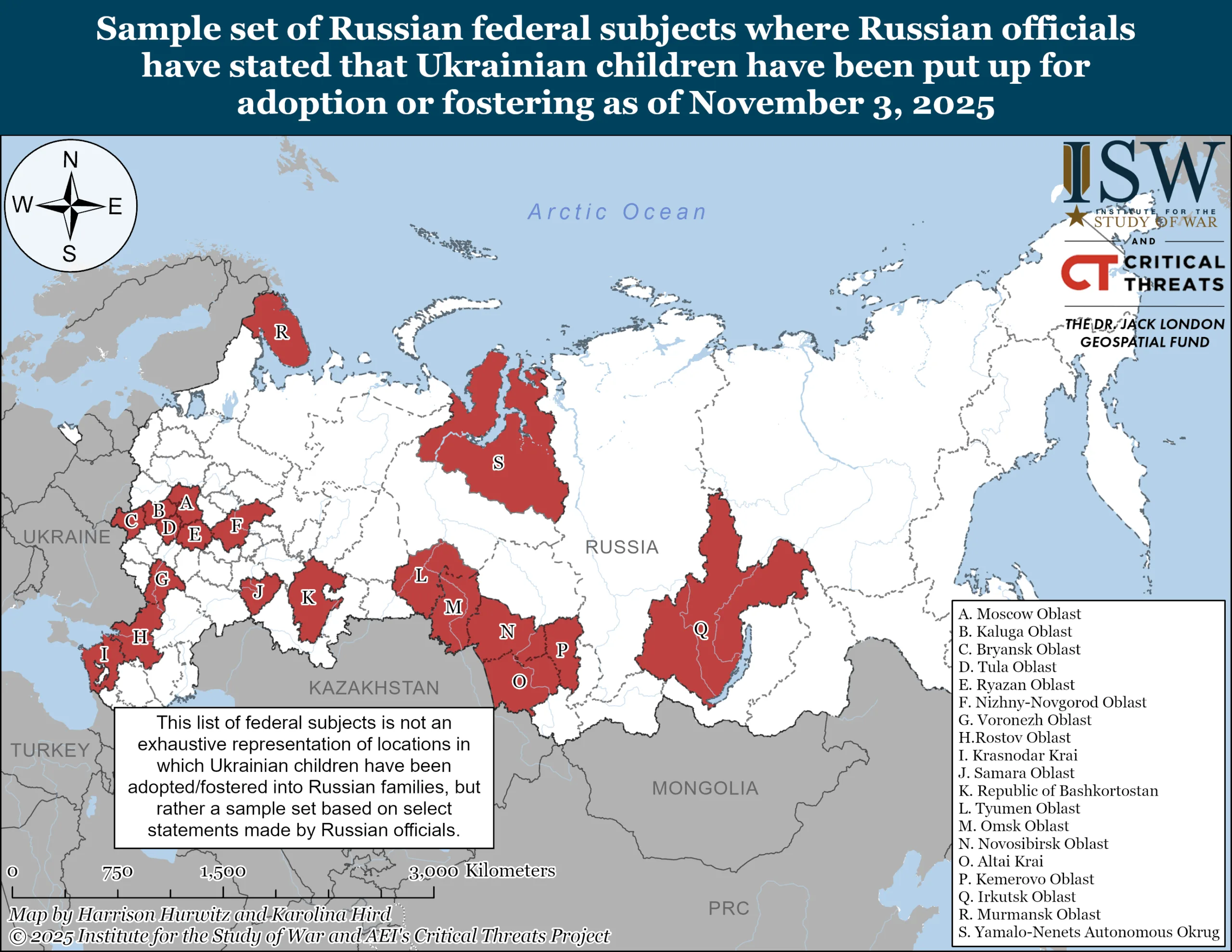
Sample set of Russian federal subjects where Russian officials have stated that Ukrainian children have been put up for adoption or fostering:
- Kremlin-appointed Commissioner for Children’s Rights Maria Lvova-Belova told Russian state media outlet RIA Novosti on June 9, 2022, that 108 children from occupied Donetsk Oblast were awaiting placement in families in Moscow, Tula, Kaluga, Rostov, and Voronezh oblasts and Yamalo-Nenets Autonomous Okrug.[11]
- Lvova-Belova stated on July 22, 2022, that Kaluga Oblast families “took in” 25 orphans from occupied Donetsk Oblast.[12]
- The Krasnodar Krai administration published a now-deleted post on August 23, 2022, stating that “children from Mariupol are looking for new families.”[13] The post noted that over 1,000 children from Mariupol have “already found new families” in Tyumen, Irkutsk, and Kemerovo oblasts and Altai Krai, and that 300 children are in orphanages in Krasnodar Krai awaiting adoption.
- Lvova-Belova posted on Telegram on September 16, 2022 that “the largest group of children and teenagers in recent memory” (125 total) arrived in Moscow Oblast from occupied Donetsk Oblast on Russian Ministry of Defense (MoD) flights.[14] Lvova-Belova later stated on October 7, 2022, that Russian MoD flights transferred 234 Ukrainian children from occupied Donetsk Oblast to Moscow Oblast.[15]
- Lvova-Belova posted footage on September 22, 2022 of 25 children from occupied Donetsk Oblast arriving in Nizhny-Novgorod Oblast to “meet their adoptive parents.”[16]
- The Murmansk Ministry of Information Policy reported on September 25, 2022 that families from the Kola Peninsula adopted 11 children from occupied Donetsk and Luhansk oblasts.[17]
- Russian newspaper Argumenty i Fakty (AiF) reported on September 28, 2022 that families in Omsk Oblast adopted 17 orphans from occupied Donetsk and Luhansk oblasts.[18]
- The Novosibirsk Oblast Social Policy Department called on September 30, 2022, for the placement of 49 children from occupied Donetsk and Luhansk oblasts aged one to 18 with Novosibirsk Oblast families.[19]
- The ruling United Russia party sent a family from Shakhovsky Raion, Moscow Oblast, a letter of gratitude for their adoption of at least four children from occupied Donetsk Oblast.[20]
- Republic of Bashkortostan Minister of Family, Labor, and Social Protection Lenara Khakimovna stated on October 4, 2022, that Bashkortostan authorities brought 32 children aged seven to 11 from occupied Donetsk Oblast to the republic for “permanent residence.”[21]
- Natalia Titova, Chief Specialist for Guardianship, Trusteeship, and Child Protection for Yarkovo District, Tyumen Oblast, stated on October 11, 2022, that 15 children from occupied Luhansk Oblast were adopted into families in Tyumen Oblast.[22] Titova stated that seven children aged two to 14 were adopted into families in Yarkovo Raion.
- Lvova-Belova reported on October 13, 2022, that 24 children aged two to 16 from occupied Luhansk Oblast, including some with unspecified disabilities, arrived in Novosibirsk Oblast for adoption.[23] Novosibirsk Oblast media published a report on October 1, 2025, detailing the lives of the 24 children over the past three years.[24]
- Lvova-Belova met on November 10, 2022 with Donetsk People’s Republic (DNR) Head Denis Pushilin and presented him with a photo album of 288 Ukrainian children who “found parents” in 15 Russian federal subjects.[25]
- Yamalo-Nenets Autonomous Okrug Governor Dmitry Artukhov stated on December 14, 2022, that families from the Okrug adopted over 20 children from occupied Donetsk, Kherson, Zaporizhia, and Luhansk oblasts.[26]
- Lvova-Belova visited a Russian family in Ryazan Oblast on December 21, 2022 who had adopted six siblings from occupied Donetsk Oblast.[27]
- Russian President Vladimir Putin stated on February 16, 2023 that there has been a significant increase in appeals from Russian families seeking to adopt children from occupied Ukraine since 2022.[28]
- The Office of the Russian Commissioner for Children’s Rights published an annual report in July 2023 stating that Russia had “accepted” a total of 700,000 children from Ukraine since 2022.[29] The report noted that the majority of the children came to Russia with parents or legal guardians but also noted that at least 1,500 orphans from occupied Donetsk and Luhansk oblasts also arrived in Russia, 380 of whom were placed in Russian foster families across 19 Russian federal subjects.[30]
- Moscow Oblast Commissioner for Children’s Rights Kseniya Mishonova stated that as of September 5, 2024, there were 213 Ukrainian orphans and children without parental care residing in Moscow Oblast, 112 of whom were living with foster families.[31] Mishonova stated that these Ukrainian children are having difficulties adapting to life in Moscow because of “the consequences of Russophobic propaganda.”
- Russian Orthodox Church (ROC) Bishop Kirill of Sergiev Posad and Dmitrov conducted a baptism service on November 1, 2024 for foster children in Moscow Oblast, including five children aged six to 16 from occupied Donetsk Oblast, during an event organized by the World Russian People’s Council and the Office of the Moscow Children’s Rights Commissioner.[32]
- Bryansk Oblast Children’s Rights Commissioner Inna Mukhina visited an orphanage in Bryansk Oblast on November 8, 2024, and stated that 20 children from occupied Donetsk and Luhansk oblasts were living at the shelter.[33]
- Samara Oblast Governor Vyacheslav Fedorishchev announced on October 22, 2025, during a meeting with the Russian Federal Council that Samara Oblast families have adopted 13 children from occupied Zaporizhia Oblast in the last month.[34]
Renewed Russian narratives surrounding deported Ukrainian children are a clear attempt to obfuscate the reality of the situation in order to cater to the Trump Administration, despite the breadth of evidence of the scale of Russia’s crimes. Russia has no intention of returning the majority of the children whom it has deported and adopted out into Russian families — these children are core to Russia’s campaign to erase Ukrainian identity, starting with its youngest and most vulnerable citizens. Russia is willing, however, to use a select handful of the children it illegally deported to create inroads for itself with the Trump Administration, essentially exploiting Melania Trump’s interest in advocating for the return of Ukrainian children for the Kremlin’s own benefit. The engagement of noted Kremlin negotiators, namely Dmitriev, in efforts to tie the return of Ukrainian children to the conduct of bilateral US-Russia relations, suggests that this is a Kremlin-directed strategy. While the return of any number of deported Ukrainian children should be seen as a net victory, it also should not preclude efforts to secure the return of the tens of thousands of other children whom Russia has taken and distributed throughout the Russian Federation. The Trump Administration must therefore remain clear-eyed and recognize that Russia’s promises to collaborate on the return of a few children are a deliberate attempt to mislead Ukraine’s partners and hide the true scale and nature of Russia’s crimes against Ukrainian children. Ukraine, not Russia, holds the needed information to support the return of these children, and Ukraine’s partners should support these identification and repatriation efforts in order to avoid reducing Ukraine’s deported children to the status of a bargaining tool.

[1] https://x.com/i/broadcasts/1lDxLBqLPMkGm
[2] https://x.com/kadmitriev/status/1976665471698280772
[3] https://understandingwar.org/research/russia-ukraine/russian-offensive-campaign-assessment-february-18-2025/; https://understandingwar.org/research/russia-ukraine/russian-offensive-campaign-assessment-october-25-2025/; https://understandingwar.org/research/russia-ukraine/russian-offensive-campaign-assessment-october-17-2025/
[4] https://www.klobuchar.senate.gov/public/index.cfm/news-releases?ID=E96731B9-8A76-467D-AE36-E0AC17DB4FFC
[5] https://www.ohchr.org/sites/default/files/documents/countries/ukraine/2022/2022-12-07-OHCHR-Thematic-Report-Killings-EN.pdf
[6] https://t.me/MID_Russia/67743
[7] https://regnum dot ru/article/3968817; https://www.mk dot ru/politics/2025/06/04/lvovabelova-rossiya-ne-pokhishhala-detey-s-ukrainy.html; https://rg dot ru/2025/06/04/zaharova-publikaciia-spiska-ukrainskih-detej-stala-shokom-dlia-sozdatelej-fejkov.html; https://tsargrad dot tv/news/lvova-belova-rossija-vedjot-rabotu-po-kazhdomu-rebjonku-iz-peredannogo-ukrainoj-spiska_1277680; https://t.me/tass_agency/318730
[8] https://www.euronews.com/2025/06/04/ukraine-demands-return-of-children-taken-by-russia-how-did-kyiv-come-up-with-the-list; https://www.bbc.com/news/world-europe-67488646; https://en.interfax.com.ua/news/general/913746
[9] https://understandingwar.org/research/russia-ukraine/why-putin-remains-uninterested-in-meaningful-negotiations-with-ukraine/; https://understandingwar.org/research/russia-ukraine/russian-offensive-campaign-assessment-october-20-2025/
[10] https://files-profile.medicine.yale.edu/documents/5444c3da-1285-489e-926a-b6d5cfb699a2
[11] https://ria.ru/20220608/deti-1793939863.html; https://t.me/malvovabelova/354
[12] https://t.me/malvovabelova/384
[13] The original post has since been removed from the administration website, but Ukrainian sources reposted screenshots of the post and ISW was able to locate an archived version. A screenshot of the post can be found here: https://understandingwar.org/research/russia-ukraine/putin-is-still-stealing-ukrainian-children-2/
[14] https://t.me/malvovabelova/569
[15] https://t.me/malvovabelova/644
[16] https://t.me/malvovabelova/580
[17] https://fedpress dot ru/news/51/society/3103958
[18] https://omsk.aif dot ru/society/reys_v_novuyu_zhizn_omskie_semi_prinyali_na_vospitanie_17_sirot_iz_donbassa?ysclid=mdt8z0r9u6593353999
[19] https://fedpress dot ru/news/54/society/3107888
[20] https://vk dot com/wall-30023195_34776; https://www.er-shahovskaya dot ru/news/1766
[21] https://gtrkrb dot ru/proekty/vesti-intervyu/285711-lenara-ivanova-udivlyaet-skolko-bashkirii-lyudey-pozhelavshih-usynovit?ysclid=m8q4k86ny731183590&utm_source=yandex.ru&utm_medium=organic&utm_campaign=yandex.ru&utm_referrer=yandex.ru
[22] https://yar72 dot ru/archives/23026
[23] https://t.me/malvovabelova/668
[24] https://www.nsktv dot ru/news/obshchestvo/vesti_uznali_o_zhizni_detey_iz_novykh_rossiyskikh_regionov_v_novosibirskikh_semyakh/
[25] [25] https://t.me/malvovabelova/752
[26] https://sever-press.ru/news/obschestvo/jamalskie-semi-prinjali-desjatki-detej-donbassa/
[27] https://t.me/malvovabelova/920
[28] https://ria dot ru/20230216/regiony-1852439917.html
[29] https://www.rbc dot ru/politics/30/07/2023/64c6c3119a794777ebcc7766?from=from_main_11
[30] https://www.rbc dot ru/politics/30/07/2023/64c6c3119a794777ebcc7766?from=from_main_11
[31] https://detimo dot mosreg.ru/sobytiya/novosti-ministerstva/kseniya-misonova-rasskazala-o-detyax-donbassa-v-podmoskove
[32] https://detimo.mosreg dot ru/sobytiya/novosti-ministerstva/episkop-sergievo-posadskii-i-dmitrovskii-kirill-soversil-tainstvo-kreshheniya-dlya-detei-iz-priyomnyx-semei-podmoskovya
[33] https://deti.gov dot ru/Press-Centr/region-news/15370
[34] https://ria dot ru/20251022/rossiya-2049925738.html