Russian Occupation Update, April 2, 2026
Key Takeaways
- Russian officials continue to exploit psychological treatment, rehabilitation, military-patriotic training, and cultural programs as pretexts for the deportation and indoctrination of Ukrainian children, while also coercing Ukrainian children into producing military equipment for Russian forces.
- Russian mismanagement is driving a dire humanitarian crisis in occupied Oleshky, Kherson Oblast. Hundreds of thousands of residents of occupied Ukraine may also be facing water shortages.
- Russian officials continue short- and long-term efforts to address occupation-driven healthcare staff shortages by attracting Russian medical workers to occupied Ukraine.
- Russia is streamlining its free economic zone (FEZ) regulatory framework and expanding federal and regional investment in occupied Ukraine to deepen the economic integration of occupied territories into the Russian financial regime.
- The Kremlin-controlled MAX messenger is proliferating in occupied Crimea.
- Russian and Donetsk Oblast occupation officials are articulating plans to develop the port of occupied Mariupol into a major hub for Russian trade and industry.
Deportation and Forcible Transfer of Ukrainian Citizens, Including Children
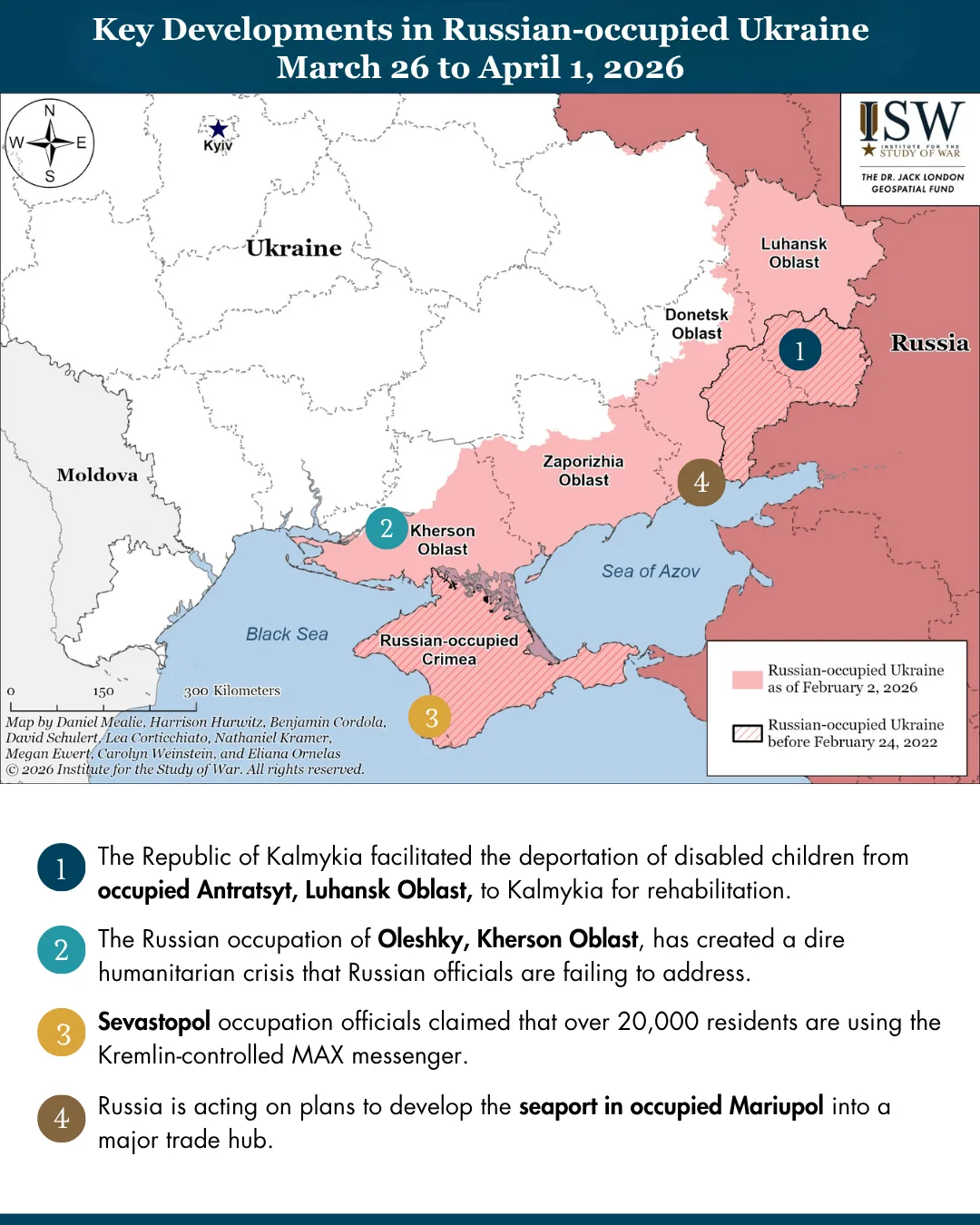
Russian officials continue to use psychological treatment and rehabilitation programs as a justification for the deportation of Ukrainian children. The Republic of Kalmykia Ministry of Social Development, Labor, and Employment announced on March 23 that a group of children with disabilities arrived in the Republic of Kalmykia from occupied Antratsyt, Luhansk Oblast for “medical and social rehabilitation.”[1] The Republic of Kalmykia is a patron region for occupied Antratsyt Raion, and has hosted children from the settlement for rehabilitation and summer programs several times since 2022.[2] Russia’s deportation of Ukrainian children for such rehabilitation programs extends beyond the patron-client relationship between the Republic of Kalmykia and Antratsyt, however. Russian State Duma Deputy Anna Kuznetsova, who notably served as the Kremlin-appointed Commissioner on Children’s Rights from 2016 to 2021, told Russian state television program Vesti on March 12 that her humanitarian organization has “organized” the “evacuation” of 3,500 Ukrainian children to Russia for “treatment and rehabilitation” since 2022.[3] Kuznetsova’s statement focused on evacuations organized through her humanitarian project, so the true number of deportations for rehabilitation programs is likely to be much higher than the 3,500. Kuznetsova noted that some children received “surgical interventions” during their rehabilitation time in Russia. Russian officials, including healthcare workers, have frequently weaponized the concept of medical or psychological care as a guise to deport Ukrainian children to Russia in a manner that is inconsistent with international legal requirements on Russia as a belligerent occupying power.[4]
The Krasnodar Krai government facilitated the temporary deportation of teenagers from occupied Kherson Oblast to a military-patriotic training camp for “pre-conscription” preparations. The Kherson Oblast occupation administration reported on March 31 that 33 teenagers from occupied Kherson Oblast took part in military-patriotic training at the Patriot Center in Krasnodar Krai, with the support and facilitation of the Krasnodar Krai government and various Krasnodar Krai-based business and charitable entities.[5] The Patriot Center intends to instill in “pre-conscription youth” a sense of “patriotic spirit” and the development of physical skills, including through tactical and special training sessions.[6] The group of Kherson Oblast teenagers was the first from occupied Ukraine to visit the Patriot Center. The Patriot Center interviewed one teenager, who stated that his experience at the Center encouraged him to pursue a career in the Russian airborne forces. The Patriot Center’s programming shares several similarities with other youth military-patriotic training institutions in Russia that have facilitated the deportation of Ukrainian youth for military training and preparation. The explicit focus on “pre-conscription” preparations highlights the fact that Russia uses these programs to prepare Ukrainian youth for future careers or service in the Russian military.
Russian authorities continue efforts to temporarily deport Ukrainian children from occupied territories to Russia for cultural re-education, indoctrination, and integration into the Russian sphere of influence. Luhansk People’s Republic (LNR) occupation Minister of Culture Roman Oleksin claimed on March 27 that students from occupied Luhansk Oblast will visit Moscow City, Sochi, St. Petersburg, and occupied Sevastopol as part of the Cultural Map 4 + 85 program.[7] Over 4,500 students from occupied Luhansk Oblast traveled to Russia in 2025 as part of the program.[8] The Russian Ministry of Culture started the Cultural Map 4 + 85 program in 2023 and framed it as a way to introduce Ukrainian children to Russian heritage, technological advancements, and achievements in music, architecture, science, and space exploration.[9] ISW previously reported on the Cultural Map 4 + 85 program’s role in integrating Ukrainian children into the Russian sphere of influence and erasing their Ukrainian identity.[10] Occupation officials also continue to temporarily deport children from occupied Ukraine to Russian health camps. The St. Petersburg Representative Office in occupied Mariupol claimed on March 28 that 115 students and 12 teachers from occupied Mariupol arrived in St. Petersburg for their spring break.[11] Students will stay at the Molodozhnoye health and educational camp, and will participate in master classes, training sessions, excursions around the city, and the development of social projects to implement in their hometown.[12] ISW continues to assess that Russian authorities use the Cultural Map 4 + 85 program and health camps to temporarily deport Ukrainian children to Russia on propaganda trips for cultural indoctrination.[13]
Sociocultural Control
Nothing significant to report.
Militarization of Occupied Areas
Russia continues to coerce children in occupied Ukraine into producing military equipment for the Russian military. Independent Crimea-based news outlet Inzhir reported on March 26 that occupation authorities forced children at a school in occupied Simferopol to weave camouflage nets for the Russian Armed Forces under threats of academic repercussions and having their parents reported to the Federal Security Service (FSB).[14] Occupation authorities framed these activities as “nurturing patriotism” and “civic responsibility.” ISW has previously reported on instances when Russian officials forced Ukrainian children to produce military goods, including camouflage nets and drone components.[15] These activities further normalize daily participation in Russia’s war effort, militarize the school system, and instill Russian military-patriotic ideals in Ukrainian children — all supporting Russia’s campaign to raise a generation of Ukrainian children loyal and supportive of the Russian military.
Administrative and Bureaucratic Control
Nothing significant to report.
Occupation Administration Mismanagement and Internal Dynamics
Russian mismanagement has created a critical food, water, and resource shortage that is driving a dire humanitarian crisis in occupied Oleshky, Kherson Oblast. The Ukrainian Media Initiative for Human Rights (MIHR) reported on March 24 that Russian occupation authorities stopped deliveries of food and supplies to occupied Oleshky in late December 2025, amid the threat of Ukrainian mines, shelling, and drone strikes.[16] MIHR stated that residents of Oleshky emptied the last two supply trucks carrying dairy products and vegetables out of desperation on January 7.[17] An evacuation volunteer told MIHR on March 24 that residents have resorted to hunting for food, and there have been multiple cases of residents dying from starvation, cold, and a lack of medical care.[18] The Ukrainian Resistance Center reported on March 26 that the occupation leadership left Oleshky and moved to Skadovsk, removing itself from the humanitarian crisis and isolating the population.[19] The Ukrainian Resistance Center reported that all stores in Oleshky have closed, and that the hospital has established itself as the only point of sale, selling food at exorbitant prices that most residents cannot afford.[20] Residents are unable to leave due to road blockades, mines, and spikes.[21] Russian Armed Forces personnel struck on February 8 two cars carrying supplies to Oleshky, and front-line artillery and drone exchanges across the Dnipro River often strike the town.[22] ISW previously assessed that Russia’s economic relationship with occupied Ukraine is extractive and self-serving, and Russia’s war restricts consumer logistics routes and limits the goods and services available to occupied Ukrainians.[23]
Ukrainian Ombudsman Dmytro Lubinets stated on March 27 that the Russian Armed Forces are deliberately disrupting aid and evacuation efforts in Oleshky.[24] Lubinets appealed to the International Committee of the Red Cross at the beginning of March, requesting that Russian authorities organize a safe route for evacuation and humanitarian aid, but Russia has not responded or acted accordingly.[25] Articles 55 and 59 of the Fourth Geneva Convention obligate states to provide civilian populations with food and medical supplies and facilitate aid during conflict.[26] Kherson Oblast occupation head Vladimir Saldo told Russian state news outlet RIA Novosti on March 30 that Ukraine is spreading false narratives about a humanitarian crisis in Oleshky, and that occupation authorities are delivering supplies on time despite the Ukrainian Armed Forces attacking civilian logistics.[27] Russia’s refusal to acknowledge the documented humanitarian situation in Oleshky and cooperate with international law demonstrates its inability to provide basic services for and ensure the wellbeing of Ukrainians under occupation.
As many as hundreds of thousands of residents of occupied Ukraine may be facing water shortages, in part due to Russian mismanagement of water infrastructure and continued inability to ensure basic services to occupied areas. The Ukrainian Luhansk Oblast Administration reported on March 29 that about 200,000 people in occupied Luhansk Oblast lack water after an accident on the water supply line between occupied Kadiivka and Alchevsk.[28] The Luhansk Oblast Administration noted that there are frequent emergencies leading to water supply disruption in occupied Luhansk Oblast, and that repairs often take several days. The Kadiivka-Alchevsk water pipeline has reportedly not undergone repairs since 2014. Other areas of occupied Ukraine are also facing water shortages. Social media footage posted on March 30 shows a resident of occupied Melitopol complaining about water shortages following purported Ukrainian strikes on energy infrastructure in occupied Zaporizhia Oblast.[29] Occupied Zaporizhia Oblast-based media reported on March 27 that there were electricity and water outages in occupied Melitopol for “reasons still unclear.”[30] Former Ukrainian Mariupol Mayoral Advisor Petro Andryushchenko also reported on March 28 that occupation officials turned off the water supply in occupied Mariupol due to electricity supply issues.[31] Ukrainian forces have been conducting a mid-range strike campaign against Russian energy infrastructure, including in occupied Ukraine, which may in part be generating electrical outages that are causing water shortages. Ukraine’s strike campaign, however, does not exculpate Russia from its international legal responsibility to provide access to basic services to the population it occupies. ISW has reported at length on Russia’s role in the ongoing water crisis in occupied Ukraine, and continues to assess that water shortages are a direct result of the full-scale invasion and Russian mismanagement during the occupation.
Russian officials continue short and long-term efforts to attract Russian medical workers to occupied Ukraine to supplement shortages in healthcare staff. ISW previously reported on growing medical staff shortages in occupied Ukraine and has assessed that these shortages are the result of Russian mismanagement of the healthcare systems in occupied areas since 2022.[32] Occupation officials are facilitating short-term trips by Russian medical professionals to occupied Ukraine to temporarily supplement these shortages. Jewish Autonomous Oblast Governor Maria Kostyuk claimed on March 28 that a team of doctors from the Jewish Autonomous Oblast visited occupied Donetsk Oblast and provided consultations to over 250 residents at occupied Amvrosiivka Central Raion Hospital.[33] Kherson Oblast occupation Senator Igor Kastyukevich claimed on March 30 that five doctors from Orenburg Oblast visited occupied Kherson Oblast for a week and treated over 600 children at Nyzhnosirohozkyi Hospital.[34] Kherson Oblast occupation head Vladimir Saldo claimed on March 29 that visiting doctors from the Republic of Adygea and Orenburg Oblast conducted diagnostic testing on 21 children at Nyzhnosirohozkyi Hospital.[35]
Occupation officials are using specialized programs and offers of free housing to attract Russian medical professionals to relocate to occupied Ukraine in the long-term. Luhansk People’s Republic (LNR) occupation Minister of Health Natalia Pashchenko claimed on March 27 that 50 medical workers hired through the “Zemsky Doctor” program will join the workforce in occupied Luhansk Oblast in 2026.[36] The workers come from Moscow, Nizhny Novgorod, and Voronezh oblasts, as well as Krasnodar Krai and the Republic of Dagestan.[37] Occupied Luhansk Oblast has received 46 “Zemsky” medical professionals over the past three years.[38] Saldo claimed on March 31 that the Kherson Oblast occupation administration provided apartments to 23 doctors and healthcare workers from occupied Kherson Oblast’s “abandoned” housing stock.[39] ISW previously reported on occupation officials’ efforts to seize, nationalize, and redistribute “abandoned” properties to Russian doctors, teachers, and municipal workers.[40] ISW continues to assess that Russia is artificially inflating the number of “ownerless” properties in occupied Ukraine so that occupation officials can seize and redistribute them to Russian medical professionals, addressing the shortage of healthcare staff and re-populating occupied Ukraine with Russian citizens.[41]
Physical and Legal Repressions
Nothing significant to report.
Economic and Financial Control
Russia is streamlining its regulatory framework around free economic zones (FEZ) to further integrate occupied Ukrainian economies into the Russian financial regime. The Russian State Duma adopted on March 24 a bill in its first reading that simplifies Russian participation in the FEZ for occupied Donetsk, Luhansk, Zaporizhia, and Kherson oblasts.[42] The bill reduces the minimum required capital investment to enter the FEZ in occupied Ukraine during the first year of project development from 30 percent to 10 percent of the total project value.[43] This reform will enable more Russian entrepreneurs to become FEZ participants in occupied Ukraine. The bill also permits the Territorial Development Fund, under the Russian Ministry of Construction, to lease land plots in occupied Ukraine to FEZ participants without a legal tender.[44] The Russian State Duma authorized the creation of the occupied Ukrainian FEZ in April 2023 and intends to use it as a means of incentivizing Russian investment in, and establishing control over, occupied Ukraine until at least 2050.[45] Russia will likely continue to expand FEZs as a means of multiplying the number of Russian investors in occupied Ukraine and reducing Ukrainian influence over the structure of their own economies. ISW has previously assessed that Russian attempts to encourage investment in occupied Ukraine are part of a broader effort to extract resources, maximize government revenue, and integrate occupied territories into the Russian economy.[46]
Information Space Control
Sevastopol occupation governor Mikhail Razvozhaev highlighted his administration’s efforts to proliferate the Kremlin-controlled MAX messenger in occupied Crimea. Razvozhaev met on March 30 with Russian Ministry of Construction Head Irek Fayzullin and discussed the development of occupied Sevastopol.[47] Razvozhaev reported to Fayzullin that the MAX messenger is becoming a “viable communication tool” in occupied Sevastopol and that 24,000 people in Sevastopol are using MAX’s “home chats.” Home chats are a central place for residents of apartment buildings to interact with building management and resolve maintenance issues.[48] A Ukrainian partisan group warned on March 13 that Razvozhaev’s administration was transferring all home chats to MAX, which ISW assessed at the time was an indicator that occupation officials were increasingly migrating basic services to MAX in order to coerce residents of occupied areas into using the application.[49] Fayzullin claimed on March 16 that over 10.8 million users across Russia and occupied Ukraine moved such housing-related chats to MAX.[50]
Infrastructure and Development Projects
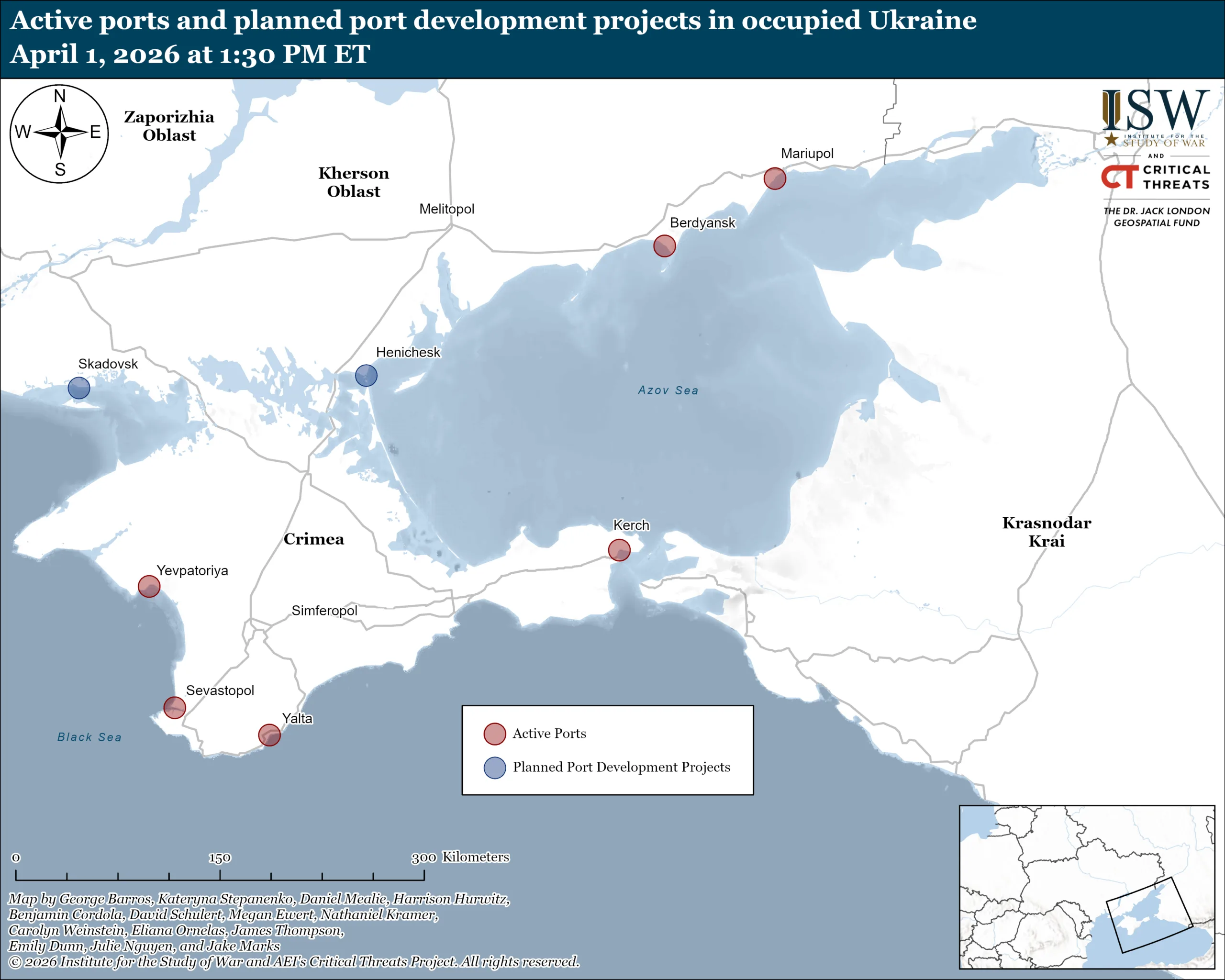
Russian and Donetsk Oblast occupation officials are articulating plans to develop the port of occupied Mariupol into a major hub for Russian trade and industry. Russian Federal Agency for Maritime and River Transport (Rosmorrechflot) Head Andrey Tarasenko met on March 27 with First Deputy Chairman of the Donetsk People’s Republic (DNR) occupation government Vladislav Ochnev to discuss a long-term development strategy for the occupied Mariupol Seaport until 2040.[51] Tarasenko and Ochnev highlighted the fact that Mariupol is the largest and deepest seaport on the Azov Sea, which provides Russia access to the Caspian Sea and Atlantic and Indian oceans. Plans for Mariupol Seaport include large-scale infrastructure modernization projects, dredging efforts that will allow the port to handle vessels weighing up to 25,000 tons, and the creation of a customs and border control point to simplify international logistics in and out of the port. The plans clearly indicate that Russia intends to formalize the integration of occupied Mariupol’s infrastructure into its wider international import-export economy. Russia already uses ports in occupied Crimea and the port at occupied Berdyansk for the export of stolen Ukrainian goods to global markets, essentially using these ports to facilitate revenue generation for the Russian budget.[52]
Russian federal subjects (regions) are providing financial and labor support for the reconstruction of occupied Ukraine to support and supplement costs for the occupation coming out of the Russian federal budget. Kremlin newswire TASS claimed on March 30 that Donetsk People’s Republic (DNR) Deputy Prime Minister and Envoy to the Russian Far East Yuri Trutnev stated that Russia’s Far Eastern regions intend to support the restoration of 107 social infrastructure facilities (schools, sports grounds, medical and cultural institutions) in sponsored settlements in occupied Donetsk Oblast through 2026.[53] Russian builders from Moscow and Kaluga oblasts are additionally working on construction projects in occupied Mariupol and occupied Pervomaiske, Luhansk Oblast, respectively.[54] ISW has previously reported on how the Kremlin appears to be relying on Russian federal subjects to offset some of the direct federal costs of the occupation by using regional funds and labor to support reconstruction projects in occupied areas.[55]
Russia also continues to funnel federal funds into occupied Ukraine, however. Occupied Luhansk Oblast-based outlet Luhansk Information Center claimed on March 27 that Luhansk People’s Republic (LNR) Minister of Culture Roman Oleksin announced that the modernization of cultural institutions in the occupied territory used about one billion rubles ($12.5 million) of federal funds in 2025.[56] Over 524 million rubles ($6.4 million) came out of the federal budget, the national project “Family”, and the state program “Development of Culture,” while the Presidential Fund for Cultural Initiatives donated another 460.8 million rubles ($5.66 million). Russian Prime Minister Mikhail Mishustin signed a decree on March 30 allocating over 8.5 billion rubles for the provision of gas to occupied Ukraine in 2026.[57] Russia’s high levels of spending on development projects in occupied Ukraine reflect the fact that Russia views these projects as fundamental avenues for the forced integration of occupied Ukraine into the Russian sphere of influence. The continued involvement of Russian regional funds and laborers reflects in parallel the Kremlin’s desire to fund the occupation using diverse means.

[1] https://minsoc08 dot ru/novosti/ocherednaya-gruppa-rebyat-s-invalidnostyu-iz-antratsitovskogo-rayona-lnr-pribyla-v-kalmykiyu-dlya-pr/
[2] https://understandingwar.org/research/russia-ukraine/russian-occupation-update-june-17-2025/
[3] https://www.vesti dot ru/ns/rf-vyvezla-35-tys-detej-postradavshikh-ot-kievskogo-rezhima-soobshchila-kuznecova
[4] https://www.thelancet.com/journals/lancet/article/PIIS0140-6736(25)02388-8/fulltext; https://understandingwar.org/wp-content/uploads/2024/03/24-210-0120ISW20Occupation20playbook.pdf; https://understandingwar.org/research/russia-ukraine/russian-occupation-update-july-7-2025/
[5] https://t.me/VGA_Kherson/37538
[6] https://patriot-kuban dot ru/news/common/s/common/e/724
[7] https://lug-info dot ru/news/deti-iz-lnr-v-ramkah-proekta-pobyvajut-v-moskve-sochi-sankt-peterburge-i/
[8] https://lug-info dot ru/news/deti-iz-lnr-v-ramkah-proekta-pobyvajut-v-moskve-sochi-sankt-peterburge-i/
[9] https://lug-info dot ru/news/deti-iz-lnr-v-ramkah-proekta-pobyvajut-v-moskve-sochi-sankt-peterburge-i/
[10] https://understandingwar.org/research/russia-ukraine/russian-occupation-update-march-19-2026/; https://understandingwar.org/research/russia-ukraine/russian-occupation-update-january-15-2026/; https://understandingwar.org/research/russia-ukraine/russian-occupation-update-october-9-2025/; https://understandingwar.org/research/russia-ukraine/russian-occupation-update-april-17-2025/;
[11] https://www.donetsk.kp dot ru/online/news/6890401/
[12] https://www.donetsk.kp dot ru/online/news/6887121/; https://www.donetsk.kp dot ru/online/news/6890401/;
[13] https://understandingwar.org/research/russia-ukraine/russian-occupation-update-march-19-2026/;
[14] https://injir dot org/shkolnyie-klassyi-kak-masterskie-dlya-voynyi-v-kryimu-uchenikov-zastavlyayut-plesti-maskirovochnyie-setki-dlya-nujd-okkupatsionnoy-armii-26-03-2026/
[15] https://understandingwar.org/research/russia-ukraine/russian-occupation-update-november-20-2025/ ; https://understandingwar.org/research/russia-ukraine/russian-occupation-update-may-22-2025/
[16] https://mipl dot org.ua/lyudy-pomyrayut-u-vlasnyh-domivkah-vid-holodu-ta-golodu-anonimni-svidchennya-z-okupovanyh-oleshok/
[17] https://mipl dot org.ua/lyudy-pomyrayut-u-vlasnyh-domivkah-vid-holodu-ta-golodu-anonimni-svidchennya-z-okupovanyh-oleshok/
[18] https://mipl dot org.ua/lyudy-pomyrayut-u-vlasnyh-domivkah-vid-holodu-ta-golodu-anonimni-svidchennya-z-okupovanyh-oleshok/
[19] https://sprotyv dot org.ua/humanitarna-katastrofa-na-okupovanii-khersonshchyni/ ; https://t.me/sprotyv_official/8405
[20] https://sprotyv dot org.ua/humanitarna-katastrofa-na-okupovanii-khersonshchyni/
[21] https://t.me/sprotyv_official/8405 ; https://mipl dot org.ua/lyudy-pomyrayut-u-vlasnyh-domivkah-vid-holodu-ta-golodu-anonimni-svidchennya-z-okupovanyh-oleshok/
[22] https://mipl dot org.ua/lyudy-pomyrayut-u-vlasnyh-domivkah-vid-holodu-ta-golodu-anonimni-svidchennya-z-okupovanyh-oleshok/
[23] https://understandingwar.org/research/russia-ukraine/russian-occupation-update-january-15-2026/ ; https://understandingwar.org/research/russia-ukraine/russian-occupation-update-february-5-2026/ ; https://understandingwar.org/research/russia-ukraine/russian-occupation-update-march-5-2026/
[24] https://t.me/dmytro_lubinetzs/11279 ; https://t.me/sprotyv_official/8418
[25] https://t.me/dmytro_lubinetzs/11279 ; https://t.me/sprotyv_official/8418
[26] https://t.me/dmytro_lubinetzs/11279
[27] https://www.herson dot kp.ru/online/news/6891933/
[28]https://www.facebook.com/odalug/posts/pfbid02NTrxLxfVG99PjmEkkjYvCMZnRKH44hbC6cVsFRkQG56hm58Fu4VhY6jP4AJmDNacl
[29] https://t.me/occupation_research_center/1163
[30] https://www.zap dot kp.ru/online/news/6887898/
[31] https://t.me/andriyshTime/54887
[32] https://understandingwar.org/research/russia-ukraine/russian-occupation-update-november-26-2025/; https://understandingwar.org/research/russia-ukraine/russian-occupation-update-may-8-2025/;
[33] https://www.donetsk.kp dot ru/online/news/6889998/
[34] https://www.herson.kp dot ru/online/news/6892474/
[35] https://www.herson.kp dot ru/online/news/6890941/
[36] https://tass dot ru/obschestvo/26912565;
[37] https://tass dot ru/obschestvo/26912565;
[38] https://tass dot ru/obschestvo/26912565;
[39] ;
[40] https://understandingwar.org/research/russia-ukraine/russian-occupation-update-march-19-2026/; ; ;
[41] https://understandingwar.org/research/russia-ukraine/russian-occupation-update-march-19-2026/; https://understandingwar.org/research/russia-ukraine/russian-occupation-update-february-26-2026/; ;
[42] https://sozd dot duma.gov.ru/bill/1142342-8
[43] https://sozd dot duma.gov.ru/bill/1142342-8
[44] https://sozd dot duma.gov.ru/bill/1142342-8
[45] https://ria dot ru/20230419/zona-1866386888.html
[46] https://understandingwar.org/research/russia-ukraine/russian-occupation-update-march-5-2026/ ; https://understandingwar.org/research/russia-ukraine/russian-occupation-update-february-5-2026/
[47] https://t.me/razvozhaev/19194
[48] https://urban-media dot ru/blog/vybiraem/kak-nayti-ili-sozdat-svoy-domovoy-chat/; https://understandingwar.org/research/russia-ukraine/russian-occupation-update-march-19-2026/
[49] https://t.me/yellowribbon_ua/13317; https://understandingwar.org/research/russia-ukraine/russian-occupation-update-march-19-2026/
[50] https://t.me/minstroyrf/22905
[51] https://pravdnr dot ru/news/v-mariupolskom-morskom-portu-na-federalnom-i-regionalnom-urovnyah-obsudili-perspektivy-razvitiya-predpriyatiya/; https://www.donetsk.kp dot ru/daily/27769.5/5228157/
[52] https://understandingwar.org/research/russia-ukraine/russian-occupation-update-template-january-30-2026/; https://understandingwar.org/research/russia-ukraine/russian-occupation-update-january-22-2026/; https://understandingwar.org/research/russia-ukraine/russian-occupation-update-october-23-2025/; https://understandingwar.org/research/russia-ukraine/russian-occupation-update-january-8-2026/; https://understandingwar.org/research/russia-ukraine/russian-occupation-update-june-3-2025/; https://understandingwar.org/research/russia-ukraine/russian-occupation-update-september-25-2025/
[53] https://tass dot ru/obschestvo/26931463
[54] https://www.donetsk dot kp.ru/online/news/6888237/; https://www.lugansk.kp dot ru/online/news/6891630/
[55] https://understandingwar.org/wp-content/uploads/2024/03/24-210-0120ISW20Occupation20playbook.pdf
[56] https://lug-info dot ru/news/okolo-milliarda-rub.-napravili-na-modernizaciju-uchrezhdenij-kultury-lnr/
[57] https://zonews dot ru/news/istoricheskie-regiony-poluchat-svyshe-85-mln-rub.-na-programmu-socgazifikacii/