Russian Occupation Update, March 12, 2026
Key Takeaways
- Russian forces have deported Ukrainian civilians from Sumy Oblast border settlements to Russia in at least two separate incidents since late December 2025.
- The United Nations Independent International Commission of Inquiry (IICOI) on Ukraine has determined that Russia’s deportation and forced transfer of Ukrainian children amount to crimes against humanity.
- The Mariupol occupation administration sent fourteen Ukrainian families to Vladimir Oblast for “psychological and social rehabilitation.”
- Russian government authorities are pursuing initiatives aimed at incentivizing Russian veterans of the war in Ukraine to resettle in occupied areas by offering up plots of land.
- The Kremlin has officially made the simplified procedure for Russian passportization in occupied Ukraine permanent.
- Russia’s majority state-owned banks Sberbank and VTB are consolidating their control over financial services in occupied Ukraine as a means of increasing dependencies on the Russian banking system.
- Russian satellite broadcaster “Russkiy Mir” and other Russian TV channels suffered a satellite failure which disrupted TV service in occupied Ukraine .
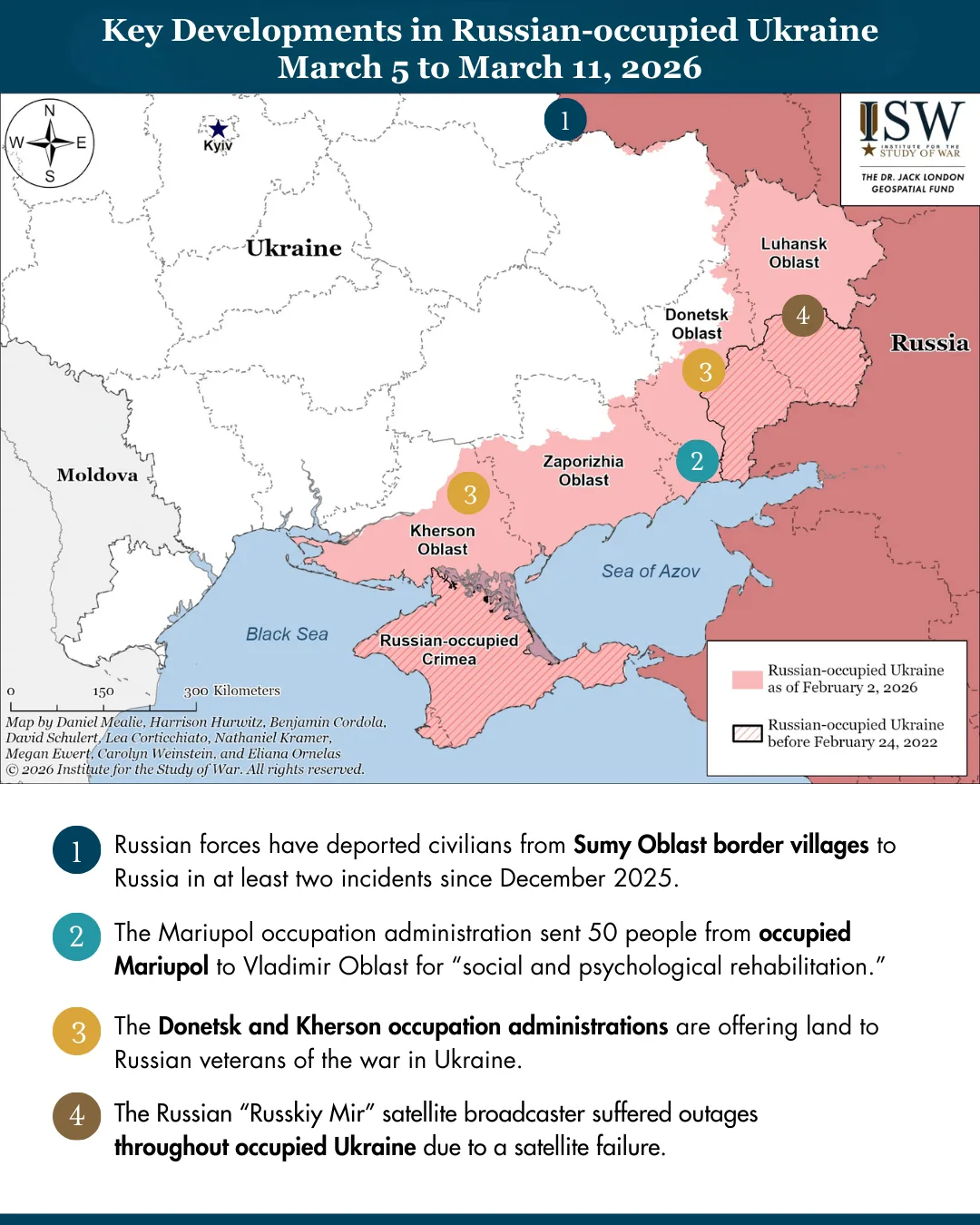
Deportation and Forcible Transfer of Ukrainian Citizens, Including Children
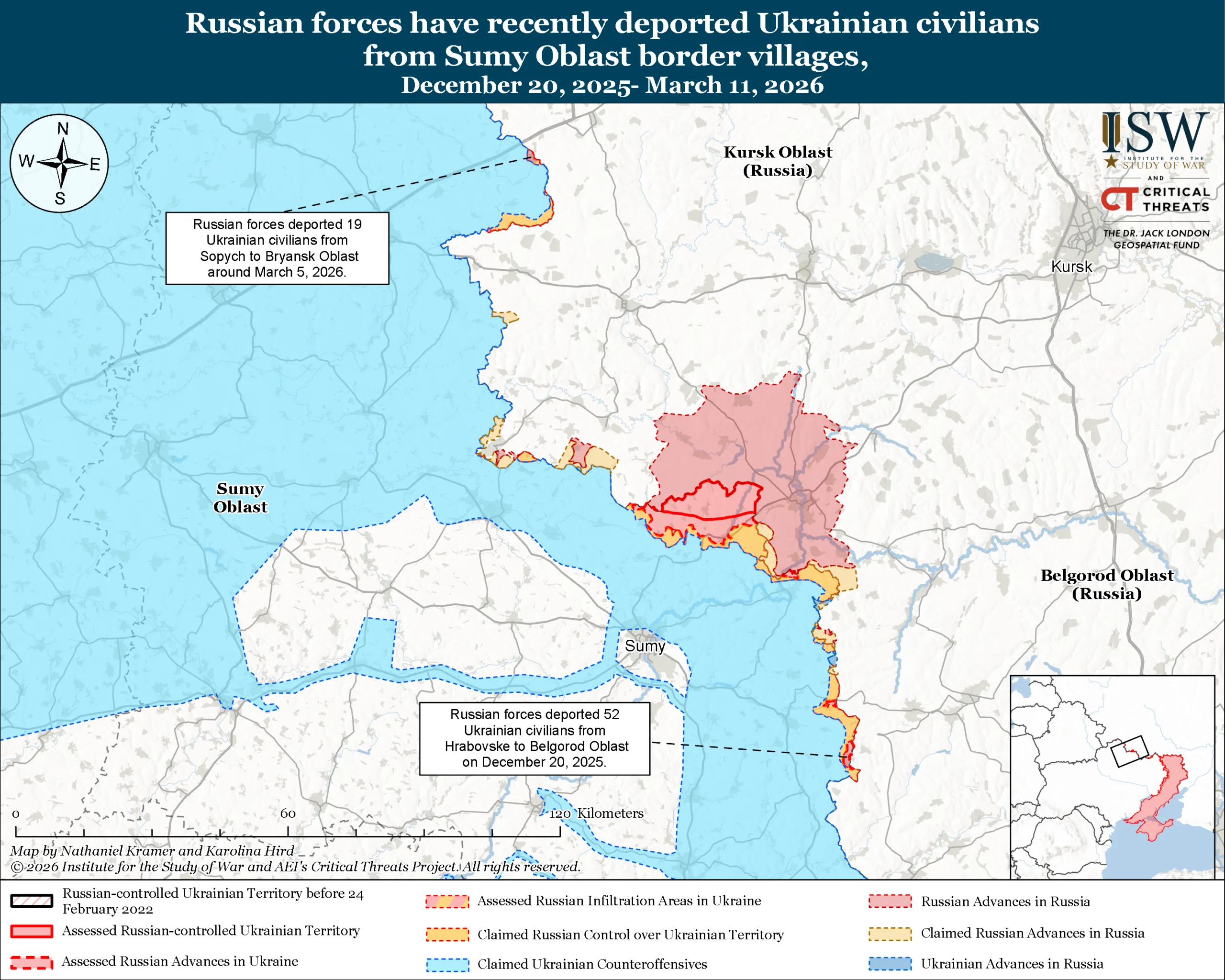
Russian forces have deported Ukrainian civilians from Sumy Oblast border settlements to Russia in at least two separate incidents since late December 2025. Ukrainian Joint Forces Task Force Spokesperson Colonel Viktor Trehubov reported that elements of the Russian “36th Brigade” deported 52 people from Hrabovske (directly on the international Sumy-Belgorod Oblast border) to Russia on December 20, 2025.[1] It is unclear what Russian formation Trehubov was referring to, as the Russian 36th Motorized Rifle Brigade (29th Combined Arms Army, Eastern Military District) has been operating in the Donetsk-Dnipropetrovsk Oblast border area since at least October 2025.[2] Ukrainian President Volodymyr Zelensky clarified on December 20 that the 52 people were civilians who refused to evacuate away from the border and did not think that Russia would “come in and take them prisoner.”[3] Zelensky noted that the majority of the civilians were women and children, but Hrabovske village head Larysa Kremezna told Ukrainian broadcaster Suspilne on December 22 that there were no children among the deportees.[4] Russian Commissioner for Human Rights Tatyana Moskalkova claimed on March 1, 2026, that Russian forces “rescued” 46 civilians from Sumy Oblast in December 2025 and brought them to Belgorod Oblast.[5] Moskalkova claimed that the civilians are free to return to Ukraine, but blamed Ukraine for inhibiting their ability to do so. Ukrainian officials have directly appealed to Russian officials for the return of the deported civilians.[6]
Russian forces also deported a group of 19 civilians from Sopych (directly on the international Sumy-Bryansk Oblast international border) to Bryansk Oblast around March 5, 2026.[7] Ukrainian Ombudsman Dmytro Lubinets reported on March 6 that Russian forces deported 19 civilians from Sopych to Russia, upon which contact with them was lost.[8] Lubinets appealed to Moskalkova for updated information on the wellbeing of the deported civilians and their quick return to Ukraine. Russian media published interviews with some of the civilians on March 5 and reported that they are currently at a temporary accommodation center in Bryansk Oblast and “are already completing the paperwork to obtain Russian citizenship.”[9] This Russian media report suggests that Russian officials have immediately initiated Russian passportization processes on the deported Ukrainian civilians, which is likely to significantly complicate their ability to return to Ukraine.
The two recent Sumy Oblast incidents appear to constitute illegal deportations, which amount to violations of the Fourth Geneva Convention.[10] Russia, as the belligerent occupying power, is prohibited from deporting populations it controls to its own territory, regardless of motive. Deportation is considered both a war crime and a crime against humanity. ISW has recently observed similar instances of Russian forces removing civilian populations from frontline areas in Donetsk Oblast further into Russian-occupied Ukraine and immediately initiating passportization procedures.[11] Russia’s consistent deportation or forced removal of civilian populations living near frontline areas appears to reflect a wider strategy of civilian population management.
The United Nations Independent International Commission of Inquiry on Ukraine has determined that Russia’s deportation and forced transfer of Ukrainian children amount to crimes against humanity.[12] The Commission examined over 2,000 documents which included the identities of deported children, involved Russian institutions, 41 official documents from Russian authorities, 42 submissions from non-governmental organizations, and open-source material.[13] The Commission confirmed Russia’s deportation or transfer of 1,205 Ukrainian children since 2022, and found that 80 percent of these children have not yet been returned to Ukraine as of 2026. The investigation found that Russia prepared for the deportation of Ukrainian children prior to the full-scale invasion and has since facilitated the adoption of Ukrainian children in families in at least 21 Russian regions. ISW previously assessed that plans for the deportation of Ukrainian children were already in place before the start of military actions on February 24, 2022.[14] The Commission stressed that deportation and adoption are conducted in a “coercive environment” that has caused “deep distress” for children and their families. The Commission found that Russian authorities failed to inform parents, legal guardians, or relatives regarding the whereabouts of the children, which is a requirement under international law.[15] Ukrainian officials estimate that Russia has deported at least 20,000 children since 2022, although the number is likely to be much higher.[16] The Commission’s findings are consistent with ISW’s long-term assessment and characterization of Russia’s campaign to deport and adopt Ukrainian children.[17]
The Mariupol occupation administration sent fourteen Ukrainian families to Vladimir Oblast for “psychological and social rehabilitation.”[18] Mariupol occupation head Anton Koltsov announced on March 11 that his administration worked with the Vladimir Oblast administration to compile a list of families from “neighborhoods that were most affected by the fighting in 2022” to receive treatment at the Sheredar rehabilitation center in Sosnovyi Bor, Vladimir Oblast.[19] The group includes 50 people, including children and their parents.[20] Sheredar’s press service told Kremlin newswire TASS on March 11 that it is launching a free psychological and social rehabilitation program for families living in occupied areas of Ukraine.[21] While it remains unclear how long families will stay at Sheredar or what type of programs they will be exposed to, ISW has observed previous instances of Ukrainians facing indoctrination while at Russian rehabilitation programs.[22] Russian officials have routinely used the guise of medical or psychological care as a pretext to deport Ukrainians, including children, to Russia to face pro-Russian social programming.[23]
Sociocultural Control
Nothing significant to report.
Militarization of Occupied Areas
Russian government authorities are pursuing initiatives aimed at incentivizing Russian veterans of the war in Ukraine to resettle in occupied areas by offering up plots of its land. Donetsk People’s Republic (DNR) Head Denis Pushilin claimed on March 10 that he gained Russian President Vladimir Putin’s support for his “Zemsky Veteran of the Special Military Operation” proposal’s inclusion in the upcoming United Russia People’s Program.[24] The proposed policy states that the Donetsk Oblast occupation administration will award interested veterans fifteen acres of land to build a house on, as well as preferential mortgages and assistance in finding employment in “civil specialties.”[25] Pushilin previously stated on March 6 that he designed the initiative taking into account the need to improve the regional demographic situation, likely referring to a policy intended to increase the population of occupied areas.[26] Kherson Oblast occupation head Vladimir Saldo similarly presented on March 6 the “Russian village” project, which will provide interested individuals with plots of land and the rights to subsidiary farming and to build housing in occupied Kherson Oblast.[27] Saldo explicitly stated that preference will be given to Russian servicemembers of the war in Ukraine. ISW previously covered Russia’s efforts to import teachers to occupied Ukraine under the “Zemsky Teacher” program, which offered beneficial payments to those willing to relocate and work in occupied areas.[28] Russia has also previously used the promise of cheap land plots in occupied Crimea to incentivize service in the Russian military and support efforts to bolster population of the peninsula with Russians.[29] The Zemsky Veteran program is also reminiscent of the traditional Russian pomestie system, which throughout history awarded land to citizens in exchange for their lifelong military service.[30]
Both the Zemsky Veteran and Russian Village programs are reflective of the Kremlin’s wider Russification policy in occupied Ukraine. These programs seek to sway the demographic composition of occupied areas to Russia’s advantage, especially through the importation of patriotic and pro-regime elements such as Ukrainian war veterans. If passed, Zemsky Veteran and its sister initiatives may serve mutually reinforcing goals: to incentivize Russians to serve in the war against Ukraine; to alleviate the burden on the state’s financial reward system; and to entrench Russian state control and Russification of occupied Ukrainian areas.
Administrative and Bureaucratic Control
The Kremlin has officially made the simplified procedure for Russian passportization in occupied Ukraine permanent. Russian President Vladimir Putin signed a decree on March 9 making the special procedure for residents of occupied Donetsk, Luhansk, Kherson, and Zaporizhia oblasts to submit documents for Russian citizenship permanent.[31] The decree amends a previous December 2022 decree which provided for the special procedure on a temporary timeline. The updated decree also removes the exemption for residents of occupied Ukraine to translate documents from Ukrainian into Russian. The new decree is retroactively applied to all Russian citizenship cases in occupied Ukraine from January 1, 2026. Putin’s December 2022 decree recognized all residents living in Russian-occupied areas of Ukraine as of September 30, 2022 as Russian citizens and provided for simplified requirements for a Russian passport, including removing the requirement for five years of residence in Russia and defining a process for the passportization of children under the age of 14.[32] The updated March 2026 decree officially concretizes these simplified processes and makes them permanent, which is likely to facilitate the further passportization of populations living under Russian occupation.
Occupation Administration Mismanagement and Internal Dynamics
Nothing significant to report.
Physical and Legal Repressions
Nothing significant to report.
Economic and Financial Control
Russia’s majority state-owned banks Sberbank and VTB are consolidating their control over financial services in occupied Ukraine as a means of increasing dependencies on the Russian banking system. Sberbank’s Southwest Bank reported on March 5 that residents of occupied Donetsk, Zaporizhia, and Kherson Oblasts signed 1,076 low-interest mortgage agreements worth a total of 5.8 billion rubles ($73 million) with Sberbank in 2025.[33] Sberbank increased its number of transactions in occupied Ukraine by 880 percent and its lending volume by 830 percent compared to the second half of 2024.[34] Sberbank incentivized residents of occupied areas to purchase housing through a preferential mortgage program that offers 2 percent interest rates.[35] Sberbank stated that 94 percent of its new contracts were for new construction projects, highlighting how Russia utilizes reconstruction and infrastructure projects as a tool for making occupied Ukrainians dependent on Russian banks.[36] ISW previously assessed that Russian banks offering infrastructure investment and financing are part of a broader Russian effort to integrate occupied Ukraine into Russia’s financial system.[37]
Russian majority state-owned VTB Bank is similarly increasing its influence in occupied Ukraine. Occupied Donetsk Oblast-based outlet Donetsk News Agency (DAN) reported on March 10 that VTB’s client base in occupied Ukraine has grown 660 percent from the beginning of 2025, which VTB attributes to its expansion of the number of branches and banking services offered in occupied regions.[38] VTB claims that it increased the number of branches in occupied Ukraine in 2025 from six to 27 and grew its network of ATMs from 41 to 127.[39] The increase in clients of both Sberbank and VTB is likely due to the ability of Russian state-owned banks to offer subsidized and preferential financial services in occupied Ukraine, as Russia uses these banks as a tool of control in occupied areas. ISW continues to assess that the expansion of Russian housing and banking services in occupied Ukraine makes Ukrainians dependent on Russian enterprises for basic needs like housing and loans.[40] Financial integration allows Russia to profit from occupation, supporting its war economy, and further detaches occupied Ukraine from Kyiv.
Information Space Control
Russian satellite broadcaster “Russkiy Mir” and other Russian TV channels suffered a satellite failure which disrupted TV service in occupied Ukraine, temporarily challenging Russian efforts to isolate occupied territories from all but Russian-controlled information sources. Ukrainian news outlet Most reported on March 8 that Russkiy Mir became unavailable in occupied Ukraine due to a satellite malfunction.[41] The Ukrainian Luhansk Oblast administration reported on March 9 that other Russian TV channels began promoting the ad hoc installation of Russkiy Mir satellite dishes for 1,500 rubles ($18) after the outage.[42] The Russian Satellite Communications Company announced on March 4 that the Ekspress-AT1 satellite which broadcasts Russkiy Mir suffered a technical accident and is now considered “lost.”[43] Russkiy Mir’s official press service last reported on the outage on March 6 and has not provided an update on coverage as of the time of this writing.[44] Russian occupation officials began free installation of Russkiy Mir satellite equipment for residents in occupied territories as early as 2023 in an effort to consolidate control over the information space and isolate occupied territories from all but pro-Russian news sources.[45] Interruptions in the broadcasting of Russkiy Mir and other Russian propaganda channels represent a temporary challenge to continuous Russian efforts to control the information space in occupied Ukraine. ISW has previously assessed that the Russian occupation’s centralization of access to information supports the occupation by denying Ukrainians access to outside information, while also manipulating public opinion in favor of the Russian occupation.[46] Russian occupation officials may need to institute new information control measures should the Russkiy Mir outages prolong.
Infrastructure and Development Projects
Nothing significant to report.

[1] https://suspilne dot media/sumy/1194662-36-rosijska-brigada-vikrala-ludej-u-grabovskomu-na-sumsini-tregubov/
[2] https://understandingwar.org/research/russia-ukraine/russian-offensive-campaign-assessment-october-31-2025/
[3] https://x.com/ZelenskyyUa/status/2003171610333983189?s=20
[4] https://suspilne dot media/sumy/1194510-pivsotnu-meskanciv-grabovskogo-na-sumsini-vivezli-do-rf-so-vidomo/
[5] https://iz dot ru/2051346/2026-03-01/moskalkova-soobshchila-o-spasenii-vs-rossii-46-grazhdan-ukrainy-iz-zony-svo
[6] https://x.com/andrii_sybiha/status/2029921028906819702; https://t.me/dmytro_lubinetzs/11114
[7] https://t.me/dmytro_lubinetzs/11114
[8] https://t.me/dmytro_lubinetzs/11114
[9] https://www.vesti dot ru/ns/chto-ostalos-vse-pogiblo-bezhency-iz-sopycha-rasskazali-o-zhestokosti-vsu
[10] https://guide-humanitarian-law.org/content/article/3/deportation-1/
[11] https://understandingwar.org/research/russia-ukraine/russian-occupation-update-february-19-2026/; https://understandingwar.org/research/russia-ukraine/russian-occupation-update-december-4-2025/
[12] https://www.ohchr.org/sites/default/files/documents/hrbodies/hrcouncil/sessions-regular/session61/a-hrc-61-crp-8.pdf
[13] https://www.ohchr.org/sites/default/files/documents/hrbodies/hrcouncil/sessions-regular/session61/a-hrc-61-crp-8.pdf
[14] https://understandingwar.org/research/russia-ukraine/putin-is-still-stealing-ukrainian-children-2/
[15] https://www.ohchr.org/sites/default/files/documents/hrbodies/hrcouncil/sessions-regular/session61/a-hrc-61-crp-8.pdf
[16] https://childrenofwar.gov.ua/en/
[17] https://understandingwar.org/research/russia-ukraine/russia-is-turning-deported-ukrainian-children-into-bargaining-chips/; https://understandingwar.org/wp-content/uploads/2024/03/24-210-0120ISW20Occupation20playbook.pdf
[18] https://t.me/KoltsovAnton/3101
[19] https://www.sheredar dot ru/
[20] https://tass dot ru/obschestvo/26723357
[21] https://tass dot ru/obschestvo/26723357
[22] https://understandingwar.org/research/russia-ukraine/russian-occupation-update-september-19-2025-2/; https://understandingwar.org/research/russia-ukraine/russian-occupation-update-september-11-2025/; https://understandingwar.org/wp-content/uploads/2024/03/24-210-0120ISW20Occupation20playbook.pdf
[23] https://understandingwar.org/wp-content/uploads/2024/03/24-210-0120ISW20Occupation20playbook.pdf
[24] https://t.me/PushilinDenis/9522 ; https://denis-pushilin dot ru/news/denis-pushilin-predstavil-doklad-vladimiru-putinu-o-situatsii-v-respublike/
[25] https://t.me/PushilinDenis/9522 ; https://denis-pushilin dot ru/news/denis-pushilin-predstavil-doklad-vladimiru-putinu-o-situatsii-v-respublike/
[26] https://tass dot ru/obschestvo/26675735
[27] https://t.me/VGA_Kherson/37108
[28] https://understandingwar.org/research/russia-ukraine/russian-occupation-update-september-19-2025-2/; https://understandingwar.org/research/russia-ukraine/russian-occupation-update-april-24-2025/
[29] https://understandingwar.org/research/russia-ukraine/russian-offensive-campaign-assessment_29-21/; https://understandingwar.org/research/russia-ukraine/russian-offensive-campaign-assessment_27-3/
[30] https://www.encyclopedia.com/history/encyclopedias-almanacs-transcripts-and-maps/pomestie
[31] https://tass dot ru/obschestvo/26650335
[32] https://base.garant dot ru/406016529/#:~:text=%D0%A3%D0%BA%D0%B0%D0%B7%20%D0%9F%D1%80%D0%B5%D0%B7%D0%B8%D0%B4%D0%B5%D0%BD%D1%82%D0%B0%20%D0%A0%D0%A4%20%D0%BE%D1%82%2026.12,%D0%BF%D1%80%D0%B8%D0%BE%D0%B1%D1%80%D0%B5%D1%82%D0%B5%D0%BD%D0%B8%D1%8F%20%D0%B3%D1%80%D0%B0%D0%B6%D0%B4%D0%B0%D0%BD%D1%81%D1%82%D0%B2%D0%B0%20%D0%A0%D0%BE%D1%81%D1%81%D0%B8%D0%B9%D1%81%D0%BA%D0%BE%D0%B9%20%D0%A4%D0%B5%D0%B4%D0%B5%D1%80%D0%B0%D1%86%D0%B8%D0%B8%22%20%7C%20%D0%93%D0%90%D0%A0%D0%90%D0%9D%D0%A2
[33] https://tass dot ru/nedvizhimost/26668283 ; https://dan-news dot ru/ekonomika/zhiteli-novyh-regionov-napravili-na-pokupku-novostroek-bolee-55-mlrd-rublej/
[34] https://dan-news dot ru/ekonomika/zhiteli-novyh-regionov-napravili-na-pokupku-novostroek-bolee-55-mlrd-rublej/
[35] https://tass dot ru/nedvizhimost/26668283
[36] https://tass dot ru/nedvizhimost/26668283
[37] https://understandingwar.org/research/russia-ukraine/russian-occupation-update-august-4-2025/
[38] https://dan-news dot ru/ekonomika/bolee-chem-v-shest-raz-vyroslo-chislo-klientov-vtb-v-donbasse-i-novorossii/; https://www.donetsk dot kp.ru/online/news/6858345/
[39] https://dan-news dot ru/ekonomika/bolee-chem-v-shest-raz-vyroslo-chislo-klientov-vtb-v-donbasse-i-novorossii/
[40] https://understandingwar.org/research/russia-ukraine/russian-occupation-update-february-19-2026/; https://understandingwar.org/research/russia-ukraine/russian-occupation-update-november-13-2025/
[41] https://most dot ks.ua/en/news/url/na-tot-hersonschini-znik-russkij-mir/#:~:text=Propaganda%20TV%20channel%20%22Russkiy%20Mir%22%20was%20disconnected,region%20due%20to%20satellite%20issues%2C%20possibly%20external
[42] https://t.me/luhanskaVTSA/33437
[43] https://www.rscc dot ru/news/1430/
[44] https://t.me/rusmirtv/1057
[45] https://understandingwar.org/research/russia-ukraine/russian-occupation-update-july-14-2025/ ; https://understandingwar.org/research/russia-ukraine/russian-occupation-update-january-22-2026/ ; https://t.me/luhanskaVTSA/33437
[46] https://understandingwar.org/research/russia-ukraine/russian-occupation-update-september-8-2025/ ; https://understandingwar.org/research/russia-ukraine/russian-occupation-update-july-14-2025/ ; https://understandingwar.org/research/russia-ukraine/russian-occupation-update-january-22-2026/