Russian Occupation Update, March 19, 2026
Key Takeaways
- Russian authorities continue efforts to temporarily deport Ukrainian children to Russia for cultural re-education, indoctrination, and forced integration into the Russian sphere of influence.
- Russian state atomic energy corporation Rosatom is also complicit in efforts to use summer camp programs for the indoctrination of Ukrainian children.
- Russian authorities are reportedly planning to resettle roughly 114,000 Russians in occupied Ukraine by 2045. Russia is already quietly manipulating the demographics of occupied Ukraine using financial incentives and work programs to draw Russians to occupied areas.
- The Zarnitsa 2.0 military-patriotic competition has begun its third season and is expanding its reach in occupied Ukraine.
- Russian occupation authorities are intensifying efforts to seize, nationalize, and redistribute properties in occupied Ukraine in accordance with Russian President Vladimir Putin’s December 2025 law.
- Russian occupation courts continue to weaponize dubious treason and espionage charges to levy harsh sentences against Ukrainians for perceived anti-Russian sentiments.
- Russia is increasingly migrating basic services to the state-controlled MAX messenger to force residents of occupied Ukraine to use the application.
- The Kremlin used the 12th anniversary of its illegal annexation of Crimea to highlight Russian purported investment in Crimea’s development — highlighting the role that such development projects play in Russia’s wider occupation strategy in Ukraine.
- Russian officials continue to highlight housing reconstruction efforts in occupied Mariupol.
Deportation and Forcible Transfer of Ukrainian Citizens, Including Children
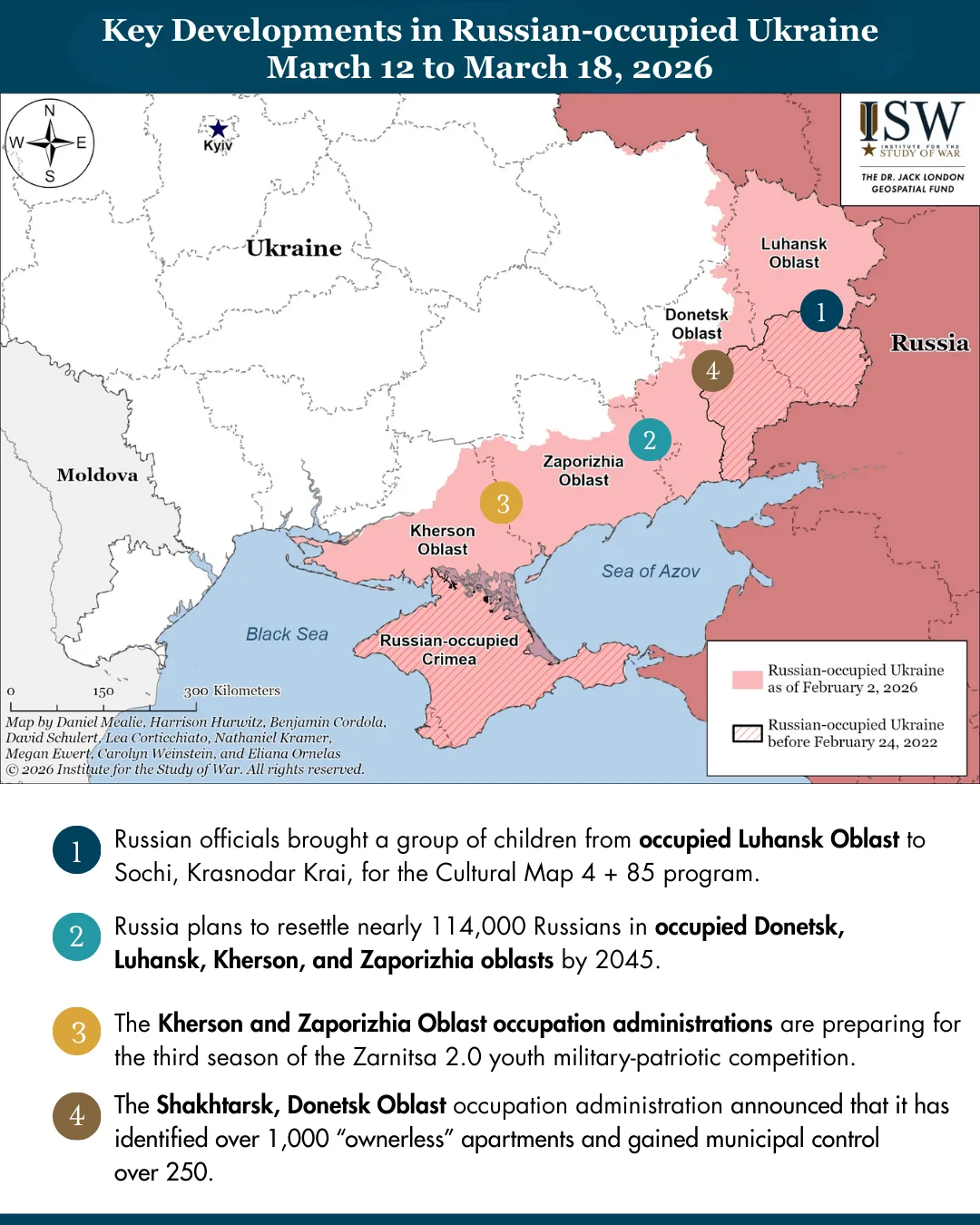
Russian authorities continue efforts to temporarily deport Ukrainian children to Russia for cultural re-education, indoctrination, and forced integration into the Russian sphere of influence. Republic of Ingushetia Minister of Foreign Relations Ruslan Miziev claimed on March 12 that over 500 children from occupied Ukraine “vacationed” in or received treatment at sanatoriums in Ingushetia in 2025.[1] ISW previously reported on the Republic of Ingushetia’s role in orchestrating summer camp programs for the deportation and indoctrination of Ukrainian children in Summer 2025.[2] Luhansk People’s Republic (LNR) occupation Minister of Culture Roman Oleksin claimed on March 15 that the first group of students from occupied Luhansk Oblast arrived in Sochi, Krasnodar Krai, as part of the Cultural Map 4 + 85 program.[3] 3,500 students from occupied Luhansk Oblast will visit Russia as part of this program in 2026.[4] ISW previously reported on the Cultural Map 4 + 85 program’s role in integrating Ukrainian children into the Russian sphere of influence and erasing their Ukrainian identity.[5] ISW continues to assess that Russia is using summer camps and educational programs, such as Cultural Map 4 + 85, to temporarily deport Ukrainian children to Russian territory for the purposes of their indoctrination.
Russian state atomic energy corporation Rosatom is also complicit in efforts to use summer camp programs for the indoctrination of Ukrainian children. Rosatom Head Alexey Likhachev claimed on March 13 that Rosatom will send over 1,600 schoolchildren from occupied Enerhodar, Zaporizhia Oblast to health camps (likely in Russia and occupied Ukraine) in summer 2026 as part of its ongoing social support program.[6] Rosatom previously sent 1,600 children from occupied Enerhodar to children’s camps in occupied Crimea in the summer of 2025.[7] ISW has previously reported on Rosatom’s involvement in the indoctrination and militarization of Ukrainian children, particularly in occupied Enerhodar.[8] Rosatom’s involvement with Ukrainian children is likely in part intended to train and curate a cadre of nuclear energy operators, supporting Russia’s wider effort to consolidate control over nuclear energy generation in occupied Ukraine.
Sociocultural Control
Russian authorities are reportedly planning to resettle roughly 114,000 Russians in occupied Ukraine by 2045. Russian business newspaper Vedomosti reported on March 17 that Russian development corporation VEB.RF and the Russian federal Unified Institute for Spatial Planning (EIPP) have jointly developed plans that would collectively increase the population of occupied Ukrainian territories by 113,800 people by 2045.[9] The blueprint outlines 15 master plans and 10 subprojects for the creation or rebuilding of industrial facilities and social infrastructure. Vedomosti reported that this includes 9.8 million square meters of new housing, 143 kindergartens and 24 schools, 3,270km of roads, nearly 430km of railway lines and 19 stations, and the reconstruction of naval and air facilities. The plans also envision the creation of ten industrial parks, nine agro-industrial parks, and four “technoparks”.[10] EIPP Director Dina Sattarova estimated that these projects will employ 225,400 people and create 36,300 new jobs, increasing the social and investment attractiveness of occupied areas.[11] The plans call for a massive increase in the population of occupied areas in order to fulfill labor requirements and territorial planning goals.[12] Russia can feasibly only generate this population increase by resettling Russians in occupied territories, likely using economic incentives and the promise of modern housing and municipal infrastructure to encourage resettlement.[13] The VEB.RF and EIPP plans are consistent with a wider observed pattern of Russian efforts to manipulate the demographic situation in occupied Ukraine by importing Russian citizens to live and work in occupied areas, creating the impression that these areas are intrinsically Russian.[14]
Russia has already been quietly manipulating the demographics of occupied Ukraine using financial incentives and work programs to draw Russians to occupied areas. Zaporizhia Oblast occupation head Yevgeny Balitsky claimed on March 15 that over 20 doctors from Moscow and other Russian regions are “considering” employment in occupied Zaporizhia Oblast in order to help remedy medical staffing shortages.[15] Russia’s Chelyabinsk Oblast is additionally searching for eight “Zemsky Kultur” cultural workers to move to occupied Yasynuvata, Donetsk Oblast and to work in the cultural sector for at least five years.[16] ISW has previously reported on Russia’s use of “Zemsky” programs to attract teachers, doctors, sports coaches, and veterans to relocate to occupied Ukraine.[17] Russian Zemsky programs, efforts to provide modern and discounted housing to Russians in occupied Ukraine, and apparent plans to relocate over 100,000 Russians to occupied areas highlight the fact that demographic manipulations are a central part of Russia’s wider occupation strategy in Ukraine.[18] International law explicitly prohibits Russia, as the belligerent occupying power, from moving “parts of its own civilian populations into the territory it occupies.”[19]
Militarization of Occupied Areas
The Zarnitsa 2.0 military-patriotic competition has begun its third season and is expanding its reach in occupied Ukraine. Zarnitsa 2.0 is a revived Soviet-era war game that aims to prepare children and youth aged seven to 23 for eventual service in the Russian military.[20] Children and youth are placed in squad-sized detachments that compete against each other in tactical drills, combat medicine, drone operation, and Russian military history, amongst other disciplines.[21] Detachments are comprised of a commander, two assault personnel, two medics, an engineer, two drone operators, a war correspondent, and a signalman.[22] ISW reported in 2025 on the proliferation of Zarnitsa 2.0 in occupied Ukraine and the role of the organization in facilitating the militarization and deportation of Ukrainian children.[23]
Zarnitsa 2.0 announced the launch of its third season and opened competition registration on February 23.[24] Russian occupation administrations are already preparing for children to participate in Zarnitsa 2.0’s 2026 season. The Kherson Oblast occupation administration, for example, reported on March 11 that it established a headquarters to coordinate preparations and participation in Zarnitsa 2.0.[25] The occupied Zaporizhia Oblast branch of Russian newspaper Komsomolskaya Pravda published an advertisement for Zarnitsa 2.0 on March 14, claiming that it presents an opportunity for children and youth to “make a name for themselves.”[26] Zarnitsa 2.0’s occupied Zaporizhia Oblast branch told Kremlin newswire TASS on February 25 that it expects at least 2,000 children from occupied Zaporizhia Oblast to participate in the 2026 season.[27] The expansion of Zarnitsa 2.0’s reach in occupied Ukraine will directly support Russia’s efforts to use such youth programs for the militarization of Ukrainian children. Ideological militarization serves to impose on children pro-Russian ideals, while physical militarization prepares children for future service in the Russian military.
Russian active-duty military and military recruitment personnel are directly participating in the militarization of Ukrainian children. Occupied Donetsk Oblast-based outlet Donetsk News Agency reported on March 15 that members of Rosgvardia’s Vostok-Donetsk Special Rapid Response Unit (SOBR)and a Russian military chaplain spoke to schoolchildren in occupied Donetsk Oblast about the history of Rosgvardia and its role in Russia’s invasion of Ukraine.[28] Donetsk News Agency reported on March 16 that members of the “Spac” SOBR unit organized a drone piloting course for cadets at a school in occupied Mariupol.[29] Occupied Zaporizhia Oblast-based outlet Zaporizhia News Agency reported on March 16 that the pro-Russian military-patriotic youth movement “Yug Molodoy” (Young South) held a series of military skills workshops at a school in occupied Melitopol, including on the assembly and disassembly of weapon replicas and tactical medicine.[30] Zaporizhia News Agency also reported on March 14 that three schools in occupied Melitopol Raion held career guidance sessions for teenagers in grades 9-11, wherein Russian military recruitment officials and personnel of the Heroes of Zaporizhia personnel program (the occupied Zaporizhia Oblast-based analogue of the federal Time of Heroes program) addressed students about military education in Russia and admission into military academies.[31] ISW has previously reported that Rosgvardia, other Russian law enforcement bodies, and other active-duty members of the Russian military frequently interact with Ukrainian children in occupied areas, normalizing Russian military-patriotic ideals in Ukrainian schools, legitimizing Russian law enforcement presence in occupied Ukraine, and encouraging Ukrainian children to pursue future careers in the Russian military.[32]
Administrative and Bureaucratic Control
Russian occupation authorities are intensifying efforts to seize, nationalize, and redistribute properties in occupied Ukraine in accordance with Russian President Vladimir Putin’s December 2025 law. Shakhtarsk occupation head Alexander Shatov claimed on March 13 that his administration identified over 1,000 “abandoned” apartments, filed lawsuits for control over 300 of them, and received affirmative court decisions for 250 apartments — likely suggesting that the occupation administration had gained control over at least 250 apartments.[33] Kherson Oblast occupation head Vladimir Saldo claimed on March 18 that he ordered his administration to accelerate the registration of “abandoned” property in occupied Kherson Oblast by the end of March.[34] The Kherson Oblast occupation administration is currently processing 2,435 properties and has only registered 569 of them.[35] Occupation officials’ intensification of property nationalization follows Putin’s signing of a December 15, 2025 law codifying the practice of seizing and nationalizing any property deemed “ownerless” in occupied Ukrainian territories.[36]
Russia is also setting conditions to artificially increase the quantity of “ownerless” properties in occupied areas. Ukrainian Luhansk Oblast military administration head Oleksiy Kharchenko reported on March 18 that the Kremlin is tightening control over real estate transactions conducted by Ukrainian citizens.[37] Real estate transactions will now require personal reception by a Russian notary on Russian territory.[38] The Kremlin nullified previous real-estate contracts by invalidating all powers of attorney issued by Ukrainian citizens before December 29, 2025.[39] These restrictions set conditions for occupation officials to recognize more real estate as “ownerless” in the future by making it more difficult for Ukrainians to prove their ownership of property.[40] ISW continues to assess that the Russian government is codifying and increasing occupation officials’ ability to seize and nationalize “ownerless” property in occupied Ukrainian territories.[41]
Occupation officials are also increasingly shifting from seizing and nationalizing “ownerless” properties to reappropriating them. Mariupol occupation head Anton Koltsov claimed on March 15 that his administration distributed 140 apartments to residents 80 years old and older.[42] The Mariupol occupation administration reportedly plans to appropriate apartments from the municipal housing stock for 500 senior residents.[43] Residents must apply for municipal housing, and likely must provide proof of Russian citizenship in order to gain access to municipal housing. Occupation officials are also beginning to codify the housing redistribution process. Kharchenko reported on March 18 that the Luhansk People’s Republic (LPR) occupation administration adopted a law on March 12 that outlines the procedure for appropriating “ownerless” housing to others, primarily Russian citizens.[44] While previous laws about “ownerless” property primarily concerned registering and seizing housing, this new law outlines explicit conditions for property transfer.[45] The occupation administration will provide housing to Russian citizens who live in occupied Ukrainian territories and have lost their property due to Russian combat operations in Ukraine.[46] The new housing distribution procedure will facilitate both the repopulation of occupied areas with Russian citizens and Russian efforts to passportize occupied areas.[47]
Occupation Administration Mismanagement and Internal Dynamics
Nothing significant to report.
Physical and Legal Repressions
Russian occupation courts continue to weaponize dubious treason and espionage charges to levy harsh sentences against Ukrainians for perceived anti-Russian sentiments. The Kherson Oblast occupation prosecutor’s office reported on March 16 that it sentenced 47-year-old Ukrainian citizen Elena Nishanova to ten years in a Russian penal colony on espionage charges.[48] The regional Russian Federal Security Service (FSB) directorate accused Nishanova of providing Ukrainian intelligence with information on the locations of Russian Armed Forces personnel and equipment.[49] Ukrainian Parliamentary Commissioner for Human Rights Dmytro Lubinets reported on March 15 that a Zaporizhia Oblast occupation court sentenced 68-year-old Ukrainian citizen Halyna Bekhter to 11 years in prison for allegedly transferring funds to the Ukrainian Armed Forces.[50] Occupied Crimea-based human rights monitoring group Crimean Tribunal reported on March 16 that FSB officers arrested a 45-year-old Feodosia resident for allegedly providing photographs of Russian helicopters to Ukrainian intelligence, which is the 11th such arrest in occupied Crimea so far in 2026.[51] Sentences involving espionage and treason are rarely less than ten years, and the United Nations has previously reported that Ukrainians often face abuse and harsh conditions while interned at Russian penal colonies.[52] ISW continues to assess that Russian occupation courts use fabricated or exaggerated charges of espionage and treason to punish dissidents, journalists, or Ukrainians under occupation with perceived anti-Russian beliefs.[53]
Russian occupation courts and security services continue to punish Ukrainian citizens on charges of extremism for allegedly associating with illegal organizations and ethnic and religious minorities. Crimea-based human rights organization Crimean Solidarity reported on March 15 that the Kyiv District occupation court in Simferopol has extended the arrests of four Crimean Tatar women until June 14.[54] The FSB originally arrested these women in October 2025 on allegations that they were involved with the Hizb ut-Tahrir pan-Islamic organization.[55] ISW previously assessed that their arrests were part of Russia’s systemic use of extremism charges to persecute Crimean Tatar women.[56] The representative organization of the President of Ukraine in Crimea reported on March 16 that 159 of the 286 persecuted Ukrainians in occupied Crimea are Crimean Tatars and that women in occupied Crimea are defendants in 53 percent of criminal cases involving “discrediting the Russian Armed Forces.”[57] ISW continues to assess that the persecution of Crimean Tatars in occupied Crimea is part of a wider Russian effort to consolidate cultural influence over occupied Crimea.[58]
Economic and Financial Control
Nothing significant to report.
Information Space Control
Russia is increasingly migrating basic services to the state-controlled MAX messenger to force residents of occupied Ukraine to use the application. A Ukrainian partisan group reported on March 13 that Russian authorities in occupied Sevastopol have transferred all “home chats” to MAX.[59] These chats are a central place for residents of apartment buildings to interact with building management and resolve maintenance issues.[60] Russian Minister of Construction, Housing, and Public Utilities Irek Fayzullin reported on March 16 that 10.8 million users across Russia and occupied Ukraine had moved such housing-related chats to MAX.[61] Ukrainian Mariupol Mayoral Advisor Petro Andryushchenko additionally posted imagery on March 17 of an announcement from a clinic in occupied Mariupol, which stated that residents must have a MAX account to make appointments with a doctor or to call an ambulance.[62] Russia appears to be increasingly tying access to basic housing and medical services in occupied Ukraine to MAX, which will serve as a coercive tool that forces residents onto the platform.
Infrastructure and Development Projects
The Kremlin used the 12th anniversary of its illegal annexation of Crimea to highlight Russian purported investment in Crimea’s development — highlighting the role that such development projects play in Russia’s wider occupation strategy in Ukraine. Russian Ministry of Foreign Affairs (MFA) Spokesperson Maria Zakharova held a press briefing on March 16 — the 12th anniversary of Russia’s sham “referendum” on Crimea’s annexation to Russia — and highlighted the various social and infrastructure projects that Russia has undertaken in Crimea over the past 12 years.[63] The Russian MFA claimed that Crimea has been “fully integrated into Russia’s political, legal, and economic space” since 2014 and that Russia has developed significant infrastructure in occupied Crimea, including bridges, gas pipelines, airports, highways, and “hundreds” of social, educational, and housing facilities.[64] The MFA also claimed that Russia has formed a “fully-fledged Crimean Tatar national and cultural autonomy” in occupied Crimea, despite ample evidence of Russia’s systematic persecution of the Crimean Tatar community since 2014.[65]
Russian President Vladimir Putin also held a video conference with members of the Russian government on March 18 — the 12-year anniversary of Russia’s formal annexation of Crimea.[66] Putin claimed that Russia has invested approximately 1.3 trillion rubles ($16 billion) in transportation, energy, industry, education, and healthcare in occupied Crimea since 2014. Putin also noted that Russia is undertaking additional development projects in occupied Crimea in 2026, including a federal children’s rehabilitation center in occupied Yevpatoria. Putin’s and the Russian MFA’s statements emphasize the fact that Russia has heavily relied on infrastructure development as a tool of occupation in Crimea since 2014. Infrastructure, industrial, and housing projects support the overarching Russian effort to forcibly integrate occupied Ukrainian territories into the Russian sphere of influence and create physical dependencies on Russia for any and all development projects. Russia is now pursuing similar levels of intense investment in the Ukrainian regions it has illegally annexed since 2014.[67]
Russian officials continue to highlight housing reconstruction efforts in occupied Mariupol. Russian Deputy Prime Minister for Construction and Regional Development Marat Khusnullin stated on March 16 that Russian specialists will complete the restoration of 30 apartment buildings in occupied Mariupol by the end of 2026.[68] Khusnullin claimed that these 30 buildings are the only remaining housing restoration projects in occupied Mariupol and that Russia will have therefore completed housing restoration by the end of the year. The Donbas Development Corporation reported on March 14 that it began a new phase of work on the 60-apartment Ametist residential complex in occupied Mariupol.[69] ISW has reported on previous Russian housing reconstruction projects in occupied Mariupol, including the Leningradsky Kvartal project — a large apartment complex that Russian officials are reportedly rebuilding in order to house Russian citizens in occupied Mariupol.[70] Despite Russian efforts to claim that they are pursing housing projects in Mariupol en masse, independent reports suggest that tens of thousands of residents remain homeless or in temporary accommodation facilities as a result of the Russian invasion of the city and of its occupation policy since 2022.[71]

[1] https://tass dot ru/obschestvo/26741621
[2] https://understandingwar.org/research/russia-ukraine/russian-occupation-update-august-7-2025/
[3] https://lug-info dot ru/news/pervaja-gruppa-detej-iz-lnr-otpravilas-v-sochi-po-programme-kulturnaja-karta/
[4] https://lug-info dot ru/news/pervaja-gruppa-detej-iz-lnr-otpravilas-v-sochi-po-programme-kulturnaja-karta/
[5] https://understandingwar.org/research/russia-ukraine/russian-occupation-update-january-15-2026/; https://understandingwar.org/research/russia-ukraine/russian-occupation-update-october-9-2025/; https://understandingwar.org/research/russia-ukraine/russian-occupation-update-april-17-2025/
[6] https://tass dot ru/obschestvo/26753229
[7] https://tass dot ru/obschestvo/26753229
[8] https://understandingwar.org/research/russia-ukraine/russian-occupation-update-september-11-2025/
[9] https://www.vedomosti dot ru/economics/articles/2026/03/17/1183273-plani-razvitiya-novih-regionov-mogut-privlech-114-000-chelovek
[10] https://www.vedomosti dot ru/economics/articles/2026/03/17/1183273-plani-razvitiya-novih-regionov-mogut-privlech-114-000-chelovek
[11] https://www.vedomosti dot ru/economics/articles/2026/03/17/1183273-plani-razvitiya-novih-regionov-mogut-privlech-114-000-chelovek
[12] https://t.me/andriyshTime/54304; https://www.vedomosti dot ru/economics/articles/2026/03/17/1183273-plani-razvitiya-novih-regionov-mogut-privlech-114-000-chelovek
[13] https://understandingwar.org/research/russia-ukraine/russian-occupation-october-2-2025/; https://understandingwar.org/research/russia-ukraine/russian-occupation-update-september-25-2025/; https://understandingwar.org/wp-content/uploads/2025/04/24-210-0120ISW20Occupation20playbook.pdf
[14] https://understandingwar.org/wp-content/uploads/2025/04/24-210-0120ISW20Occupation20playbook.pdf
[15] https://t.me/BalitskyEV/7587
[16] https://tass dot ru/obschestvo/26776205
[17] https://understandingwar.org/research/russia-ukraine/russian-occupation-update-july-29-2025/; https://understandingwar.org/research/russia-ukraine/russian-occupation-update-march-12-2026/
[18] https://understandingwar.org/wp-content/uploads/2025/04/24-210-0120ISW20Occupation20playbook.pdf
[19] https://ihl-databases.icrc.org/ru/customary-ihl/v2/rule130
[20] https://understandingwar.org/research/russia-ukraine/russian-occupation-update-april-10-2025/; https://xn--80aatfyr8b.xn--90acagbhgpca7c8c7f dot xn--p1ai/
[21] https://xn--80aatfyr8b.xn--90acagbhgpca7c8c7f dot xn--p1ai/competitions/
[22] https://xn--80aatfyr8b.xn--90acagbhgpca7c8c7f dot xn--p1ai/
[23] https://understandingwar.org/research/russia-ukraine/russian-occupation-update-april-10-2025/; https://understandingwar.org/research/russia-ukraine/russian-occupation-update-may-8-2025/; https://understandingwar.org/research/russia-ukraine/russian-occupation-update-september-19-2025-2/; https://understandingwar.org/research/russia-ukraine/russian-occupation-update-june-30-2025/; https://understandingwar.org/research/russia-ukraine/russian-occupation-update-june-26-2025/; https://understandingwar.org/research/russia-ukraine/russian-occupation-update-may-15-2025/
[24] https://t.me/zarnitsa2_0/1417; https://t.me/zarnitsa2_0/1419
[25] https://t.me/VGA_Kherson/37194
[26] https://www.zap.kp dot ru/daily/27765.5/5221540/
[27] https://tass dot ru/obschestvo/26543661
[28] https://dan-news dot ru/defence/mariupolskie-shkolniki-proshli-master-klass-po-pilotirovaniju-bpla/
[29] https://dan-news dot ru/obschestvo/ot-istorii-vojsk-do-duhovnosti-bojcy-sobr-vstretilis-so-shkolnikami/
[30] https://zonews dot ru/news/shkolnikam-v-zaporozhskoj-oblasti-proveli-urok-po-takticheskoj-medicine/
[31] https://zonews dot ru/news/starsheklassnikam-iz-melitopolskogo-okruga-rasskazali-o-postuplenii-v-voennye/
[32] https://understandingwar.org/research/russia-ukraine/russian-occupation-update-february-5-2026/ ; https://understandingwar.org/research/russia-ukraine/russian-occupation-update-november-20-2025/ ; https://understandingwar.org/research/russia-ukraine/russian-occupation-update-july-31-2025/ ;
[33] https://dan-news dot ru/exclusive/v-shahterske-sotni-beshozjajnyh-kvartir-stali-municipalnymi.-kogda-ih-vydadut/
[34] https://t.me/VGA_Kherson/37318
[35] https://t.me/VGA_Kherson/37318
[36] http://publication.pravo.gov dot ru/document/0001202512150024?index=1;%20https://tass%20dot%20ru/obschestvo/25917727
[37] https://t.me/luhanskaVTSA/33615
[38] https://t.me/luhanskaVTSA/33615
[39] https://t.me/luhanskaVTSA/33615
[40] https://t.me/luhanskaVTSA/33615
[41] https://understandingwar.org/research/russia-ukraine/russian-occupation-update-february-12-2026/; https://understandingwar.org/research/russia-ukraine/russian-occupation-update-december-11-2025/; https://understandingwar.org/research/russia-ukraine/russian-occupation-update-october-23-2025/;
[42] https://t.me/KoltsovAnton/3137
[43] https://t.me/KoltsovAnton/3137
[44] https://www.facebook.com/odalug/posts/pfbid02wcPd9S4cXMDPntzuSB3nXeWz7U7zGDe5d3X7AgY67VGWv16ECaF3Em4TaAdoMZTSl?cft[0]=AZZ_Tw04Sbbts0LDYx3wgozjGJnIXjOmDy08Xpa9bnlF_EczQc6ygl8AgeaRa4DOkh06a3B5y7L4bnqRRxezdNuapOl2y07QnIIVAqcesVl98ITgv-aWc1pX3JJsb5iLBvBCGTZEBjPWTTL0gbx7qrwNladQ76S-oJ9ZCYYZvk–xw&tn=%2CO%2CP-R
[45] https://www.facebook.com/odalug/posts/pfbid02wcPd9S4cXMDPntzuSB3nXeWz7U7zGDe5d3X7AgY67VGWv16ECaF3Em4TaAdoMZTSl?cft[0]=AZZ_Tw04Sbbts0LDYx3wgozjGJnIXjOmDy08Xpa9bnlF_EczQc6ygl8AgeaRa4DOkh06a3B5y7L4bnqRRxezdNuapOl2y07QnIIVAqcesVl98ITgv-aWc1pX3JJsb5iLBvBCGTZEBjPWTTL0gbx7qrwNladQ76S-oJ9ZCYYZvk–xw&tn=%2CO%2CP-R
[46] https://www.facebook.com/odalug/posts/pfbid02wcPd9S4cXMDPntzuSB3nXeWz7U7zGDe5d3X7AgY67VGWv16ECaF3Em4TaAdoMZTSl?cft[0]=AZZ_Tw04Sbbts0LDYx3wgozjGJnIXjOmDy08Xpa9bnlF_EczQc6ygl8AgeaRa4DOkh06a3B5y7L4bnqRRxezdNuapOl2y07QnIIVAqcesVl98ITgv-aWc1pX3JJsb5iLBvBCGTZEBjPWTTL0gbx7qrwNladQ76S-oJ9ZCYYZvk–xw&tn=%2CO%2CP-R
[47] https://www.facebook.com/odalug/posts/pfbid02wcPd9S4cXMDPntzuSB3nXeWz7U7zGDe5d3X7AgY67VGWv16ECaF3Em4TaAdoMZTSl?cft[0]=AZZ_Tw04Sbbts0LDYx3wgozjGJnIXjOmDy08Xpa9bnlF_EczQc6ygl8AgeaRa4DOkh06a3B5y7L4bnqRRxezdNuapOl2y07QnIIVAqcesVl98ITgv-aWc1pX3JJsb5iLBvBCGTZEBjPWTTL0gbx7qrwNladQ76S-oJ9ZCYYZvk–xw&tn=%2CO%2CP-R
[48] https://zmina dot info/news/na-okupovanij-hersonshhyni-misczevu-meshkanku-pozbavyv-voli-na-10-rokiv-za-shpygunstvo/
[49] https://tass dot ru/proisshestviya/26773501
[50] https://t.me/dmytro_lubinetzs/11186
[51] https://t.me/tribunal_crimean/333
[52] https://ukraine dot ohchr.org/en/civilian-detainees-subjected-to-troubling-patterns-of-torture-and-ill-treatment-since-russia-s-full-scale-attack-on-ukraine-un-report; https://www.amnesty.org/en/wp-content/uploads/2025/03/EUR-50.9046.2025-A-deafening-silence-2.pdf ; https://understandingwar.org/research/russia-ukraine/russian-occupation-update-november-13-2025/
[53] https://understandingwar.org/research/russia-ukraine/russian-occupation-update-november-13-2025/
[54] https://ua dot krymr.com/a/krym-news-krymchanki-prodovgut-perebyvaty-v-sizo/33707172.html
[55] https://understandingwar.org/research/russia-ukraine/russian-occupation-update-october-23-2025/
[56] https://understandingwar.org/research/russia-ukraine/russian-occupation-update-october-23-2025/
[57] https://www.facebook.com/ppu.gov.ua/posts/pfbid033GZobymAbdxHdpUcLXL3vpGatLyb3wgWBYcbU1QtF2TPZ2KVa4bTCzb33XTZJAFql
[58] https://understandingwar.org/research/russia-ukraine/russian-occupation-update-october-23-2025/
[59] https://t.me/yellowribbon_ua/13317
[60] https://urban-media dot ru/blog/vybiraem/kak-nayti-ili-sozdat-svoy-domovoy-chat/
[61] https://t.me/minstroyrf/22905
[62] https://t.me/andriyshTime/54174
[63] https://t.me/MID_Russia/75690
[64] https://t.me/MID_Russia/75691
[65] https://www.hrw.org/news/2017/11/14/crimea-persecution-crimean-tatars-intensifies;
[66] http://kremlin dot ru/events/president/news/79355
[67] https://monitoring.bbc.co.uk/product/b0003dvb; https://www.cbc.ca/news/politics/ukraine-russia-war-infrastructure-1.7082725
[68] https://dan-news dot ru/obschestvo/husnullin-v-mariupole-ostalos-vosstanovit-30-mnogokvartirnyh-domov/
[69] https://www.donetsk dot kp.ru/online/news/6865259/
[70] https://understandingwar.org/research/russia-ukraine/russian-occupation-update-template-january-30-2026/; https://understandingwar.org/research/russia-ukraine/russian-occupation-update-may-5-2025/
[71] https://understandingwar.org/research/russia-ukraine/russian-occupation-update-template-january-30-2026/; https://understandingwar.org/research/russia-ukraine/russian-occupation-update-january-15-2026/; https://www.amnesty.org/en/latest/news/2024/03/russia-ukraine-a-decade-of-suppressing-non-russian-identities-in-occupied-crimea/; https://rm.coe.int/report-on-crimean-tatars-by-dunja-mijatovic-commissioner-for-human-rig/1680aaeb4b; https://www.wilsoncenter.org/blog-post/crimean-tatars-and-russification; https://understandingwar.org/research/russia-ukraine/russian-occupation-update-march-5-2026/; https://understandingwar.org/research/russia-ukraine/russian-occupation-update-january-15-2026/; https://understandingwar.org/research/russia-ukraine/russian-occupation-update-july-17-2025/; https://understandingwar.org/research/russia-ukraine/russian-occupation-update-may-22-2025/