
Trending scam alerts
Insurance companies declared roughly 4.1 million vehicles total losses in the United States in 2024,…
Read more →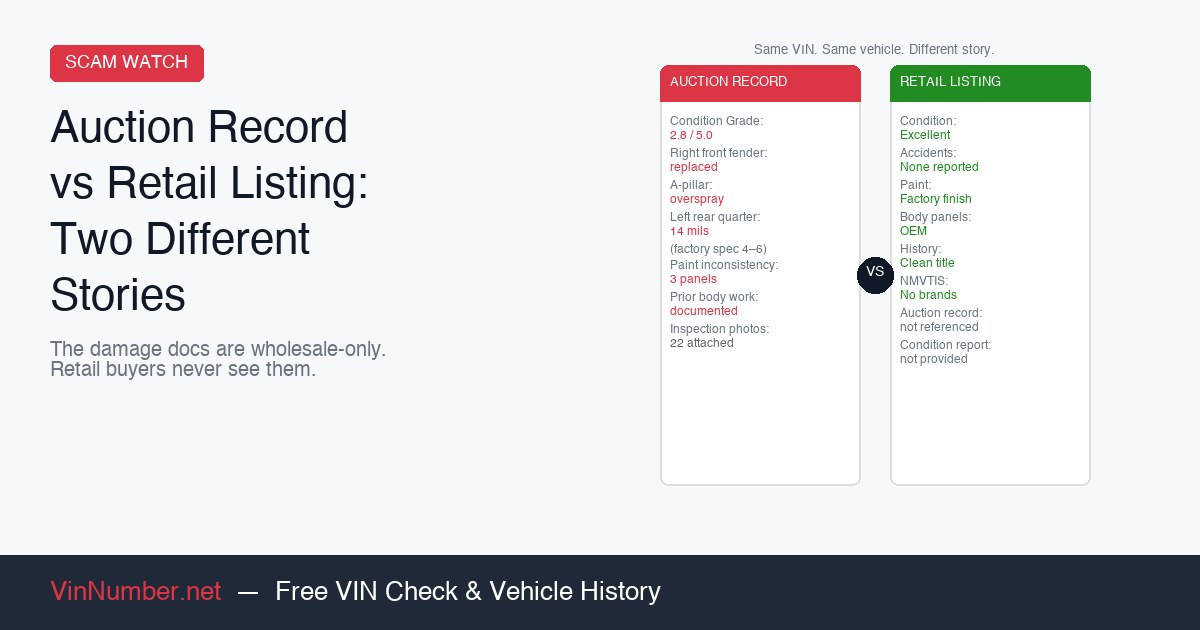
NAAA member auctions sold more than 8 million vehicles in 2025, up 3 percent from the prior year, wi…
Read more →Latest auto news
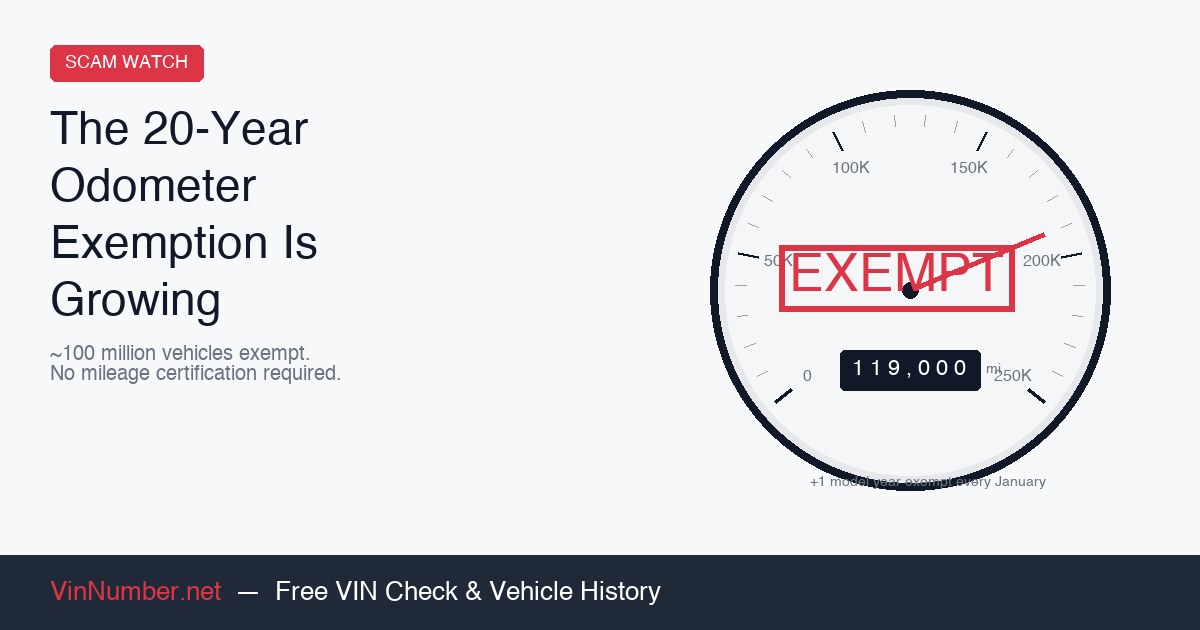
Federal odometer disclosure requirements under 49 USC 32705 don’t apply to vehicles that are 20 mode…
Read more →
The NICB released its full year 2025 theft data on March 18, and the headline number was 659880 repo…
Read more →Buyer's Guides
How a VIN check actually works
All you need is the VIN number.
Find the VIN
Run the Check
Make Your Call
What every VIN check covers
What the report includes.
Accident & Collision Records
Every reported crash, where it happened and when, pulled from insurance and police filesFull Odometer Timeline
All mileage readings logged over the vehicle lifetime, flagged if they do not add upOpen Safety Recalls
Current NHTSA alerts tied to this VIN that have not been repaired yetTitle Brands
Salvage, flood, lemon law, and total loss designations recorded on the titleTheft & Recovery Status
Run against national stolen vehicle registries to confirm clean statusLien & Ownership History
How many owners, and whether any outstanding loans are attached to the titleStructural Damage
Frame and body damage from repair shop reports and insurance filingsAirbag Deployment Records
Any airbag activations tied to this VIN, with incident context where availableInspection History
State safety inspection results logged over the vehicle registration historyEmissions Data
Emissions test outcomes from state records, where that data is availableTotal Loss Records
Cases where an insurer declared the vehicle a write-off rather than repair itPrior Vehicle Use
Whether the car spent time as a rental, fleet unit, taxi, or at a salvage auctionThere are over 50 million vehicles in the system right now. We draw from 110 different databases, including state DMV offices, NHTSA, insurance filings, and auction records. The data gets updated every day, so a report you run this afternoon will not be missing last week's filings.
Accounts from buyers who ran a check before purchase
"Bought a 2018 F-150 last spring. Dealer had it listed as a one-owner work truck, clean title. I almost skipped the VIN check because the price seemed fair. Ran it anyway: two insurance claims from 2020 and 2021, both collision, plus a lien that hadn't been cleared. Walked out. Found a cleaner truck two weeks later for about the same money."
Marcus T., Texas
"My uncle sold cars for 20 years. He always said check the VIN before you fall in love with the vehicle. I didn't listen on my first used car. Did it properly the second time. The check flagged a flood history the seller hadn't brought up. Easy decision after that."
Jennifer R., Ohio
"I work in property management and buy used trucks for the business every couple years. Started running VIN checks after one of my guys got stuck with a van that kept showing warning lights nobody could explain. History showed it had been in a fire. Now I check everything before we even go look at it in person."
David K., Florida
VIN check by manufacturer
Select a manufacturer for model-specific VIN data, known issues, and history tips.

Ford 👁 Chevrolet VIN check

Chevrolet 👁 Toyota VIN check

Toyota 👁 Honda VIN check
Honda 👁 Nissan VIN check

Nissan 👁 Jeep VIN check

Jeep 👁 Ram VIN check

Ram 👁 Dodge VIN check

Dodge 👁 GMC VIN check

GMC 👁 BMW VIN check

BMW 👁 Mercedes-Benz VIN check

Mercedes-Benz 👁 Tesla VIN check

Tesla 👁 Audi VIN check

Audi 👁 Volkswagen VIN check

Volkswagen 👁 Hyundai VIN check

Hyundai 👁 Kia VIN check

Kia
In 2023, the National Insurance Crime Bureau recorded more than 1.02 million vehicle thefts in the United States, the highest total in nearly two decades. A significant portion of those vehicles were eventually recovered, retitled, and fed back into the used car market. Some came with clean paperwork. The buyers who found out what they had purchased did so after the fact, when a mechanic pulled up the history or a resale attempt surfaced the original theft record. A VIN number check run before the sale would have shown the same thing in under a minute.
The used vehicle market in the United States processes roughly 40 million transactions per year, according to data compiled by Cox Automotive. Every one of those vehicles carries a 17-character identifier that links it to a chain of title records, registration filings, insurance claims, and federal recall notices. The information exists. It is distributed across state DMV databases, the National Motor Vehicle Title Information System, NHTSA recall records, and salvage auction logs maintained by insurance carriers. What a VIN check does is pull those sources together against a single number. show whether the mileage on the dashboard matches the mileage on file. Title brands issued after flood events, fire damage, or total-loss declarations follow the vehicle regardless of how many times it changes hands or crosses state lines. Accident reports filed by insurance adjusters attach to the VIN at the time the claim is processed, not at the time the owner decides to disclose them.
The vehicles that generate the most VIN check activity are not the obvious candidates. Pickup trucks, particularly full-size models from domestic manufacturers, account for a disproportionate share of both theft records and structural damage claims in the national databases. Late-model SUVs returning from rental fleets carry commercial use histories that their odometer readings do not fully explain. Luxury imports from Germany and the United Kingdom show up in VIN records with European damage history that predates their US title registration, because insurers in those markets file claims that eventually surface in American databases when the vehicle is imported and registered. Dealers operating at the retail level are required by federal law to disclose known defects, but . The gap between what a seller is required to say and what a VIN check will show is where most of the findings live.