
Abstract
Phooey is a functional UI library for Haskell. Or it's two of them, as it provides a
Besides this wiki page, here are more ways to find out about Phooey:
- Read the Haddock docs (with source code, additional examples, and Comment/Talk links).
- Get the code repository: .
The package can also be installed from Hackage.
Phooey is also used in GuiTV, a library for composable interfaces and "tangible values".
Since Reactive is currently broken (as of February 2010), Phooey is also broken.
Introduction
GUIs are usually programmed in an unnatural style, in that implementation dependencies are inverted, relative to logical dependencies. This reversal results directly from the push (data-driven) orientation of most GUI libraries. While outputs depend on inputs from a user and semantic point of view, the push style imposes an implementation dependence of inputs on outputs.
A second drawback of the push style is that it is imperative rather than declarative. A GUI program describes actions to update a model and view in reaction to user input. In contrast to the how-to-update style of an imperative program, a functional GUI program would express what-it-is of a model in terms of the inputs and of the view in terms of the model.
The questions of push-vs-pull and imperative-vs-declarative are related. While an imperative GUI program could certainly be written to pull (poll) values from input to model and model to view, thus eliminating the dependency inversion, I don't know how a declarative program could be written in the inverted-dependency style. (Do you?).
A important reason for using push rather than pull in a GUI implementation is that push is typically much more efficient. A simple pull implementation would either waste time recomputing an unchanging model and view (pegging your CPU for no benefit), or deal with the complexity of avoiding that recomputation. The push style computes only when inputs change. (Continuous change, i.e. animation, negates this advantage of push.)
Phooey ("Phunctional ooser ynterfaces") adopts the declarative style, in which outputs are expressed in terms of inputs. Under the hood, however, the implementation is push-based (data-driven). Phooey uses the Reactive library to perform the dependency inversion invisibly, so that programmers may express GUIs simply and declaratively while still getting an efficient implementation.
Phooey came out of Pajama and Eros. Pajama is a re-implementation of the Pan language and compiler for function synthesis of interactive, continuous, infinite images. Pan and Pajama use a monadic style for specifying GUIs and are able to do so because they use the implementation trick of Compiling Embedded Languages, in which one manipulates expressions rather than values. (This trick is mostly transparent, but the illusion shows through in places.)
One example, two interfaces
As an example, below is a simple shopping list GUI. The

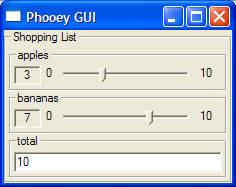
Phooey presents two styles of functional GUI interfaces, structured as a monad and as an applicative functor. (I have removed the original arrow interface.) Below you can see the code for the shopping list example in each of these styles.
The examples below are all found under src/Examples/ in the phooey distribution, in the modules Monad.hs, and Applicative.hs. In each case, the example is run by loading the corresponding example module into ghci and typing
Monad
Here is a definition for the GUI shown above, formulated in terms of Phooey's monadic interface. See the monad interface and its source code.