|
VOOZH | about |
|
VOOZH | about |
The Threads share button is now fully available from AddToAny on all major platforms, including the web!
Like we said, as soon as Threads deployed an official sharing endpoint for the web, AddToAny would support it. The Threads team listened to our feedback, and promise fulfilled! AddToAny had the new Threads endpoint live within a few minutes of the news.
You may have already noticed the Threads share button on mobile, especially if you pre-enabled it using the WordPress share plugin. Beginning today, the Threads share button is available on both desktop and mobile.
For fans of the AddToAny browser extension for Chrome or Firefox, look for Threads in an update soon!
This month Oracle (the owner of AddThis, a platform similar to AddToAny) posted a notice that they are terminating all AddThis services after May 31, 2023. So:
We warmly welcome AddThis users to AddToAny, the original universal sharing platform.
AddToAny is the perfect drop-in replacement for AddThis. Since launching similar platforms way back in 2006, AddToAny & AddThis have quite a bit of overlap in design & features. There are some major upgrades in migrating to AddToAny too:
Generally, any website can get the AddToAny HTML code and customize it, and we have a guide on how to remove AddThis and install AddToAny.
We also have some official platform recommendations…
WordPress sites: Get the popular AddToAny plugin.
Drupal sites: Get the popular AddToAny module.
Cloudflare sites: Check out the no-code AddToAny app.
See also: Joomla, Tumblr, Blogger, and other platforms.
If you have AddThis code manually installed on your site, the switch to AddToAny involves some search & replace. Check out our detailed guide:
Publishers & developers: Is there a particular AddThis feature you’re looking for in AddToAny, or something we can do to make migrating to AddToAny easier? Let us know!
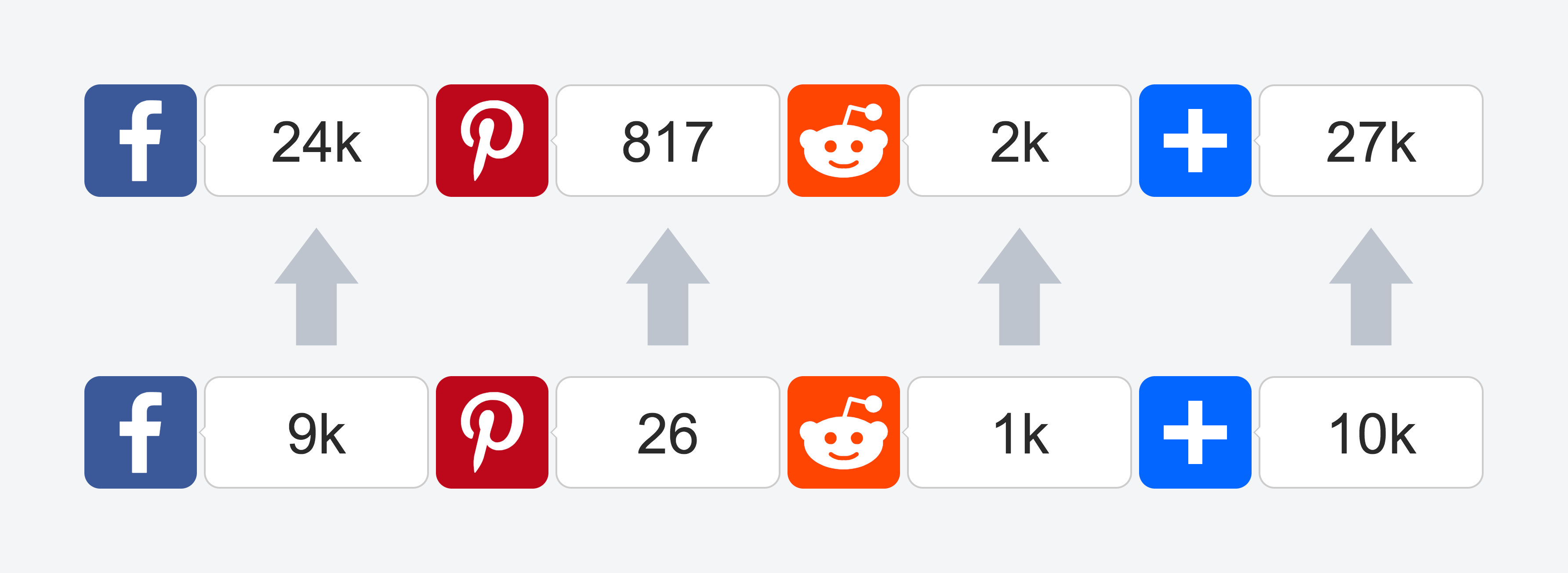
AddToAny Share Count Recovery is a free & mighty feature for publishers using share counters.
You can recover lost share counts when moving to HTTPS, a new domain name, or a new URL structure. A previous URL’s share counts are simply added to the current URL’s share counts, so you won’t lose your new counts.
👁 AddToAny Share Count Recovery
As websites transition from plain HTTP to encrypted HTTPS, publishers are finding that share counts — especially Facebook Likes — reset to zero. This is because Facebook considers http://example.com/ and https://example.com/ to be completely different URLs.
Facebook offers technical guidance on how developers can redirect URLs and exempt their crawler from redirects to retain share counts. This is doable for some developers and WebOps teams, but the Facebook crawler exemption can be difficult to setup, awkward to maintain, and it still doesn’t cover Pinterest and Reddit.
With AddToAny share count recovery, it’s just one line to combine counts for the HTTP and HTTPS versions of shared URLs.
HTTP recovery applies to Facebook, Pinterest, and Reddit. Some services — such as Tumblr — are ‘protocol neutral’ with shared URLs, meaning they consider http://example.com/ to be the same as https://example.com/. So if you’re only recovering HTTP counts, AddToAny skips the extra lookup for unaffected services such as Tumblr.
Whether you’ve switched to a new domain name or a new subdomain, AddToAny has your domain recovery needs covered too.
Just place your old domain name in a line of code as demonstrated in the share count recovery docs.
For more complex changes, AddToAny lets you script out your own recovery logic within a custom JavaScript function. A helpful data object is passed to your custom recovery function, making it convenient to reconstruct an old URL structure based on parts of the shared URL, such as the domain, protocol, and pathname parts. You can also get values from any HTML data-* attributes you may have provided, such as a post ID, day, month, or year.
See the WordPress, Drupal, and HTML guides for how to use share count recovery to get your share counts back.