
The Pentagon's research labs are ramping up their search for munitions that can be mass-produced—an effort likely to be buoyed by billions of dollars in the department's new fiscal 2027 budget request and tens of billions in the upcoming years. While the topline information shared about the President’s defense budget…
As Ukraine Prepares to Get F-16s, US Provides AMRAAM Missiles
Sept. 2, 2023 | By Chris Gordon
Share Article
Audio of this article is brought to you by the Air & Space Forces Association, honoring and supporting our Airmen, Guardians, and their families. Find out more at afa.org
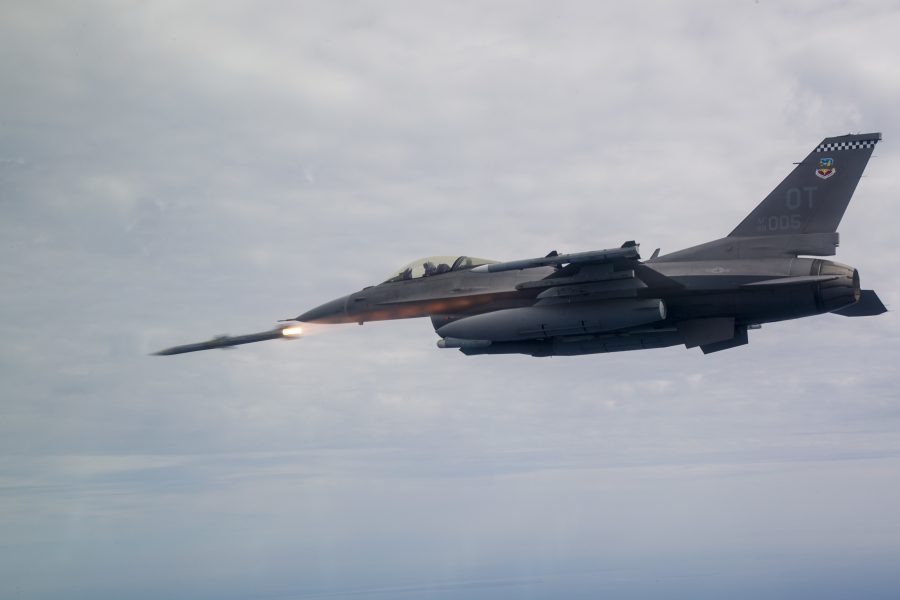
Ukraine will receive AIM-120 AMRAAM advanced air-to-air missiles from the U.S. that could be used on its aircraft, Ukrainian officials told Air & Space Forces Magazine.
“The United States will supply Ukraine with AMRAAM aircraft missiles with a range of 160-180 km,” said Yuriy Inhat, the spokesman for the Ukrainian Air Force.
“AMRAAM are universal aviation missiles and can used for both fighters and air defense systems,” Inhat added.
Until recently, the U.S. has held back from approving the provision of F-16s and the munitions they can employ. But last month, the Biden administration endorsed a European plan to send the American-made F-16s to Ukraine and announced it will assist in training Ukrainian pilots.
“We need weapons that can withstand Russian fighters,” Inhat said.
The provision of AMRAAMs would go one step further, potentially arming those aircraft with radar-guided air-to-air missiles. AMRAAMs are used by the U.S. and many allies. They “are more than enough to get Russian aircraft without entering the enemy air defense zone of destruction,” Inhat said.
The Pentagon decision came to light following a contract announcement Aug. 31, which disclosed a contract worth up to $192 million with Raytheon Missiles and Defense for an indefinite quantity of AMRAAMs. The Pentagon said the contract “provides for Raytheon purchasing fielded AMRAAM weapons from various sources.”
The AIM-120 AMRAAM comes in several versions. The U.S. Air Force uses three: AIM-120B, a reprogrammable variant of the earlier AIM-120A; the AIM-120C, which is optimized for the F-22 and F-35; and the AIM-120D, which includes GPS guidance, anti-jam features, and greater range and lethality. It is not clear which version Ukraine will have. The range the Ukrainian spokesman cited is for the D. It is possible multiple versions will be provided, with older models coming sooner.
The Pentagon contract announcement did not specify which versions would be purchased or for what purpose, nor did the Ukrainians.
“Specific modifications that can be supplied to Ukraine are not made public,” Inhat said.
The initial purchase under the agreement is for $7,688,220, using funds from the Ukraine Security Assistance Initiative (USAI), the Pentagon said, with work “expected to be completed by Nov. 29, 2024.”
The USAI is one of the primary mechanisms for arming Ukraine, funding purchases of weapons directly from industry. The U.S. has also provided weapons directly from existing U.S. stocks.
Pentagon Press Secretary Brig. Gen. Patrick S. Ryder declined to comment on how the Ukrainians might employ the AMRAAMs.
In an interview published Aug. 30 Ukrainian president Volodymyr Zelenskyy told the Portuguese outlet RTP that he expected F-16s to arrive towards the beginning of next year.
“We need fighter jets merely to defend ourselves,” Zelenskyy told RTP. “To defend our land, our sea, our sky.”
That may be optimistic; U.S. officials have suggested it will take until the middle of 2024 or later for Ukrainian F-16 pilots to be combat-ready. Several Ukrainian pilots are scheduled to begin English-language training at Lackland Air Force Base, Texas, later this month, then transition to pilot training in the F-16 at Morris Air National Guard Base in Tucson, Ariz. The Arizona Air National Guard’s 162nd Wing there operates the primary schoolhouse for foreign pilots, covering some 25 countries, according to the wing.
Ukraine is getting F-16s from Denmark, the Netherlands, and Norway, under a deal agreed to by President Biden. The U.S. had to agree because the F-16 is American-made.
AMRAAMs are not limited to air-to-air service. The same missile can also be fired by NASAMS, the U.S.-Norwegian ground-based air-defense system. Ukraine has NASAMS launchers, and already employs AMRAAMs as surface-to-air interceptors.
Ukraine also has sought more advanced surface-to-surface missiles, such as ATACMS, with a range of 200 miles. The Biden administration has so far declined requests for ATACMS. Instead, it has provided HIMARS launchers with GMLRS surface-to-air rockets, shorter range weapons with a range of around 40 miles, and Ukraine is not allowed to use those missiles to attack targets inside Russian territory. Similarly, Ukraine has received JDAM extended-range guided bombs and HARM anti-radiation missiles, but not longer-range airborne weapons.
Recently, however, allies have begun to provide longer-range arms. Britain and France gave Storm Shadow/SCALP air-launched cruise missiles to Ukraine, weapons that can strike from up to 300 miles away.
That kind of long-range threat answers a need Zelenskyy has repeated sought. Ukraine, he told RTP, needs a “powerful air force that does not give Russia the possibility to dominate the airspace.”
Audio of this article is brought to you by the Air & Space Forces Association, honoring and supporting our Airmen, Guardians, and their families. Find out more at afa.org