|
VOOZH | about |
|
VOOZH | about |
Download the free Kindle app and start reading Kindle books instantly on your smartphone, tablet, or computer - no Kindle device required.
Read instantly on your browser with Kindle for Web.
Using your mobile phone camera - scan the code below and download the Kindle app.
OK
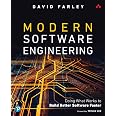
"The title says it all. In this book, Dave Farley shares his wisdom and experience as an outstanding software engineer and leader. The reader is fortunate to see the world of software design through the eyes of a master designer. Modern - It describes the practices tools and technology used today to build working software with a productive cadence.
Modern Software Engineering provides a reader with a clear understanding of the field of software engineering and why it is indeed engineering. Dave explains the essential aspects of software engineering concisely from the perspective of a software engineer. Unlike many books which focus on one right way, he stresses the importance of good judgment, experimentation, and measurement. Many authors discuss the goodness of cohesion, coupling, and separation of concerns but Dave illustrates concepts while discussing the natural tensions between them which are part of the art of software design. His passion and discussion for TDD and perspective on how and why it works, provide fresh motivation as TDD as design practice.
Throughout the book, Dave presents concrete examples of design choices, where creative experimentation, measure, and iterative development are essential. The book presents a series of courteous conversations about software product design and implementation. It is a book that professionals will return to often to reread and think about these important design conversations.
This is an excellent book that belongs on the self of every software engineer be they new or leading a large team."
―Dave Thomas, CEO of Bedarra Corporation
Dave Farley is co-author of the award winning book 'Continuous Delivery' and a contributor to the 'Reactive Manifesto'. He has been having fun with computers for over 30 years. During that period he has worked on most types of software, from firmware, through tinkering with operating systems and device drivers, to writing games, and commercial applications of all shapes and sizes. In recent years Dave has worked in the field of low-latency systems and was a contributor to the Duke award-winning 'LMAX Disruptor', open-source project.
He started working in large scale distributed systems about 25 years ago, doing research into the development of loose-coupled, message-based systems-a forerunner of today's Micro-Service architecture. He has a wide range of experience leading the development of complex software in teams, both large and small, in the UK and USA.
Dave was an early adopter of agile development techniques, employing iterative development, continuous integration and significant levels of automated testing on commercial projects from the early 1990s. He honed his approach to agile development in his four and a half year stint at ThoughtWorks where he was a technical principal working on some of their biggest and most challenging projects.
Dave is currently working as an independent software developer and consultant.
Customer Reviews, including Product Star Ratings help customers to learn more about the product and decide whether it is the right product for them.
To calculate the overall star rating and percentage breakdown by star, we don’t use a simple average. Instead, our system considers things like how recent a review is and if the reviewer bought the item on Amazon. It also analyzed reviews to verify trustworthiness.
Learn more how customers reviews work on AmazonThis is one of the best modern books on software engineering. The author's take on the empirical process of software engineering is a descaling operation on modern middle management "shm-agile".
In all honesty, this is one of the best books on software engineering, albeit a modern explication on the "No Silver Bullet" paper. Experienced engineers will find all of our suspicions confirmed: software is empirical not prescriptive, all software is deployment, all software is testability. In other words, Golang. But at least we have a faithful book to point at for the non-believers.
This is a must have book for software engineers. The part on engineering philosophy is a must for every engineer in my opinion. So why the 4 stars?let me explain my reasoning. The ideas in the book are important, but the presentation is still raw and underdeveloped. The ideas are intertwined making the text a hard read. For such a short book, I found that it took me a surprisingly long time to read. I hope that the author will treat this book in the same manner we should treat our software. With future, better and improved editions and with better clarity and separation of concerns between the topics. I do recommend that you buy and read this book. But like software, it can be improved.
Recently, I finished reading this great book by Dave Farley. It immediately was added to my "zero B.S. readings", along with Team Topologies and a few others. Those books I would take to a desert island if someone asked me to build up a software facility from zero. :)
What I really liked of the book is that it retakes the often discussed concept of software "engineering" and refines it to suit today's needs. I always felt we need an "engineering approach", but after the (gone) CMMI days, the term was always used more as a synonym to development rather than something to describe a professional, disciplined way to produce better software. I feel Dave's book puts back engineering into development, but with a very pragmatic and realistic approach, derived from actual experience.
When reading it, I felt a similar sensation to that I felt when I read Steve McConnell's Code Complete and Rapid Development, many years ago. Though very different books, I think Dave's also has that "handbook" nature. A book that you read once, but come back very often to look for ideas, concepts, etc. I hope Dave does not mind about my comparison.
Thanks Dave!
About 1/2 way through Dave Farley’s book at this point. I had an item in my ready column related to improving the performance of a query that is core to my new product. After reading the chapter on #empiricism and #experimentation I sat down this morning and set up an experiment with code that generated clear measures as a baseline. Then I set about #refactoring and ensuring I wasn’t more than a few undos from green tests. As I progressed I continued to compare my new measures.
After about 2 1/2 - 3 hours of refactoring I had achieved a 15x improvement and the queries are now “fast enough” to please my future customers. I was planning on doing this work anyways, but I think that what I had just read the night before pushed me towards a very disciplined, more scientific approach. I doubt that with a looser approach that I would have achieved that much improvement in such a short time.
I was prepared to #git reset and toss the work. I had no presupposition that it would be successful. It turned out to be completely worthwhile and an improvement to the codebase, to boot.
There is a difference between #development and #engineering.
Thanks, Dave.
#softwareengineering #softwaredevelopment #science #engineering
I really like Dave Farley, the author of this book and host of the Continuous Delivery channel. His treatment of software engineering from a true engineering perspective was eye opening to me. I've been an developer for years and years, but had never thought of it directly in that manner.
You won't read it in one sitting - the subject matter is perfect for skipping around to different chapters, depending on what you're currently working on or what topics pique your interest. Great book!
He says the same things over and over again but in different chapters. Very little code shown. Though anyone can gain some value, it seems to be more for a larger team. I got the big picture but very few practical examples.
I agree with most things he says. It is easy for someone to say what to do. But how to do it? Someone needs to write a book on how to find a job/company that does all those things he suggests.
When Dave Farley speaks or writes I pay attention. The CD book blew me away in 2010. This book doesn't add many new concepts or ideas to the discussion of what good software engineering looks like. But that's ok. It pulls a lot of apparently disparate things together at various levels of detail and helps you see how they relate to one another. It takes some positions that I don't necessarily agree with but any book worth reading should challenge your thinking. For example, it pushes TDD hard. I'm sorry, but the experience of many (I'd say most) is that (new of modified) tests being accompanied by a change during any checkin is more important than how you achieve that outcome. I tire when people suggest that TDD is the only way to do that. My point here is an illustration of outcome mattering more than mechanism, ironically covered in the last chapter of the book. That said, the book is loaded with sound advice, backed by experience that few people can match. Definitely worth a read.
Even if the concepts presented on managing complexity were familiar, I really enjoyed how everything was linked together to bring the focus on the process of software engineering .
amazing book !
I’ve been involved in building various kinds of software for nearly 20 years now (the book describes this as engineering, rather than building), and this book describes very well of what we should aim to when building software and this very much matches my personal perception of that. The book covers very fundamental subjects, yet it is really easy to read. We should not really treat ideas described in this book as dogma, but I believe that every software engineer, software developer, programmer or whatever they call themselves should read this book.
Describes many important concepts, and makes clear why those concepts matter.
Such concepts are incrementalism, feedback, separation of concerns, abstraction, ...
Some technical concepts are explained somewhere else in more depth, but I think that's fine: The book provides a good overview.
I loved this book, from start to end. All topics were well founded with a good amount of good examples. I understand that people expect more practical examples with real scenarios, but as stated by David, the book is not a recipe to achieve quality, but a foundation based on ingredients that are likely to lead your development to success. The examples given were simple, to illustrate and have a starting point to describe an idea. It's not only about coding my fellow friends, it's much more.
A collection of interesting approaches and insights on how to become or remain a modern software engineer.