|
VOOZH | about |
|
VOOZH | about |
Download the free Kindle app and start reading Kindle books instantly on your smartphone, tablet, or computer - no Kindle device required.
Read instantly on your browser with Kindle for Web.
Using your mobile phone camera - scan the code below and download the Kindle app.
OK
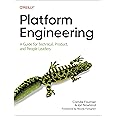
Until recently, infrastructure was the backbone of organizations operating software they developed in-house. But now that cloud vendors run the computers, companies can finally bring the benefits of agile custom-centricity to their own developers. Adding product management to infrastructure organizations is now all the rage.
But how's that possible when infrastructure is still the operational layer of the company?
This practical book guides engineers, managers, product managers, and leaders through the shifts required to become a modern platform-led organization. You'll learn what platform engineering is "and isn't" and what benefits and value it brings to developers and teams. You'll understand what it means to approach your platform as a product and learn some of the most common technical and managerial barriers to success.
With this book, you'll:
Sharing the knowledge of experts
O'Reilly's mission is to change the world by sharing the knowledge of innovators. For over 40 years, we've inspired companies and individuals to do new things (and do them better) by providing the skills and understanding that are necessary for success.
Our customers are hungry to build the innovations that propel the world forward. And we help them do just that.
Who This Book Is For
This book is focused on the technical, product, and people leaders in organizations that engineer and operate software platforms: senior engineers; architects; product, program, and engineering managers. Most of these readers understand intuitively that platforms are not just about building automation for the cloud and open source systems, but they lack both a clearer definition of what they should be doing and the practices to do it well.
We also hope to reach the broader technology leadership community: the CTOs, SVPs, and “product engineering” leadership team. These leaders have a tendency to ask questions like “Why is the platform organization so big when we also have AWS?” “Why does our platform have all this headcount but still move so slowly?” and “Why didn’t our recent adoption of [public cloud/SRE/developer experience] solve this?” The first two chapters of the book should start to answer these basic questions, and many of the techniques we spell out in the later chapters will be useful to product organizations as well (and may even provoke some introspection by these leaders!).
Finally, this book is really for anyone interested in learning how to make platform engineering work beyond the technical implementation details. Whether you are at a startup wondering when to start, a big company thinking about moving from infrastructure engineering to platform engineering, or anywhere in between, this book is for you.
Camille Fournier a technology executive with leadership experience ranging from early stage startups to Fortune 50 corporations. She is the author of several books including "The Manager's Path" and her upcoming book, "Platform Engineering: A Guide for Technical, Product, and People Leaders."
Ian Nowland has been in the software industry for 25 years, most recently 4 years at Datadog where he was the SVP of Core Engineering. Prior, he was at AWS in their early days of 2008-2016, where he was the lead engineer on the launch of Amazon EMR, and the leader of the first 5 years of the EC2 Nitro project. He is currently a cofounder at a stealth mode startup.
Customer Reviews, including Product Star Ratings help customers to learn more about the product and decide whether it is the right product for them.
To calculate the overall star rating and percentage breakdown by star, we don’t use a simple average. Instead, our system considers things like how recent a review is and if the reviewer bought the item on Amazon. It also analyzed reviews to verify trustworthiness.
Learn more how customers reviews work on AmazonI first became familiar with Camille's work through The Manager's Path., which has been an invaluable reference throughout my career as an Engineering Manager. It's a book I find myself returning to repeatedly for guidance and inspiration.
Platform Engineering by Ian and Camille is about to become another essential resource for me. This book dives deeply into the nuances of building trusted platforms, covering everything from managing stakeholders to planning, operating, and evolving platforms. The level of detail and practical advice is excellent.
One of my favorite chapters explores adopting a product-focused approach to platform building. This perspective strongly resonated with me, as it mirrored successful platform strategies I’ve observed in my own experience working within engineering organizations. Also, the chapter on "Rearchitecting vs. Building a v2" offered great insights into the hidden costs of migrations and emphasized the value of iterative modernization for existing platforms.
This book is a must-read for anyone involved in platform development or engineering leadership.
The book's accessible and clear writing style makes it relevant for readers from all backgrounds.
Having led a large platform team myself, I found the content both relatable and an invaluable reference. In particular, the insights on stakeholder management in complex organizations are both practical and immediately actionable.
For those stepping into similar roles, I recommend sharing this book with your leadership team. It provides valuable perspective on upcoming challenges and effective strategies to address them.
Highly recommended reading for technology leaders.
Camille and Ian created a valuable reference that covers many of the Why's, What's, and How's of Platform Engineering. However, the utility of this book is much broader in scope than that, and many of the topics discussed will feel familiar to all who work in large technical organizations, even if they aren't creating a "platform". I expect that I'll end up buying multiples of this book, to help folks facing common challenges.
I know that authors read these reviews and I want to first say that it was well written from a grammar, organization, and knowledge sentiment. It was simply all thoery and no application. Give me the knowledge, then back it up with real world examples that I can relate to. Maybe even speak to industry tools and real products.
Maybe if you are a CTO, perhaps this book would help you think about the direction, but then you would need another book for implementation.
The booked stepped through all parts of building and running a successful platform. It includes useful anecdotes and insights from guest authors.
I enjoyed this book a lot. Even working in the space the opinions and perspectives were eye-opining and supported a different perspective. It demonstrates what a real platform is and should support while it can be very specific to a company.
The book is very dense with experience. Recommended to Platform Engineers and Platform Leaders.