|
VOOZH | about |
|
VOOZH | about |
Download the free Kindle app and start reading Kindle books instantly on your smartphone, tablet, or computer - no Kindle device required.
Read instantly on your browser with Kindle for Web.
Using your mobile phone camera - scan the code below and download the Kindle app.
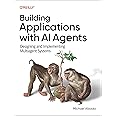
Generative AI has revolutionized how organizations tackle problems, accelerating the journey from concept to prototype to solution. As the models become increasingly capable, we have witnessed a new design pattern emerge: AI agents. By combining tools, knowledge, memory, and learning with advanced foundation models, we can now sequence multiple model inferences together to solve ambiguous and difficult problems. From coding agents to research agents to analyst agents and more, we've already seen agents accelerate teams and organizations. While these agents enhance efficiency, they often require extensive planning, drafting, and revising to complete complex tasks, and deploying them remains a challenge for many organizations, especially as technology and research rapidly develops.
This book is your indispensable guide through this intricate and fast-moving landscape. Author Michael Albada provides a practical and research-based approach to designing and implementing single- and multiagent systems. It simplifies the complexities and equips you with the tools to move from concept to solution efficiently.
Sharing the knowledge of experts
O'Reilly's mission is to change the world by sharing the knowledge of innovators. For over 40 years, we've inspired companies and individuals to do new things (and do them better) by providing the skills and understanding that are necessary for success.
Our customers are hungry to build the innovations that propel the world forward. And we help them do just that.
What This Book Is About
This book provides a practical framework for building robust applications using AI agents. It addresses key challenges and offers solutions to questions such as:
The content draws from established engineering principles and emerging practices in AI agents, with case studies (such as support for customer, personal assistants, legal, advertising, and code review agents) and discussions on trade-offs to help you tailor solutions to your needs.
What This Book Is Not
This book isn’t an introduction to AI or ML basics. It assumes familiarity with concepts like neural networks, natural language processing, and basic programming in languages like Python. If you’re new to these, pointers to resources are provided, but the focus is on applied agent building.
It’s also not a step-by-step tutorial for specific tools, as technologies evolve rapidly. Instead, it offers guidance on evaluating and selecting tools, with pseudocode and examples to illustrate concepts. For hands-on implementation, online tutorials and documentation are recommended, including frameworks like LangChain and AutoGen.
Who This Book Is For
This book is for engineers, developers, and technical leaders aiming to build AI agent-based applications. It’s geared toward roles like AI engineers, software developers, ML engineers, data scientists, and product managers with a technical bent. You might relate to scenarios like the following:
You can also benefit if you’re a tool builder identifying gaps in the agent ecosystem, a researcher exploring applications, or a job seeker preparing for AI agent roles.
Customer Reviews, including Product Star Ratings help customers to learn more about the product and decide whether it is the right product for them.
To calculate the overall star rating and percentage breakdown by star, we don’t use a simple average. Instead, our system considers things like how recent a review is and if the reviewer bought the item on Amazon. It also analyzed reviews to verify trustworthiness.
Learn more how customers reviews work on AmazonVery thoughtful, well-organized, comprehensive overview of agents. Used it as a reference when building an agentic system, and it provided a good initial framing to get me started.
amazing book
I think this book is a pretty good high level overview of using agents. However, I think the name of the book is a bit misleading - the book gives no real insights into building actual applications with agents; rather, it's mostly just disparate code snippets. Moreover, the book was obviously written by a data scientist - the book's github repo is terrible, and is clearly missing a lot of the dependencies that would be needed to run the code. Also, the code itself is terribly broken, with references to variables that are never defined, among other things. I also had an issue where the author is clearly misdefining or conflating memory and knowledge at different points in one chapter.
All that being said, I think that the high level info is pretty good, and gives a decent account of retrieval techniques and agents.
Excelente libro, recomendado
Excelente libro, recomendado
Super disappointed! Not sure what the author is trying to achieve. Verbose at the same time not technical enough. I will see if I can return it. The author did not make any attempt to help the reader to run the applications like author books where you go to the github and there the code is linked to say Google Colab.
This book tries to cover a lot of ground on agentic system design, and to be fair, it does collect many of the right ideas in one place. If you’re new to the topic, you’ll probably recognize most of the concepts and buzzwords. The problem is that everything stays very high level, so you never really feel like you’re learning how to build or reason about real systems.
It’s also extremely repetitive. The same points come up again and again, often in back-to-back chapters, with little added depth. Instead of reinforcing ideas, the repetition just becomes tiring. The code examples don’t help much either, they feel artificial and often unrelated to the actual discussion, as if they were added just to check a box.
Overall, it’s not a great read. While it works as a loose collection of ideas, it lacks focus, depth, and practical relevance. I wouldn’t recommend it unless you just want a shallow overview and don’t mind wading through a lot of repetition.
It reads like AI-generated slop.
Entirely AI written, not in a good way. I was looking for an author's judgment, as a first book its disappointing Michael. I looked on your website and seems like you could know what you are talking about. Have more faith in your ability. If you do use AI, use it in a way that improves the work.
Gran libro - un poco teórico pero muy completo
Lite för långrandig, men helt ok!
Ottimo testo, chiaro e con esempi dettagliati
Very insightful. A must read.
I just have begun reading and glimpsed through overall content. The author’s writing style is quite good. Contents are not shallow. The chapters are insightful. Obviously contents are not AI generated. There are good code examples in many places. However some areas are barely touched at ten thousand feet high. For examples, Vector stores & RAG together gets probably place for about one page. So, understandably this is not a beginner book. But I still wish this had covered or at least listed some key techniques and few good examples in those areas. Am I expecting too much? May be. I really would like to see this book as one comprehensive resource. The author has a great potential as far as I see. Like Martin Kleppman’s “Designing Data Intensive Applications” this author too, I believe, can write a book of that stature. Hope to see more comprehensive future editions. But for now, this book is quite good in this area. This is pretty great already and may be this would turn into Gold standard in this area in up coming editions.