|
VOOZH | about |
|
VOOZH | about |
Download the free Kindle app and start reading Kindle books instantly on your smartphone, tablet, or computer - no Kindle device required.
Read instantly on your browser with Kindle for Web.
Using your mobile phone camera - scan the code below and download the Kindle app.
OK
As the digital economy changes the rules of the game for enterprises, the role of software and IT architects is also transforming. Rather than focus on technical decisions alone, architects and senior technologists need to combine organizational and technical knowledge to effect change in their company’s structure and processes. To accomplish that, they need to connect the IT engine room to the penthouse, where the business strategy is defined.
In this guide, author Gregor Hohpe shares real-world advice and hard-learned lessons from actual IT transformations. His anecdotes help architects, senior developers, and other IT professionals prepare for a more complex but rewarding role in the enterprise.
This book is ideal for:
Sharing the knowledge of experts
O'Reilly's mission is to change the world by sharing the knowledge of innovators. For over 40 years, we've inspired companies and individuals to do new things (and do them better) by providing the skills and understanding that are necessary for success.
Our customers are hungry to build the innovations that propel the world forward. And we help them do just that.
Architects play a critical role as a connecting and translating element, especially in large organizations where departments speak different languages, have different viewpoints, and drive toward conflicting objectives. Many layers of management only exacerbate the problem as communicating up and down the corporate ladder resembles the telephone game. The worst-case scenario materializes when people holding relevant information or expertise aren’t empowered to make decisions, whereas the decision makers lack relevant information. Not a good state to be in for a corporate IT department, especially in the days when technology has become a driving factor for most businesses.
Architects can fill an important void in large enterprises: they work and communicate closely with technical staff on projects, but are also able to convey technical topics to upper management without losing the essence of the message (Chapter 2). Conversely, they understand the company’s business strategy and can translate it into technical decisions that support it.
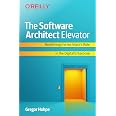
If you picture the levels of an organization as the floors in a building, architects can ride what I call the architect elevator: they ride the elevator up and down to move between a large enterprise’s board room and the engine room where software is being built. Such a direct linkage between the levels has become more important than ever in times of rapid IT evolution and digital disruption.
Stretching the analogy to that of a large ship, if the bridge officers spot an obstacle and need to turn the proverbial tanker, they will set the engines to reverse. But if in reality the engines are running full speed ahead, a major disaster is preprogrammed. This is why even old steamboats had a pipe to echo commands directly from the captain to the boiler room and back. In large enterprises architects need to play exactly that role!
|
The Manager's Path
|
Art of Leadership
|
97 Things Every Engineering Manager Should Know
|
|
|---|---|---|---|
| Customer Reviews |
4.6 out of 5 stars 3,348
|
4.4 out of 5 stars 338
|
4.2 out of 5 stars 158
|
| Price | $22.13$22.13 | $25.49$25.49 | $24.04$24.04 |
| Related books by O'Reilly Media | A Guide for Tech Leaders Navigating Growth and Change | Small Things, Done Well | Collective Wisdom from the Experts |
He has served as Smart Nation Fellow to the Singapore government, as technical director in Google Cloud’s Office of the CTO, and as Chief Architect at Allianz SE, where he oversaw the architecture of a global data center consolidation and deployed the first private cloud software delivery platform. Having worked for both digital native companies and traditional enterprise IT allows him to reveal the many misconceptions that these organizations have about each other in the form of pointed anecdotes harvested from the daily grind of IT transformation.
Gregor is known as coauthor of the seminal book Enterprise Integration Patterns (Addison-Wesley), which is widely cited as the reference vocabulary for asynchronous messaging solutions. His articles have been featured in numerous publications, including Best Software Writing (Apress), selected and introduced by Joel Spolsky, and 97 Things Every Software Architect Should Know (O’Reilly), by Richard Monson-Haefel.
Gregor Hohpe advises CTOs and technology leaders in the transformation of both their organization and technology platform. Riding the Architect Elevator from the engine room to the penthouse, he assures that corporate strategy connects with the technical implementation and vice versa.
Gregor has served as Smart Nation Fellow to the Singapore government, as technical director in Google Cloud’s Office of the CTO, and as Chief Architect at Allianz SE, where he oversaw the architecture of a global data center consolidation and deployed the first private cloud software delivery platform.
Gregor is a widely recognized thought leader on asynchronous messaging and service-oriented architectures. He co-authored the seminal book 'Enterprise Integration Patterns' (Addison-Wesley, 2004), followed by "Integration Patterns" and "Enterprise Solution Patterns", both published by Microsoft Press. He was nominated a Microsoft MVP (Most Valuable Professional) Solution Architect for his contributions to the developer community and recognized as an active member of the patterns community by the Hillside Group. In 2005, Joel Spolsky selected Gregor's article 'Starbucks Does Not Use Two-phase Commit' for his 'Best Software Writing' (APress).
Gregor speaks regularly at technical conferences around the world. He likes to cut through the hype surrounding service-oriented architectures and captures nuggets of advice in the form of design patterns that can help developers avoid costly mistakes. Find out more about his work at eaipatterns.com and architectelevator.com
Customer Reviews, including Product Star Ratings help customers to learn more about the product and decide whether it is the right product for them.
To calculate the overall star rating and percentage breakdown by star, we don’t use a simple average. Instead, our system considers things like how recent a review is and if the reviewer bought the item on Amazon. It also analyzed reviews to verify trustworthiness.
Learn more how customers reviews work on AmazonThis is a very thoughtful and enjoyable book. I read it like a devotional, one chapter per day. The chapters and very short and standalone, a bit like informal essays or well-crafted blog posts. Many have important insights that are worth letting sink in, at least for consideration if not for incorporation. The insights aren't provocative but often non-trivial and clearly won by hard experience. Gregor has a background that is hard to match: author of the most influential book ever on async messaging patterns, Director at Google, advisor to enterprises and is now with AWS. He has "big tech" experience but also understands that the challenges both technical and cultural at traditional enterprises are quite complex -- and he advocates for patterns that can help you to take them on. I like the fact that he calls out patterns from big tech companies that can be applied at enterprises but cautions against air-lifting them all unless you have the same context. One of my favorite essays was the one on Starbucks and two-phase commits. Simple but brilliant. Great book. Keep it coming.
This is a great book about EA! Well thought out, with instructive stories from a successful leader in the EA space. While much information in the book could be found with a search engine and enough time, the value of this book comes from its collection of insights into points of view and understanding tradeoffs that are critical for EA's contribution to successful digital transformation.
The book is very useful to a technician or technically focused architect who is transitioning to EA, or an experienced architect dealing with changes brought on by digital transformation.
Not only “The Architect Elevator” is skilfully written,
it also packs a life time experience dealing with abstract and complex problems:
Organisational Behaviour , Technical Disruption, Bleeding Edge Technologies, Resistance to Change, Human Psychology...
It is like you mix Kahneman’s Thinking Fast and Slow, with some Harvard Business books and the latest by O’Reilly in Devops...all woven together by a seamless , coherent and fun narrative.
If you are serious about your IT Architect career, and have already hit a glass ceiling after mastering your technical stuff, this is the book that will push you forward...and above!
Traditionally, companies live and die by a fixed hierarchical approach where power and influence are garnered by climbing to the top of the ladder. However, recent decades have witnessed the rise of digital companies promising an economic disruption. Stereotypically, a smart young kid writes some code to change the way business is done and become rich in the process. We, in the public, then use their software for decades to come. Many companies still have not adapted to the new dynamic, so in this book, Gregor Hohpe tries to shine a path for software architects in these companies to take responsibility for adapting their businesses to digital realities.
This book’s central thesis tries to redefine the software architect’s role. Traditionally, their prestigious position was to define how software is designed for the entire company or division. Instead, Hohpe proposes that they need to be more agile and focus on integrating new digital products into a company’s culture. With prior work experience at Google, his vision corresponds to that of so-called Big Tech.
Personally, I work in software efforts at a major academic medical center that has sought to be at the forefront of the digital transformation. Seeking to be the disrupters, we are well-acquainted with the newer digital culture. Further, our non-profit organization is not driven solely by the bottom line and shareholders. Since my organizational culture has already progressed significantly towards an agile digital approach, I don’t reside in this book’s target audience. Hohpe’s work after Google seems to have focused on transforming organizations to be more like Google. My organization already looks a lot like Google in its approach to research.
Reading this book certainly conveyed peaks of deep insight to me. For instance, the section on organizations helped me think through ways to implement my software’s disruptive change. The rest of its contents are solid and reliable. Most of this book, however, contains insights already shared in existing literature with little new content to provoke pondering thoughts. That shortcoming prevents it from going from good to great. Its title addresses ambitious developers looking to advance their career, but is a lot more about the digital enterprise as a whole. Perhaps taking responsibility for that organization is the step more developers need to take.
Excellent book, must read for all software architects who want to make or improve their impact !!!?
IT industry is full of books about patters, technics, technologies and processes. There are also separate books on communication, leadership, coaching and so on. While these are all very valuable and help you build your skills, you need an experience to make it stick together and be useful. Gregor Hope shared a lot of his personal experience in a well structured and easy to consume manner. It's just great.
I loved every single part of this book, not only Gregor has so many insights and guidance for us architects that are part of big enterprises making the change to Digital Companies, but he is able to make it entertaining! Strongly recommended, a book that will be key in this turning point in the world of big companies.
Highly recommend for anyone in the tech field that is looking into management/architecture. Easy to read and understand, this book doesn't deep dive into code but rather focuses on important higher level topics.
Ideal for any architect. It's never just about the technology, and knowing how to communicate and listen with the 'business' is a core skill.
First of all, I will say I like Gregor Hohpe's writing and have been following his presentations on YouTube. I purchased a previous book called "37 Things One Architect Knows About IT Transformation", and really appreciated his insight. So I was interested in reading more. I purchased this book, only to discover, however, this book is the exact same book under a different name and publisher and is noted as the 1st edition.
If you are reading Hohpe for the first time, then proceed with this book. If you've been following him and have purchased "37 Things.." you already have the content of this book. Save your money for one of his others; Cloud Strategy or Platform Strategy when it comes out.
Gregor Hohpe brings a great book about the role of IT Architects in modern organizations. He talks about soft skills that are required for IT Architects, like communication, leadership, decision making.
Hat mir eine neue Perspektive auf die Rolle des Softwarearchitekten gegeben.
Einiges was beschrieben wird ist meiner Meinung nach Common Sense. Trotzdem waren auch diese Teile hilfreich und haben neue Perspektiven aufgezeigt.
A very well written book, both accessible and concise. I recommend this book to anyone considering a move in to 'IT architecture' (regardless of what type of architect you intend to be) and to those who have already established a career as an architect.
I have been in IT for 20 years, 10 of those as an architect of one kind or another, mainly with enterprise scale clients. I found the book was at times therapeutic ('so its not just me!') , insightful ('I never considered it from that angle'), immediately applicable ( after reading a section on powerpoints I closed the book and immediately edited a executive level slide deck I was working on).
The challenge with architecture as a discipline, in my opinion, is that it is always different and dependent on context. This book does a great job of explaining what architecture means in large organisations as well as providing numerous ways to communicate your ideas.