|
VOOZH | about |
|
VOOZH | about |
Download the free Kindle app and start reading Kindle books instantly on your smartphone, tablet, or computer - no Kindle device required.
Read instantly on your browser with Kindle for Web.
Using your mobile phone camera - scan the code below and download the Kindle app.
OK
👁 Knowledge Graphs and LLMs in Action quote 1
“Builds understanding both at a theoretical and a practical level.”
Corey L. Lanum, Visualization Partners
👁 Knowledge Graphs and LLMs in Action quote 2
“An excellent introduction to building KG and LLM-powered applications.”
Dave Bechberger, Author of Graph Databases in Action
👁 Knowledge Graphs and LLMs in Action quote 3
“Comprehensive and well thought out! The authors hit it out of the park again.”
Sujit Pal, Elsevier
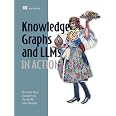
Knowledge Graphs and LLMs in Action provides a practical guide to combining structured knowledge graphs with LLMs, showing you how to build, enrich, and exploit graphs in tandem with large language models to gain better context, reasoning, and explainability.
You get hands-on techniques, code, and best practices across all stages—labeling data, modeling the graph, linking to LLM outputs—so you can apply these concepts in real systems.
The synergy helps mitigate common LLM weaknesses—like hallucinations or lack of factual grounding—by anchoring their outputs in explicit relational structure.
Manning helps developers and tech professionals stay ahead in a fast-moving industry with expert-led books, videos, and projects. Learning never stops, but it’s hard to keep up, so we focus on content that’s practical, clear, and trusted. As an independent publisher, we adapt quickly, from pioneering early-access books to offering DRM-free eBooks. Our series, like "In Action" and "In a Month of Lunches", reflect a commitment to making complex topics accessible.
|
Build a Large Language Model (From Scratch)
|
AI Agents in Action
|
Natural Language Processing in Action, Second Edition
|
LLMs in Production: From language models to successful products
|
Data Analysis with LLMs: Text, tables, images and sound (In Action)
|
Causal AI
|
|
|---|---|---|---|---|---|---|
| Customer Reviews |
4.5 out of 5 stars 543
|
4.0 out of 5 stars 47
|
4.8 out of 5 stars 7
|
4.5 out of 5 stars 34
|
4.8 out of 5 stars 6
|
4.4 out of 5 stars 14
|
| Price | $49.24$49.24 | $41.64$41.64 | $68.21$68.21 | $50.66$50.66 | $36.49$36.49 | $51.86$51.86 |
| Level of proficiency | Intermediate | Intermediate | Intermediate | Intermediate | Intermediate | Advanced |
| About the reader | Readers need intermediate Python skills and some knowledge of machine learning. | For intermediate Python programmers. | For intermediate Python programmers. | For data scientists and ML engineers. | For data scientists and data analysts. | For data scientists and machine learning engineers. |
| Special features | Includes liveBook with out built-in AI assistant. | Includes liveBook with out built-in AI assistant. | Includes liveBook with out built-in AI assistant. | Includes liveBook with out built-in AI assistant. | Includes liveBook with out built-in AI assistant. | Includes liveBook with out built-in AI assistant. |
| Pages | 368 | 344 | 688 | 456 | 232 | 520 |
Discover more of the author’s books, see similar authors, read book recommendations and more.
Customer Reviews, including Product Star Ratings help customers to learn more about the product and decide whether it is the right product for them.
To calculate the overall star rating and percentage breakdown by star, we don’t use a simple average. Instead, our system considers things like how recent a review is and if the reviewer bought the item on Amazon. It also analyzed reviews to verify trustworthiness.
Learn more how customers reviews work on Amazonknowledge Graphs and LLMs in Action arrives at exactly the right time, when many teams are discovering that large language models alone are not enough to support reliable, domain-specific applications. This book makes a convincing case for hybrid systems—where knowledge graphs and LLMs work together—and, more importantly, shows you how to build them.
The authors move beyond theory quickly and focus on how knowledge graphs (KGs) can strengthen real-world AI systems. From healthcare and financial crime detection to enterprise search and question-answering systems, the book grounds its ideas in practical use cases that clearly demonstrate why structured knowledge still matters in the age of generative AI. Rather than positioning LLMs as replacements for classical approaches, the book frames them as complementary—a perspective that feels both mature and refreshing.
One of the book’s standout qualities is its progression from fundamentals to advanced implementation. The early chapters provide a solid foundation in knowledge representation, ontologies, and graph modeling without becoming academic or abstract. As the chapters advance, readers are guided through real engineering challenges such as multisource data integration, entity disambiguation, and building graphs from unstructured data. These sections are especially valuable because they reflect the messy realities of real deployments, not just clean examples.
The chapters on using LLMs to construct and enrich knowledge graphs are among the most compelling. Instead of treating LLMs as a magic box, the authors explain where they shine and where they struggle. The discussion on named entity disambiguation, especially when combining open-source LLMs with domain ontologies, is both technically strong and practically useful. It’s clear the authors have encountered the hard problems firsthand.
Part 4 is a welcome deep dive into machine learning and graph neural networks for knowledge graphs. Concepts such as node classification, link prediction, and representation learning are explained clearly, with Python examples that strike a good balance between explanation and implementation. The authors don’t just teach you how these models work—they explain when to use them and what you get in return.
The final section on retrieval-augmented generation (RAG) brings everything together. The integration between knowledge graphs and RAG systems is handled thoughtfully, with examples of natural language querying, question answering, and building a QA agent using LangGraph. These chapters do an excellent job of showing how structured knowledge can dramatically improve LLM reliability, factual accuracy, and traceability.
The authors’ expertise is evident throughout. Alessandro Negro and his co-authors write with clarity and authority, and the content reflects deep experience in both industry and research. While the book does require technical background—especially in Python, machine learning, and data engineering—it rewards that effort with insights that go far beyond surface-level tutorials.
Overall, Knowledge Graphs and LLMs in Action is a practical, well-structured, and forward-looking guide for anyone serious about building production-grade AI systems. If you are working with LLMs today and wondering how to make them more trustworthy, explainable, and scalable, this book is not just useful—it’s essential reading.
I read their earlier book on Graph Powered Machine Learning, and thought I understood about graphs, but this book is so much more, and there are more to knowledge graphs than I would expect.
They give a lot of technical details but they also try to explain the terms, but there is some assumption, I think, that you have some knowledge of graphs in general and some natural language concepts, as they won't go into detail about their graphing algorithms, so you may need to look up these terms, but they do try to keep it as simple while covering this information well.
I do now understand better how a corporation could build a knowledge graph to help them to try to find new uses for some drugs or to perhaps find a potentially new approach to find a cure, and they work through how to create an intelligent agent system for health care professionals, where it will pull data from different sources.
So it is more than just building a graph, as they go into detail where they had over 10k pages of handwritten notes and how they were turning those into a graph to be able to answer questions. The big part is that the goal is to make a system that can help others with questions that they didn't realize they had. For example, you work at a consulting company. If a top salesman leaves and a new one is hired, how does the new salesman know what people to talk with at different companies to get good results? It may be that the best person at one company is the barista on the first floor, as she may understand how to reach out to different people. If you had notes and voice recordings from the various employees you could build a graph to help understand connectedness or to see which people are the critical pieces to help engineers when solving a problem. It may be that a particular janitor is very intuitive and some of the engineers bounce ideas off on him and he is able to help them work though the challenges.
So when looking at handwritten notes, you need to convert them into text first, so they discuss that. Then you have that people may use a shorthand to reference jobs or names and so how do you handle that? They cover that.
They build up from one scenario where they are working through the various challenges and at times they will mention that to continue would be out of scope of the book, but then they go onto a different situation with new challenges and this continues.
They also talk quite a bit about how LLMs can help with this work, and where they are strong and weak, and how to use different tools together in a pipeline to potentially have a better system.
Then, you have a knowledge graph that is well-designed and useful. Can you do more with this graph? Then we get into the machine learning part, so how do you do feature engineering on a graph? They discuss that in detail. How do you make a neural network that is from a graph, or a GNN? They give an example of designing an anti-money laundering system, then they go into how do you build a system that can answer questions from a chatbot? They cover that also.
So, they give a great amount of information, and this is a great book to expand our minds on what is possible. I am going to see if I can use Postgres Apache AGE extension for these, as their examples all use neo4j, which is a good database, but I like Postgres.
Knowledge Graphs and LLMs in Action comes at the perfect time. As more teams realize that large language models alone can’t deliver reliable, domain-specific systems, this book offers a compelling argument for hybrid architectures—where knowledge graphs and LLMs work together—and, more importantly, shows you how to build them.
The authors quickly move beyond theory and focus on how knowledge graphs can strengthen real-world AI applications. With examples spanning healthcare, financial crime detection, enterprise search, and question answering, the book clearly demonstrates why structured knowledge remains essential even in the era of generative AI. Instead of treating LLMs as replacements for classical methods, it frames them as complementary—a balanced and refreshing perspective.
One of the book’s biggest strengths is its progression from fundamentals to advanced engineering. The early chapters introduce knowledge representation, ontologies, and graph modeling in a way that’s approachable without being superficial. Later chapters dig into real implementation challenges like multisource data integration, entity disambiguation, and building graphs from unstructured text—topics that reflect the messy realities of production systems.
The sections on using LLMs to build and enrich knowledge graphs are especially strong. Rather than presenting LLMs as magic, the authors explain where they excel and where they fall short. Their deep dive into named entity disambiguation—especially how to combine open-source LLMs with domain ontologies—is both technically rigorous and practically valuable.
Part 4 offers a well-executed guide to machine learning and graph neural networks for knowledge graphs. Concepts like node classification, link prediction, and representation learning are explained clearly, supported by Python examples that balance clarity with real-world applicability. The authors don’t just show how these models work—they explain when to use them and what benefits they provide.
The final section on retrieval-augmented generation (RAG) ties everything together. The discussion of KG-enhanced RAG systems, natural language querying, and building a QA agent using LangGraph shows how structured knowledge can significantly improve LLM reliability, accuracy, and traceability.
Throughout the book, the authors’ expertise is unmistakable. Alessandro Negro and his co-authors write with authority and practical insight, drawing from deep experience in industry and research. While the material assumes some familiarity with Python, machine learning, and data engineering, the payoff is substantial.
Overall, Knowledge Graphs and LLMs in Action is a practical, thorough, and forward-looking guide for anyone serious about building production-ready AI systems. If you want to make your LLM applications more trustworthy, explainable, and scalable, this isn’t just a useful book—it’s essential reading.
Knowledge graphs are a structured way to represent human knowledge into machines using nodes, relationships, and properties. They are comparatively expensive to build and their access patterns are also intricate.
This book focuses on building and querying KGs and also summarizing from KGs in text form. LLMs and KGs can work together and complement each other to improve accuracy, domain-specific knowledge and at the same time reduce hallucinations. This is not without a different set of challenges. In order to determine if KG is the right solution to address your business and technical challenges, one must go over some questions which are highlighted in this book.
What this book does a good job is to help us learn to adopt a business-need mindset, model KG schemas, use LLMs to extract domain-relevant entities, and validate ingested information. It also teaches how to perform analysis using graph neural networks, and query and visualize graph portions, using LLMs for natural questions.
The book is divided in to parts that explain building KGs from structured data sources and text. Then it explains how to use machine learning on KGs followed by Information retrieval with both KGs and LLMs in tandem.
This book is very comprehensive and may require reading more than once. I haven't seen any book on this topic with so much details. This book contains a lot of code and diagrams which make it relatively easy to follow by doing, rather than reading.
I’m still working my way through this book, so I can’t give a full verdict yet, but I wanted to share some early impressions (I’ll update this review once I’m done).
So far, the book does a great job explaining how knowledge graphs and LLMs actually fit together in real applications. The diagrams and examples make the concepts easier to digest, which I always appreciate.
I haven’t gone deep enough yet to comment on every chapter, but so far it’s been a useful and easy-to-follow resource. If you’re interested in how knowledge graphs can make LLMs more reliable, or you just want to understand modern graph-based AI systems in more depth, this book seems like a solid pick.
Will update with more details once I finish the rest!
This book is written for people who are trying to build real systems in areas like search, drug discovery, medical diagnosis, and financial risk. It puts knowledge graphs at the center of intelligent systems for such domains. The authors work with a simple requirement for useful intelligence in these settings: a system needs some way to accumulate knowledge about the world, keep it in a structured form, and recombine it when answering questions or making decisions. KGs fill that role by encoding entities, relationships, and constraints, so that there is a stable substrate to query rather than a vague cloud of patterns. The book walks through concrete examples, for instance finding plausible drug repurposing candidates by following chains such as Disease → Pathway → Target → Drug, or answering medical questions that require combining patient history, clinical guidelines, and lab results. In these settings, conventional vector based RAG often falls short because semantic search retrieves fragments rather than a complete chain of evidence. The book explains how KGs and GraphRAG can surface a coherent subgraph that captures all relevant links, and how LLMs can then sit on top to summarize, explain, or handle softer relations that are hard to encode as strict schema edges.
The book is very pragmatic about what kind of KG needs to be built. It urges readers to start with a business or scientific problem, not with an abstract goal of collecting all possible facts. A useful KG represents only the slice of the world that matters for a given task, and its schema, update process, and integration with LLMs all follow from that choice. RAG and GraphRAG are presented as grounding techniques that need to be shaped to retrieval demands such as multi hop reasoning, exhaustive evidence gathering, or strict constraint checking, rather than as general cures for hallucination.
Overall, I found the book illuminating, especially in how it thinks about intelligence, and practical.
The opening chapters do an excellent job selling the value of knowledge graphs: what they are, why they matter, and how to use them effectively. The rest of the book shifts into a ground-up implementation guide using modern techniques and tooling.
I can’t give it full marks, though. After the introductory material, the book gets bogged down in implementation details, especially around the author’s preferred stack, Neo4j, with a lot of printed code that didn’t always feel worth the page count.
To be fair, I did use what I learned here to build a knowledge graph for a work use case. But I came away pretty unimpressed with Neo4j. We were able to get much of the same functionality (arguably better) using Markdown files, Obsidian, Claude Code, and a small internal wiki. No accounts, AWS instances, or extra infrastructure required.
Overall, the book is a bit too long and too focused on specific tooling. The first half is easily five-star material for learning knowledge graph concepts and best practices; the second half is more uneven.
Recommended, with the caveats above.
I, regrettably, cannot recommend this book, and its github code repository.
It is clear from the first few chapters that it is very sloppy.
It starts with installing Neo4j; It is confusing, and the authors did not make the task easy for readers with less experience.
They propose five ways to install it, each with its own issues and errors will arise from the code listings.
1. Community version - Listing 3.16 will return an error as on the community version it is not possible to create extra databases. The neo4j is the only one available.
2. Neo4j Desktop - Can create extra databases, but appendix B does not explain how to install the neosemantics plugin.
3. Neo4j Browser - Impossible to install the plugins...
4. Neo4j Enterprise is limited in time, and otherwise payable. So not really a long term option if you want to come back to the book in future.
5. The neo4j official docker image. It does not include the plugins... Not a word about how to install them and how to forward ports. A few lines of text would make it easier on readers meeting neo4j for the first time. Assuming that people know Docker is not a good starting point.
The README of the code repository won't help you either. It is laconic and just states "Make sure that the Neo4j instance you want to use is up and running. Follow the instructions Appendix B for installation directions."
The sloppiness continues with listing not starting from 1. So the first listing of chapter 3 is 3.16 (the first for chapter 2 is 2.1), and listing 3.28 is empty, leaving you to wonder if you are missing code.
It continues with not a single comment in those listings. Constantly hoping back and forth from the book to the repo is tiring, and the book also lists the code without a single comment...
Instead of using Python scripts to connect to Neo4j in order to set it up for each chapter, wouldn't it be easier to package the community version, with the plugins, and the necessary code in a Dockerfile???
To summarise, my hope is that the above will be fixed in a future edition of the book; Until then keep away from it, as it is not the polish I expect from a product costing anything between 50$ and 60$.