|
VOOZH | about |
|
VOOZH | about |
Download the free Kindle app and start reading Kindle books instantly on your smartphone, tablet, or computer - no Kindle device required.
Read instantly on your browser with Kindle for Web.
Using your mobile phone camera - scan the code below and download the Kindle app.
OK
In an era where AI can generate code in minutes, why do software teams still struggle to deliver?
While artificial intelligence transforms how we build software, most organizations remain trapped by friction that turns AI's promise of speed into bottleneck nightmares. Slow deployments, brittle systems, and frustrated developers create invisible drag on innovation—costing US companies $1.52 trillion annually in technical debt alone.
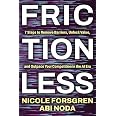
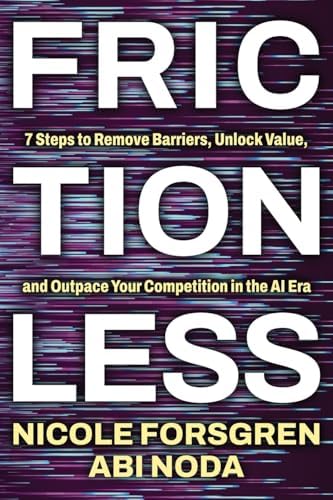
Frictionless: 7 Steps to Remove Barriers, Unlock Value, and Outpace Your Competition in the AI Era reveals the strategic framework that separates high-performing software organizations from the rest. Authors Nicole Forsgren and Abi Noda show how eliminating development friction isn't just about happier developers—it's about unlocking competitive advantage.
Drawing from work with hundreds of software teams, this practical guide demonstrates how companies like LinkedIn transformed their trajectory by systematically removing friction, going from monthly deployments to multiple releases per day. You'll discover how poor developer experience hides catastrophic business risks and—most importantly—how to fix it.
Perfect for engineering leaders, CTOs, and anyone responsible for software delivery, this book provides everything needed to transform developer experience: proven measurement frameworks, a 7-step implementation methodology, and real-world strategies that work whether teams embrace AI tools or use established workflows.
The organizations investing in developer experience today will move faster, build better, and lead tomorrow. Whether you're struggling with slow deployments, frustrated developers, or unrealized AI potential, Frictionless shows you how to remove the barriers limiting your success.
Explore your book, then jump right back to where you left off with Page Flip.
View high quality images that let you zoom in to take a closer look.
Enjoy features only possible in digital – start reading right away, carry your library with you, adjust the font, create shareable notes and highlights, and more.
Discover additional details about the events, people, and places in your book, with Wikipedia integration.
"In my mission to help geeks feel safe in the world, external friction frequently creates anxiety. "Why can't I go faster? I'm told I have to go faster!" Frictionless makes the business case and the human case for reducing friction as a strategic investment." - Kent Beck
"Frictionless is a comprehensive, practical reference for implementing a developer experience practice at your organization. It's the book I wish I'd had when I was leading this role. Based on a wealth of experience at the cutting edge of this field, this book is an essential guide for leaders and practitioners who want to achieve breakthrough, lasting improvements in engineering productivity and team health." - Jez Humble
"An encyclopedic resource for anyone at any stage of their DevEx transformation journey" - Camille Fournier
Nicole Forsgren is an expert in DevOps and Developer Experience and has led and advised DevEx efforts across the industry. She is the lead author of the Shingo Publication Award-winning book Accelerate: The Science of Lean Software and DevOps: Building High Performing Technology Organizations. Her work on technical practices and development has been published in industry and academic journals and is used to guide organizational transformations around the world. For more information, visit her website at nicolefv.com.
Abi Noda is the founder and CEO at DX, where he leads the company's strategic direction and R&D efforts. His work focuses on developing measurement methods to help organizations improve developer experience and productivity. Before joining DX, Noda held engineering leadership roles at various companies and founded Pull Panda, which was acquired by GitHub in 2019. For more information, visit his website at abinoda.com.
Dr. Nicole Forsgren is considered one of the most prominent and important minds in DevOps and developer productivity. She is author of two best-selling, award-winning books: Accelerate: The Science of Lean Software and DevOps, which netted a Shingo Publication Award, and The DevOps Handbook: How to Create World-Class Agility, Reliability & Security in Technology Organizations, now in its second edition. Her latest, Frictionless: 7 Steps to Remove Barriers, Unlock Value, and Outpace Your Competition in the Age of AI, was recently released. She is best known for her work measuring the technology process and as the lead investigator on the largest DevOps studies to date. She has been an entrepreneur (with an exit to Google), professor, developer, sysadmin, and performance engineer.
Nicole’s work has been published in several peer-reviewed journals and conferences. Nicole earned her PhD in Management Information Systems and Masters in Accounting from the University of Arizona. She splits her time between the Southwest and the PNW, and recharges her brain with gym time, tacos, and Diet Coke.
Abi Noda is the Co-Founder and CEO of DX, where he leads the company's strategic direction and R&D efforts. His work focuses on helping leaders measure and improve developer experience.
Before joining DX, Noda held engineering leadership roles at several companies and was the Founder and CEO of Pull Panda, which was acquired by Github in 2019.
Customer Reviews, including Product Star Ratings help customers to learn more about the product and decide whether it is the right product for them.
To calculate the overall star rating and percentage breakdown by star, we don’t use a simple average. Instead, our system considers things like how recent a review is and if the reviewer bought the item on Amazon. It also analyzed reviews to verify trustworthiness.
Learn more how customers reviews work on AmazonI am so disappointed! I enthusiastically rummaged through the book, hoping to find all those AI-generated insights promised by one or two of the Amazon reviewers. Alas, no. The book is clearly written by humans. I didn’t even need my stylometric/authorship analysis tool kit to recognize some of the authors’ writing tone/style from their other books (e.g., Forsgren's "Accelerate") and Noda's blog posts. Their writing style is fantastic, by the way. Sadness 😊.
Jokes aside, I personally loved how the book was arranged into a large collection of short chapters (very easy to read). The book is neatly arranged into three parts. The first is a fantastic primer on DevEx, its essential elements, and why it is a business imperative (recovering time, saving money, making money). The second part goes over the seven steps for improving DevEx. The third discussing how to evolve and sustain DevEx in an AI-enabled world.
As someone deep in the machine learning/AI space, my favorites were the parts about cognitive load, and the possible efficiency tradeoffs of standardizing (Gen AI) tool use versus personalization (for effective use), AI trust calibration, telemetry usage, and the SPACE framework for AI-augmented development.
I am so disappointed! I enthusiastically rummaged through the book, hoping to find all those AI-generated insights promised by one or two of the Amazon reviewers. Alas, no. The book is clearly written by humans. I didn’t even need my stylometric/authorship analysis tool kit to recognize some of the authors’ writing tone/style from their other books (e.g., Forsgren's "Accelerate") and Noda's blog posts. Their writing style is fantastic, by the way. Sadness 😊.
Jokes aside, I personally loved how the book was arranged into a large collection of short chapters (very easy to read). The book is neatly arranged into three parts. The first is a fantastic primer on DevEx, its essential elements, and why it is a business imperative (recovering time, saving money, making money). The second part goes over the seven steps for improving DevEx. The third discussing how to evolve and sustain DevEx in an AI-enabled world.
As someone deep in the machine learning/AI space, my favorites were the parts about cognitive load, and the possible efficiency tradeoffs of standardizing (Gen AI) tool use versus personalization (for effective use), AI trust calibration, telemetry usage, and the SPACE framework for AI-augmented development.
⭐⭐⭐⭐⭐
Nicole Forsgren and Abi Noda have written the book I'll be recommending to anyone who asks "What exactly is DevEx and why should we care?"
For those familiar with Forsgren's work, including her groundbreaking research in "Accelerate" and contributions to the State of DevOps Reports, this book represents another major contribution from one of the brightest minds in our field. She's been improving how we think about software delivery and developer productivity for years, bringing rigorous research and practical insights to questions that matter. "Frictionless" continues that tradition with the same clarity and depth we've come to expect.
What I appreciate most about this book is its straightforward explanation of what developer experience actually is, and more importantly, how friction in the development workflow directly slows down both productivity and business growth. Forsgren and Noda make the connection crystal clear: when developers spend their time fighting tools, waiting for builds, or navigating unclear processes, that's not just frustrating, it's a business problem.
The approach to improvement is refreshingly practical and rooted in common sense. Rather than pushing expensive tools or dramatic reorganizations, the authors show you how to systematically identify what's actually slowing your teams down, prioritize what matters most, and implement changes that stick. The methodology feels intuitive once you see it laid out, but it's the kind of structured thinking that's easy to miss when you're in the weeds.
I particularly valued how the book addresses the team impact. It's not just about individual developer productivity, it's about how friction compounds across teams, affecting collaboration, morale, and ultimately the organization's ability to deliver value. The frameworks they provide help you see these connections and address them holistically.
The practical tools and workbooks that accompany the book aren't just nice-to-haves, they're evidence of how seriously the authors take implementation. This is a book written by people who understand that good ideas only matter if you can actually put them into practice.
Forsgren has been elevating the entire software community for years with research-backed insights that actually work in the real world. "Frictionless" is another essential addition to that body of work. Whether you're trying to understand DevEx for the first time or looking for a systematic way to improve it, this book delivers. Highly recommended.
We read for our engineering book club I co-host and Dr. Nicole Forsgren has delivered excellence again and this time with brilliant accompanied knowledge fromco-author Abi Noda.
This book is packed with so many metrics, practical insights, and real world stories from leading companies and interviews. There are reminders of what we already know, but should be practicing, but now newly done through the lens of agentic AI developments, finding clarity in new competing business priorities of 2026, and a blueprint for why DevEx needs to be an integral part of successful orgs. I loved it and highly recommend.
I was thoroughly impressed with the clarity and depth of this book. The authors present a straightforward, step-by-step guide to building support for a DevEx program, making even complex concepts feel accessible. They also weave in the rise of AI and explain how it can either accelerate or complicate a developer’s day-to-day work, which adds timely relevance to the framework.
Whether you are launching your first DevEx initiative or you have been doing this for years, the book delivers a wealth of practical insights. My highlighter did not stand a chance!
This is an outstanding book in its subject (developer experience). There are some great, practical walkthroughs of what data to collect, how to influence, but most importantly, how to successfully evangelize the importance to your organization (at any level: developer, manager or executive leadership). The book can become a bit repetitive in parts, and I wish there were more concrete examples of real-world attempts (as the existing ones are great), but this will likely become a classic and the go-to, how-to for making the case and delivering on the value of DevEx.
I'm inline with those who found this book to be lacking and possibly sections generated by AI, which could just be in style of writing, it's definitely not for an audience of seasoned engineers or engineering management. I'll highlight the positive; if you've never lead an initiative around pushing for larger visibility and improvement in an organization, this book has some good tips. Unfortunately in outlining those tips and objectives it's a bit of, lead from where you are, you can do all the things and try to get a majority of change in bullet point blog like fashion.
The bad, wasted space, missing page numbers, misspellings, bullet points in almost every chapter and the book has 61 chapters? It really does feel like most of it is a series of blog posts. It's just poor form and doesn't do the topic justice.
This is the book that has been missing from the industry discussion around Developer Experience and Developer Productivity. Forsgen and Noda, as a team of luminaries, offer a scalable and repeatable framework for increasing throughput of engineering teams by focusing on the systemic issues most organizations face in DevEx, which is the leading indicator for productivity in engineering teams. Everyone responsible for software engineering output should keep this book on their desk.
Helpful for someone who hasn't driven large initiatives before. Could've been a blog post for people who just want devex-specific pointers.
AI specific points seemed crammed in after it was already written.
Nearly every single page mentions AI. This industry and this book is obsessed with AI. With phrases like this from Chapter 9: "Consider this: If competitors release AI features quarterly" -- Why does this need to mention AI at all? Why can't it just be _all_ features? Yes, AI is the elephant in the room right now but seriously is this a book about Developer Experience or AI experience? Was this book WRITTEN by AI?
The book's content is great, but the print quality is poor. For almost all right-side pages, the print is not good, and in some cases, it is tough to read.
I can't believe how disappointed I was with this book. Accelerate is one of my favourite software engineering books and this one is one of, if not my least favourite. It's very clearly ChatGPT generated: full of "it's not just this – it's that", and the same point repeated over and over in fluffy, woolly words. And it's barely about the nominal subject matter. The bulk of the book is taken up by what feels like generic change management advice – building consensus, deciding on metrics etc etc. There's very little actually to do with AI here. To be fair after the first few chapters I started skimming rather than reading because the signal to noise ratio was so low.
I am surprised to see so many positive reviews for this book. Did you guys read it? I could only read half of it, and I still cannot tell what it is about. The main message of Frictionless is on the first pages: Eliminate the friction, improve the DevEx, and, by the way, DevEx is not only about the tools. That's it! This could be a blog post, instead of a book. The rest of the book (well, the first half I managed to read) are a number of very short chapters. Each of them presents very concrete instructions: Do this, do that, here is our XYZ framework. Very little motivation, no personal experience, no explanation whatsoever. As if the authors after all felt they had to support their arguments somehow, some chapters end with mention improvement stories from several companies. It's not even clear to me, whether the authors participated in improving DevEx there, or they just found these examples on the Internet.
The frameworks look like a recollection of all the management advice out there. Talk to the stakeholders, document your processes, oh, make surveys, etc. The whole writeup looks like a long wiki left by a manager (perhaps, a wise one!) to their successor. It simply does not read like a book. By the way, I was reading the Kindle edition. Maybe the paper book does its magic.
The book has "AI" in the title, yet, what is there about AI? It seems AI is mentioned there from time to time just for the FOMO. At first I thought, that the book itself was AI-generated. Yet, it does not look as bad as typical AI slop. Honestly, I've read maybe 20-30 books on management and software development processes in my life. This one is definitely the worst of them.
I bought this expecting the rigor of Accelerate. What I got was a 300-page restatement of three ideas: speed up feedback loops, reduce cognitive load, protect flow state. That's the entire book. Everything else is padding.
The writing reads like it was inflated to hit a page count — the same points recycled in slightly different words, chapter after chapter, wrapped in consultant boilerplate like "share your progress," "navigate conflicts," and "manage technical debt." There is almost nothing actionable underneath it. For a reference-style book of this length, there are only a couple of diagrams, a handful of tables, and no index. It's dense, monotonous, and a genuine slog to finish.
The "AI Era" in the title is marketing. The AI material is clearly bolted on after the fact — a few paragraphs sprinkled in to look current, with no real engagement with how AI-assisted development actually changes the work. Strip that veneer away and you have a generic, already-familiar DevEx overview.
Honestly, you can get more from a single afternoon of free reading: the original DORA capabilities, the DX team's own blog posts, or a couple of issues of The Pragmatic Engineer will teach you more about developer experience than this entire book, and respect your time while doing it. The worthwhile content here is maybe a 15-page article that's been expanded into a product.