|
VOOZH | about |
|
VOOZH | about |
Download the free Kindle app and start reading Kindle books instantly on your smartphone, tablet, or computer - no Kindle device required.
Read instantly on your browser with Kindle for Web.
Using your mobile phone camera - scan the code below and download the Kindle app.
OK
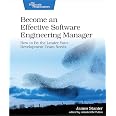
Software startups make global headlines every day. As technology companies succeed and grow, so do their engineering departments. In your career, you'll may suddenly get the opportunity to lead teams: to become a manager. But this is often uncharted territory. How can you decide whether this career move is right for you? And if you do, what do you need to learn to succeed? Where do you start? How do you know that you're doing it right? What does "it" even mean? And isn't management a dirty word? This book will share the secrets you need to know to manage engineers successfully.
Going from engineer to manager doesn't have to be intimidating. Engineers can be managers, and fantastic ones at that. Cast aside the rhetoric and focus on practical, hands-on techniques and tools. You'll become an effective and supportive team leader that your staff will look up to.
Start with your transition to being a manager and see how that compares to being an engineer. Learn how to better organize information, feel productive, and delegate, but not micromanage. Discover how to manage your own boss, hire and fire, do performance and salary reviews, and build a great team. You'll also learn the psychology: how to ship while keeping staff happy, coach and mentor, deal with deadline pressure, handle sensitive information, and navigate workplace politics.
Consider your whole department. How can you work with other teams to ensure best practice? How do you help form guilds and committees and communicate effectively? How can you create career tracks for individual contributors and managers? How can you support flexible and remote working? How can you improve diversity in the industry through your own actions? This book will show you how.
Great managers can make the world a better place. Join us.
In the first part of the book, Getting Oriented, you’re going to drop right into your new job. In A New Adventure you’ll be getting to grips with your new role and working out who your team are, what they do, and how they relate to the rest of the organization. Then you’re going to learn how to Manage Yourself First by getting your routine and habits in order.
Then we’re going to move on to the second part of the book, Working with Individuals. Here you’re going to learn all of the necessary tools and processes to be a success in your day-to-day role. We’ll look at the ways in which you will be Interfacing with Humans every day, focusing on how you can make those interactions fruitful and positive. You’ll then learn how to begin doing weekly One-to-Ones, which is the bedrock of your relationship with your staff.
You’ll also learn how we’re all motivated differently in The Right Job for the Person, understanding how you can use this to help people succeed and be happy. Then, we’ll get to the nitty-gritty. We’ll look into hiring in Join Us! and people leaving in Game Over.
We’ll close out the second part of the book by considering how you can begin to increase your impact outside of your team in How to Win Friends and Influence People, where you’ll find a number of ways that you can contribute to your department for the greater good.
The third part of the book is called The Bigger Picture. This is where you’ll begin to experience the messier sides of management. We’ll look at why Humans Are Hard and Projects Are Hard and what you can do in various tricky scenarios. Then we’ll consider the information that you’ll have to handle, share, and store in The Information Stock Exchange. We’ll then dive deeper into the often-paradoxical psychology of being an effective manager in Letting Go of Control.
We’ll then turn our focus to your environment. You’ll learn ways in which you can make your department’s communication more effective in Good Housekeeping. Then, we’ll consider how to create career progression tracks for your staff in Dual Ladders. The Modern Workplace addresses inclusivity, diversity, and culture and what you can do to make your company a better place for everyone.
We’ll finish off by considering your future. After all, this is a book about you. In Startups we’ll explore whether you might want to try and accelerate your career by joining a small but fast-growing organization. Then, in The Crystal Ball, we’ll run through an exercise together that you can use to think deeply about where your career is going. And guess what? You can use it with your own staff as well.
All that’s left is for me to thank you for embarking on this journey together with me. I hope that you find it entertaining and informative and that it helps you become a better manager and maybe even a better person. All I know is that if I had this book when I started, I would have felt more confident, more comfortable, and more able to know that I was doing a good job for myself, but especially for those in my team. I truly hope that it does the same for you.
|
Become a Great Engineering Leader: Build Effective Skills to Lead and Grow
|
Become an Effective Software Engineering Manager: How to Be the Leader Your D...
|
Effective Remote Work: For Yourself, Your Team, and Your Company
|
|
|---|---|---|---|
| Customer Reviews |
4.4 out of 5 stars 6
|
4.6 out of 5 stars 339
|
4.6 out of 5 stars 17
|
| Books by Dr. James Stanier | no data | no data | no data |
James Stanier is an experienced senior engineering leader who has held leadership and advisory positions in both startups and established companies. He holds a Ph.D. in computer science and runs The Engineering Manager newsletter.
Customer Reviews, including Product Star Ratings help customers to learn more about the product and decide whether it is the right product for them.
To calculate the overall star rating and percentage breakdown by star, we don’t use a simple average. Instead, our system considers things like how recent a review is and if the reviewer bought the item on Amazon. It also analyzed reviews to verify trustworthiness.
Learn more how customers reviews work on AmazonIf you are new manager, already doing it for some time or even long time manager - take the book and read it. This is the book you can read chapter by chapter when needed. I found ir very helpful when I started and also found multiple times it very useful when was going through difficult situations. Book is very practical and with almost zero bullshit. Very recommended.
Managing software engineering efforts is a difficult task. One needs a thorough knowledge of authoring software, which itself is a rare, time-consuming accomplishment. Almost all general managers do not have an in-depth knowledge of programming (though many assume they do!). A few of the best software developers are promoted into a managerial role and have to figure out what to do on the job. Much literature on general management topics exists, but few writings center on the notoriously fickle yet narrow job of writing code. James Sanier’s book attempts to provide one of the few guides in this domain.
This book’s intended audience certainly lies on the side of those beginning with managerial tasks. In concept, it provides a comprehensive overview for the first year in the new role. Choosing to provide quick tutorials, it avoids going into details on specific topics. At times, it makes generalizations for the sake of simplicity and brevity, like when it describes simple career tracks. Those who already have advanced knowledge might find these simplifications a bit trite, but beginners will appreciate the sensitivity for orienting newbies.
The book is relatively non-technical in that it fundamentally describes people-oriented tasks instead of, say, financial approaches that involve algorithms. It tends to divide programmers into sociological categories, like a cathedral constructor versus a bazaar browser. Again, these distinctions help, especially at the beginning, but they don’t provide a ton of nuance.
The writing style is accessible to general readers, and endnotes are provided for further research. Not many IT-specific terms are used, but prior exposure to a team that produces software is assumed. I took away a couple of new concepts, such as a mentorship matrix and the Dunning-Kruger effect, but I will explore these in more detail through other writings since only overviews were provided here. This approach fits very much in line with what I’ve come to expect from the Pragmatic Programmer series. It helpfully fills a niche for people who want a non-theoretical approach to learning programming, a unique approach that’s both useful and needed.
This book is a fountain of knowledge. I’ve experienced many things in book during my career but never had the ability to put them into context. I’ve also learned a lot of new things that I’m excited to try out. The content here is valuable to managers regardless of industry. The strategies discussed are concrete and applicable.
This book has very great insight and described good strategies for new EMs. It’s also helpful if you don’t have the EM experience but interviewing for a position.
I'm an experienced engineering manager, and I manage frontline managers. This book is one of the two books I give as required reading for new managers in my team - together with the Manager's Path. I've gotten several actionable ideas on the second part of the book on more advanced topics.
What I most like about the book is that it is a "modern", 2020 take on engineering management - with the focus being on the "hard to get right the first time" parts. I have yet to read a book on engineering management that covers 1:1s, performance reviews, hiring and laying off, diversity & inclusion, workplace politics, remote work, and the need for managers to relax. I have definitely not seen all of these in one place. As I read, I kept nodding along with the experiences and advice. It's similar advice to what I'd give to anyone wanting to build a great team with a strong developer culture, being a thoughtful manager.
I strongly recommend this book to people just starting - or about to start - their first engineering management role. There is a wealth of practical and genuinely good advice written. It is the kind of advice you get in your first two years as a manager - assuming you have one or two great mentors and are surrounded by multiple peers who continuously give you well-intended feedback. Which is not the case for many people. How do you manage your perception? How do you decide what information to broadcast? How do you do good 1:1s? Do perf reviews? Hire? Let people go? I also find myself looking these topics up when I am mentoring less experienced managers, drawing inspiration on activities to suggest for these managers to take on to grow.
More experienced managers like myself can also take away good parts, especially in the second part of the book. How do you manage high-stakes "The Eye of Sauron" projects? How do you get the news through the grapevine? How do you make workplace politics work for you? What are ways to communicate well within a larger group? How should you design career ladders? What about diversity, inclusion, remote working and work-life balance?
The cover was creased
The cover was creased
This is a fantastic book about engineering management and is a must read for any software engineer who wants to become an engineering manager. But beware, some chapters and content is overly political and leans towards certain political group. Otherwise is a good book if you don't pay attention to that.
I was an engineering manager at an early stage startup and helped take it from ~20->200 employees before switching over to senior technical track. I have to say: I would have loved to have this book when I started being a manager. There's a lot of great tactical advice about how to actually run day-to-day manager responsibilities.
However, I benefitted from reading this even though I'm not a manager anymore. It helped frame my relationship with my manager better, and it gave me more respect for managers on my team. One of my favorite sections is on coaching, as I think it's something that everyone can become skilled at and it will bring value to their role.
Very nicely and in detail explains about day to day activities of EM, VERY GOOD if you are new to the field and want to some experience on how this role works
A light read about engineering management. It gives hints about common practices, still becoming a manager requires innate attitude and a lot of practice.
Very relevant content for managers of all levels.
I strongly recommend this book to people looking at their first engineering managers and more experienced managers.
Livro novo, mas chegou com amassados profundos na lombada, orelha na parte inferior das páginas e uma mancha preta na parte superior da capa. Provavelmente causado pelo transporte pois estava solto dentro do pacote.