|
VOOZH | about |
|
VOOZH | about |
Download the free Kindle app and start reading Kindle books instantly on your smartphone, tablet, or computer - no Kindle device required.
Read instantly on your browser with Kindle for Web.
Using your mobile phone camera - scan the code below and download the Kindle app.
OK
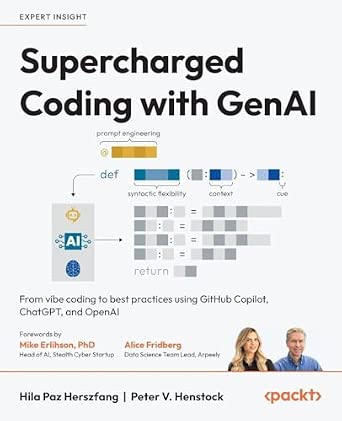
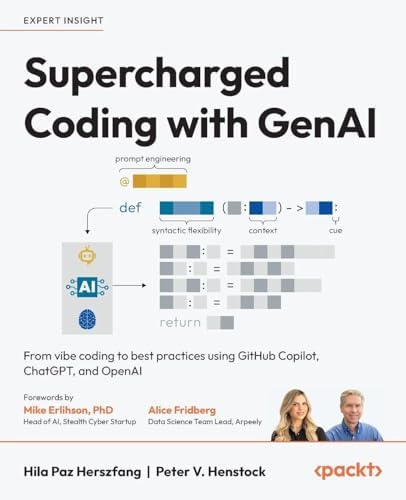
Unlock the power of generative AI in Python development and learn how you can enhance your coding speed, quality, and efficiency with real-world examples and hands-on strategies
Software development is being transformed by GenAI tools, such as ChatGPT, OpenAI API, and GitHub Copilot, redefining how developers work. This book will help you become a power user of GenAI for Python code generation, enabling you to write better software faster. Written by an ML advisor with a thriving tech social media presence and a top AI leader who brings Harvard-level instruction to the table, this book combines practical industry insights with academic expertise.
With this book, you'll gain a deep understanding of large language models (LLMs) and develop a systematic approach to solving complex tasks with AI. Through real-world examples and practical exercises, you’ll master best practices for leveraging GenAI, including prompt engineering techniques like few-shot learning and Chain-of-Thought (CoT).
Going beyond simple code generation, this book teaches you how to automate debugging, refactoring, performance optimization, testing, and monitoring. By applying reusable prompt frameworks and AI-driven workflows, you’ll streamline your software development lifecycle (SDLC) and produce high-quality, well-structured code.
By the end of this book, you'll know how to select the right AI tool for each task, boost efficiency, and anticipate your next coding moves—helping you stay ahead in the AI-powered development era.
If you are a Python developer curious about GenAI and are looking to elevate your software engineering productivity, Supercharged Coding with GenAI will transform your approach to software. Covering various structured examples of varying problem complexities that showcase the use of advanced prompting techniques, this book is suitable for early intermediate through advanced developers. To get the most out of this book, you should have at least one year of hands-on Python development experience and be somewhat familiar with the SDLC.
(N.B. Please use the Read Sample option to see further chapters)
Hila Paz Herszfang, with seven years of building machine learning (ML) services and leading teams, holds a master's degree in information management systems and is completing a second master's in data science, both from Harvard Extension School. She developed a Python for MLOps Udemy course and runs a math and tech TikTok channel boasting 15K followers and 300K+ likes.
Peter V. Henstock is an AI expert with 25+ years of experience at Pfizer, Incyte, and MIT LL. He teaches graduate software engineering and AI/ML courses at Harvard Extension School. He holds a PhD in AI from Purdue and seven Master's degrees. Recognized as a top AI leader by DKA, Peter guides professionals in AI/ML, software, visualization, and statistics.
Hila is a machine learning advisor and leader for building AI services and the co-author of the book “Supercharged Coding with GenAI.” She holds a master’s degree in information management systems and is completing a second master’s in data science, both from Harvard Extension School. She developed a Python for MLOps course for Udemy and runs a math and tech TikTok channel boasting 14.5K followers and 300K+ likes.
Peter Henstock is the Machine Learning Group Leader at Incyte. Previously he worked for 20 years leading AI/ML efforts at Pfizer. His work has focused at the intersection of AI, visualization, statistics and software engineering applied mostly to drug discovery but more recently to clinical trials. Peter holds 9 degrees including a PhD in Artificial Intelligence from Purdue University and an MBA from Boston University. He was recognized as being among the top 12 leaders in AI and Pharma globally by the Deep Knowledge Analytics group. He also currently teaches graduate Artificial Intelligence and Software Engineering courses at Harvard.
Discover more of the author’s books, see similar authors, read book recommendations and more.
Discover more of the author’s books, see similar authors, read book recommendations and more.
Customer Reviews, including Product Star Ratings help customers to learn more about the product and decide whether it is the right product for them.
To calculate the overall star rating and percentage breakdown by star, we don’t use a simple average. Instead, our system considers things like how recent a review is and if the reviewer bought the item on Amazon. It also analyzed reviews to verify trustworthiness.
Learn more how customers reviews work on AmazonPackt publishing has improved its game with this release for GenAI. The topics covered and quality of the product was at an introduction level to GenAI and the most important models available, ChatGPT and GitHub Copilot. It is also east to skim, and deep dive in the chapters that are of most interest. There are other books on LLMs and Deep Learning once you have a good foundation for GenAI. Packt also has another book specifically on GitHub Copilot which I plan to buy next since using GenAI for programming is my interest, but if you are interested in NLP, then a specific book on ChatGPT is more appropriate once you finish learning the basics of how these tools work.
I’ve read my share of technical books, but this book stands out a bit for its hands-on, no-nonsense approach. This isn’t just a book about prompt engineering stuff or a parade of ChatGPT screenshots. It’s a practical, builder’s manual for anyone who wants to make generative AI a real part of their coding workflow.
What I liked most is how the book doesn’t just skim the surface. For example, in Chapter 7, the author walks you through a real codebase (not just toy examples) that calculates Manhattan distance, complete with a directory tree and explanations of files like app.py, src/manhattan.py, and even the Dockerfile and requirements.txt. This is the kind of detail that makes you feel like you’re working alongside a seasoned developer, not just reading a textbook.
The coding exercises are genuinely useful and not just filler. There’s a whole section on using GitHub Copilot to generate functions like get_gross_returns and get_geometric_mean, showing how Copilot predicts and completes code based on context. The book even compares Copilot’s output to ChatGPT and the OpenAI API, pointing out that Copilot excels at code completion, while ChatGPT sometimes adds too many comments and docstrings, making the code harder to read. I found the side-by-side code samples and the discussion of prompt engineering techniques like few-shot learning and chain-of-thought (CoT) especially helpful for understanding how to get the best results from these tools.
Another highlight is the focus on code quality and maintainability. The book doesn’t shy away from real-world issues like stale docstrings or the need to refactor code for readability and performance. There’s a great example where the author uses GenAI tools to detect and update outdated comments in Python functions, and even shows how to use the OpenAI API to automate this process. This is the kind of practical advice that’s missing from most AI books.
My main issue with the book is that it's like a lot of the other books I've read on the subject: It uses Toy examples. What I think could have set it apart was if they actually dove into a larger codebase and taught us how it works in the real world with real world code. Almost none of the guides or books that I've read do that... and I think this is where this one could have shined. But for now, I have to dock it several stars because although the explanations are good, it's just not production ready nor does it show us what it's like to work with a production ready project. I think the rest of the book is good enough as an introduction. But there are a lot of introductions out there...
Wow! This is not just another guide to making quick vibe coded applications; this is a rigorous operational playbook for the AI-augmented software development life cycle. It successfully focuses on preparing code for real-world production environments, where there’s less room for mistakes and blips to happen. What impressed me most was the book's comprehensive commitment to the entire Software Development Life Cycle (SDLC). It dedicates Part 3 to moving "From Code to Production", covering vital skills often looked over by software engineers and passed to devops engineers, such as efficient logging and monitoring methods—which in my opinion is essential knowledge for any modern software engineer.
The book achieves a necessary level of technical depth without losing focus on practicality. It dives deeply into the foundations of LLMs so you truly understand the models that run tools like Copilot and ChatGPT, presenting reader with a pragmatic picture of the GenAI coding ecosystem. Furthermore, the coverage of advanced topics like fine-tuning models to specialize for specific tasks is invaluable. This theoretical grounding is perfectly balanced with many great hands on exercises that feature useful Python code samples, paired with chatGPT, openAI API, and Github Copilot. For developers interested in the intersection of AI and coding, or for any programmer looking to transcend rapid prototyping and write production-ready code, this book is highly recommended.
**Note: the publisher provided me with a review copy of the book.
A must-read for developers exploring the power of GenAI in coding! The book balances theory and practice beautifully, covering GitHub Copilot, ChatGPT, and OpenAI API with real-world Python examples. I especially appreciated the clear explanations of prompt engineering techniques and how to apply GenAI across the entire SDLC. Perfect for anyone looking to boost productivity and code quality with AI-driven workflows.
This is a very timely book, with remarkably deep and broad (beginning to advanced) coverage of the field of GenAI-powered coding. This is not just about Vibe Coding -- the book supercharges and provides thorough coverage of all of the associated components, requirements, and implementation details (including refactoring, fine-tuning, unit testing, logging, monitoring, memory management, documentation, and more -- supercharged with the power of GenAI). Purchase of the book comes with additional perks from Packt (the book's publisher).
Disclosure: the publisher provided me with a free review copy of the book.
This is a very timely book, with remarkably deep and broad (beginning to advanced) coverage of the field of GenAI-powered coding. This is not just about Vibe Coding -- the book supercharges and provides thorough coverage of all of the associated components, requirements, and implementation details (including refactoring, fine-tuning, unit testing, logging, monitoring, memory management, documentation, and more -- supercharged with the power of GenAI). Purchase of the book comes with additional perks from Packt (the book's publisher).
Disclosure: the publisher provided me with a free review copy of the book.
Really enjoyed the book! It takes co-poilot and chat gpt beyond the basics and shows how to actually use them in day today coding. The examples are clear and I picked up lot of skills, I can apply right away.
A comprehensive book explaining how copilot tools can be integrated across sdlc lifecycle.