VOOZH about

URL: https://www.amazon.com/dp/B010EUWHDS

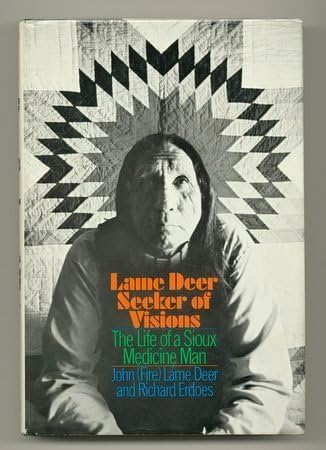
⇱ Lame Deer: Seeker of visions, The life of a Sioux Medicine man. Hardcover August 7, 1972: John Fire Lame Deer: Amazon.com: Books


πŸ‘ Image
πŸ‘ Image

Download the free Kindle app and start reading Kindle books instantly on your smartphone, tablet, or computer - no Kindle device required.

Read instantly on your browser with Kindle for Web.


Using your mobile phone camera - scan the code below and download the Kindle app.

πŸ‘ QR code to download the Kindle App


Follow the authors

Get new release updates & improved recommendations
Something went wrong. Please try your request again later.

OK

Lame Deer: Seeker of visions, The life of a Sioux Medicine man. Hardcover August 7, 1972 Unknown Binding


Lame Deer

Storyteller, rebel, medicine man, Lame Deer was born almost a century ago on the Rosebud Reservation in South Dakota. A full-blooded Sioux, he was many things in the white man's world -- rodeo clown, painter, prisioner. But, above all, he was a holy man of the Lakota tribe.

Seeker of Vision

The story he tells is one of harsh youth and reckless manhood, shotgun marriage and divorce, history and folklore as rich today as ever -- and of his fierce struggle to keep pride alive, though living as a stranger in his own ancestral land.


The Amazon Book Review
Book recommendations, author interviews, editors' picks, and more. Read it now

Customers who viewed this item also viewed

Page 1 of 1 Start over

Customers also bought or read

Page 1 of 1Start over
Loading...

Product details

  • ASIN ‏ : β€Ž B010EUWHDS
  • Publisher ‏ : β€Ž simon & schuster; first edition, first printing edition (august 7, 1972)
  • Customer Reviews:
Brief content visible, double tap to read full content.
Full content visible, double tap to read brief content.

Videos

Help others learn more about this product by uploading a video!
Upload your video

About the authors

Follow authors to get new release updates, plus improved recommendations.

Customer reviews

4.8 out of 5 stars
409 global ratings
How customer reviews and ratings work

Customer Reviews, including Product Star Ratings help customers to learn more about the product and decide whether it is the right product for them.

To calculate the overall star rating and percentage breakdown by star, we don’t use a simple average. Instead, our system considers things like how recent a review is and if the reviewer bought the item on Amazon. It also analyzed reviews to verify trustworthiness.

Learn more how customers reviews work on Amazon


Customers say

Customers find the book insightful and informative, with one noting it serves as a meaningful guide for life. They appreciate its humor, with one review mentioning how each story is both funny and sad. The book receives positive feedback for its story, with one customer describing it as a great true story of Native American struggle. They value its anthropological content, with one review highlighting its anthropology dealing with Native Americana. Customers consider the book a good deal.
AI Generated from the text of customer reviewsπŸ‘ Image
Generated from the text of customer reviews

Select to learn more

61 customers mention content, 61 positive, 0 negative61 customers mention "Content"61 positive0 negative
Customers find the book informative and insightful, with one customer noting it serves as a meaningful guide for life.
"great read for anyone interested in Native history..."Read more
"Great book, lots of humor and thoughtful moments. A meaningful look into the mind of a great philosopher and medicine man"Read more
"Excellent book. Another vision about the american society, as she was at the time, anther point of vue about beliefs and values frim native Americans."Read more
"...Profane, hilarious, sacred and profound, he destroys every stereotype about not only grim, unsmiling stoic Indians, but also grinning, antiseptic..."Read more
9 customers mention humor, 9 positive, 0 negative9 customers mention "Humor"9 positive0 negative
Customers find the book humorous, with one mentioning that each story is both funny and sad.
"...All in all, a profound, deeply moving, provocative, funny and disturbing look at Native American culture subsumed by American white culture, but..."Read more
"Great book, lots of humor and thoughtful moments. A meaningful look into the mind of a great philosopher and medicine man"Read more
"...and will provide the reader with both spiritual uplifting and laugh out loud humor. Well worth your time."Read more
"Great book, funny too!"Read more
8 customers mention story, 8 positive, 0 negative8 customers mention "Story"8 positive0 negative
Customers enjoy the story, with one describing it as a great true tale of Native American struggle and another noting its approachable narrative style.
"This is a great TRUE story of the actual harsh realities of the Native American people and thier corage to continue in what was a very unfair and..."Read more
"Lame Deer's life was an amazing journey and we're all lucky enough that it has been written down...."Read more
"Great story -- I remembered it from my teen years and I gave it to a student of mine with an interest in Native American issues to read...."Read more
"This book was an excellent real-life story of a lakota medicine man, which has some interesting similarities to the book "Black Elk Speaks", which..."Read more
5 customers mention anthropology, 5 positive, 0 negative5 customers mention "Anthropology"5 positive0 negative
Customers appreciate the anthropology in the book, with one review highlighting its exploration of Native American culture through Native American ceremonies.
"...a profound, deeply moving, provocative, funny and disturbing look at Native American culture subsumed by American white culture, but never defeated..."Read more
"...We, the reader, are taken to Native American ceremonies. We are shown what happens and why...."Read more
"...in Native American Spirituality, Animism, and anthropology dealing with Native Americana...."Read more
"Was told of this book by Black Wolf at Gatlinburg. A peek into the Lakota culture."Read more
5 customers mention value for money, 5 positive, 0 negative5 customers mention "Value for money"5 positive0 negative
Customers find the book to be a good deal.
"This is exactly what I was looking for. Glad to have found it at a good price and good condition."Read more
"...Well worth your time."Read more
"...Lame Deer’s Book is priceless reading for all of us."Read more
"Good Deal, Great Purchase, would buy from again"Read more

Amazon Customer
5 out of 5 stars
Enjoyable book
I got this book because it was referenced in a course on the meaning of life. I was expecting a book on Native Ethics but it was not but rather a story of Lame Deer's life yes there were plenty of themes that came be use in a philosophy. John Fire Lame Deer is a fun character and there is a lot wisdom there. Very enjoyable.
Thank you for your feedback
Sorry, there was an error
Sorry we couldn't load the review

Top reviews from the United States

There was a problem filtering reviews. Please reload the page.

  • Reviewed in the United States on January 31, 2026
    Format: Mass Market PaperbackVerified Purchase
    Great book, lots of humor and thoughtful moments. A meaningful look into the mind of a great philosopher and medicine man
  • Daniel A. Brown
    Reviewed in the United States on March 21, 2010
    Format: Mass Market PaperbackVerified Purchase
    A review by Daniel A. Brown
    Β©2010 Daniel A. Brown

    This book, published in 1972 about a contemporary Lakota elder and holy man was co-written by an unlikely source. Born in 1912 in Frankfort, Germany; Richard Erdoes was a shy, lonely kid, finding solace in nature and loving American Indians thanks to Karl May, who was famous in Europe for writing fantastically vivid Western epics.

    Fleeing Hitler, Erdoes re-settled in New York City, but found himself traveling to the wide open prairies of South Dakota, which filled him with a sense of peace. It was only a matter of time before he came into the company of Lakota spiritual elders, one of whom, John Fire Lame Deer, decided that he wanted Erdoes to write a book about his life and Lakota traditions. And so they began, at a time when Native Americans were finally emerging from their own Dark Ages of having their culture suppressed. "Lame Deer, Seeker of Visions" is the result of this collaboration.

    The story is narrated exclusively by its namesake and the old guy is a hoot. Profane, hilarious, sacred and profound, he destroys every stereotype about not only grim, unsmiling stoic Indians, but also grinning, antiseptic New Age "teachers". Raised on the Rosebud reservation right after the turn of the century, he began life as an angry, if not, imaginative rebel who refused to accept his humiliating station in life. Early in his story, Lame Deer describes this mad car-stealing spree in which he hijacked several Model T's in the middle of a South Dakota blizzard while "drunk as a boiled owl", one of the colorful metaphors that Lame Deer peppers his language with.

    Sent to a reformatory, he learned a trade and after a stint as a sign painter, rodeo clown, peyote-church worshipper, tribal cop, and sheep herder; all described in nuances that suggest an indigenous Garrison Keillor, he finally settled down into what he decided was his true mission in life, namely, "Being an Indian".

    A major portion of the narrative concerns the explanation of Lakota rituals and spiritual world-view that are most likely well-known to any informed reader. But these sections are not what make this tale unique. It is more about Lame Deer observing how the secret threads of life operate differently from the linear pattern we have come to expect: Go to school, get a job, get married, move up the ladder of material success, and then retire.

    Lame Deer looks at this differently, the result of his own erratic life. "The `find-out'", he explains, "It has lasted my whole life. In a way I was always hopping back and forth across the boundary line of my mind." He identifies with artists because they are the "Indians of the white world". Meaning, they are the dreamers and visionaries who see the spirit realm and usually have trouble navigating the "Green Frog Skin World", the colorful adjective referring to Lame Deer's term for money. Lame Deer understands only too well what a corrupting influence the Green Frog Skin has had, not only on his own people, but on humanity at large.

    "Lame Deer, Seeker of Visions" might seem dated in the present culture of Indian casinos and New Age megabucks but it is an excellent bridge between the current and the traditional as well as a shrewdly entertaining read. Both Lame Deer and Erdoes have passed away but their book is a fitting tribute to the integrity of both men and their unusual partnership.

    Daniel A. Brown is a writer, artist and photographer living in Greenfield, Mass. His artwork can be seen at [...].
    13 people found this helpful
    Report
  • Thomas Cannon
    Reviewed in the United States on December 27, 2017
    Format: Mass Market PaperbackVerified Purchase
    Lame Deer Seeker of Visions

    I highly recommend this book describing the life of John Lame Deer if you are interested in the history of Native Americans or their view of The United States.

    These are the memoirs of Lame Deer that he worked on with Richard Erdoes. Lame Deer describes how Native Americans dealt with whites taking their land through lies and massacres. He also describes trying to keep his culture alive.

    We, the reader, are taken to Native American ceremonies. We are shown what happens and why. Lame Deer also explains how they have changed through whites interference. To me, this book also gives the best description of how Native American people are connected to the land.

    We also get the long life of Lame Deer. That guy lived quite a life. From criminal to Medicine Man, Lame Deer gives us frank description of all points in his life.

    For me, the descriptions of the ceremonies and the myths behind them got a little tedious, but yet it is important to have a complete description of them.

    This book is a good reminder that the history of Native Americans is not over. It continues as does their battles for their sacred lands. As a dominant culture we have a tendency to think, we have to move on. That is the past. This book describes how Native Americans are trying to do this, but their ancestors were massacred. They were not even allowed to keep their culture. It was taken from them at gun point.
    8 people found this helpful
    Report
  • Richard Reese (author of Understanding Sustainability)
    Reviewed in the United States on August 28, 2012
    Format: Mass Market PaperbackVerified Purchase
    Tahca Ushte (Lame Deer) was a Lakota medicine man from a land now known as South Dakota ("Sioux" is a white name that insults the Lakota). His government-issued name was John Fire. He was born some time between 1895 and 1903, and died in 1976. His parents were of the last generation to be born wild and free. Two of his grandfathers had been at the battle of Little Big Horn, Custer's last stand, and one of them survived the massacre at Wounded Knee.

    Lame Deer's early years were spent in a remote location, where they had no contact with the outside world. He never saw a white man until he was five. At 14, he was taken away to a boarding school, where he was prohibited from speaking his language or singing his songs. The class work never went beyond the level of third grade, so Lame Deer spent six years in the third grade. He eventually gained renown for being a rebellious troublemaker. When he was 16, he went on a vision quest, and discovered that he was to become a medicine man.

    Sons destined to become medicine men were often removed from school by their families, because schooling was harmful to the growth of someone walking a spiritual path. One father drove away truancy officers with a shotgun. For medicine men, the skills of reading and writing had absolutely no value.

    When Lame Deer was 17, his mother died, and the family fell apart. The white world was closing in, making it hard for his father to survive as a rancher. He gave his children some livestock and wished them good luck. By that time, the buffalo were dead, their land was gone, many lived on reservations, and the good old days for the Lakota were behind them.

    Lame Deer straddled two worlds, the sacred path of Lakota tradition, and the pure madness of the "frog-skinners," -- people who were driven by an insatiable hunger for green frog-skins (dollar bills). The frog-skinners were bred to be consumers, not human beings, so they were not fun to be around.

    Lame Deer spent maybe 20 years wandering. He made money as a rodeo rider, clown, square dance caller, potato picker, shepherd, and so on. He always avoided work in factories or offices, "because any human being is too good for that kind of no-life, even white people." He enjoyed many women, did more than a little drinking, stole a few cars, and shunned the conventional civilized life.

    Between jobs he would return to his reservation and spend time with the elders. During World War II, just before Normandy, he was thrown out of the Army when they discovered that he was 39, too old. Soon after, he abandoned the frog-skin world and became a full time Indian, walking on the sacred path of a medicine man.

    For the Lakota, the Black Hills were the most sacred place in their world. To retain possession of them, they surrendered much of what became Montana, Wyoming, and the Dakotas. The treaty declared that the Black Hills would remain Indian territory "for as long as the sun shined." Soon after, whites discovered gold in the Black Hills, and flooded into the holy lands with drills, dynamite, whiskey, and prostitutes. The Lakota were horrified by the behavior of these civilized Christians.

    The frog-skinners exterminated the buffalo, and replaced them with livestock. Buffalo were beings of great power and intelligence. They even had a sense of humor. Lame Deer said that if buffalo were used in bullfighting, the cocky matadors would promptly be trampled and gored into extinction. Cattle were dullards that had the power bred out of them. Sheep and goats would stand calmly while you cut their throats.

    To provide additional vegetation for the dim-witted livestock, the prairie dogs had to go. Ranchers launched an intensive poisoning campaign that also killed more than a few children and pets. With the prairie dogs gone, there was far less prey for the wolves, coyotes, bobcats, foxes, badgers, hawks, and eagles. A diverse, thriving prairie ecosystem was replaced with monocultures of destructive sub-intelligent exotic species.

    Sheep were amazingly frail. They often fell over, with their feet in the air, and couldn't get back up again. If the shepherd didn't rescue them, they would bloat up and die. Lambs often had to be hand-raised because their mothers didn't recognize them or feed them.

    "There was great power in a wolf, even in a coyote. You have made him into a freak -- a toy poodle, a Pekingese, a lap dog. ... You have not only altered, declawed, and malformed your winged and four-legged cousins; you have done it to yourselves. ... You live in prisons which you have built for yourselves, calling them homes, offices, factories."

    In the 1880s, the Indians of the west were in despair, and the Ghost Dance movement was spreading from tribe to tribe. It was a grand magic act intended to bring a new world into existence via sacred song and dance. The dead would come back to life, the buffalo herds would return, the whites would get sent back home, and the civilized world would be rolled up like a dirty old carpet -- the cities, mines, farms, and factories. This would reveal a healthy unspoiled land, with many teepees and animals, as it once had been.

    Dancers were not allowed to possess things from the white world: liquor, guns, knives, kettles, or metal ornaments. They would dance for four days. Whites feared an armed uprising, so they attacked the dancers. Hundreds of unarmed Indians were murdered at the Wounded Knee massacre.

    The magic dancing did not succeed, but today many can see that a great healing is badly needed. Obviously, the madness cannot continue forever. Lame Deer was clear: "The machine will stop." He said that a young man would one day come who would know how to turn it off. "It won't be bad, doing without many things you are now used to, things taken out of the earth and wasted foolishly." We will have to learn how to live more simply, and this will be good for one and all.

    Lame Deer asked Richard Erdoes to help write his story, to pass along important information. He included several chapters describing the sacred culture of the Lakota. He wanted hold up a mirror for us, to give us a different perspective, to feed a sane voice into our lost and confused world. "We must try to save the white man from himself. This can be done if only all of us, Indians and non-Indians alike, can once again see ourselves as part of this earth."

    Richard Adrian Reese
    Author of What Is Sustainable
    47 people found this helpful
    Report

Top reviews from other countries

  • sebastia catala
    5.0 out of 5 stars gran recordatorio
    Reviewed in Spain on January 31, 2025
    Format: PaperbackVerified Purchase
    mi espiritualidad
  • refugeewurzel
    5.0 out of 5 stars This is a great read
    Reviewed in the United Kingdom on June 1, 2013
    Format: Mass Market PaperbackVerified Purchase
    I read the original print version on winter in Canada, it was a loan book was not keen to return it but a promise is a promise and this is a prize I understand someone wanting to keep. This mans story is a great insight into the culture clash and the disenfranchising intransigence of white supremis cultural imposition on the indigenous peoples of Turtle island. There is no mistaking the loss and desolation that affected the rose bud nation reserve and its catastrophic inheritance that visits the people even today. This mans life was full of the celebrations and knowledge of his people, their well being and a history that represented health.
    A book of ambassadorial information and an honour to the first nation peoples and their ways. In spite of the injustices they were subjugated beneath. Put today strife into context, And offers insight rather than judgement for the people of the Rose bud nation.
  • 5.0 out of 5 stars SUPER LIVRE
    Reviewed in France on November 13, 2015
    Format: Mass Market PaperbackVerified Purchase
    Cadeau pour mon mari , il parrait que c'estun shaman trΓ©s connu .... bon livre a recommander
    bonne lecture mes amis
  • Marcelo Coscollano
    5.0 out of 5 stars Sehr gut.
    Reviewed in Germany on June 26, 2013
    Format: Mass Market PaperbackVerified Purchase
    Sehr gut und billig, hab das Buch mal vor 28 Jahren auf Deutsch gelesen, und bin sehr froh es wieder gefunden zu haben.
  • 不死ι³₯
    5.0 out of 5 stars so nice!
    Reviewed in Japan on October 5, 2014
    Format: Mass Market PaperbackVerified Purchase
    It is the book we have to read in this century. Well, it is not only for this century but foreve ever.