|
VOOZH | about |
|
VOOZH | about |
These promotions will be applied to this item:
Some promotions may be combined; others are not eligible to be combined with other offers. For details, please see the Terms & Conditions associated with these promotions.
Download the free Kindle app and start reading Kindle books instantly on your smartphone, tablet, or computer - no Kindle device required.
Read instantly on your browser with Kindle for Web.
Using your mobile phone camera - scan the code below and download the Kindle app.
OK
The Hidden Pattern of Everyday Life
What men daily do, not knowing what they do!
—William Shakespeare, Much Ado About Nothing
If you want to measure the world’s emotional state, to find a mood ring large enough to encircle the globe, you could do worse than Twitter. Nearly one billion human beings have accounts, and they post roughly 6,000 tweets every second. The sheer volume of these minimessages—what people say and how they say it—has produced an ocean of data that social scientists can swim through to understand human behavior.
A few years ago, two Cornell University sociologists, Michael Macy and Scott Golder, studied more than 500 million tweets that 2.4 million users in eighty-four countries posted over a two-year period. They hoped to use this trove to measure people’s emotions—in particular, how “positive affect” (emotions such as enthusiasm, confidence, and alertness) and “negative affect” (emotions such as anger, lethargy, and guilt) varied over time. The researchers didn’t read those half a billion tweets one by one, of course. Instead, they fed the posts into a powerful and widely used computerized text-analysis program called LIWC (Linguistic Inquiry and Word Count) that evaluated each word for the emotion it conveyed.
What Macy and Golder found, and published in the eminent journal Science, was a remarkably consistent pattern across people’s waking hours. Positive affect—language revealing that tweeters felt active, engaged, and hopeful—generally rose in the morning, plummeted in the afternoon, and climbed back up again in the early evening. Whether a tweeter was North American or Asian, Muslim or atheist, black or white or brown, didn’t matter. “The temporal affective pattern is similarly shaped across disparate cultures and geographic locations,” they write. Nor did it matter whether people were tweeting on a Monday or a Thursday. Each weekday was basically the same. Weekend results differed slightly. Positive affect was generally a bit higher on Saturdays and Sundays—and the morning peak began about two hours later than on weekdays—but the overall shape stayed the same. Whether measured in a large, diverse country like the United States or a smaller, more homogenous country like the United Arab Emirates, the daily pattern remained weirdly similar.
Across continents and time zones, as predictable as the ocean tides, was the same daily oscillation—a peak, a trough, and a rebound. Beneath the surface of our everyday life is a hidden pattern: crucial, unexpected, and revealing.
Understanding this pattern—where it comes from and what it means—begins with a potted plant, a Mimosa pudica, to be exact, that perched on the windowsill of an office in eighteenth-century France. Both the office and the plant belonged to Jean-Jacques d’Ortous de Mairan, a prominent astronomer of his time. Early one summer evening in 1729, de Mairan sat at his desk doing what both eighteenth-century French astronomers and twenty-first-century American writers do when they have serious work to complete: He was staring out the window. As twilight approached, de Mairan noticed that the leaves of the plant sitting on his windowsill had closed up. Earlier in the day, when sunlight streamed through the window, the leaves were spread open. This pattern—leaves unfurled during the sunny morning and furled as darkness loomed—spurred questions. How did the plant sense its surroundings? And what would happen if that pattern of light and dark was disrupted?
So in what would become an act of historically productive procrastination, de Mairan removed the plant from the windowsill, stuck it in a cabinet, and shut the door to seal off light. The following morning, he opened the cabinet to check on the plant and—mon Dieu!—the leaves had unfurled despite being in complete darkness. He continued his investigation for a few more weeks, draping black curtains over his windows to prevent even a sliver of light from penetrating the office. The pattern remained. The Mimosa pudica’s leaves opened in the morning, closed in the evening. The plant wasn’t reacting to external light. It was abiding by its own internal clock.
Since de Mairan’s discovery nearly three centuries ago, scientists have established that nearly all living things—from single-cell organisms that lurk in ponds to multicellular organisms that drive minivans—have biological clocks. These internal timekeepers play an essential role in proper functioning. They govern a collection of what are called circadian rhythms (from the Latin circa [around] and diem [day]) that set the daily backbeat of every creature’s life. (Indeed, from de Mairan’s potted plant eventually bloomed an entirely new science of biological rhythms known as chronobiology.)
For you and me, the biological Big Ben is the suprachiasmatic nucleus, or SCN, a cluster of some 20,000 cells the size of a grain of rice in the hypothalamus, which sits in the lower center of the brain. The SCN controls the rise and fall of our body temperature, regulates our hormones, and helps us fall asleep at night and awaken in the morning. The SCN’s daily timer runs a bit longer than it takes for the Earth to make one full rotation—about twenty-four hours and eleven minutes. So our built-in clock uses social cues (office schedules and bus timetables) and environmental signals (sunrise and sunset) to make small adjustments that bring the internal and external cycles more or less in synch, a process called “entrainment.”
The result is that, like the plant on de Mairan’s windowsill, human beings metaphorically “open” and “close” at regular times during each day. The patterns aren’t identical for every person—just as my blood pressure and pulse aren’t exactly the same as yours or even the same as mine were twenty years ago or will be twenty years hence. But the broad contours are remarkably similar. And where they’re not, they differ in predictable ways.
Chronobiologists and other researchers began by examining physiological functions such as melatonin production and metabolic response, but the work has now widened to include emotions and behavior. Their research is unlocking some surprising time-based patterns in how we feel and how we perform—which, in turn, yields guidance on how we can configure our own daily lives.
Mood Swings and Stock Swings
For all their volume, hundreds of millions of tweets cannot provide a perfect window into our daily souls. While other studies using Twitter to measure mood have found much the same patterns that Macy and Golder discovered, both the medium and the methodology have limits. People often use social media to present an ideal face to the world that might mask their true, and perhaps less ideal, emotions. In addition, the industrial-strength analytic tools necessary to interpret so much data can’t always detect irony, sarcasm, and other subtle human tricks.
Fortunately, behavioral scientists have other methods to understand what we are thinking and feeling, and one is especially good for charting hour-to-hour changes in how we feel. It’s called the Day Reconstruction Method (DRM), the creation of a quintet of researchers that included Daniel Kahneman, winner of the Nobel Prize in Economics, and Alan Krueger, who served as chairman of the White House Council of Economic Advisers under Barack Obama. With the DRM, participants reconstruct the previous day—chronicling everything they did and how they felt while doing it. DRM research, for instance, has shown that during any given day people typically are least happy while commuting and most happy while canoodling.
In 2006, Kahneman, Krueger, and crew enlisted the DRM to measure “a quality of affect that is often overlooked: its rhythmicity over the course of a day.” They asked more than nine hundred American women—a mix of races, ages, household incomes, and education levels—to think about the previous “day as a continuous series of scenes or episodes in a film,” each one lasting between about fifteen minutes and two hours. The women then described what they were doing during each episode and chose from a list of twelve adjectives (happy, frustrated, enjoying myself, annoyed, and so on) to characterize their emotions during that time.
When the researchers crunched the numbers, they found a “consistent and strong bimodal pattern”—twin peaks—during the day. The women’s positive affect climbed in the morning hours until it reached an “optimal emotional point” around midday. Then their good mood quickly plummeted and stayed low throughout the afternoon only to rise again in the early evening.
Here, for example, are charts for three positive emotions—happy, warm, and enjoying myself. (The vertical axis represents the participants’ measure of their mood, with higher numbers being more positive and lower numbers less positive. The horizontal axis shows the time of day, from 7 a.m. to 9 p.m.)
The three charts are obviously not identical, but they all share the same essential shape. What’s more, that shape—and the cycle of the day it represents—looks a lot like the one on page 10. An early spike, a big drop, and a subsequent recovery.
On a matter as elusive as human emotion, no study or methodology is definitive. This DRM looked only at women. In addition, what and when can be difficult to untangle. One reason “enjoying myself” is high at noon and low at 5 p.m. is that we tend to dig socializing (which people do around lunchtime) and detest battling traffic (which people often do in the early evening). Yet the pattern is so regular, and has been replicated so many times, that it’s difficult to ignore.
So far I’ve described only what DRM researchers found about positive affect. The ups and downs of negative emotions—feeling frustrated, worried, or hassled—were not as pronounced, but they typically showed a reverse pattern, rising in the afternoon and sinking as the day drew to a close. But when the researchers combined the two emotions, the effect was especially stark. The following graph depicts what you might think of as “net good mood.” It takes the hourly ratings for happiness and subtracts the ratings for frustration.
Once again, a peak, a trough, and a rebound.
Moods are an internal state, but they have an external impact. Try as we might to conceal our emotions, they inevitably leak—and that shapes how others respond to our words and actions.
Which leads us inexorably to canned soup.
If you’ve ever prepared a bowl of cream of tomato soup for lunch, Doug Conant might be the reason why. From 2001 to 2011, Conant was the CEO of Campbell Soup Company, the iconic brand with those iconic cans. During his tenure, Conant helped to revitalize the company and return it to steady growth. Like all CEOs, Conant juggled multiple duties. But one he handled with particular calm and aplomb is the rite of corporate life known as the quarterly earnings call.
Every three months, Conant and two or three lieutenants (usually the company’s chief financial officer, controller, and head of investor relations) would walk into a boardroom in Campbell’s Camden, New Jersey, headquarters. Each person would take a seat along one of the sides of a long rectangular table. At the center of the table sat a speakerphone, the staging ground for a one-hour conference call. At the other end of the speakerphone were one hundred or so investors, journalists, and, most important, stock analysts, whose job is to assess a company’s strengths and weaknesses. In the first half hour, Conant would report on Campbell’s revenue, expenses, and earnings the previous quarter. In the second half hour, the executives would answer questions posed by analysts, who would probe for clues about the company’s performance.
At Campbell Soup and all public companies, the stakes are high for earnings calls. How analysts react—did the CEO’s comments leave them bullish or bearish about the company’s prospects?—can send a stock soaring or sinking. “You have to thread the needle,” Conant told me. “You have to be responsible and unbiased, and report the facts. But you also have a chance to champion the company and set the record straight.” Conant says his goal was always to “take uncertainty out of an uncertain marketplace. For me, these calls introduced a sense of rhythmic certainty into my relationships with investors.”
CEOs are human beings, of course, and therefore presumably subject to the same daily changes in mood as the rest of us. But CEOs are also a stalwart lot. They’re tough-minded and strategic. They know that millions of dollars ride on every syllable they utter in these calls, so they arrive at these encounters poised and prepared. Surely it couldn’t make any difference—to the CEO’s performance or the company’s fortunes—when these calls occur?
Three American business school professors decided to find out. In a first-of-its-kind study, they analyzed more than 26,000 earnings calls from more than 2,100 public companies over six and a half years using linguistic algorithms similar to the ones employed in the Twitter study. They examined whether the time of day influenced the emotional tenor of these critical conversations—and, as a consequence, perhaps even the price of the company’s stock.
Calls held first thing in the morning turned out to be reasonably upbeat and positive. But as the day progressed, the “tone grew more negative and less resolute.” Around lunchtime, mood rebounded slightly, probably because call participants recharged their mental and emotional batteries, the professors conjectured. But in the afternoon, negativity deepened again, with mood recovering only after the market’s closing bell. Moreover, this pattern held “even after controlling for factors such as industry norms, financial distress, growth opportunities, and the news that companies were reporting.” In other words, even when the researchers factored in economic news (a slowdown in China that hindered a company’s exports) or firm fundamentals (a company that reported abysmal quarterly earnings), afternoon calls “were more negative, irritable, and combative” than morning calls.
Perhaps more important, especially for investors, the time of the call and the subsequent mood it engendered influenced companies’ stock prices. Shares declined in response to negative tone—again, even after adjusting for actual good news or bad news—“leading to temporary stock mispricing for firms hosting earnings calls later in the day.”
While the share prices eventually righted themselves, these results are remarkable. As the researchers note, “call participants represent the near embodiment of the idealized homo economicus.” Both the analysts and the executives know the stakes. It’s not merely the people on the call who are listening. It’s the entire market. The wrong word, a clumsy answer, or an unconvincing response can send a stock’s price spiraling downward, imperiling the company’s prospects and the executives’ paychecks. These hardheaded businesspeople have every incentive to act rationally, and I’m sure they believe they do. But economic rationality is no match for a biological clock forged during a few million years of evolution. Even “sophisticated economic agents acting in real and highly incentivized settings are influenced by diurnal rhythms in the performance of their professional duties.”
These findings have wide implications, say the researchers. The results “are indicative of a much more pervasive phenomenon of diurnal rhythms influencing corporate communications, decision-making and performance across all employee ranks and business enterprises throughout the economy.” So stark were the results that the authors do something rare in academic papers: They offer specific, practical advice.
“[A]n important takeaway from our study for corporate executivesis that communications with investors, and probably other criticalmanagerial decisions and negotiations, should be conducted earlier in the day.”
Should the rest of us heed this counsel? (Campbell, as it happens,typically held its earnings calls in the morning.) Our moods cycle in a regular pattern—and, almost invisibly, that affects how corporate executives do their job. So should those of us who haven’t ascended to the C-suite also frontload our days and tackle our important work in the morning?
The answer is yes. And no.
Daniel H. Pink is the #1 New York Times bestselling author of seven books -- including his latest, THE POWER OF REGRET: How Looking Backward Moves Us Forward. His books have sold millions of copies around the world, been translated into forty-two languages, and have won multiple awards. He lives with his family in Washington, DC.
Customer Reviews, including Product Star Ratings help customers to learn more about the product and decide whether it is the right product for them.
To calculate the overall star rating and percentage breakdown by star, we don’t use a simple average. Instead, our system considers things like how recent a review is and if the reviewer bought the item on Amazon. It also analyzed reviews to verify trustworthiness.
Learn more how customers reviews work on AmazonDaniel Pink has already written a couple of best-selling books, and it’s safe to say this one will be his latest. It’s a book about timing, the “when” side of the “what” coin. When is a lot more critical than most of us assume. And it’s importance is naturally underscored simply because “when” seems less controllable than “what”.
But both assumptions are generally wrong. Or at least a bit myopic. We can adapt the what to the when in most cases. And we can control the when, perhaps by starting over, or taking a short break, or even a nap (“Zambonis for our brains”), far more than we may currently imagine.
The key is to understand “when” in a more expansive context. And, in the end, that’s what the book strives to do, and does well. Pink puts when in the context of the waves of the day (your chronobiology), the events of the day (the importance of lunch, breaks, naps), the when of getting on track (sometimes you need to re-start), the meaning of when milestones (the importance of midpoints and poignant endings), and the important role of timing in becoming synchronized with the people and the world around us, which, in turn, fosters belonging and a sense of purpose.
As is the current trend in books of this genre, the prognosis and the recommendations are scientific, which essentially means that Pink and his researchers have scoured a lot of literature looking for patterns.
The problem with patterns, however, is that it is often difficult to know if you are witnessing a causal pattern or a resulting pattern. Pink is clearly aware of the problem and has taken as many steps as can be practically taken to differentiate one from the other. Nonetheless, even in a thorough and responsible research effort such as this, the patterns discerned are ultimately probabilistic, not certain.
A related problem is determining which patterns are truly natural and which are acquired. A night owl behaves and performs like the night owls in the study but were they born that way or did they acquire the pattern through prior habit, ingrained out of necessity, not choice? And can those patterns be altered or redefined? (Maybe the stuff of a future book?)
Pink, however, is well aware of both of these limitations to research such as is chronicled here. And in addition to navigating around them he makes it work by not over-promising on the conclusions. While the book is inspirational, therefore, it stops short of promising an end to world hunger. And that, compared to many popular books in the genre, I think, gives the work even more credibility and importance.
In the beginning, I might warn you, many of the observations and recommendations may strike some readers as plainly intuitive. As a sexagenarian I have to admit that I had, through trial and error, already come to some of the same conclusions the book identifies without the benefit of the scientific research. That’s no claim to fame or attempt to dissuade you from reading it, however. I lost a lot of time getting there on my own and, in the end, Pink does what great researchers and historians ultimately do by rising above the facts and figures. He puts it all into a larger perspective that draws it all together and enhances the impact in a way that I never had.
While it’s a minor footnote in the book’s premise, the money line for me has less to do with timing and more to do with the bandwidth of time itself. Pink notes, “By now, it’s well known that 99 percent of us cannot multitask.”
I could not agree more. Multitasking, I believe, or attempts to multitask, are killing productivity in the American workplace and, in fact, causing a lot of harm (e.g., texting while driving). Multitasking is a myth and we do people a grave injustice by encouraging it. If your boss tells you that you are good at multi-tasking I strongly recommend you find a new boss.
I also agree that contrary to what we are frequently told by our personal coaches and advisors, “living in the present” is a lot less important than understanding the present in the larger context of who we are and why we’re here.
All told, this is a very easy and quick read. The writing is crisp and clear and the author has a good sense of humor. It should take no more than a few hours and there are plenty of study guides and worksheets to help you translate the research into actual behavior.
Very well done.
Pink is a great story-teller. This book reinforces that reputation. Starting with an example from WWI era (Lusitania), Pink posits that time at which decisions are made has a significant impact; After poring over various theories, Pink, in a surprising oversimplification argues that "may be the decisions (made by the Captain) were bad because they were made at noon". Thankfully, the rest of the book doesn't stay that superficial.
With a thorough introduction to various research methods involving sentiment analysis and techniques such as DRM, Pink clearly demonstrates why a reader should pay attention to the time at which decisions are made; the narrative of the discovery of circadian rhythms itself is a fun read.
The rest of the book highlights various insights (and strategies) associated with starts, endings and "in-betweens" - the power of breaks, an interesting look at motivation and its residual effects, etc. Pink then channels Kahneman's work and defines strategies on synchronization/group coordination.
Pink sticks to a narrative style that has been well-received - a collection of motivating examples, an introduction to the core research method/project, simplified interpretation, and then a practical suggestion based on that insight. Here, he takes it a step further and creates almost a parallel book (Time Hacker's Handbook) that focuses on providing practical advise and self-tests. This allow a reader to quickly refer to these tips at a later day without having to hunt for them. The parallel-book approach is an interesting narrative device. In addition, the detailed notes/citations and suggested readings makes it a useful resource for the more curious reader.
At times, the book seems a bit drawn out; the core message and premise is a simple one; various examples seem to mostly reemphasize the core premise than substantially add or qualify. While Pink mentions the challenges of such research, one keeps wondering how representative these insights are (for example, Twitter analysis was consistent across different cultures, but it assumes Twitter users are representative of the world). Despite such minor academic squabbles one can create, the book provides a useful framework to evaluate one's routines and explore if there are ways in which timing of decisions have any impact. One would have benefited from more explanations or hypotheses from areas that have tried biofeedback mechanisms (day traders, air traffic controllers, ...etc) that could've triggered more reading/research. 4.5*
Daniel Pink asks REALLY interesting questions. Then he researches them carefully and writes beautifully about them. He reminds me a lot of Dan Ariely, the James B. Duke Professor of Psychology and Behavioral Economics at Duke. They both ask really insightful questions, that no one else would think of, and they both deploy a great sense of humor as they answer those questions. In this latest book, Pink examines how time and timing impacts what we do and when we do it, and why. He draws from a wide range of fascinating examples, starting with how the time of day may have played a major role in bad decisions made by the captain of the Lusitania that led to its sinking by a German U-boat in 1915, to how 5,000 Dabbawalas in modern Mumbai synchronize the delivery of 200,000 homemade lunches to their customers, to explore the biological and scientific reason why many things happen when they do. As with Dan Pink's other books, I learned a tremendous amount about myself and my world that I probably never would have considered seriously without reading this book, and, also like his other books, it was a great read! Buckle up for an amazing ride and prepare to be blown away - AGAIN! As a university professor, I finally understand exactly why my students get very little from their classes before about 11:00 a.m., and why they're all in their prime late in the evening. As an administrator, I need to figure out how we can make the university synch better with their very specific circadian rhythms to enhance learning.
We all need strategies to make our finite resources work harder and stretch farther—why not
also time, the most rigidly finite resource of all? While there are the same 24 hours in a day for
each of us, those 24 hours are not created equal. Some of them are more productive than
others, brimful with potential; some are best reserved for naps. Dan Pink has combed the
science and synthesized the results to help us elasticize our seemingly most inflexible
constraint. We can’t make more time, but we can make more out of it by understanding how it
works for and against us depending on where we are in the daily, monthly, yearly dance of the
hours. From when to exercise or imbibe the first cup of coffee, the ideal age to marry and what
month your spouse is most likely to divorce you, what sort of bird your biological clock most
closely mimics, how business (and other critical) decisions can be poisoned by bad timing—it’s
all rolled out in When. Loved this book for the large net it casts over the whole construct of time
and its dominion in our lives, but especially for the tips and hacks to help us take back some of
that power and become the agents of our smarter beginnings, more adept midpoints, and
graceful, grateful endings. Five stars, and then some.
The central thesis is very simple and builds off of a small body of research. Because of this, much of the book is repetitive and trying to stretch the idea across several avenues. You really get everything you need out of just a chapter or two.
I think the best way for you to know what Dan Pink wants you to get out of When: The Scientific Secrets of Perfect is to quote a long paragraph from the end of the book.
“The product of writing— this book— contains more answers than questions. But the process of writing is the opposite. Writing is an act of discovering what you think and what you believe. I used to believe in ignoring the waves of the day. Now I believe in surfing them. I used to believe that lunch breaks, naps, and taking walks were niceties. Now I believe they’re necessities. I used to believe that the best way to overcome a bad start at work, at school, or at home was to shake it off and move on. Now I believe the better approach is to start again or start together. I used to believe that midpoints didn’t matter— mostly because I was oblivious to their very existence. Now I believe that midpoints illustrate something fundamental about how people behave and how the world works. I used to believe in the value of happy endings. Now I believe that the power of endings rests not in their unmitigated sunniness but in their poignancy and meaning. I used to believe that synchronizing with others was merely a mechanical process. Now I believe that it requires a sense of belonging, rewards a sense of purpose, and reveals a part of our nature. I used to believe that timing was everything. Now I believe that everything is timing.”
Dan Pink begins the book like the good speech writer he was, with an interesting story and a question. The story is about Captain William Turner, who was in command of the Lusitania when German U-boats sank her and escalated World War I. We know that in the hours immediately prior to being torpedoed, Turner made several bad decisions. Pink says, “Maybe those decisions were bad because he made them in the afternoon.”
That’s his transition to the opening of the book and the idea that we can understand many things about us by understanding what scientific research is finding out about timing. Pink calls it “an emerging body of multi-faceted, multi-disciplinary research.”
Pink has divided his book on “perfect timing” into three sections. Part 1 is about the day. There are two chapters. Part 2 is about “Beginnings, endings, and in between.” There are five chapters in that section. Part 3 is two chapters on “Syncing and Thinking.” Here’s a little more detail about the contents.
Chapter one is devoted to the hidden pattern of everyday life and introduces us to chronotypes. While chronotypes result in a personal pattern of daily rhythms, they all include three stages: a peak, a trough, and a rebound.
The next chapter is about breaks and naps. It also addresses the question that Pink raised in the introduction about whether Captain Turner’s bad decisions were caused by being in the afternoon.
Part 2 is about the emotional power of beginnings and endings. There are also some crucial insights on midpoints. That’s where Pink introduces us to what he calls “The uh-oh effect.” That’s that period where you or your team are working on a project and suddenly realize that if you don’t get your act together, you won’t make your deadline. Uh-oh.
The final section of the book is devoted to syncing and thinking. There’s one chapter on syncing, the way that we work in groups. Pink says that group timing requires “someone or something above and apart from the group itself to set the pace, maintain the standards, and focus the collective mind.” He calls that “someone or something” a “boss.”
The final content chapter of the book is “Thinking in Tenses.” It’s about how we deal with the past, present, and future.
In addition to the core content of this book, Pink gives us a “Time Hacker’s Handbook.” I suspect that he does this for two reasons. It makes the book longer, pushing it up beyond the magical 250 pages that most mainline publishers want a business book to have. And, by putting the practical applications stuff in the Time Hacker’s Handbook, Pink avoids the tough writing challenge of integrating it into the basic text of the book.
In A Nutshell
When: The Scientific Secrets of Perfect is pretty much Dan Pink. The writing clips along, and you'll learn lots of interesting stuff. Pink is great at pulling together a bunch of surveys and studies and stuff and making a point. But that’s also the problem, he’s always making a point. That means that he glosses over things that don’t help him make his point. He also doesn’t spend much time talking about the complexities. In this book, one of those complexities might be how the different factors, such as diets and schedules and chronotypes interact in real life. And, as with every Dan Pink book, I always wonder what he’s left out.
If you want a quick introduction to the research around timing and our biological clocks, buy and read this book. If you want a more comprehensive or even-handed treatment of the subject, skip this book and do some of the research work yourself.
This is the book I was looking for two years ago when beginning my research, and I'm beyond delighted to have found it. I owe so many thanks to the people who sent it my way! (And of course to Daniel Pink for writing it. Thanks!)
My focus area is meetings and how organizations can use them to keep work humming and people connected. There's plenty of research into meeting practice, but I couldn't find anything that addressed the crucial question of timing—how often should people meet, at what times of the day, for how long—and how this question of timing taps into what makes us tick. "When" is not a book about meetings (never fear!) but it is an easy, delightful read that gives us all the clues we need to start tackling this timing question in earnest.
I especially appreciate Mr. Pink's ability to pull new insights from existing studies by revisiting them through the lens of "When". For example, he talks about the Israeli parole board study, which is often cited as evidence that we all have a finite capacity for decision making each day. "Decision fatigue" implies that decision making is a muscle that wears out; that there's only so much deciding we can do in a day. What if instead, it's just plain fatigue? It's not that we have a fixed allotment of decisions each day. The real challenge is managing energy. Take a break, have a nap, eat a snack - boom! You have a shot at making decent rational decisions again. That an infinitely more useful conclusion than the advice to always wear the same outfit so you won't waste a precious decision on your choice of t-shirt.
I am utterly thrilled by the opportunity to continue exploring and building on these ideas, and by having such a wonderfully readable reference to share with others.
Many of us first heard of Dan Pink from watching his Ted Talk, “The puzzle of motivation.” His talk has been viewed more than 19,800,000 times.
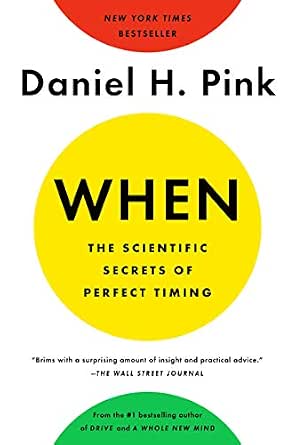
His latest book is titled When: The Scientific Secrets of Perfect Timing. In this outstanding book, Dan Pink examines research related to “time” and makes important, practical application to our regular routines.
He begins by explaining the hidden pattern of everyday life. For most people, there is a consistent daily pattern during which we experience a peak, a trough, and a rebound during the day. A child could read that sentence and understand it but what Dan Pink does with it in clearly layout important research that documents the pattern and makes important recommendations about how to apply this knowledge and improve our lives as a result.
He also explains the significance of beginnings, midpoints, and endings. Many people will have thought about some of what he writes, but most of us have not considered how these matters of timing and cycles can lead to energy or fatigue, success or failure, and the impact on our sense of well-being. In addition, he explains some important dynamics of group timing.
Dan Pink has a gift for being able to take a complex topic, break it down into the key elements, and explain them clearly and simply. When: The Scientific Secrets of Perfect Timing needs to be on your reading list.
Sehr gutes Buch über den Einfluss des "Wann" auf berufliche, wie auch persönliche Entscheidungen, Entwicklungen und Situationen im Allgemeinen. Viele praktische Tipps zum Einbau des Gelesenen/Gelernten in den eigenen Alltag. Das Buch lässt sich zudem wirklich gut lesen und fesselt auch durch viele Studien und Beispiele. Bin froh, dass ich auf es gestoßen bin!
This book is first book writen in English by Daniel Pink for me.
I could deeply understand when I would be better to act for business decision.
Muy ameno de leer y el tema es muy interesante, aplicable en el día cotidiano y a nivel profesional.
Este escritor sabe cómo mantener la atención del lector durante todo el libro.
Aunque está en inglés es bastante fácil de leer, utiliza un lenguaje y vocabulario muy sencillo.
A diferencia de otros libros, este autor cita escrupulosamente todas las fuentes, así que un 10% del libro son páginas de referencias, lo cual no le resta calidad al libro y puede que sea útil si te mueves en ese campo y quieres consultar alguna fuente.
Calidad de papel y portada buenos, es un formato de libro pequeño, cabe en cualquier bolso.
In 1792, a prominent French astronomer de Mairan, while gazing at the stars through his window, observed that the leaves of the plant on the window sill, would open at sunrise and closeup at sunset. Strangely, and counter intuitively, the plant would behave the same way, even if it were to be kept in darkness, completely shut out from sunlight. This led to the concept of biological rhythms and a new science of chronobiology.
Humans are no exception, and in fact have a daily biorhythm that is slightly over 24 hours. The external world events like the local time, sunrise and the daily schedules readjust our day. Apart from a normal sleep duration of about 7 hours, the rest of the day, for two thirds of us begins with a peak capability in the morning till noon, tapers into a trough till about 4 PM and recovers till about 9 PM broadly speaking. Awareness of this pattern would enable us to plan our day in such a way that we focus on the most important tasks before noon. The book highlights the fact that surgeries performed between 2 and 4 PM are prone to more than four times the error than those performed in the morning. We are at our lowest at 2:55 PM to be precise. An afternoon siesta for about 20 minutes is recommended to improve our day. Vigilance breaks that goes through a check list for example, can reduce mistakes. Restorative breaks like a siesta or a short walk in the park tend to enhance performance.
While two thirds (or third birds) follow a normal daily pattern, a fifth of us (owls) are comfortable working late beyond midnight and the rest who prefer to start the day by 4 AM are termed larks. We tend to be larks as infants, owls as teens and third birds in adulthood. Once again, the pattern changes in old age, tending to be larks.
Adequate sleep and appropriate breaks are key to high performance. Let us not blindly admire those stalwarts who survive on just four hours of sleep. ‘They are not heroes as we might think…, but are fools who are likely doing subpar work and maybe hurting rest of us because of poor choices’, is a powerful statement in this book.
It is also interesting that the book has extended this concept beyond a daily routine. Timing of our graduation is a great example. Those who graduate during a recession end up with lower starting pays, and it takes nearly two decades to catch up with those who graduated in a booming economy. Business school students graduating in a bull market are more likely to end up with a job on wall street, and hence likely to become insanely wealthy, compared to others who might be just extremely rich.
Everything that we do seems to follow a pattern in time and timing. Projects start with a bang, slump mid-way and recover towards the deadline. A good project manager should split the project into logical milestones, celebrate each of them and ensure that the team works with the same level of enthusiasm throughout. Midlife crisis is a similar phenomenon that can be appropriately managed.
To enhance happiness in all that we do, it is important that we are in sync with a goal or objective, we work in sync with the team and belong to the tribe, and the work that we do is in sync with our heart. The example of the Mumbai Dabbawallas (tiffin carriers) is used as a case to aptly explain this. The dabbawallas, deliver happiness to their customers and not just tiffin.
Highly informative and extremely practical, this book is yet another Classic for Daniel Pink.
I've read several of Daniel Pink's books and on the strength of those bought this one. The subject of 'when' is the best time to do certain things (such as analytical and creative thinking, exercising, decision-making and so on) and good timing is a really interesting subject matter and not one I've thought much about before. Daniel's researched this meticulously and presented it really well - making it flow well and a good length.
Reading the chapter on morning larks and night owls, which took the concept beyond what you usually hear, made a lot of sense as to the times of day, and how, I work well and less so. In addition to being a fascinating read each chapter contains a section on practical applications. Now I know when I'm best off doing my creative thinking, the benefits of an afternoon nap and a possible reason why my recent visit to the doctor was worse in the afternoon than in the morning.